Introduction: Commencing the Proof of the Islamic Creed
In the Name of Allah, the Most Gracious, the Most Merciful. Peace be upon you, and Allah’s mercy and blessings. My dear brothers, I ask Allah, Glorified and Exalted, to accept from me and from you our fasting, standing in prayer, bowing and prostration during this blessed month. Here we are together for the third episode of our live programme, still discussing The Way to Belief from our book The System of Islam. In the previous episode, we examined the criterion for the correct creed: how do we distinguish the true creed from false creeds? We established that the true creed is based on the mind and agrees with man’s nature. We also said that thinking about the biggest knot—the universe, man and life, and knowing their origin and destination—must rely on enlightened thought. Now that we have established these principles, by Allah’s permission we begin proving the Islamic creed. We start with the first pillar of belief: belief in Allah, Glorified and Exalted. How do we prove to those who do not believe in Allah that Allah is real, and that He is the Creator of the heavens and the earth—the Creator of the universe, man and life?
The First Passage from The System of Islam
Islam addressed the biggest knot of the humanbeing and solved it in a manner that agrees to the innateness (fitTrah), convinces the mind, and fills the heart with tranquility. Islam made entering into it dependent upon rational approval of this solution. Therefore, Islam is built upon one basis, the ‘Aqeedah, which states that there is behind universe, man and life a Creator (Khaaliq), who created all of them and created everything: He is Allah ﷻ. This Creator brought everything into existence out of nothing (‘adam). His is the Necessary Existent (waajib ul-wujood) and thus He is not created - otherwise, He wouldn’t be a Creator. The fact that He is attributed as being creator makes it necessary that He is not created, and that His is the Necessary Existent, because all things depend for their existence on Him and He does not depend on anything.
The Islamic Creed and the Solution to the Biggest Knot
Islam, brothers—the Islamic creed, the Islamic ideology, Islam’s intellectual basis and Islam’s intellectual leadership—are expressions and names for one and the same thing: the universal idea that Islam gives about the universe, man and life; that is, about this worldly life, what preceded it, what follows it, its relationship to what preceded it and its relationship to what follows it. What is this conception? In brief, what idea does Islam give in this field?
Islam came to state that this worldly life, expressed as the universe, man and life, consists of limited entities created at a specific time destined to end. Thus it answers the first question regarding the reality of the universe, humanity and existence: they are contingent creations with definite beginnings and ends.
As for answering the second question, namely what preceded this worldly life, the answer is self-evident as a result of the first: that which preceded it is the Creator and Arranger of the heavens and earth, the Creator of the universe, man and life—Allah, Glorified and Exalted. As for answering the third question regarding after this worldly life, it is the Day of Judgment, where there will be either Paradise or Fire.
This worldly life, what preceded it and what follows it.
The Relationship of This Worldly Life to What Comes Before and After It
So, what is the relationship of this worldly life to what preceded it? In other words, what is man’s relationship, in his present worldly existence, with his Creator, Glorified and Exalted? Islam states that the relationship of man in this worldly life to what preceded it is the relationship of creation: man is created, and the universe in which he lives and the life within it are created by Allah, Glorified and Exalted. The relationship connecting man in this worldly life to his Creator is one of guidance and organisation. This means that man must conduct himself in this life according to Allah’s commands and prohibitions, and perform his actions in accordance with them.
In other words, man ought to live this worldly life in a manner pleasing to his Lord, the Exalted and Glorious, without turning away from Him so as to adopt alternative ways of living; for such is the relationship between this world and that which preceded it.
As for the answer to the fifth and final question of the biggest knot—the relationship of this worldly life to what follows it—what is man’s relationship in his worldly existence to the Hereafter? It is, quite simply, a relationship of accountability. If a person lives this worldly life according to Allah’s commands and prohibitions, submits to Allah, Glorified and Exalted, and follows the life that Allah has prescribed and guided him to, his destination will be Paradise, whose breadth is that of the heavens and the earth. But if he disbelieves in Allah, Glorified and Exalted, behaves arrogantly towards Him, turns away from His Shari’ah and lives in ways that neither please Allah nor befit man, his reckoning will lead him to Hellfire—an evil destination. This is the universal idea that Islam gives about the universe, man and life. This is Islam’s solution to the biggest knot for mankind.
Verses Summarising the Universal Idea
The verses of the Book of Allah, Glorified and Exalted, summarise this matter. He, Glorified and Exalted, said:
﴿ قَالَ ٱهْبِطَا مِنْهَا جَمِيعًۢا ﴾
‘He said, “Descend from it, both of you, together.”’ [20:123]
This is the relationship of this worldly life to what preceded it.
﴿ فَإِمَّا يَأْتِيَنَّكُم مِّنِّى هُدًى فَمَنِ ٱتَّبَعَ هُدَاىَ فَلَا يَضِلُّ وَلَا يَشْقَىٰ ﴾
‘Then if guidance comes to you from Me, whoever follows My guidance will neither go astray nor suffer.’ [20:123]
﴿ وَمَنْ أَعْرَضَ عَن ذِكْرِى فَإِنَّ لَهُۥ مَعِيشَةً ضَنكًا ﴾
‘But whoever turns away from My remembrance will have a miserable life.’ [20:124]
This means that he will live in misery in this life.
﴿ وَنَحْشُرُهُۥ يَوْمَ ٱلْقِيَـٰمَةِ أَعْمَىٰ ﴾
‘And We shall raise him blind on the Day of Resurrection.’ [20:124]
This is the relationship of this worldly life to what follows it. The man says:
﴿ قَالَ رَبِّ لِمَ حَشَرْتَنِىٓ أَعْمَىٰ وَقَدْ كُنتُ بَصِيرًا ﴾
‘He will say, “My Lord, why have You raised me blind when I used to see?”’ [20:125]
Allah, Glorified and Exalted, reminds him that he neglected his relationship in this life to what preceded it. His recompense was therefore that Allah forgot him on the Day of Resurrection. Here, forgetting does not mean heedlessness; it means neglect and abandonment in the Fire.
﴿ قَالَ رَبِّ لِمَ حَشَرْتَنِىٓ أَعْمَىٰ وَقَدْ كُنتُ بَصِيرًا ﴾
‘He will say, “My Lord, why have You raised me blind when I used to see?”’ [20:125]
﴿ قَالَ كَذَٰلِكَ أَتَتْكَ ءَايَـٰتُنَا فَنَسِيتَهَا ۖ وَكَذَٰلِكَ ٱلْيَوْمَ تُنسَىٰ ﴾
‘He will say, “Thus did Our signs come to you, but you forgot them; and thus today you are forgotten.”’ [20:126]
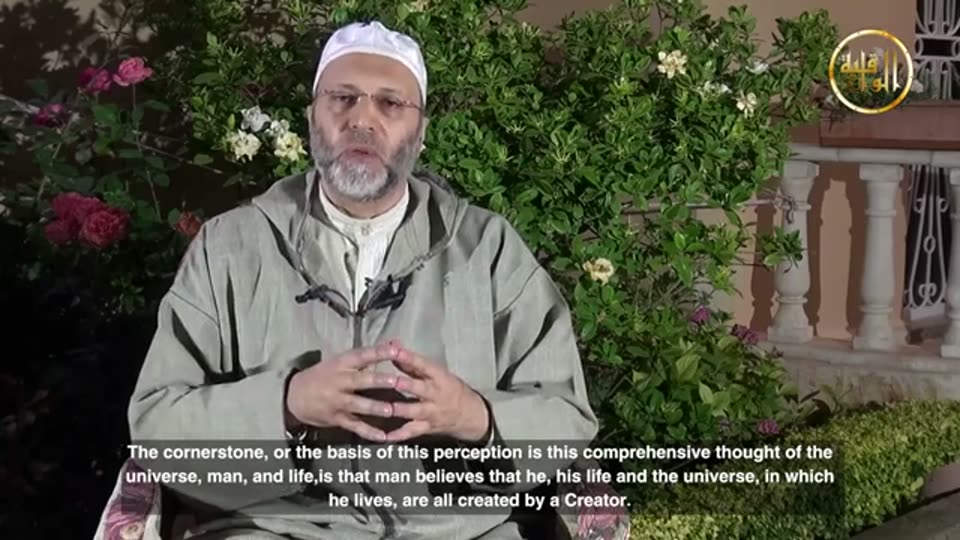
Thus, this universal idea bestowed by Islam upon humanity concerning this worldly life and what preceded it and followed it, along with its relationship to both the past and future, enabled man in this existence to comprehend his origin, destination, and purpose of being. He also recognised his connection to that which came before his arrival here and that which awaits him after departure from it. Consequently, the cornerstone or foundation within this conception of the universe, humanity, and life is for a person to believe that he himself, his life, and the cosmos in which he resides are all created by a Creator and Arranger.
Preparing to Prove the Existence of the Creator
What rational evidence can we use to oblige people, convince their minds and establish for everyone the existence of Allah, the Creator and Arranger?
Before we begin listing the evidence proving the existence of Allah, Glorified and Exalted be He, it is necessary to complete the picture with a few words. If we speak about the universe, man and life being created by our Creator, Sublime and Glorious, then this Creator cannot in any way be conceived as having been created; otherwise, He would not be a Creator. For He is the Creator, and the Creator cannot possibly be a creation because He is the Necessary Existent. Were it not for His existence, nothing would exist at all. As long as the heavens and earth remain, and so do the universe, man and life—all created things—they are in need of their Creator. The Creator is the Necessary Existent; His non-existence cannot be conceived. If He is indeed the Necessary Existent, this means that He certainly exists without beginning or end, because nothing can exist apart from Him.
This is Islam’s conception of the reality of this worldly life and what it contains of the universe, man and life. This is Islam’s universal idea about the universe, man and life.
We must now begin presenting the evidence for the existence of the Creator, Glorified and Exalted, after listening together to the following passage.
The Second Passage from The System of Islam
The reason that things must have a Creator who created them, is because the things that the mind perceives are the man, life and universe, and these are limited; so they are unable, deficient and are dependent on the other. Man is limited, because he grows in every aspect to a certain limit that he cannot surpass, so he is limited. Life is limited, because it manifests itself only in individuals, and what is noticed by the senses is that it is concluded with the individual, thus it is limited. The universe is limited, because it is the sum of celestial bodies, and each body is limited; and the sum of limited things is self-evidently limited. Thus, man, life, and the universe are definitely limited. When we ponder on the limited (thing), we see that it is not azali (pre-existent), otherwise it would not have been limited, and therefore, it must be created by something else, which is the Creator of man, life and the universe. This Creator is either created by someone else, creator of oneself, or azali (pre-existent) whose existence is necessary (waajib ul-wujood). It is absolutely false that He is created by someone else, because He would then be limited. It is also false that He is the creator of himself because He would be simultaneously created by oneself and creator of oneself. This is simply absurd. Hence, the creator must be azali (pre-existent) whose existence is necessary. He is Allah ﷻ. In the Name of Allah, the Most Merciful, the Most Compassionate.
Matter or the Pre-existent Creator?
﴿ أَمْ خُلِقُوا۟ مِنْ غَيْرِ شَىْءٍ أَمْ هُمُ ٱلْخَـٰلِقُونَ أَمْ خَلَقُوا۟ ٱلسَّمَـٰوَٰتِ وَٱلْأَرْضَ ۚ بَل لَّا يُوقِنُونَ ﴾
‘Or were they created from nothing, or are they themselves the creators? Or did they create the heavens and the earth? Rather, they have no certainty.’ [52:35–36]
These eloquent verses are proof against every person who decides to let his mind judge, away from his desires, brothers.
Everyone agrees on one fundamental point, both those who believe in a Creator and atheists: something must exist whose non-existence at any time is inconceivable. Why?
For the tangible reality we inhabit, there exist entities of which we are a part; the universe, humanity and life are existing things. These existent things cannot come into being by themselves nor after non-existence without an Originator.
The dispute between believers in the Exalted Creator and atheists concerns this proposition: what has existed since eternity? Is it matter—the substance of the universe, humanity, and life—or something else that brought it into existence? Or is there another entity who created it?
Any possibility other than these two is impossible. Either the matter of the universe, man and life has existed eternally and is therefore, in the atheists’ view, the Necessary Existent independent of a Creator; or it came into existence at a particular time. If it came into existence at a particular time, someone must have brought it into existence, because nothing can bring itself into existence. To bring itself into existence, it would already have to exist. How could it exist before coming into existence? Such reasoning is impossible.
Something must therefore have existed eternally: either the matter surrounding us—the matter of this worldly life, the universe, man and life—or the One who brought it into existence, namely the Creator, Glorified and Exalted. This leads to the decisive question:.
Does the matter of this worldly life—the universe, man and life—contain anything showing that it is the Necessary Existent, eternal and self-subsisting without anyone who brought it into existence? Or does rational evidence establish that the matter of the universe, man and life is limited, and therefore must have come into existence at a particular time and may end at a particular time? If so, it is not the original, eternal existence, but was created by the Creator, who is eternal and the Necessary Existent.
What does the reality of worldly life indicate? It indicates that human beings live within the cosmos; therefore, we say that worldly life is humanity itself. These three entities—humanity, life, and the cosmos—if proven to be limited, powerless, deficient, and in need of others, then it is established that they are not the original existent nor necessarily existing, but rather contingent. The true original existence lies elsewhere: with the Creator, glorified and exalted above all.
The Limits of Man and Life
Let us examine the reality of the universe, humanity, and life: their tangible, visible nature is limited.
How? Let us begin with man. Is man not limited in both size and time? Man comes into existence at a particular time, when he is formed and born into this worldly life, and his life ends with death. However long a person lives, his life begins at one moment and ends at a later moment. His existence in this life is therefore limited in time. The body in which he grows is also limited. Every person grows until reaching full development, then gradually declines until his life ends. He is thus limited both in time and in bodily growth. His life is therefore limited. Limited means that something exists from a particular time and ends at a later time.
Someone may say, ‘This applies to the individual, but the individual is part of human life, which does not end when one person dies.’ We answer: yes, human life is the sum of individual lives. Yet however many individuals there are, their total remains limited. Humanity has a limited lifespan, because man came into existence at one time and will cease to exist at another. Humanity is therefore necessarily limited, and what is limited cannot be eternal. Let us continue briefly. Someone may say, ‘Human life may indeed be limited and have begun at a particular time, but why do we not assume that man is the continuation of a living being which evolved into man?’
Here the idea of evolution is advanced—the theory of origin and development—which has always been a theory. Some arrogant people, indeed many, have treated it as an absolute truth, even after scientists presented sensory evidence that the theory had become outdated. Nevertheless, some still adhere to it. In any case, we say:.
Regardless of whether the subject is a human being or any other living organism, life itself constitutes reality in all living things—whether animal, plant, or otherwise. Life as such is cellular: cells are born, grow, reproduce, and then die; no cell has ever been born that did not subsequently perish, while others continue to be generated and pass away. Since every living entity consists of these finite cells which undergo birth followed by death, however numerous they may become in any given organism, the inherent limitation of each individual cell ensures that all life forms remain limited: a collection of finite elements remains finite regardless of quantity. Thus, whether referring to human existence or non-human animal and plant life, reality itself manifests as cellular finitude—cells are born from pre-existing cells and die again, in an unending cycle. All biologists affirm that neither a cell nor any living organism can originate spontaneously; they must arise only from another living entity according to the laws we observe today.
The self-evident question man must therefore ask is this: since life, in the reality we live in and observe, arises only from other life, how did life arise for the first time? How did the first living cell come into existence when a living cell can arise only from another living cell?
Despite the development of science, technical equipment, laboratories and scientists’ enormous capacity to intervene, they have been unable to create a living being from an inanimate object or non-living matter.
Since this is the case, someone must have created the living being for the first time, whether that living being was a human, animal or plant.
Who created life for the first time? The mind says: life appears in individuals, and all living beings we observe today are born from other living beings. Someone must therefore have created life for the first time, after which it continued until today and will continue until its course ends. Life is thus limited by its nature, and what is limited cannot be eternal. What is not eternal cannot continue for ever through its own power or by itself.
This concerns man and life.
The Limits of the Universe
As for the reality of the universe, how naïve and ignorant are those who have taught people from childhood that the universe is an infinite expanse without end. Who told you that the universe is infinite, without end and without limits?
They rely on science and claim that it is everything in thought and the only means of knowing truths. Yet this same science says, ‘I cannot judge anything beyond the reach of the senses.’ Anything which cannot be sensed, observed and tested does not fall within science.
Therefore, the utmost that science—physics, astronomy, space exploration, or whatever you wish to call it—can assert is that we have reached a certain limit in this universe. In every period they claim to have extended our knowledge further; thus, they may say we know of the cosmos only what has been perceived by the senses and what falls under observation and testing. To claim instead that this universe constitutes an infinite extent would mean they are imposing their minds and sciences upon something beyond its capacity and beyond the possibility of inquiry—whether such inquiry is purely abstract or conducted within a scientific methodology.
As for the intellect, it has another discourse. When I speak of the intellect and the rational methodology and approach in thinking as opposed to the scientific method of thought, I am not speaking about contradictions; rather, the scientific method does not depart from the intellectual method nor from man’s innate mode of reasoning but constitutes a part thereof within his overall intellectual way of thinking.
The method of the mind is to sense reality, connect this perceived reality with the previous information it possesses—including the self-evident truths formed through knowledge of the reality of the universe, man and life—and then judge that reality.
If we follow the rational method of thinking, which enables humans to perceive truths about things, what do we find when observing reality?
We find that the universe is a collection of celestial bodies: planets, moons, suns, stars and meteors. However small or large these bodies may be, each has a definite size and weight. Since the universe consists of a collection of these bodies, it follows that the universe consists of a collection of limited things.
Whether our senses perceive all these celestial bodies or only some, as long as they are perceived by us in relation to a portion of the universe’s constituents, we have established that the cosmos consists of a finite set of entities.
The universe therefore consists of a collection of limited things. It is consequently limited, because however many limited things there may be, and whether or not we can count them, a collection of limited things is also limited. The limited remains limited, however numerous its parts. The universe consists of limited celestial bodies and is therefore limited. The universe is thus limited.
Change, Time and the Expansion of the Universe
It is enough to observe certain facts about the universe to understand that, by its nature, it cannot be eternal. It is in motion and undergoes change. This motion and change required time to occur, and they continue to require more time to reach another state, another proportion, another size or another distance between its planets.
They say that the universe in which we live and which we see around us is continuously expanding. Very well.
It will expand still further after our time. If we ask them why the universe has reached this extent but not yet expanded further, they will answer that insufficient time has passed for greater expansion. We are therefore speaking about time, and speaking about time conflicts with speaking about eternity. Only enough time for the universe to reach its present extent has passed, and it requires more time to expand further. Sufficient time has not yet passed. This means that we are speaking about a limited period.
Differences in Temperature and What They Indicate
Let us consider the matter from another angle. This requires no scientists, because we perceive and experience it every day. If several bodies at different temperatures are brought together—one at a particular temperature, another at a higher temperature and a third at a lower temperature—they affect one another’s temperature. The hot is affected by the cold, and the cold by the hot. The cold becomes warmer and the hot becomes cooler until they all reach the same temperature. Is this not what happens when we put something hot in a refrigerator? It takes time to reach the refrigerator’s temperature. While it is still hot, it affects the things around it and raises their temperature until the refrigerator cools them again.
The reality is therefore that bodies at different temperatures affect one another until their temperatures become equal. It is then said that the temperature will continue to fall until it reaches absolute zero. The universe now contains celestial bodies at different temperatures: a blazing sun, a cold moon and an Earth at a moderate temperature. They all exchange heat. The Earth is affected by the Sun’s heat; this is why one side is warmer by day and colder by night. In winter, when the Sun’s rays fall more obliquely on one part of the Earth, that part becomes colder, while the part receiving almost perpendicular rays becomes warmer. The Sun exists in space which is colder than the Sun itself, and it is expected to cool over time; according to them, it has already cooled compared with its earlier state. The celestial bodies are therefore still exchanging heat, and insufficient time has passed for all of them to reach the same temperature. We are thus speaking about a limited period in which sufficient time has not yet passed.
I have expanded slightly upon some self-evident rational proofs. If man applies them, he will naturally conclude that changing things are limited by their nature and cannot be eternal.
Were we to continue and expand upon this line of reasoning, our discourse would never end; for the examples are far too numerous for any human being to enumerate them.
The Pre-existent Creator as the Necessary Existent
We return, then, to the proof that these things and their time are limited. Only the time which enabled them to reach their present state has passed. This means that they did not exist and then came into existence.
These things did not exist and then came into existence. They are therefore created. Created by whom? Created by whom?
﴿ أَمْ خُلِقُوا۟ مِنْ غَيْرِ شَىْءٍ أَمْ هُمُ ٱلْخَـٰلِقُونَ أَمْ خَلَقُوا۟ ٱلسَّمَـٰوَٰتِ وَٱلْأَرْضَ ۚ بَل لَّا يُوقِنُونَ ﴾
‘Or were they created from nothing, or are they themselves the creators? Or did they create the heavens and the earth? Rather, they have no certainty.’ [52:35–36]
Can it create itself? Of course not. It did not exist, so how could it create anything while it did not exist? Indeed, how could it create itself? Nothing can create itself. It must therefore have been created by another, meaning that a Creator existed before it. This Creator cannot Himself be created, because all existence depends upon Him; without His existence, nothing would exist. He is therefore the Necessary Existent, whose non-existence is inconceivable. This Creator is the First and Eternal, the Necessary Existent without whom absolutely nothing would exist—not us in this worldly life, nor anything in this universe.
This is rational evidence—indeed, several self-evident rational proofs. Every reasonable person who humbly accepts the truth and does not behave arrogantly should reach this absolute truth, far removed from the absurd claims and assumptions that some attempt to formulate.
There is a vast difference between assumptions which man attempts to complete and patch together to make them appear possible, and self-evident rational thought about perceptible reality. This reality shows that the matter of the universe, man and life is limited, that it therefore came into existence at a particular time, and that it was consequently created by a Creator.
Signs of Order and Precision
This is sufficient, although one could say much more and draw attention to many other things.
Whenever man looks at the universe, man and life around him, he finds proof after proof—an abundance of evidence that neither this life nor this universe can exist by itself.
When we observe humanity and see that its existence depends on a vast array of conditions, the failure of any one would render life impossible. Man requires water; he needs moderate heat; he demands specific atmospheric pressure; he relies upon particular gravitational pull from Earth. Consider how all these conditions converge to enable human survival. If even one condition were altered—whether Earth moved slightly closer or farther from the Sun, if gravity increased marginally or diminished by a fraction, should atmospheric pressure rise or fall imperceptibly, or if rotational speed around its axis or orbit varied minutely—all prudent scholars engaged in such matters affirm that any slight deviation renders human life utterly impossible. Indeed, it would make existence unfeasible not only for humanity but for all living beings upon this Earth.
Did these extensive and precise conditions arise by themselves?
Do you know what must be said about someone who claims that these conditions and factors came together by chance? This view leads to delusion. Let us ask the person himself.
If you saw a beautiful oil painting depicting the sea, the shore, a tree and the stars, would your first admiring thought not be that the painter was skilled and possessed refined taste? You would know that such a work could not have created itself.
Whoever claims that this painting could have existed spontaneously, or if we imagine an earthquake occurred and ink boxes fell onto one of the panels to produce a sea, ship, shore, tree, fisherman fishing, and so on—those who assert the painting came into being in such a manner were told they are mad and deluded. This is because this painting requires a set of precise conditions, foremost among them artistry and refined sensibility in whoever creates it.
This panel is insignificant compared to the reality of the universe, its human life, and existence within it—filled with wonders that baffle the human mind.
It is enough to consider the organs of the human body—or those of any animal—and observe the harmony, interaction and complementary roles among the body’s systems. This reveals profound wisdom and immense power behind these living creatures.
The Qur’an’s Call to Observe and Think
Listen briefly to the words of Allah, Exalted be He, on this subject, as Allah draws man’s attention to the reality of the universe, man and life.
Allah, Glorified and Exalted, asks man:
﴿ أَفَلَا يَنظُرُونَ إِلَى ٱلْإِبِلِ كَيْفَ خُلِقَتْ ﴾
‘Do they not look at the camels—how they were created?’ [88:17]
Observe here that the Qur’an calls for reflection, then enlightenment after such contemplation.
What did I mean by enlightened thinking here? It is not enough for man to look at created things; he must then ask how they came into existence.
﴿ أَفَلَا يَنظُرُونَ إِلَى ٱلْإِبِلِ كَيْفَ خُلِقَتْ وَإِلَى ٱلسَّمَآءِ كَيْفَ رُفِعَتْ وَإِلَى ٱلْجِبَالِ كَيْفَ نُصِبَتْ وَإِلَى ٱلْأَرْضِ كَيْفَ سُطِحَتْ ﴾
‘Do they not look at the camels—how they were created; and at the sky—how it was raised; and at the mountains—how they were set up; and at the earth—how it was spread out?’ [88:17–20]
This directs man’s attention.
Look and think: how could these things come into existence like this? Could they exist by themselves?
﴿ ٱلَّذِى خَلَقَ ٱلْمَوْتَ وَٱلْحَيَوٰةَ لِيَبْلُوَكُمْ أَيُّكُمْ أَحْسَنُ عَمَلًا ﴾
‘He who created death and life to test which of you is best in deed.’ [67:2]
﴿ ٱلَّذِى خَلَقَ سَبْعَ سَمَـٰوَٰتٍ طِبَاقًا ۖ مَّا تَرَىٰ فِى خَلْقِ ٱلرَّحْمَـٰنِ مِن تَفَـٰوُتٍ ﴾
‘He who created seven heavens in layers. You see no inconsistency in the creation of the Most Merciful.’ [67:3]
You see no contradiction in creation and no conflict between created beings.
﴿ لَا ٱلشَّمْسُ يَنۢبَغِى لَهَآ أَن تُدْرِكَ ٱلْقَمَرَ وَلَا ٱلَّيْلُ سَابِقُ ٱلنَّهَارِ ۚ وَكُلٌّ فِى فَلَكٍ يَسْبَحُونَ ﴾
‘The sun cannot overtake the moon, nor can the night outstrip the day. Each floats in an orbit.’ [36:40]
Harmony and order.
﴿ ٱلَّذِى خَلَقَ سَبْعَ سَمَـٰوَٰتٍ طِبَاقًا ۖ مَّا تَرَىٰ فِى خَلْقِ ٱلرَّحْمَـٰنِ مِن تَفَـٰوُتٍ فَٱرْجِعِ ٱلْبَصَرَ ﴾
‘He who created seven heavens in layers. You see no inconsistency in the creation of the Most Merciful. Look again.’ [67:3]
Notice here the call to deep thinking:
﴿ فَٱرْجِعِ ٱلْبَصَرَ هَلْ تَرَىٰ مِن فُطُورٍ ﴾
‘Look again: do you see any flaw?’ [67:3]
This is a call to enlightened thinking:
﴿ هَلْ تَرَىٰ مِن فُطُورٍ ﴾
‘Do you see any flaw?’ [67:3]
﴿ ثُمَّ ٱرْجِعِ ٱلْبَصَرَ كَرَّتَيْنِ ﴾
‘Then look again and again.’ [67:4]
He calls upon man to look repeatedly—that is, to think more deeply. This is what we discussed earlier: man must think deeply and then think in an enlightened way. He must look, then look, then look, and then ask: how?
﴿ فَٱرْجِعِ ٱلْبَصَرَ هَلْ تَرَىٰ مِن فُطُورٍ ثُمَّ ٱرْجِعِ ٱلْبَصَرَ كَرَّتَيْنِ يَنقَلِبْ إِلَيْكَ ٱلْبَصَرُ خَاسِئًا وَهُوَ حَسِيرٌ ﴾
‘Look again: do you see any flaw? Then look again and again. Your sight will return to you humbled and weary.’ [67:3–4]
These words are directed at those who try to prove that the universe is purposeless and could have arisen by itself.
The atheist who claims that this matter came into existence and developed by chance, or through what they call the law of necessity, invents assumptions and then turns assumptions supported by neither reason nor science into facts. He tries to build upon them a call inviting people to atheism, when in reality it is merely Satan’s call. Wherever man looks around him, he sees in the universe, man and life proofs upon proofs that he cannot count and whose indication he cannot possibly evade. Signs have multiplied and spread around him, showing that these things were created by a Creator, Glorified and Exalted. Let us listen together to further examples of these signs in the following passage.
The Third Passage from The System of Islam
Anyone who has the mental faculty can perceive from the mere existence of things that can be sensed that they have a Creator. This is because what is noticed in all of them is that they are deficient, unable and dependent on the other, so they are definitely created. Therefore, it is sufficient to draw one’s attention to anything in the universe, life and man to infer from that the existence of the Creator and Arranger. Hence, looking at any celestial body of the universe, contemplating upon any facet of life, or perceiving any aspect of man, indicates definitive proof of the existence of Allah ﷻ. Therefore, we see that the Qur’an draws attention to these things and instructs man to ponder upon them, their surroundings, and what is related to them, and to conclude from his pondering the existence of Allah ﷻ. In fact, when man looks at things how they are in need of other things, he definitely realises from this the existence of Allah ﷻ, the Creator and Arranger. There are hundreds of Qur’anic aayaat expressing this meaning. In Surah Aali-‘Imraan, Allah the Exalted said:
﴿ إِنَّ فِى خَلْقِ ٱلسَّمَـٰوَٰتِ وَٱلْأَرْضِ وَٱخْتِلَـٰفِ ٱلَّيْلِ وَٱلنَّهَارِ لَـَٔايَـٰتٍ لِّأُو۟لِى ٱلْأَلْبَـٰبِ ﴾
‘Behold! In the creation of the heavens and the earth and the alteration of night and day, these are indeed signs for men of understanding.’ [3:190]
In Surah ar-Rum, He the Exalted said:
﴿ وَمِنْ ءَايَـٰتِهِۦ خَلْقُ ٱلسَّمَـٰوَٰتِ وَٱلْأَرْضِ وَٱخْتِلَـٰفُ أَلْسِنَتِكُمْ وَأَلْوَٰنِكُمْ ﴾
‘And of His signs is the creation of the heavens and the earth, and the difference of your languages and colours.’ [30:22]
And He, Exalted be He, said in Surah al-Ghashiyah… Peace be upon you, and Allah’s mercy.
Questions and Discussion
We now proceed with our dear brothers to answer the questions received, or some of these questions.
The Difference between Life and This Worldly Life
The first question says: we have noticed that the book speaks in one place about this worldly life, which man must live, and elsewhere about life as deficient, unable and dependent. Does the book mean two different things by these expressions?
And how so? Yes, this is a pertinent question; yes, when we speak of life in general, we refer to one thing, whereas when we speak specifically of worldly life, we are referring to something else.
By worldly life we mean that temporal and spatial realm in which a human being exists from birth until death; thus, we speak of the individual’s earthly existence commencing with his entry into this world through birth and concluding at his passing. We also address humanity’s collective earthly life, which began when Adam (peace be upon him) descended to earth and will end on the Day of Resurrection. This worldly life is experienced by humans within this universe; indeed, it is a human living in the cosmos—this phrase encapsulates worldly life: “a human living in the cosmos.” It denotes that temporal dimension which begins with the advent of either an individual or humanity as such into existence.
This period ends when the individual or humanity ends. That is this worldly life. When we speak of ‘the universe, man and life’, however, by life we mean the quality present in living beings which distinguishes them from dead beings and inanimate matter. Why do we examine life?
For the reality of worldly life consists of three major facts: that a human lives in the universe. Thus, when we sought to understand this reality, we investigated these three constituent elements. We examined humanity and established its limitations; we examined existence itself—defined by the distinction between living and dead organisms—and confirmed it is also limited, comprising cellular vitality within beings; and we considered the cosmos wherein humans dwell.
Thus, discourse on life differs from that of worldly existence; the latter is merely the stage through which a human passes from entering this cosmos until departing it. This constitutes worldly life.
Do Other Creeds Satisfy the Human Need?
Question Two.
Have creeds other than Islam satisfied man’s need and addressed his incapacity and dependence? Creeds other than Islam do not meet man’s need. We previously explained that the correct creed is the creed that agrees with man’s nature. If it agrees with man’s nature, it has truly met his need and led him to address his dependence and deficiency in the proper place by turning to his Lord and Creator, Glorified and Exalted. Creeds that conflict with man’s nature include atheistic creeds, which say that man has no Creator and there is no God, and creeds which say that the Creator may exist but has no relationship to your life and does not organise your affairs. These also fail to satisfy man’s need or lead him to address his deficiency and dependence. Why? Because man’s nature includes the need for the Creator and Arranger and the feeling of dependence upon Him. If you tell man that there is no Creator, you conflict with his nature. If you tell him that the Creator does not arrange his affairs, as the creed separating religion from life maintains, you again conflict with his nature and fail to satisfy it.
The deficiency and dependence found in things, including man, prove that they were created by a Creator. Creeds which deny this Creator’s existence reach a dead end, because they cannot explain why the matter of the universe, man and life is limited, unable and dependent on another. Peace be upon you.
The Dependence and Interdependence of Things
It is said that incapacity, deficiency and need appear in one being of existence but are completed by others; thus everything in this life has something completing it within other beings. How then can deficiency, incapacity and need serve as proof?
Yes, I mentioned this assumption during my discussion and answered it: as long as need is evident in the reality of matter—even in a single instance of it—this means that matter is dependent. Matter is therefore dependent by its very nature. It is not matter that makes its parts complete one another. Rather, the One who gave these things an order, under which they complement one another, imposed this system upon them from outside themselves. This is further proof that someone created them, because the One who created them is the One who imposed this system upon them.
For water to boil, it requires a certain temperature; for it to freeze, certain conditions must be present. Who subjected it to this law? For an embryo to be formed or born in a woman’s womb, a set of conditions must be present according to specific laws; it cannot possibly exist outside these laws. Who subjected these things to these laws, so that they cannot complement one another outside them and cannot change them?
In other words, matter is not intelligent, as some claim when they say, ‘Matter is intelligent.’ If it were intelligent, it would be able to change its laws and depart from them. Nor can intelligent man, despite the modern scientific methods he has developed, help matter to change these laws.
However, in reality, humanity, regardless of its intervention or the extent to which it has advanced through science and discoveries, ultimately finds that it discovers laws and works to harness them rather than change or modify them. All theories and all material scientific output are based on knowledge of these laws and how they can be used, or changes induced within them, in order to achieve desired outcomes from them and to obtain further things.
It is therefore certain that the matter of the universe, man and life—the matter of things—is unable and dependent on another. It required someone to make its parts complement one another and someone to impose this system upon it so that it functions as it does. If these laws were disrupted, as we said, life would be disrupted and man could not exist in this worldly life.
Does Reason Always Give the Correct Answer?
You have explained the reality of the universe, man and life and established that all these created things have a Creator who created them, and that the mind judges that the One who brought existence into being exists. The question is: does the mind always give the correct answer? We see that other ideologies, such as communism and capitalism, are also said to be based on reason, and that man starts from rational principles to prove the existence of the One who brought existence into being.
The first question is whether the mind always produces correct and definitive results. Yes. When all the conditions for thought are present, thinking produces definitive judgements, provided that the mind is used in its proper domain. When the mind examines a perceptible reality and has sufficient information to interpret it, the mind produces definitive judgements.
If we assumed that the mind could not be relied upon regarding any truth, man would place himself in nihilism and conclude that he could trust no truth at all. He would reach the absurd claims reached by Westerners when they said that all truths are relative: that there is no definitive idea and no definitive judgement of the mind, because every judgement can someday be overturned. All ideas would therefore be relative and open to refutation. This is false. Otherwise, man would end by doubting his own existence, the existence of those around him, and the existence of the matter of the universe, man and life. Yet the science revered by the West relies solely on examining the reality of perceptible things.
There are therefore matters about which the mind reaches definitive judgements. The mind establishes with complete certainty and without doubt that perceptible things exist. We establish the existence of the matter of the universe, man and life—everything that our senses have perceived deeply and repeatedly, as we said a moment ago.
Similarly, the intellect conclusively determines that if a thing exists and bears an effect of another entity, this effect indicates its cause. As stated previously, just as light in a lamp cannot illuminate without electricity or energy present to produce it, so too does the intellect conclude that a plant cannot exist without water; thus, finding the plant confirms the existence of water even if unseen. These are definitive intellectual rulings.
In this way, we have proved the existence of Allah, Glorified and Exalted, with definitive proof. Why? Because everything around us points to the Creator. When we establish that things are limited, and that their limitation means they came into existence at a particular time, it follows with certainty that someone created them.
The same applies to the famous example we have often cited. When a Bedouin was asked how he could believe in Allah, Glorified and Exalted, without having seen Him, he gave the self-evident answer based on definitive rational principles: ‘Droppings indicate a camel, and tracks indicate a journey.’ The droppings could not be here unless a camel had passed. The footprints mean that a caravan passed this way. These are definitive rational judgements: an effect necessarily indicates that which produced it.
The mind’s judgements are definitive in matters within its reach and for which it has the capacity to judge. If the mind investigates the unseen, however, its judgements are neither definitive nor probable, but merely notions and baseless assumptions.
Is there life on other planets? Is there human-like life in other galaxies? These are notions. The mind can neither prove nor disprove them. The mind therefore gives definitive judgements when used correctly.
Are Communism and Capitalism Based on Reason?
When the mind is used under its proper conditions, it therefore gives definitive judgements. As for the second part of the question—whether other creeds, such as communism and capitalism, are based on reason—the answer is no. The communist creed was not based on reason. Communists assumed in advance that matter is the origin of all things and that the mind is a product of matter, thereby making matter the basis of the mind. Their creed was therefore based on matter, not on reason. Without proof, they assumed that matter is the Necessary Existent and that its non-existence is inconceivable; that it is eternal, with nothing before or after it. They thus built their creed upon matter, not upon reason.
The capitalists did not build their creed upon reason either. Their minds should have answered the questions of the biggest knot: are the universe, man and life created by a Creator or not? If they are created by a Creator, what role does the Creator have in man’s life, and can man live without guidance from the Creator? They did not answer this question.
They faced a conflict between, on one side, a Church which imposed belief in Allah by force and then imposed its own positions and creeds upon people, and, on the other side, philosophers who denied the Creator or denied revelation, the prophets and the scriptures.
They said, ‘We shall escape this dilemma through a compromise: we shall separate religion from life and separate the Creator—if He exists—from His creation.’ This was a compromise between two opposing views and currents.
Thus, they built their creed upon the compromise, not upon reason. They evaded the answer and therefore did not build their creed upon reason. Reason cannot produce contradictory answers as long as it properly examines the reality upon which it judges. Here we are dealing with the reality of the universe, man and life—perceptible things which sense and reason have established are limited and therefore created.
Are These Proofs Enough to Convince Atheists?
Do you think the evidence you have presented for the existence of the Creator is enough to convince today’s new atheists? Atheists are atheists; there is no difference between the new ones and those of the past, about whom Allah, Glorified and Exalted, said:
﴿ وَقَالُوا۟ مَا هِىَ إِلَّا حَيَاتُنَا ٱلدُّنْيَا نَمُوتُ وَنَحْيَا وَمَا يُهْلِكُنَآ إِلَّا ٱلدَّهْرُ ﴾
‘They say, “There is nothing but our worldly life: we die and we live, and nothing destroys us but time.”’ [45:24]
Atheists merely come and embellish their atheism, giving it a philosophical appearance through theories which they try to present as complete. Some speak of chance, others of the law of material evolution or the theory of origin and development, and others of the law of necessity or intelligent matter. All these are assumptions. They do not address a perceptible reality.
They began by assuming that matter is eternal and uncreated. They then sought justifications and theories to support that assumption. What a jumble of conflicting theories they try to combine into a coherent explanation!
Rulings, by contrast, must be based on a perceptible reality. The perceptible reality is that the matter of the universe, man and life is limited and therefore cannot be eternal; it is unable and therefore cannot come into existence by itself; and it is deficient and therefore cannot remedy its own deficiency. Rather, it is subject to the One who brought it into existence, subjected it to a law and established harmony among its parts, my dear brothers.
Conclusion
We have used enough time, and we ask Allah, Glorified and Exalted, that we have given this subject its due. As we said earlier, if we continued examining and discussing the proofs that lead to belief in the Creator, Glorified and Exalted, the discussion would be very long. We might hold session after session, presenting a new proof of the Creator’s existence each time. O Allah, benefit us through what You have taught us, teach us what benefits us, and make our knowledge and deeds sincerely for Your Noble Countenance. O Allah, send Your peace and blessings upon our master Muhammad, his family, his Companions and all who follow his guidance with excellence until the Day of Judgement. Peace be upon you, and Allah’s mercy.