Introduction and Subject of This Episode
Peace, mercy and blessings be upon you. In the name of Allah, the Most Gracious, the Most Merciful. All praise is due to Allah, and peace and blessings be upon His Messenger, his family, his Companions, and all who follow his path with excellence until the Day of Judgement. My dear brothers.
Here we are with you in a new episode of our live programme, still addressing The Way to Belief—a subject that, when contemplated correctly by humanity, leads ultimately to belief in the sound creed that Allah, Exalted is He, has approved for His servants.
We previously discussed belief in Allah, the Almighty. We established through definitive rational evidence that the universe, humanity, and life are created by a Creator—this being conclusive proof of Allah’s existence, Exalted is He.
In our last session, we addressed an issue of critical importance: belief in Allah, Glorified be He, cannot be left solely to affectivity (wijdaan). His existence must instead be established through rational evidence, because affectivity may lead a person astray into worshipping other than Allah, associating partners with Him, or attributing to Him qualities unworthy of Him.
Today, we continue our discussion on belief in Allah, Exalted is He. We now turn to another matter of utmost importance—one whose ambiguity has led many astray into grave dilemmas that may sometimes remove a person from the circle of belief: If human reason can infer through rational proof the existence of Allah, Glorified be He, then does this same reason possess the capacity to perceive His Essence and thereby comprehend His attributes? Or is knowledge of Allah’s attributes—or some of them—dependent upon transmitted evidence that comes directly from Allah, Exalted is He? This is our topic for today.
Passage Read from The System of Islam
Despite the obligation to use the mind to arrive at the belief in Allah ﷻ, man is unable to perceive things beyond his senses and mind. This is because man’s mind is limited, and its potential, regardless of how much it develops and grows, is limited by boundaries it cannot surpass; hence, its perception is limited. Therefore, the mind will fall short of perceiving the essence and reality of Allah ﷻ, because He is beyond universe, man and life; and the human mind cannot perceive what is beyond universe, man and life. Thus the human mind is unable to perceive the Essence of Allah ﷻ. It should not be asked how can man believe in Allah with his mind, while his mind cannot perceive the Essence of Allah ﷻ. This is because belief (iman) entailsiman in the existence of Allah ﷻ, whose existence is perceived through the existence of His creation, the universe, man and life. These creations are within the limits of what the mind can perceive. Thus, man perceived them; and through the perception of them, man perceived the existence of a creator for them who is Allah ﷻ. Therefore, `iman in the existence of Allah is rational and within the limits of man’s mental capacity. This is in contrast to the essence of Allah ﷻ, which is impossible to perceive since He is beyond universe, man and life; and hence He is beyond the mind. The mind is incapable of perceiving what is beyond its bounds because of its inability to do so.
This inability itself should be one of the elements which strengthen the iman and not a factor of suspicion and doubt. Moreover, since ouriman in Allah ﷻ is reached through our mind, our perception of His existence is perfectly complete. And since our feeling of His existence is associated with the mind, then our feeling of His existence is absolutely certain. All this produces in us a complete perception and certain feeling of all divine attributes.
This would convince us that we will be unable to perceive the reality of the Essence of Allah ﷻ, despite our firm believe in Him. Therefore, we have to submit to all that He has informed us about, of which the mind is incapable to perceive or to arrive at its perception. This is due to the natural inability of the human mind, by its relative and finite criteria, to perceive what is beyond it; for this perception would need irrelative and infinite criteria, matters which man neither possess nor can acquire.
The Limits of the Intellect According to Ibn Khaldun
My brothers, I begin my discussion on this topic by reading an exquisite passage from the eminent scholar Ibn Khaldun—may Allah have mercy upon him. From his renowned work The Muqaddimah, he speaks of the intellect and its significance as well as its boundaries.
He says—may Allah have mercy upon him: ‘The intellect is a sound measure; its judgments are certain, containing no falsehood. Yet you cannot hope to weigh by it matters of monotheism, the reality of prophethood, or the truths of divine attributes and all that lies beyond them—for such an aspiration would be a desire for what is impossible.’
To illustrate this, he presents a fine example of the intellect’s capacity: comparing it to a man who saw a scale used for weighing gold and imagined using it to weigh mountains. Just as one finds an accurate scale for gold, so too might admiration lead him to believe it could measure mountains.
Ibn Khaldun—may Allah have mercy upon him—continues: ‘This does not mean that the scale is false in its judgements. Rather, reason has a limit at which it stops and cannot go beyond its sphere so as to encompass Allah and His attributes, for it is but one atom among the atoms of existence brought about by Him.’ He then says—may Allah have mercy upon him: ‘So recognise from this the error of those who give reason precedence over transmitted evidence in such matters, the deficiency of their understanding and the weakness of their opinion. The truth of the matter has now become clear to you.’
The Domain of Reason and Belief in the Unseen
Thus, Ibn Khaldun here draws attention to the importance of reason and confirms that its rulings within its domain—where it is capable of judging—are definitive and free from doubt.
However, if reason extends its judgment beyond sensation, its conclusions are no longer truly rational but mere illusions and delusions. This was the case with many philosophers who were captivated by reason, believing they could uncover through it truths about things perceived by the senses as well as realities that lie beyond sensory perception—even though their effects may be sensed.
They thought that the mind was capable of judging everything, even matters beyond the senses. This is what the Qur’anic expression calls the unseen. Allah says:
﴿ ذَٰلِكَ ٱلْكِتَـٰبُ لَا رَيْبَ فِيهِ هُدًى لِّلْمُتَّقِينَ ٱلَّذِينَ يُؤْمِنُونَ بِٱلْغَيْبِ وَيُقِيمُونَ ٱلصَّلَوٰةَ ﴾
‘This is the Book in which there is no doubt, a guidance for the God-conscious, who believe in the unseen and establish the prayer’ [2:2–3]
They believe in the unseen. Belief in the unseen is an essential matter and a fundamental part of the Islamic creed. We believe in matters that Allah, Glorified be He, has obliged us to believe in without seeing them, without perceiving them with our minds, and even without our senses perceiving their effects. We believe in them because certain information about them has reached us from a source beyond doubt: revelation from Allah, Glorified be He. Belief in the attributes of Allah, the Almighty, belongs to this category.
The Reality of Reason and the Limits of Perception
Can a human being use reason to establish the attributes of Allah, Glorified be He? Of course not, because reason is simply a faculty of perception in the human being that depends on material elements. What, then, is reason?
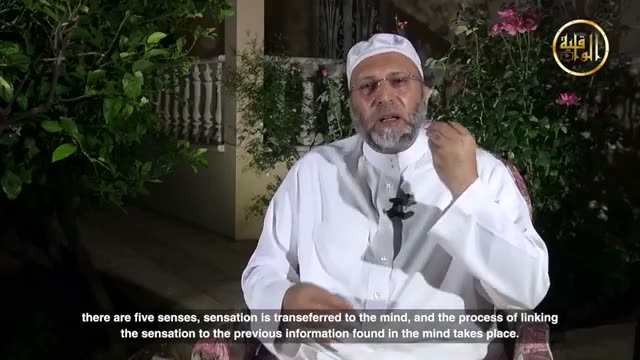
Reason, in reality, results from transmitting sensation of things to the brain. Allah, Glorified be He, created in you five senses with which you sense the things around you: you see, hear, smell, touch and taste. These five senses transmit sensation of things to the brain. In the brain, this sensation is linked to previous information stored in the person’s mind. This linking is reason. In Arabic, ‘aql means linking or binding: to bind a thing is to tie it.
The mind’s judgment is based on reality as perceived through sensation. Consequently, human reason’s capacity for perception is constrained by the limits of human sensory experience: what a person perceives—what they see, hear, taste, or touch—they comprehend through these senses alone. It is through this sensory framework that processes of perception, thought, and reasoning arise.
Rational Proof of the Creator’s Existence
When we establish the existence of Allah, the Almighty, it is not because reason can perceive His Essence—of course not. Rather, by examining the things surrounding us—the material universe, humanity, and life—we observe that they are limited, incapable, and deficient. They cannot exist independently; nothing within them suggests eternity or an absence of beginning for their existence. Instead, we judge that they must have a beginning. Therefore, there exists something that brought these things into being: the universe, humanity, and life. We perceive the Creator through observing His effects and experiencing evidence of Him—namely creation itself. There is no creation without a Creator.
Since reason has established with certainty that the things around us are created, this proves the existence of the Creator, the Almighty. This is where the mind’s capacity regarding belief in Allah ends: the senses perceived the effect—creation—and from it we perceived the existence of the Creator, Glorified be He. Naturally, among the things our senses perceive are indications of some of the Creator’s attributes.
What the Intellect Perceives of the Creator’s Attributes and Their Sources
By rational judgement, Allah, the Almighty, is All-Powerful, because one who has no power could not create these beings. He is Great and Wise, and the effects of wisdom are spread all around us. We perceive whatever effects of His attributes our senses can reach. But a human being must not let imagination roam and suppose that he can comprehend the attributes of Allah, Glorified be He. These attributes lie beyond reason and sensation. By reason alone, a person therefore cannot establish with certainty, for example, that Allah is the Judge, the Provider, All-Hearing, All-Seeing or the Giver of victory. A person cannot know these attributes by reason alone. We became certain of the attributes that Allah informed us of through the revelation sent to His Prophet Muhammad (peace and blessings be upon him). The Qur’an and Sunnah include descriptions of Allah’s attributes. Belief in these attributes is belief in the revelation sent to the Messenger of Allah (peace and blessings be upon him), and it completes belief in Allah, because belief in Allah’s attributes is part of our belief in Him.
We therefore believe in Allah as the Creator and Arranger, and we believe in everything with which He has described Himself in His Noble Book or in the Sunnah of His Prophet (peace and blessings be upon him), when it has reached us through a certain transmission.
The Inability to Perceive Allah’s Essence Strengthens Belief
Someone may ask, ‘Does this not show weakness in belief in Allah, the Almighty?’ We answer: quite the opposite. When a person sanctifies and worships gods that fall within the senses—with limited size and finite dimensions, contained by the universe, the earth and the sky—this clearly proves that he worships what should not be worshipped and does not deserve worship. He worships things perceived by human senses in this limited, finite world. Allah, Glorified be He, is the Creator of all these things. He made human sensation in this life limited to the universe, man and life. Believing in His attributes while being unable to perceive them with one’s senses or mind—the human being’s inability to comprehend the Essence of Allah—strengthens the believer’s belief. He believes in a God greater than the creatures He created and far removed from being part of the creatures upon which human sensation falls. We believe in a God who created the heavens and the earth, the universe, man and life. We believe in Allah, the Almighty, who gave us enough perception to comprehend the matter of the universe, man and life, and the things connected with them that fall within the senses. It is therefore natural for the believer to feel assured when worshipping a Creator, a God too great and exalted for sight to encompass in this universe and life, within which human perception and sensation are limited.
The Transmitted Evidence of Allah’s Attributes
The sole path to believing in the Attributes of Allah is through transmitted evidence—what do we mean by transmission?
We mean that if it is established for us that Allah, Glorified be He, revealed to His Prophet (peace and blessings be upon him)—which we shall discuss in later sessions, Allah willing—a Book through which He informs us of His attributes and of the origin, destination and nature of the universe, man and life, and their relationship with what came before and what comes after, then we believe with certainty in what He has informed us of. This is because the one conveying it is Allah’s Prophet, receiving revelation from Allah, the Almighty.
The Mistake of Philosophers in Speculating on the Essence of the Creator
The philosophers therefore went astray when they began imagining who the Creator is, what the Creator is, and what His nature is. Some described the Creator, the Almighty, as the First Soul; others called Him the Universal Intellect; and others called Allah the First Spirit or the Universal Spirit, and so on. All of this is mere conjecture and delusion. It would have been enough for them to say: We have perceived the existence of a Creator of the universe, man and life, but we do not know the essence of this Creator or His attributes. From this we also recognise the error of those who gave their minds some licence to expand in understanding the attributes of Allah mentioned in the Book and the Sunnah, in the Book alone, or in the Sunnah alone.
The Effect of Belief in Allah’s Attributes on Conduct
When Allah, Glorified be He, informs us that He is All-Seeing, we stop there and add nothing. We do not ask how Allah, Glorified be He, sees. The same applies when He informs us that He is All-Hearing and that:
﴿ يَعْلَمُ خَآئِنَةَ ٱلْأَعْيُنِ وَمَا تُخْفِى ٱلصُّدُورُ ﴾
‘He knows the treachery of the eyes and what the hearts conceal’ [40:19]
When Allah, the Exalted, informs us of His attributes, we confine our understanding to what reason can perceive within this domain.
If we believe that Allah, Glorified be He, is All-Seeing, the certain meaning sufficient for us is that He sees us in everything we do. This produces fear and awe of Allah, the Almighty, so that we do not do what displeases Him, because He sees us.
For if we believe that Allah, the Most High, is All-Hearing, then from this definitive attribute we understand that He hears every word we utter. Thus, we fear Allah, the Almighty, and refrain from speaking or letting slip a single word that may displease Him.
Belief in the attributes of Allah, Glorified be He, is not intended to make us form an image in our minds of His Essence. Allah is far above that. The purpose is not to form any image, imagination or conception of His Essence. Rather, belief in Allah’s attributes affects the servant’s actions and the human being’s conduct and thinking, making him more fearful of Allah and more hopeful of His mercy.
Forgiveness, Victory and Provision
When you know that Allah, Glorified be He, is Forgiving and Merciful, and that He accepts His servant’s repentance, Allah Almighty says:
﴿ ۞ قُلْ يَـٰعِبَادِىَ ٱلَّذِينَ أَسْرَفُوا۟ عَلَىٰٓ أَنفُسِهِمْ لَا تَقْنَطُوا۟ مِن رَّحْمَةِ ٱللَّهِ ﴾
‘Say, “O My servants who have transgressed against themselves, do not despair of Allah’s mercy”’ [39:53]
How is the belief that Allah, Glorified be He, is Forgiving and forgives all sins reflected in the servant? It is not reflected by imagining an image of Allah. It is reflected in the servant’s life: he turns to obedience to Allah, repents to Him and seeks His forgiveness if he has sinned against Allah, disobeyed Him or strayed.
Even if a person spends their entire life in disbelief and misguidance, Allah, Glorified be He, keeps the opportunity open for them until just before they die. As long as they have not died and their soul has not reached their throat, the doors of piety and repentance remain open before them:
﴿ ۞ قُلْ يَـٰعِبَادِىَ ٱلَّذِينَ أَسْرَفُوا۟ عَلَىٰٓ أَنفُسِهِمْ لَا تَقْنَطُوا۟ مِن رَّحْمَةِ ٱللَّهِ إِنَّ ٱللَّهَ يَغْفِرُ ٱلذُّنُوبَ جَمِيعًا ﴾
‘Say, “O My servants who have transgressed against themselves, do not despair of Allah’s mercy. Indeed, Allah forgives all sins”’ [39:53]
Belief in the attributes of Allah, the Almighty, thus drives a person towards greater piety, submission to Allah and restraint from disobeying Him.
Here you recognise that Allah, Glorified be He, grants victory to the believers and that victory comes from Allah. This is reflected in your seeking victory from Him by adhering to His commands and prohibitions, and by not seeking the means to victory outside obedience to Him, as many people do today. Allah, Glorified be He, is the Giver of victory.
When you believe that Allah, Glorified be He, is the Provider, the Possessor of Power, the Firm, the purpose is not for you to think about how provision is given to people. Allah, Glorified be He, is able to provide for all people:
﴿ وَمَا خَلَقْتُ ٱلْجِنَّ وَٱلْإِنسَ إِلَّا لِيَعْبُدُونِ مَآ أُرِيدُ مِنْهُم مِّن رِّزْقٍ وَمَآ أُرِيدُ أَن يُطْعِمُونِ إِنَّ ٱللَّهَ هُوَ ٱلرَّزَّاقُ ذُو ٱلْقُوَّةِ ٱلْمَتِينُ ﴾
‘I created jinn and mankind only to worship Me. I seek no provision from them, nor do I want them to feed Me. Indeed, Allah is the Provider, the Possessor of Power, the Firm’ [51:56–58]
If you believe that Allah, Glorified be He, is the Provider, you do not seek provision through disobedience to Allah; you do not seek provision through what is prohibited. Also, if you know that Allah, Glorified be He, is the Provider and that provision is in His hand, you do not despair if you work but receive no provision, because provision is in Allah’s hand. How many people have striven to seek provision but received none, and how many people received provision while sitting in their homes! Do not despair if Allah, Glorified be He, tests you in your provision. Rather, say:
﴿ إِنَّا لِلَّهِ وَإِنَّآ إِلَيْهِ رَٰجِعُونَ ﴾
‘Indeed, we belong to Allah, and indeed to Him we return’ [2:156]
To Allah belongs what He has taken, and to Allah belongs what He has given [agreed upon, paraphrased].
Delving into Ambiguous Verses
Allah, Glorified be He, addressed us concerning belief in His attributes, not so that we would combine them into an imagined picture or perception of His Essence. Far from it; Allah is exalted far above that.
From this arises the error of those who delve into interpreting certain ambiguous verses in the Qur’an or Sunnah, thereby deviating from their context, purpose and intended meanings.
These individuals have erred. The dispute over terms such as ‘hand’ or ‘face’ mentioned in the Qur’an stems from their contextual usage and grammatical construction; meaning is derived solely from this composition—not from isolated words taken separately, one apart from another.
For example, when Allah, Glorified be He, says:
﴿ وَقَالَتِ ٱلْيَهُودُ يَدُ ٱللَّهِ مَغْلُولَةٌ غُلَّتْ أَيْدِيهِمْ وَلُعِنُوا۟ بِمَا قَالُوا۟ بَلْ يَدَاهُ مَبْسُوطَتَانِ يُنفِقُ كَيْفَ يَشَآءُ ﴾
‘The Jews say, “Allah’s hand is fettered.” May their hands be fettered, and may they be cursed for what they say! Rather, both His hands are outspread; He spends as He wills’ [5:64]
This verse clearly indicates that the subject is provision. In saying this, the Jews—upon whom is Allah’s curse—who said that Allah’s hand is fettered meant that Allah, Glorified be He, is miserly and does not give the servants what they deserve. Allah, Glorified be He, answered them in His Noble Book, saying:
﴿ بَلْ يَدَاهُ مَبْسُوطَتَانِ يُنفِقُ كَيْفَ يَشَآءُ ﴾
‘Rather, both His hands are outspread; He spends as He wills’ [5:64]
The subject of the verse is Allah’s spending upon His servants.
Then comes one who extracts isolated terms from such verses to engage in interpretations beyond what the mind can comprehend.
He attempts to ascertain the precise meaning of ‘hand’, ‘hands’ or ‘the hands’, thereby departing entirely from their contextual framework.
Some claim it is necessary to deny the attribute of a hand, while others insist it must be affirmed. In doing so, they distort this verse from its context and meaning, engaging in speculative debates that neither the earliest believers nor the Companions of the Prophet (saw) ever pursued.
These discussions into which they entered in this area burdened their minds with what they could not bear.
The Limits of Reason and the Influence of Belief on Conduct
For this reason, it must be a fundamental principle in speech and thought that it is invalid for a person to say: ‘If I have not seen Allah, the Exalted, nor perceived His Essence, then I cannot believe in Him.’ This is a grave mistake.
You believe in a Creator who created the heavens and the earth because you perceived that, by their very nature, the heavens and the earth are created. You also believe that Allah, Glorified be He, revealed a Qur’an in which He described Himself with attributes. You believe in these attributes as they were stated and in a way that has a positive effect on your conduct.
Consider the issues into which the theologians delved. You will find that these issues have no effect whatsoever on human conduct.
If you believe that Allah, the Exalted, is All-Seeing, this alone should increase your fear of Him. Therefore, do not commit what angers Him, for He sees you.
But what does this add if one delves into the following question: Does He see me with an eye or without? With a pupil or without? This inquiry is presumption against the Essence of Allah, and it has no effect on the servant’s actions—whether he believes in Him or denies Him.
If you believe that Allah, the Exalted, is All-Hearing, this will make you refrain from speaking words that displease Him.
But what does it add if you then delve into the question: How does He hear—with an ear or without an ear? Some, or indeed many, of the theologians delved into this. Instead of increasing clarity of mind and purity of belief, it confused their minds and intellects and divided people between conflicting understandings, until, regrettably, some of them declared others unbelievers.
Ihsan, Then Questions
Dear brothers, yes, we should practise ihsan in our obedience and piety.
The Prophet (peace be upon him) was asked—Jibril asked him: ‘Tell me about ihsan.’ He said: «الإحسان أن تعبد الله كأنك تراه، فإن لم تكن تراه فإنه يراك». — ‘Ihsan is to worship Allah as though you see Him; and if you do not see Him, He sees you.’ [Sahih Muslim 8].
Worship Allah, the Exalted, as though you see Him—even though you do not. Why? Because you have true certainty in His existence. If you cannot see Him while He sees you, then surely He surrounds you from all sides. He is with you wherever you are by His knowledge, hearing, sight, decree and guidance if you deserve it; His punishment awaits you if you deserve it; and He tests you if His wisdom requires it.
This ihsan in worship results from belief in a great Creator whose existence can be perceived, but whose Essence cannot be perceived.
I say this and seek Allah’s forgiveness for myself and for you all.
I will remain with you to answer the questions I have received.
Questions and Discussion
A question from Alaa al-Nadi follows.
The Complexity of Allah’s Attributes and Alienating People from Religion
Some preoccupy themselves with the attributes of Allah in a manner that complicates religion and creed for people, restricting their understanding to religious scholars alone. By doing so, they distance individuals from religion and thus lay the groundwork for its separation from life—Allah forbid.
I referred to this at the end of my remarks. They deal with the attributes of Allah in a complicated way and delve into logical details that neither the Prophet (peace and blessings be upon him) nor his noble Companions after him discussed. One should instead limit oneself to the certain meanings of Allah’s attributes that have a positive effect on the believer in the form of piety and restraint. Yes.
Attributes Established by Reason
The comment is apt. A question from al-Abid Bayt al-Maqdis asks: Does the Creator, Glorified be He, not have attributes? Are there not attributes of the Creator established by reason, such as His being Powerful, Living, the Necessary Existent and All-Powerful, and so on? Are these not inherent in the word ‘Creator’? This is what I mentioned near the beginning of today’s discussion: there are attributes whose effects fall within our senses.
Yes, one of Allah’s attributes is that He is All-Powerful. Without power, He could not have created this universe. He is Powerful; without power, this universe could not exist. The power of the Creator, Glorified be He, is therefore evident in this universe.
Just as we perceived Allah’s existence by reason when our senses encountered the effects of the Creator, Glorified be He, any attributes whose effects fall within the senses can likewise be perceived by reason, as we have said.
The Trial of the Quran’s Creation and Branches of Creed
A question arises through the path of dignity: we have witnessed a prior dispute between caliphs and scholars regarding creedal research, such as whether the Quran is created or uncreated Speech of Allah.
This refers to the correct expression of the dispute that took place during the reign of al-Ma’mun, which originated when the Mu’tazila engaged in theological discourse on this matter.
The first group widely known for their engagement in such discourse were the Mu’tazila. They debated whether this Quran is created or uncreated.
They gained control over the conviction of al-Ma’mun, the Caliph of the Muslims at that time, and persuaded him to adopt their school of thought. Regrettably, al-Ma’mun then compelled the other scholars to say what the Mu’tazila said on their various issues, including whether the Qur’an was created or uncreated. He thereby put people to trial over the matter. One of the most famous of those subjected to this trial—meaning those who were tested, not that they deviated, went astray or fell—was Imam Ahmad ibn Hanbal, may Allah have mercy upon him. His story in this matter is well known. The issue was: Is the Qur’an created or uncreated?
Look for this inquiry among the noble Companions and the Followers, and you will not find it. It only appeared later with the emergence of scholastic theology (ilm al-kalam).
The Companions—may Allah be pleased with them—were unanimous in their certainty, just as every believer among us today is certain, that the Qur’an is the Speech of Allah.
Is it not sufficient for you to affirm that the Qur’an is the Speech of Allah and that He—exalted be His name—revealed it to His Prophet (saw)? It was neither produced by any human being nor composed by any human or jinn.
Belief in the Qur’an means affirming that it is the Speech of Allah, revealed by Him to His Prophet (saw).
But the Mu’tazila insisted on delving into this matter, putting people to trial and, through the Caliph of the Muslims at the time, compelling them to say what they said: that the Qur’an was created. Al-Ma’mun erred when he took up disputed issues that were not at the core of the creed but among its subsidiary matters, adopted an opinion on them, and obliged everyone to follow it.
Al-Ma’mun therefore subjected to trial and torture everyone who did not say that the Qur’an was created, everyone who insisted on avoiding this issue, and everyone who said that the Qur’an was the uncreated Speech of Allah, until he compelled them to adopt the Mu’tazila’s position.
It was incumbent upon the Islamic State under al-Ma’mun, then Caliph of the Muslims, to refrain from compelling people to adopt any of the views held by theologians or schools of thought.
These matters do not constitute the core of the creed. The essence of belief is affirming that the Qur’an is the Speech of Allah, that it was not created by any human being, but rather revealed by Allah, the Exalted, to His Prophet (saw). There is absolutely no need thereafter to delve into matters beyond those addressed by the Companions.
It was therefore incumbent upon the Islamic State at that time to withdraw from the debates engaged in by the Mu’tazila and theologians, and to refrain entirely from compelling Muslims—particularly Muslim scholars—to adhere to any particular school of thought. The Islamic State must not adopt as official doctrine what are termed branches of creedal matters.
The Companions, may Allah be pleased with them, themselves differed on certain issues classified under the heading of creed, yet these were not part of the core creed itself.
Did the Companions, may Allah be pleased with them, differ over whether the Prophet (saw) saw his Lord during the Night Journey and Ascension? Some said he did see Him; others said he did not. Is this a matter of fundamental creed that distinguishes between a believer and a disbeliever? Certainly not.
Nor did the Companions themselves treat this issue as one of belief upon which to differentiate between those whose creed was sound and correct, and those whose creed was corrupt?
It is also well known that the Mother of the Believers, Aishah—may Allah be pleased with her—said that the body of the Prophet (peace and blessings be upon him) did not leave his bed on the night of the Isra and Mi’raj. She and those who shared her opinion therefore said that the Isra and Mi’raj took place with the spirit and not the body.
Others maintained it occurred with both spirit and body. But did this matter cause division among the Companions—leading them to split into those holding a correct creed and others holding an incorrect one? They differed over this issue, and this disagreement has persisted until our own time. Such matters are often categorised under creeds in books of belief, yet they do not constitute core creed; otherwise, people would have excommunicated each other on such grounds.
The Islamic State must therefore avoid adopting and enforcing opinions in subsidiary reports or in the subsidiary matters placed under what is called the chapter of creed.
The Meaning of Istiwa’
I shall now read the final question from Brother Tariq Sharqiyyah: ‘Peace be upon you. May Allah bless you.’
And upon you be peace, mercy, and blessings of Allah. The most challenging aspect here is interpreting the term istiwa. What does this istiwa refer to in these verses? Allah says:
﴿ إِنَّ رَبَّكُمُ ٱللَّهُ ٱلَّذِى خَلَقَ ٱلسَّمَـٰوَٰتِ وَٱلْأَرْضَ فِى سِتَّةِ أَيَّامٍ ثُمَّ ٱسْتَوَىٰ عَلَى ٱلْعَرْشِ يُغْشِى ٱلَّيْلَ ٱلنَّهَارَ يَطْلُبُهُۥ حَثِيثًا وَٱلشَّمْسَ وَٱلْقَمَرَ وَٱلنُّجُومَ مُسَخَّرَٰتٍۭ بِأَمْرِهِۦٓ أَلَا لَهُ ٱلْخَلْقُ وَٱلْأَمْرُ تَبَارَكَ ٱللَّهُ رَبُّ ٱلْعَـٰلَمِينَ ﴾
‘Indeed, your Lord is Allah, Who created the heavens and the earth in six days and then established Himself over the Throne. He covers the day with the night, which pursues it swiftly. The sun, the moon and the stars are subjected by His command. Surely, all creation and command belong to Him. Blessed is Allah, Lord of all worlds’ [7:54]
And Allah Almighty says:
﴿ هُوَ ٱلَّذِى خَلَقَ لَكُم مَّا فِى ٱلْأَرْضِ جَمِيعًا ثُمَّ ٱسْتَوَىٰٓ إِلَى ٱلسَّمَآءِ فَسَوَّىٰهُنَّ سَبْعَ سَمَـٰوَٰتٍ وَهُوَ بِكُلِّ شَىْءٍ عَلِيمٌ ﴾
‘He is the One Who created for you all that is on earth, then turned towards heaven and formed them into seven heavens. He has knowledge of all things’ [2:29]
And Allah, Glorified be He, says:
﴿ ٱلرَّحْمَـٰنُ عَلَى ٱلْعَرْشِ ٱسْتَوَىٰ ﴾
‘The Most Merciful established Himself over the Throne’ [20:5]
The difficulty here arises because Arabic words often carry multiple meanings. This common term, therefore, encompasses more than one meaning.
When a word occurs in the Noble Qur’an that describes an act of Allah, Glorified be He—here, istiwa’, that Allah established Himself over the Throne—then, quite simply, Muslim believers should avoid the ambiguities that arose and continue to arise to this day.
If the word istiwa’ has several meanings, some meanings are certain because they involve no problem and imply no resemblance. Other meanings contain ambiguity or resemblance and are speculative. For belief to be true—firm and certain—it must be decisive, because belief or creed is decisive assent. A person’s speculative assumptions are not belief. What you do not affirm decisively and with certainty is not creed; it may be a speculative assent that is most likely correct. But belief is decisive assent, and creed is decisive assent. If these verses have certain meanings and other speculative meanings, it is sufficient for the believer to take the certain meanings that contain no problem or resemblance.
We must not choose a meaning unworthy of Allah, Glorified be He, when that meaning is only a speculative indication of the word in Allah’s Book—such as sitting—and then say that istiwa’ over the Throne means sitting upon the Throne.
Thus, we have gone too far and presumed excessively; yet among the definitive meanings of istiwā’ are exalted status, greatness, and power.
It is certain that Allah, Glorified be He, performed istiwa’, and it is certain that this istiwa’ indicates Allah’s exaltedness in status, greatness and power. From the Qur’anic meanings concerning Allah’s attributes that are hidden from the senses, let us therefore take the certain indications that increase the believer’s trust in Allah, fear of Him and awe of Him, Glorified be He.
This is how one should engage with texts, verses, and hadiths whose meanings are speculative or open to interpretation. There is a definitive meaning in words that we affirm as part of our belief; there are also speculative indications which we do not consider part of belief nor part of the Islamic creed, dear brothers. I shall conclude here for today.
Conclusion
And I ask Allah, the Exalted, that He may have benefited me and you in this discussion. We pray to Allah, the Mighty, that He teaches us what benefits us, enables us by what He has taught us, and makes our knowledge and deeds sincere for His Noble Countenance. May peace be upon you and the mercy of Allah.