Introduction and Subject of This Episode
Peace be upon you, mercy and blessings of Allah. In the name of Allah, all praise is due to Him, and peace and blessings upon His Messenger. Dear brothers, welcome to this new episode. From your programme Live Segment, we continue discussing The Way to Belief, progressing through a series of ideas until we establish the full proof of the Islamic creed.
In the previous episode, we addressed proving the existence of Allah, the Exalted—matters pertaining to belief in Him, Glorified be He.
Having finished that subject, today we turn to a matter of great importance: after a person knows his Creator, Glorified be He—that is, after he believes that the universe, man and life have a Creator who created them—can this belief and conviction simply pass through his mind without becoming the foundation on which he builds his life, thought and viewpoint in life?
This is our topic today: what does belief in Allah’s existence entail?
Passage Read from The System of Islam
As for the affirmative proof of the need for messengers, it has been proven that man is created by Allah ﷻ and that religiousness is innate (fiTri) in man, since it is one of his instincts. Thus, man, by his nature, sanctifies his Creator, and this sanctification means worship, which is the relationship between man and his Creator. Leaving this relationship without organisation will lead to turmoil and to worshipping other than the Creator. Therefore, it is necessary to organise this relationship with a correct system which cannot emanate from man, because he cannot perceive the reality of the Creator in order to set up this relationship between himself and the Creator. Hence, this system must come from the Creator. Since the Creator has to convey this system to man, therefore there should be messengers to convey to the people the religion (deen) of Allah ﷻ.
The Contradiction of Western Civilisation in Separating the Creator from Life
Remarkable is the case of the Western civilisation that dominates the world today. It tells man: ‘Yes, the existence of a Creator is not unlikely.’ Indeed, the prevailing culture in some major Western countries, such as the United States of America, indicates that their people trust in and believe in a Creator. At the same time, however, they tell people: ‘This Creator created you, but then left you to live your lives however you wish and according to whatever you consider to be in your interest.’
Some Enlightenment philosophers articulated this notion by comparing the Creator—exalted is He—to a clockmaker who crafts a timepiece and then leaves it; thereafter, it functions independently of his intervention.
Thus, they convinced people that the Creator—exalted is He—created humanity but thereafter took no part in their lives: neither legislation nor guidance, nor direction for mankind, nor even providence or success for them.
They therefore completely severed the connection between the Creator and creation in this life. They denied prophethood, revelation, the prophets and the revealed Books. This summarises the idea, or creed, of separating religion from life.
Here we address all humanity—speaking to man as a human being in his fundamental essence. O man, after becoming certain that Allah is the Truth and that He created you and the heavens and earth around you, how can you turn away from this great and momentous truth and live your life apart from it?
This is the very contradiction between a fundamental truth known by humanity and actions that contradict it.
Belief in the Creator Demands Seeking His Guidance
When man believes in the Creator of the heavens and earth, who created him and placed him in this life among all people, then this belief must inevitably shape his thinking. A human being cannot live in this life with peace of mind, tranquillity of heart or confidence in their path unless they are conscious of a need—specifically the need for a message from Allah, the Exalted. As long as one acknowledges that there is a Creator who brought them into existence, their direction in this life must come from Allah, the Exalted. From this we say: Man has an inevitable need for messengers—for a Messenger from Allah, Glorified be He, who acquaints man with the meaning of his existence: why he exists, how he establishes his relationship with his Creator, and how he proceeds in this life according to guidance so that he lives well and attains elevation. He can then depart from this life for the next life that Allah has prepared, carrying his provisions to meet his Lord while his Lord is pleased with him.
The First Proof: The Instinct of Religiousness and the Need to Know Worship
I begin with a fundamental point in this discussion: how we establish that humanity requires a message from Allah, the Exalted.
It has been established beyond doubt that man is religious by nature. Man’s fitrah has been formed for worship, sanctification and religiousness. His natural feeling of deficiency and need makes him feel his need for the Creator and Organiser, so that he turns to Him in worship and sanctification. This instinct is a hunger within man—a hunger he must satisfy. How does he satisfy it? By worshipping his Lord. This includes sanctifying his Lord, Glorified be He. In this worship, gratitude to the Benefactor is manifested, for He granted man his life, sight, hearing and all the blessings of life surrounding him.
Once he believes that he was created by a Creator, it is natural for him to turn to this Exalted Creator in submission, humility, sanctification and worship. However, a question remains: Can man truly perceive the correct worship that Allah, the Exalted, deserves—worship befitting humanity and fully satisfying his instinct of religiousness? This is the question.
Let us cast a brief yet comprehensive glance at past and present nations throughout history. Let us observe them closely.
When they did not derive guidance from Allah, the Exalted, nor His rites of worship, how could they truly worship Him?
Among them are those who embodied Allah, exalted is He above all that, in idols. Others drew near to Him by worshipping false gods, men, kings or objects from nature.
Others said, ‘I will worship Allah alone.’ But when they had no message from Allah, Glorified be He—or did not follow and submit to that message—they began inventing rituals of their own through which to draw near to Allah Almighty.
There are the disbelievers of Quraysh. What did they say about their worship of idols? They said:
﴿ مَا نَعْبُدُهُمْ إِلَّا لِيُقَرِّبُونَآ إِلَى ٱللَّهِ زُلْفَىٰٓ ﴾
‘We worship them only so that they may bring us nearer to Allah’ [39:3]
They claimed that they drew near to Allah Almighty by worshipping idols they had fashioned with their own hands.
Reason and reality both affirm that the Creator must be worshipped in a manner befitting His majesty. As long as humanity does not perceive Allah’s essence, it is natural they remain unaware of what constitutes worship worthy of Him.
When confronted with a worshipper and an object of worship, who determines the manner of worship? Since worship is directed to Allah alone, may a person then claim for himself the right to choose how he worships his Creator?
Imagine a person who wants to thank someone who granted him a great blessing. Someone did another person a great favour, so he wanted to thank his benefactor. When he decided how to thank him, however, he chose a form of thanks that pleased himself but angered the person who had favoured him. Would that be gratitude or ingratitude?
If you wish to thank the One who has favoured you, it is natural to seek gratitude that pleases Him—not what pleases yourself. The truth is that what pleases Him also pleases you, for your intention is to earn His approval and express sincere appreciation.
If he is pleased, you are pleased. What, then, of the Creator of the heavens and earth, who created you, gives you life, causes you to die, provides for you and controls your destiny? You feel that you are His humble servant. If you want to worship Him, you must ask Him to tell you which worship He loves and accepts. That worship therefore befits you, because it befits a servant to submit to his Creator as his Creator wills.
How foolish are those who say that everyone who believes in Allah—despite their different ways of worship, directions and forms of turning to Him—worships Allah and that none is better than another. This is among the most foolish statements one can hear. We see this idea expressed daily in slogans, pictures and designs. They depict all worshippers as equal: one worships Allah through certain rites, another through different rites, and a third through still other rituals. They claim that everyone seeks Allah’s pleasure, so it does not matter how each person worships his Lord. This is the height of falsehood and insolence towards Allah Almighty, who created man, guides him in how to worship, and determines the worship befitting Him.
When Allah commands prayer, fasting, pilgrimage rites, supplication, night vigils, remembrance, glorification, and other acts of worship—specifying how they are to be performed—a person who adheres to them has thanked Allah and fulfilled their innate religious instinct, satisfying the very disposition with which He created them.
And He said:
﴿ فَأَقِمْ وَجْهَكَ لِلدِّينِ حَنِيفًا فِطْرَتَ ٱللَّهِ ٱلَّتِى فَطَرَ ٱلنَّاسَ عَلَيْهَا لَا تَبْدِيلَ لِخَلْقِ ٱللَّهِ ذَٰلِكَ ٱلدِّينُ ٱلْقَيِّمُ وَلَـٰكِنَّ أَكْثَرَ ٱلنَّاسِ لَا يَعْلَمُونَ ﴾
‘So set your face towards the Deen, upright—the fitrah of Allah upon which He created mankind. There is no changing Allah’s creation. That is the upright Deen, but most people do not know’ [30:30]
Thus, humanity’s need for knowledge of acts that satisfy their instinct of religiousness—directing them in humility and reverence to their Creator—proves conclusively that they require a Messenger to convey the message detailing how worship should be performed.
Hence, the Messengers were bringers of glad tidings and warners; they stood as proof against people and guides leading them in Allah’s prescribed worship. This is the first definitive evidence that humanity must have a divine message from Allah. We now continue with our topic, brothers.
The Second Proof: Man’s Need for a System Regulating the Satisfaction of His Needs
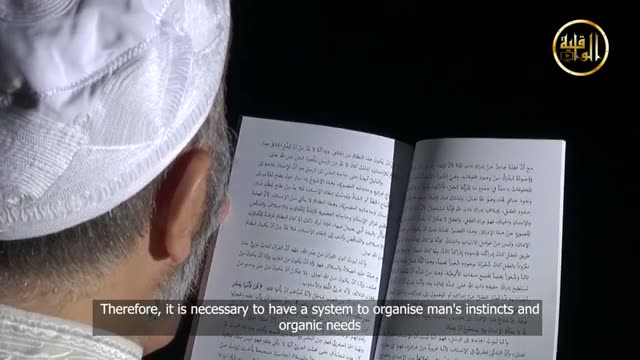
Following the next break. Further proof of the peoples need for messengers is that the satisfaction of man’s instincts and organic needs is a necessity. If this satisfaction were left without a system, it would lead to an erroneous and perverse fulfilment and thus result in man’s misery. Therefore, it is necessary to have a system to organise man’s instincts and organic needs. This system does not come from man, because his understanding of the organisation of man’s instincts and organic needs is liable to disparity, differences, contradiction and is influenced by the environment in which he lives. Thus, if this organisation was left to man, the system would be liable to disparity, differences and contradiction and would lead to man’s misery. Therefore, this system must come from Allah ﷻ.
Peace be upon you; we return, dear brothers, to the topic of humanity’s need for messengers.
Among the decisive proofs of humanity’s need for messengers is the necessity for a system in this life that regulates conduct and thereby organises human relations.
All people, without dispute, acknowledge that humans possess a vital energy compelling them to act, behave, and perform deeds—thus leading to conduct.
This vital energy consists of the needs that Allah, the Exalted, has implanted in humanity: organic necessities such as hunger for food and drink or warmth; and instincts He has endowed within them, requiring satisfaction—such as the instinct of procreation and survival. Earlier, we discussed the instinct of religiousness. These faculties within humans, termed vital energy, drive individuals toward their gratification, compelling them to act in pursuit of satisfying these needs.
As man acts to satisfy his needs, he finds that many of them can be met only through other people. He must therefore exchange benefits with them: he obtains some of what he needs from them and, in return, meets some of their needs. Relations between people arise from this, and society comes into being. This creates the pressing need for a system that regulates the satisfaction of these instincts and, through that regulation, organises relations between people, because those relations arose to satisfy people’s needs.
From this understanding, people agreed that there must be a legislative framework—whatever name they chose to call it—to regulate human conduct. Consequently, such laws would govern relationships among individuals within a single society and between societies across nations; thus, a regulatory system is indispensable. Man’s conduct may concern the relationship between him and himself, which is classified under manners and morals; the relationship between him and other people, which falls under transactions (mu’aamalaat); or the relationship between him and his Creator, which we discussed earlier.
Where Does the System Originate?
The question then arises: from where does this legislative system originate—the one that regulates human needs and governs relationships arising from the necessity to satisfy them? This is the system in question. There are two possibilities: either this system comes from man, or it comes from man’s Creator, Glorified be He. The system made by man is the reality of most—indeed, almost all—societies existing today, which are governed by man-made systems. The other possibility is that the system comes from the Creator, Glorified be He. Which system is suitable for man?
The system that a person establishes regarding their own affairs arises from the differences among people, the disparities between them, and how they are influenced by the environments in which they live. These varied environments—whether natural settings, societies, or historical, political, and geographical conditions—lead to real differences among humanity.
Each individual is shaped by their environment; thus, when left to human discretion to legislate, the laws they establish are inherently prone to variation, contradiction, and inconsistency.
For this is the nature of humanity. We know that people differ in their levels of thought, that they vary in their judgments, and that they disagree among themselves due to differing intellectual backgrounds or foundational principles from which they operate. You see one person prohibiting an act while another permits it, yet a third may even make the same act obligatory. People may agree on a particular matter, but then differ over the extent to which it should be permitted, restricted or left unrestricted. Consider how the West itself split at one time: even within a single Western society and among closely related Western communities, how did they differ on ownership—whether a person has the right to own property or not? Some argued that ownership is permissible only up to a certain limit; others claimed it depends on the methods of acquisition. Still others insisted private property was impermissible, insisting instead that all property must be collective, with individuals taking only what they need. These were people living in the same society, sharing the same communities—each holding their own view. In truth, when humans legislate, they are susceptible to division, inconsistency, contradiction, and environmental influence; this is the reality of the matter.
The Limitations of Human Legislation and Its Environmental Influence
If we examine the legislator when he begins to deliberate, you will find that the human legislator does not legislate for humanity in its general sense. What do I mean by this?
When man sought to legislate, his focus was on addressing specific problems experienced by humans who grew up within a particular environment and under certain conditions. The circumstances of life and the surrounding milieu in which he lived were marked by particular challenges, so his entire mind concentrated on resolving those very issues.
If you examine these problems closely, you will find that they are not universal human problems or inherent to humanity as a whole. Rather, they were specific difficulties encountered by humans within that particular society, at that time and in those conditions. Thus, he framed laws to address those specific problems—not humanity in its essential nature. Consequently, such legislation—solutions devised by human beings—has no value in another society that has not faced the same problems. It may even lose its value in the same society after time passes, old problems disappear and new ones arise.
You will observe legislators stating: ‘The system we now possess has no meaning because it was enacted for past issues, problems, and matters. We require new legislation today.’ Thus, note that nations, once they establish their laws, whenever reality imposes pressures or circumstances shift—times changing, conditions evolving—they begin revising their laws day by day, year by year, decade after decade without end. This is the nature of humanity.
Capitalism as a Product of a Specific Historical Reality
To illustrate this point concretely and avoid mere theoretical discussion today: the system dominating the world is capitalism. This capitalist system arose within a specific environment, at a particular moment in history, in one place and within a particular society.
Capitalism emerged in Europe during an era when people had rejected feudalism and the political regime that upheld it—the monarchy governed through the theory of divine right. Royal families ruled societies under this pretext, with the church’s support, based on a doctrine they either accepted or were compelled to embrace: that kings were divinely appointed by Allah to govern humanity. This is the doctrine of divine right. For centuries, people endured this system. Eventually, circumstances enabled people to overthrow that reality, and a new system arose. It combined a capitalist economic system with democratic government and general freedoms in society and politics.
Thus emerged the system we recognise today in the West: founded on the creed of separating religion from life—a reaction to clerical control over people’s lives. Democracy, too, arose as a response to monarchies that ruled societies for centuries, while capitalism developed as a counter-reaction to feudalism. Therefore, this system originated under specific conditions and evolved in response to particular circumstances experienced by European societies.
Other societies did not experience these conditions—for example, the Islamic world never encountered them. The historical context that spanned centuries in Europe was unknown to the peoples of East Asia—India, China—and all other nations. They were unfamiliar with this system as it developed in Europe; capitalism emerged there solely as a reaction against feudalism.
When the West set about colonising the world and forcing people to submit to capitalism, that system was imposed coercively in those lands. It neither met people’s needs nor expressed their requirements, and it had no connection to their reality. It therefore did not produce the revival—corrupt though it was—that it produced in the West; instead, it produced distorted societies. In the rest of the world, the capitalist or liberal legislator did not legislate for man as man. He did not seek the system suitable for man as man: the system suitable for satisfying the survival instinct, the system suitable for satisfying the procreation instinct, and the system suitable for establishing sound human relations.
Crises of Capitalism and the Rise of Socialism
We may cite another example: capitalism itself, after being applied in Europe for decades, created horrifying problems and crises that became the greatest catastrophes to strike European societies.
The greatest calamity to strike European societies was the enormous contradiction and disparity between two classes: the capitalists and the workers and peasants. Wealth became concentrated in the hands of a very small group of capitalists—one or two per cent of society in Europe and America—who acquired more than ninety per cent of society’s wealth.
Thus, this capitalist class held ownership of most major factories, large-scale farms, principal trading enterprises, and key institutions. Over ninety per cent of society was forced to work as wage labourers or employees under these capitalists. As a result, the supply of labour grew; with an abundance of workers available, wages inevitably declined.
This led to the existence of immense numbers of workers, employees and farmers—farm labourers compelled to accept meagre wages in coins. Each one labours from dawn until dusk at tasks more gruelling than those endured by serfs in medieval times, only to receive a handful of coins thereafter. Those wages barely met the worker’s and his family’s basic needs. This system created discontent and anger in Europe. Thinkers and theorists then emerged from the working class—the labouring class, as they called it, or the proletariat—and began formulating new theories for the economic system in society.
Socialist theories then emerged, most prominently Marxist socialism. This holds that means of production cannot belong to any individual or private hands but must be public property under state ownership, ensuring equal—or nearly equal—wages for all. The Marxist communist socialist idea took root, leading to the formation of parties dedicated to it, and eventually to states built upon its principles, with the Soviet Union at their head in the last century.
Have you observed that the socialist communist idea arose as a reaction against conditions created by capitalism? Thus, it did not propose solutions for humanity in its essence but rather sought to address specific problems suffered by particular societies—or European communities. What then is the relevance of other societies that had never experienced capitalism nor, before that, feudalism?
This shows that legislators do not address people’s fundamental needs or enact laws for humanity in its entirety.
The Creator’s Legislation Addresses Humanity as Such
When the system and legislation come from man’s Creator, however, this legislation is for man as man. The One who created man placed his organic needs, instincts and hungers within him—things that man cannot even see or identify directly.
Does any scholar claim to have placed these instincts under a microscope? The instinct of religiousness, the instinct of survival, or the instinct of species preservation—of course not.
We know that human nature contains instincts. We perceive the existence of something through its effects on our senses: just as we perceive Allah’s existence from His creation’s impact upon us, so too do we recognise these instincts in humanity—not because we have seen them directly, but because we observe their consequences.
This is the very impulse that drives a human being—simply as a human—to seek satisfaction. For survival’s sake, he defends himself, maintains conditions of safety, seeks medical treatment from doctors, and so on.
And to preserve his species, he is driven toward the opposite sex: he marries, reproduces, and procreates. Emotional bonds tie him to his wife, mother, father, son, brother—and beyond. These are human instincts whose existence we perceive through their effects.
Yet our perception of these instincts’ existence does not mean we know which methods satisfy them properly. The One who created these instincts in humanity—Allah, the Exalted—is the One who knows what programme suits their management, satisfaction, and regulation. Glory be to Allah.
Consider how a person interacts with complex devices: when he encounters them, his first thought is that whoever understands how this device operates is its creator. In many cases, when we purchase such a device, the manufacturer includes instructions on how to use it—and sometimes even sends a manual for technicians to consult if the device malfunctions.
This is only an example, and to Allah belongs the highest example. Which is more complex: the human soul, which no one has ever placed under a microscope or seen with their own eyes, or that material device made by man? A person who does not fully understand what has been made does not know how to handle it. Which is more complex? Without doubt, it is the human soul. Those unfortunate psychologists claimed that they had analysed the human psyche, discovered what suited it, and devised a programme for how it should live and how its problems should be treated. Yet those same psychologists disagreed among themselves, their opinions conflicted, and they developed different approaches, each contradicting the others.
This is natural: they seek guidance from human beings instead of seeking it from Allah, the Exalted and Glorified. A person seeks treatment for his problems from another person who himself needs someone to treat those same problems.
The indisputable truth is that He who created man knows what his soul whispers to him and is closer to him than his jugular vein, as Allah says:
﴿ وَنَعْلَمُ مَا تُوَسْوِسُ بِهِۦ نَفْسُهُۥ وَنَحْنُ أَقْرَبُ إِلَيْهِ مِنْ حَبْلِ ٱلْوَرِيدِ ﴾
‘We know what his soul whispers to him, and We are closer to him than his jugular vein’ [50:16]
He knows what is suitable for this soul, these needs, these hungers and this remarkable temperament. He knows the proper way to satisfy them. He therefore regulates man’s conduct and, consequently, people’s relations in society. When the system comes from Allah, the Creator of man, it resolves man’s problems and legislates for man in every place, at every time, in every environment and in every society.
The Historical Reality Between Human Systems and the Shari’ah
Let us apply what we have said to reality. I told you shortly ago: when Westerners came to apply their system to all peoples, what did their system do in Africa? Did it bring revival to the African peoples as it did in Europe and America? What did it do to the Muslim lands when they were forced to submit to it?
What did this system do in other lands? It did not bear there the same fruit it had borne where it arose—despite the corrupt fruit it bore in those Western lands. We are not saying that this system succeeded among Western peoples. It did bear certain fruits, but bitter ones: it gave them wormwood and bitterness, corrupted their societies and plunged them into psychological crises. My specific point here is that the system could be applied and bear a particular fruit where it arose, yet was incapable of doing so in other societies.
As for that system which we believe Allah, the Exalted, has revealed—the Shari’ah of Islam—this law emerged in Arabia and is entirely disconnected from what the Arabs had in terms of thought, culture, or style of life before it.
Whoever reads history—and whoever truly studies Arab history—knows that there was absolutely no connection between Islamic life after the revelation of Islam and the pre-Islamic life, the age of ignorance (Jāhiliyyah).
There existed a community living by a particular style of life. Then Islam came and completely replaced that way of living—cutting all ties intellectually, culturally, legally, and civilisational with what the Arabs had before Islam, in their age of ignorance. It created an entirely new existence unrelated to the previous one. Yet it was those very same people who transitioned from ignorance into Islam; they changed their way of life, transformed their characters, and began living according to a system that Allah, the Exalted, had revealed for them—a system suited to them.
Does the matter end there? No. Islam expanded beyond Arabia into Syria, where the Romans were; into Iraq and Persia, where the Persians resided; then to North Africa, the Caucasus, Central Asia across the Oxus River up to China’s borders, and India. Indeed, it penetrated deep into Europe from the west as far as France’s frontiers. From the east, Islam reached Central Europe. What did Islam create after spreading through all those lands? Consider what it created, as acknowledged by Western and Orientalist thinkers who studied Islamic civilisation and history closely.
They say that, despite those lands’ different histories, previous cultures, languages, colours and previous religions, Islam created one Ummah from all those nations after they embraced the Islamic creed, adhered to Islam’s Shari’ah and organised their lives by Islam’s system.
They all merged into one civilisation, lived according to the same pattern and one style of life, and organised their relations by one Shari’ah. It was the same Shari’ah that created Islamic society in Arabia, the Levant, Persia, Indonesia, al-Andalus and North Africa. Even differences between their schools of jurisprudence were not linked to local environments. For example, the Maliki and Shafi‘i schools arose in the Arabian Peninsula, in the city of Allah’s Messenger (saw), yet they were applied in the far east and far west. The people of al-Andalus and North Africa—the Islamic Maghreb—adopted the Maliki school, as did some inhabitants of the Malay lands, including Malaysia. The Shafi‘i school likewise spread in Indonesia, and so on.
Why? Because this Shari’ah did not come for the Arabs or to treat the Arabs’ problems as Arabs. It treated human problems as human problems. This Shari’ah came to correspond and harmonise with the human fitrah. All share the same humanity created by Allah, the Exalted: though their colours and forms vary, and perhaps their temperaments differ due to diverse environments, they all possess the same instincts, organic needs and innate nature. Ultimately, all are from one lineage—they are all children of Adam, all part of humanity.
When they carried one culture and one message and lived together according to this Shari’ah and message, Islam’s message produced a revival in al-Andalus, North Africa and Central Asia. That revival matched the Muslims’ revival in Islam’s birthplace and in the land where revelation descended, the Arabian Peninsula.
This is a definitive indication that the legislation revealed by Allah, exalted be He, is what truly suits humanity. It conclusively demonstrates that man cannot dispense with a divine message from Allah, exalted be He, which clarifies for him how to worship and glorify Allah, exalted be He, and how to fulfil his instincts and organic needs. We now return to the foundational points of our discussion, as we began in earlier sessions—perhaps even in the very first session.
Knowledge of the Creator and the Meaning of Life
Do you remember what we said in earlier episodes? The way man proceeds in this life, and the thought about life that he carries, depend on knowing the comprehensive idea about the universe, man and life.
Once he has learned that the One who created him and created the heavens and earth is Allah, Glorified be He, it is natural for him to say: ‘There is a Creator who created me. He is Allah Almighty, who existed before the universe, man and life and created the universe, man and life. Since I have perceived His existence, then…’ ‘No one except Allah, Glorified be He, has the right to acquaint me with the meaning of my existence in this life and give me the idea about this worldly life. Allah Almighty, who created man, is the One who tells man what his existence in this life means and why he is here. He is the One who explains the meaning of life to man, because He created him and placed him in this worldly life.’
Then the Creator, Glorified be He, says to man:
﴿ ٱلَّذِى خَلَقَ ٱلْمَوْتَ وَٱلْحَيَوٰةَ لِيَبْلُوَكُمْ أَيُّكُمْ أَحْسَنُ عَمَلًا ﴾
‘Who created death and life to test which of you is best in deeds’ [67:2]
He sent man legislation: if he follows its guidance in this life, he rises and finds tranquillity; but if he turns away from Allah’s Shari’ah and proceeds according to other laws, he is wretched.
﴿ وَمَنْ أَعْرَضَ عَن ذِكْرِى فَإِنَّ لَهُۥ مَعِيشَةً ضَنكًا ﴾
‘Whoever turns away from My remembrance will have a miserable life’ [20:124]
As soon as you become certain that a Creator created you and that He is Allah, Glorified be He, you immediately become certain that He is the One who defines the meaning of life for you. You therefore turn to Him with a request and a supplication: ‘My Lord, guide me in this life.’
﴿ ٱهْدِنَا ٱلصِّرَٰطَ ٱلْمُسْتَقِيمَ ﴾
‘Guide us to the straight path’ [1:6]
This is why we should note the following. The surah we read every day, repeatedly in every prayer, begins with praise. This is what knowledge of the Creator, Glorified be He, requires:
﴿ ٱلْحَمْدُ لِلَّهِ رَبِّ ٱلْعَـٰلَمِينَ ﴾
‘All praise belongs to Allah, Lord of all worlds’ [1:2]
The first thing knowledge of Allah Almighty requires—the first thing knowledge of Allah requires—is that you thank Allah and turn to Him in worship. You must also derive the manner of worship from Him:
﴿ ٱلْحَمْدُ لِلَّهِ رَبِّ ٱلْعَـٰلَمِينَ ٱلرَّحْمَـٰنِ ٱلرَّحِيمِ ﴾
‘All praise belongs to Allah, Lord of all worlds, the Most Merciful, the Especially Merciful’ [1:2–3]
﴿ مَـٰلِكِ يَوْمِ ٱلدِّينِ إِيَّاكَ نَعْبُدُ وَإِيَّاكَ نَسْتَعِينُ ﴾
‘Master of the Day of Judgement. You alone we worship, and You alone we ask for help’ [1:4–5]
We seek Your help in our lives.
﴿ ٱهْدِنَا ٱلصِّرَٰطَ ٱلْمُسْتَقِيمَ صِرَٰطَ ٱلَّذِينَ أَنْعَمْتَ عَلَيْهِمْ ﴾
‘Guide us to the straight path, the path of those You have favoured’ [1:6–7]
﴿ غَيْرِ ٱلْمَغْضُوبِ عَلَيْهِمْ وَلَا ٱلضَّآلِّينَ ﴾
‘Not those who earned anger, nor those who went astray’ [1:7]
It is as though, when Allah, Glorified be He, required man to recite this surah every day in the rak‘ahs of his daily prayers, He was saying: ‘This is the foundation on which life is built. You have known your Lord, so thank and praise Him, submit and humble yourself to Him, follow His guidance, and ask Him to guide you to the straight path’—that is, to guide you to the correct way of living in this life.
Introduction to the Next Halaqa
A person who has not yet believed will naturally say: ‘You claim that what you possess is a message from Allah, Glorified be He. What proves to us that what you Muslims possess is a message from Allah? What proves that your Deen, Islam, is truly Allah’s Deen and the message Allah sent to man to acquaint him with the meaning of his life, guide him in how to worship Allah, and give him the system suitable for his life?’
This will be our topic in the next episode, Allah willing. Join us for the following session as we establish that Islam is Allah’s Deen by proving that Muhammad is His Messenger and that the Qur’an is Allah’s Book. All praise is due to Allah, Lord of all worlds.
Questions and Responses
We now turn to the questions raised during this discussion.
Has Modern Knowledge Rendered the Messengers Obsolete for Humanity?
A question from al-‘Abid al-Quds: People in the past were primitive in their thinking and needs—or their needs were primitive—so they needed messengers or philosophers to guide them in organising their affairs. But after the Industrial Revolution and the enormous accumulation of human knowledge, the human mind developed and became more capable of organising its affairs by itself.
It appears that our brother al-‘Abid al-Quds has presented an objection so that it can be answered. He did not ask a question, but stated one of the objections that people promote. We answer them: this is among the claims of Westerners—that people were primitive and needed someone to guide them, whereas after the Industrial Revolution people could supposedly dispense with messengers and prophets organising their lives and could organise their own affairs. In fact, this claim is incorrect. This is evident from their experience: when they began to establish systems, they disagreed over how to organise them; and once they implemented those systems, major crises and disasters overwhelmed them. Do you suppose that today’s West is satisfied with its current state? If you were to travel there, you would find that people are keenly aware of the crisis caused by the civilisation and culture in which they live.
Is the West content today with this spiritual emptiness and aridity? Does man not feel wretched because his instinct for religiousness is neither fulfilled nor met according to its nature? Is the West satisfied today with individualism, which has driven people to seek warmth—the warmth of family, affection, emotions—yet find none?
Is the West content today with the psychological crises that are destroying it and from which it cannot escape? The West claimed that psychology had resolved human mental problems, yet in reality, this advanced and elevated West—which has the largest number of psychologists, clinics, and psychiatric centres—is also experiencing the world’s most severe psychological crises. The society that leads all others in its revival is paradoxically the one most afflicted by psychological crises. Statistical evidence confirms this: it records the highest rates of suicide and attempted suicide. As they themselves acknowledge, such acts arise from despair, frustration, and a profound lack of purpose or meaning in life. They have constructed systems for their own benefit, convinced—and deceived—that at some point they would resolve humanity’s fundamental problems. In reality, however, they have subjected people to the greatest psychological and societal crisis ever witnessed by history.
No matter how far man advances in industry, this is merely the outward aspect of the life of this world. As Allah Almighty says:
﴿ يَعْلَمُونَ ظَـٰهِرًا مِّنَ ٱلْحَيَوٰةِ ٱلدُّنْيَا وَهُمْ عَنِ ٱلْـَٔاخِرَةِ هُمْ غَـٰفِلُونَ ﴾
‘They know only what is outward of the life of this world, while they are heedless of the Hereafter’ [30:7]
No matter what man discovers and invents, or what achievements he reaches in the material field, he remains incapable in the spiritual and psychological fields and in regulating human relations. He can never take the place of the Creator, Glorified be He, in legislating for man.
What of Nations That Received No Messengers?
Brother Abdullah raises a question: People require messengers, yet there are nations and peoples to whom no messenger came.
As we know, does this negate the necessity of messengers? No, of course not. If people could dispense with messengers, Allah, Glorified be He, would not have sent messengers to them. However, in His wisdom, Allah, Glorified be He, required His servants who believed to bear this trust. Allah, Glorified be He, said:
﴿ وَكَذَٰلِكَ جَعَلْنَـٰكُمْ أُمَّةً وَسَطًا لِّتَكُونُوا۟ شُهَدَآءَ عَلَى ٱلنَّاسِ وَيَكُونَ ٱلرَّسُولُ عَلَيْكُمْ شَهِيدًا ﴾
‘Thus We made you a balanced Ummah so that you may be witnesses over mankind and the Messenger may be a witness over you’ [2:143]
Allah, Glorified be He, sent the Messenger, who conveyed the message to those it reached. Whoever received this message and believed in it then bore this trust. After the Messenger (saw), their responsibility was to carry it to all other people. The Islamic Ummah today is responsible for conveying this message to all people, and it is sinful and blameworthy if it neglects this responsibility.
Imagine with me: if the Islamic Ummah had an Islamic State where Islamic life was lived out and Shari’ah applied, yet it failed to carry Islam’s message to the world—it would still be blameworthy. How much greater is its sin when, for over a century, it has willingly accepted living under non-Islamic states that enforce human-made laws while abandoning Islamic life itself? This guilt is compounded.
The Ummah is therefore obliged to live an Islamic life by applying the Shari’ah in its lands under an Islamic State. It must then discharge its trust by carrying Islam’s message to the world through the Islamic State. The Islamic Ummah must continue carrying Islam’s message to the world until it encompasses the whole earth.
Why Did Allah Send a Messenger from among Humans?
A question from Tariq al-‘Izzah: Peace be upon you, and Allah’s mercy and blessings. May Allah bless and honour you. On the subject of man’s need for messengers, Allah says:
﴿ وَمَا مَنَعَ ٱلنَّاسَ أَن يُؤْمِنُوٓا۟ إِذْ جَآءَهُمُ ٱلْهُدَىٰٓ إِلَّآ أَن قَالُوٓا۟ أَبَعَثَ ٱللَّهُ بَشَرًا رَّسُولًا قُل لَّوْ كَانَ فِى ٱلْأَرْضِ مَلَـٰٓئِكَةٌ يَمْشُونَ مُطْمَئِنِّينَ لَنَزَّلْنَا عَلَيْهِم مِّنَ ٱلسَّمَآءِ مَلَكًا رَّسُولًا ﴾
‘Nothing prevented people from believing when guidance came to them except that they said, “Has Allah sent a human being as a Messenger?” Say, “Had there been angels walking securely on earth, We would certainly have sent down to them from heaven an angel as a Messenger”’ [17:94–95]
Allow me two questions.
How can we comprehend the people’s objection in the verse regarding the sending of a Messenger from among themselves, and how does Allah respond by stating that He sends a Messenger of their own kind to them?
I will first address the initial question before proceeding to the second: How can we understand the people’s objection in the verse concerning the sending of a Messenger from among humans?
This was not, in fact, a rational objection. The people who rejected the Messenger’s message and the messages of earlier prophets were driven to disbelief and denial, and to turning people away from Allah’s path, by the following: They saw that this message would deprive them of their gains. For example, the leading disbelievers of Quraysh could not accept that Muhammad (saw) was the one who received revelation. They asked: ‘Why is revelation given to you? What distinguishes you from us, the leaders of Quraysh? If we follow you, you will become our leader and then the leader of the Arabs.’
What drove them to disbelief and denial was their attachment to their gains and positions, in addition to their tribal loyalty to what they had inherited from their fathers and forefathers. They therefore invented pretexts to justify their rejection of the Messenger (saw).
It is as though someone might say, for example:
﴿ وَقَالُوا۟ لَوْلَا نُزِّلَ هَـٰذَا ٱلْقُرْءَانُ عَلَىٰ رَجُلٍ مِّنَ ٱلْقَرْيَتَيْنِ عَظِيمٍ ﴾
‘They said, “Why was this Qur’an not sent down to a great man from one of the two cities?”’ [43:31]
Why should it be sent down to you and not to someone from one of the two cities, Makkah or Ta’if—a great man from one of those two cities?
Earlier peoples similarly said: ‘Are we to follow so-and-so when we are more important than he is? We are worthier than he is and have a greater claim to authority than he does,’ and so on.
Among the pretexts they fabricated was this: ‘Why should you be Allah’s Messenger instead of Allah sending an angel? Would it not be more fitting for an angel to carry Allah’s message to us? You are only a human like us.’ These are merely pretexts those people invented. Are they rational? No.
Allah, Glorified be He, also answered them rationally: if you were angels walking on earth, He would have sent you an angel as a Messenger. But you are human. Even if an angel had been sent to communicate with you, that angel would have had to appear in human form. You would therefore still be following a human form. The one who addresses, debates and discusses with human beings is a human being. When Allah sent a Messenger to human beings, He sent a human being from among them.
Why Was the Message Delivered by a Messenger?
As for the second question: why does Allah Almighty use an intermediary to convey His commands and prohibitions to creation when He is able not to do so?
It seems the questioner—whether male or female—asks: if Allah, blessed and exalted be He, had the ability to address humanity directly, then why did He send human messengers to convey His message to them?
Here we return briefly to what was discussed in our previous session: yes, the mind may imagine that Allah, exalted be He, could address each individual directly. Why then did He not do so?
Here you enter a question concerning the very essence of Allah, sublime and majestic. Once you believe in the existence of the Creator, exalted be He, you are no longer considering something your senses can perceive and your mind can examine.
Among the things you believed is that this Creator has wisdom, that He does only what contains wisdom, and that He acts without being questioned about what He does. Man is always incapable of fully understanding Allah’s wisdom.
Allah, Exalted be He, decreed in His wisdom to convey His message through a human Messenger. Had He willed otherwise, He could have done so differently. Yet Allah, Sublime and Holy, acts according to His absolute wisdom—one that no human can fully comprehend. Man cannot comprehend it fully. Allah, Glorified be He, says:
﴿ لَا يُسْـَٔلُ عَمَّا يَفْعَلُ وَهُمْ يُسْـَٔلُونَ ﴾
‘He is not questioned about what He does, but they will be questioned’ [21:23]
I have the right to ask Allah Almighty what He wants from me and what He wants of me in having created me.
What prompted my creation? That is not my concern; the wisdom of the Creator, Glorified be He, required it. What is the wisdom behind my creation? What do You want from creating me? My Lord, what is the purpose of my creation? I ask so that I know how to live. Allah, Glorified be He, says:
﴿ وَمَا خَلَقْتُ ٱلْجِنَّ وَٱلْإِنسَ إِلَّا لِيَعْبُدُونِ ﴾
‘I created jinn and mankind only to worship Me’ [51:56]
Man asks his Creator about matters related to his life, his actions and his conduct. No human can intervene in the wisdom of Allah, Exalted be He, nor argue: ‘Why did His wisdom require this rather than that?’ Can a man, with his limited intellect and ability, debate what Allah’s wisdom has required? Certainly not. Once you believe that He is the Creator, you believe and become certain that He possesses the absolute divine attributes, including wisdom. You therefore know that what He does is wisdom, while any ideas that suggest otherwise are contrary to wisdom, because true wisdom is Allah’s wisdom. Allah Almighty is not asked: ‘Why did You send Your message in that way and not in another?’ He is not questioned about what He does, while we are questioned about what we do.
Conclusion
It appears that these are the questions we received today, dear brothers. We praise Allah, Glorified be He, for the blessing of Islam, and we ask Him to enable us to carry this message to ourselves and to all people. He is All-Hearing and Responsive. O Allah, send blessings upon Muhammad, the family of Muhammad, the Companions of Muhammad, and everyone who follows his path with excellence until the Day of Judgement.