Introduction and Subject of This Episode
All praise is due to Allah, the Most Merciful. Peace, mercy and blessings of Allah be upon you. All praise is due to Allah, and prayers and peace upon the Messenger of Allah, his family, companions, and those who follow them in righteousness. Now, let us proceed.
Welcome, noble brothers, to another episode of your programme Halaqa Online. In this eighth session, we continue our discussion on the topic: ‘The Way to Belief’.
In the previous episode, we discussed proving that the Qur’an is the Speech of Allah, thereby establishing that Muhammad (peace be upon him) was His Messenger. It has now been established for us that in our possession lies a message from Allah—exalted is He—which is Islam, embodied in the Book of Allah and the Sunnah of His Prophet (peace be upon him). We have confirmed that before us are the Book of Allah—glorified and exalted—and the Sunnah of His Messenger: a message sent by Allah.
What Does Establishing the Message Entail?
What does it mean to establish that we possess a message from Allah? It means, quite simply: after we have used rational evidence to arrive at certain answers to the fundamental questions of creed (‘Aqeedah)—the grand framework concerning the universe, humanity and life—what is the nature of the universe, what are humans, and what is life? Are they created or uncreated? Consequently: What existed before this worldly life? And what comes after it? How does this worldly life relate to that which preceded it, and how does it relate to that which follows?
When we established the existence of the Creator, Glorified and Exalted is He, we answered our fundamental question: what is the reality of the universe, humanity, and life? That earthly existence is created, and naturally what preceded it is Allah, the Eternal Creator, Glorified and Exalted is He, whose existence has no beginning. And Allah, Glorified and Exalted is He, is the Everlasting One with no end to His existence. Thus, it became clear that earthly life’s relationship to what preceded it is that it was created by Allah; and humanity is a creation of Allah, the Most High, who formed them and brought them into this worldly life.
The answers here remain incomplete—how can they be completed? How do we address further questions about this fundamental issue? What is the true nature of the relationship between earthly life and what preceded it, beyond that of creation? And what is the relationship between earthly life and what follows it—the afterlife—and its connection to what comes thereafter?
These are matters of the unseen that human intellect cannot independently perceive. Only when we attain certainty in Allah’s existence, and acknowledge that He sent a Messenger who brought us His message, does the door open for us to obtain answers to the remaining questions about this fundamental issue through that revelation which Allah revealed upon His Messenger Muhammad (saw).
Rational Evidence and Transmitted Evidence
Here arises the role of what is termed revelatory evidence, or transmitted evidence—what does one mean by transmitted evidence? In brief, evidence for belief and creed is either rational or transmitted. We have established Allah’s existence through rational evidence, and we have proven the Prophethood of Muhammad (saw) through rational argumentation. Why? Because belief in Allah, Almighty and Exalted, and in the Prophethood of Muhammad (saw) pertains to that which the intellect can perceive and attain by its own capacity and capability; for their subject matter falls within sensory perception.
Of course, Allah’s Essence does not fall under sensory perception. However, we have perceived His existence through perceiving His effects—namely, His creations—for an effect indicates the presence of its cause. Thus, the created beings of Allah, which rational evidence has established as limited and incapable, cannot be eternal but must have come into being at a particular time, thereby indicating Allah’s existence. Therefore, belief in Allah’s existence pertains to that whose subject matter falls under sensory perception—namely, His creations.
We also affirm belief in the Prophethood of Muhammad (saw), for his Prophethood is established by confirming that the Qur’an is the Speech of Allah. The Qur’an lies before us, and through decisive rational proof we have demonstrated that this Qur’an could not possibly be the creation of any human being or created entity—it must therefore originate from Allah, the Exalted. Since the Qur’an has been established as the Speech of Allah, it follows that Muhammad (saw) is His Messenger, for he was the one who brought forth the Qur’an. These creeds—the belief in Allah, that the Qur’an is His Speech, and that Muhammad (saw) is His Messenger—are such that reason can deduce them and confirm their truth. These are creeds established by rational evidence.
What the Intellect Cannot Perceive and the Role of Revelation
What the mind cannot perceive through sensation nor observe its effects through sensation—that cannot be confirmed by reason alone. However, once reason has established that the Qur’an is the Speech of Allah and that Muhammad (saw) is His Messenger, we then have before us transmitted reports from Allah, the Exalted—evidence conveyed to us in revelation. Whatever Allah, the Exalted, informed us of through His revelation—the Qur’an and the Sunnah—is true and certain because He possesses divine attributes. All that He informs us about is truthful and beyond doubt. Thus, from the Speech of Allah conveyed to us and the words of His Messenger (saw) transmitted to us, we derive the remaining creeds.
If the Islamic creed is belief in Allah, His angels, His books, His messengers, the Day of Judgment, and belief in al-Qadar (destiny)—both its good and evil—from Allah, the Exalted, then what remains after our belief through rational proof in the existence of Allah, the Qur’an as the Speech of Allah, the Most High, and Muhammad as His Messenger is to believe in the Hereafter through transmitted evidence conveyed by the Qur’an and Sunnah. We must also believe in all other books that Allah has informed us about in His Noble Scripture, in all prophets whom He has mentioned, and in the Day of Judgment—including resurrection, gathering for reckoning, reward, punishment, and so forth—and in al-Qadar: Allah’s eternal knowledge recorded by Him in the Preserved Tablet. These creeds—belief in Allah’s angels—cannot be perceived by the senses nor proven through rational deduction. The only path to believing in them is transmitted evidence—that which Allah has stated and what His Messenger (saw) conveyed.
When Allah, the Exalted, says in His Noble Scripture:
﴿ يَـٰٓأَيُّهَا ٱلَّذِينَ ءَامَنُوٓا۟ ءَامِنُوا۟ بِٱللَّهِ وَرَسُولِهِۦ وَٱلْكِتَـٰبِ ٱلَّذِى نَزَّلَ عَلَىٰ رَسُولِهِۦ وَٱلْكِتَـٰبِ ٱلَّذِىٓ أَنزَلَ مِن قَبْلُ ۚ وَمَن يَكْفُرْ بِٱللَّهِ وَمَلَـٰٓئِكَتِهِۦ وَكُتُبِهِۦ وَرُسُلِهِۦ وَٱلْيَوْمِ ٱلْـَٔاخِرِ فَقَدْ ضَلَّ ضَلَـٰلًۢا بَعِيدًا ﴾
‘O you who believe, believe in Allah, His Messenger, the Book He has sent down to His Messenger, and the Scriptures He sent down before. Whoever disbelieves in Allah, His angels, His Books, His messengers, and the Last Day has certainly strayed far away’ [4:136],
this is a definitive command, one of the verses in Allah’s Book that instructs belief—not only in Him and that the Qur’an is His Speech and Muhammad (saw) is His Messenger—but also to believe in angels, all other books, all prophets, the Day of Judgment, and al-Qadar. This is confirmed by a Hadeeth of the Prophet (saw): «الإيمان أن تؤمن بالله وملائكته وكتبه ورسله واليوم الآخر، وأن تؤمن بالقدر خيره وشره من الله تعالى» — ‘Iman is to believe in Allah, His angels, His books, His messengers, the Last Day, and al-Qadar—both its good and evil—from Allah, the Most High’ [Sahih Muslim 8a]. Of course, belief in al-Qadar concerns what this term denotes, not necessarily the term itself. It is expressed in several ways in Allah’s Book, and we are commanded to affirm it.
Therefore, this is the transmitted evidence: if you believe that the Qur’an is the Speech of Allah and Muhammad (saw) is His Messenger, then whatever Allah has informed us about must be true. We have no need to invent rational proofs—such as some people attempt—to demonstrate the existence of angels or the Hereafter; the coming of the Day of Judgment; belief in Paradise, Hellfire, and accountability; or belief in jinn. Some individuals try to convince non-Muslims—or even themselves—with fabricated rational arguments, detached from the transmitted evidence found in Allah’s Book and the Sunnah of His Messenger (saw).
This is an error. If we did not possess any discourse from Allah, the Exalted, nor any message from Him, the Most High, then it would be absolutely impossible in any way to deduce the existence of angels. Nor could we establish certainty regarding the earlier scriptures before the Qur’an, since they are not fully preserved or miraculous like the Qur’an—the Book of Muhammad (peace and blessings be upon him). Consequently, without Allah informing us about them, we cannot affirm with certainty the prophethood of previous messengers. Similarly, we cannot confirm a future Day involving resurrection, reckoning, reward, punishment, Paradise, and Hellfire. The intellect alone can never deduce these matters, for such things do not fall under sensory perception to be grasped by reason, nor is there any trace left within the senses that the mind could perceive their existence.
What has reached us from Allah, the Exalted, is sufficient. He informed us of matters beyond human perception through revelation. Belief in these unseen realities—those hidden from sensory experience—is a defining mark of the believer who is certain that the Qur’an is the Speech of Allah. Thus, one must be certain about every word revealed by Him. Belief in the unseen means believing in whatever Allah has informed us concerning matters beyond perception and those leaving no trace within it. Through these answers—and through these creedal beliefs that both the Qur’an and the Messenger Muhammad (peace and blessings be upon him) commanded believers to affirm—the Islamic creed is complete. This also completes our comprehensive understanding of the universe, humanity, life itself, what preceded this worldly existence, what follows it, their relationships with one another.
How Do We Verify a Transmitted Report?
It is the right of any person called to belief in Islam to ask questions—and indeed, they must do so. We acknowledge that the Speech of Allah is true and that whatever Allah, exalted be He, has informed us about is absolute truth beyond doubt. Likewise, we affirm as certain what the Messenger of Allah (saw) conveyed; for when Allah sends a messenger, He does so with veracity, and it is impossible for a prophet to lie against his Lord. Yet we have not heard the Book of Allah directly from the Prophet (saw), nor have we received the verses of the Qur’an straight from him. Centuries separate us from him, and beyond that, we did not hear what he spoke in matters other than the Qur’an—such as his narrations—directly from him.
How then can we be certain that the Qur’an in our possession is exactly what was revealed to the Messenger of Allah (saw) and recited by his noble Companions, may Allah be pleased with them? And how do we confirm that the reports attributed to the Prophet (saw) are indeed precisely those he uttered when addressing his companions?
We say: ‘Yes,’ this is a valid question, and it certainly deserves an answer. We reply: ‘And with Allah’s guidance we succeed.’
The Five Categories of Reports
This concerns the classification of reports: the distinction between an authentic report and an inaccurate one, between a report that is certainly true and one that is certainly false—these are its categories.
Let us examine the nature of the reports people naturally encounter in their lives. Every report that reaches a person, every report we receive or hear, falls into one of five possibilities: each report lies within these five categories. Either it is a report whose truth is certain—this is the highest category of reports—or it may be a report whose truth is probable; that is, there is a preponderant likelihood that it is true. This constitutes the second category.
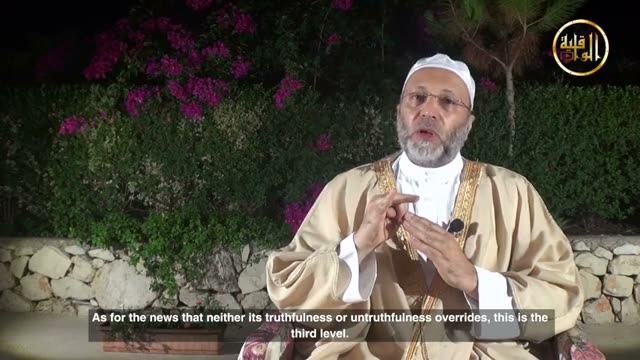
There are three cases where a report’s truthfulness does not outweigh its falsehood: we hear reports whose authenticity or falsity cannot be determined; this is the third category. As for the fourth category, it consists of reports that our preponderant probability deems false—that is, incorrect. The fifth category is a report we know with certainty to be false.
These are the categories of reports: a report whose truthfulness is certain; a report whose truthfulness is probable by preponderant probability; or where neither its truth nor falsity prevails. The fourth type is one where we judge it more likely to be false than true, or incorrect rather than correct. The fifth category is an outright false report—certainly so.
Let us provide examples for each of these five categories: What constitutes a report whose truthfulness is certain? A certain truthful report is either the Speech of Allah, may He be exalted—the words of Allah to His Messenger. If someone hears directly from Allah, the Exalted, as He addresses His angels or prophets, then if that speech comes from Allah, it is a certain report. Similarly, if such news also comes from the Prophet (saw), it remains a certain report; for if a person hears directly from the Prophet (saw), what they heard is certainly true and authentic—beyond any doubt. If a Companion of the Companions hears speech from the Prophet (saw) that originates from Allah, the Exalted, through revelation, then this constitutes certainty in their creed, belief, and iman.
However, these two categories do not apply to any human being today: no one speaks directly with Allah the Exalted today, for revelation has ended and was exclusive to His messengers. No one today can converse privately with the Prophet (saw), since his presence among people concluded upon his death.
The Mass-Transmitted Report
One remaining category of reports provides certainty in their truthfulness: the mass-transmitted report. What do we mean by a mass-transmitted report? It is not transmitted through one person, two people, or even three individuals who know each other and could rationally conspire to fabricate lies. Rather, it is news passed down from group to group among whom collusion in deception is impossible.
Let us illustrate this with an example: suppose we are seated in a gathering when a man arrives and says, ‘I saw such-and-such place burning.’ We would say that this is a report from an individual who may be truthful or lying. If our trust in him is strong, the preponderant probability leans toward his truthfulness—though it remains uncertain. If another person then comes forward, unknown to the first, and we are certain they did not conspire to lie, our confidence in this report increases further. Should a third, fourth, and fifth person arrive—a group all testifying to the same event—and we have absolute certainty that none could collude in deception, such a report becomes one of certainty, provided each independently witnessed it rather than relaying it from another. If they all confirm having seen and heard what they narrate—each conveying their own direct perception—then the transmission is independent: they saw for themselves and reported accordingly, making collusion impossible. This is what constitutes mass-transmitted report (khabar al-mutawatir), which begets certainty and eliminates doubt entirely.
For instance, consider hearing news: we turn to a particular channel and find that one news agency has directly quoted the president of a major state saying ‘such-and-such.’ Another agency, with its own correspondent, reports the same statement, followed by a third agency relaying it further. These agencies cannot collude in falsehood because they are inherently competitive; thus, we do not say this report is merely probable or doubtful. Instead, we affirm: ‘The report has been mass-transmitted from multiple reliable sources regarding the president of a great state—someone who could not lie without immediate exposure.’ Therefore, such an explicit statement constitutes certain mass-transmitted knowledge. This mass-transmitted report serves as a definitive transmitted proof—the highest category of reports.
The Solitary Report (Khabar al-Ahad)
The lowest rank in the hierarchy of transmitted reports is that which has not attained the level of mass-transmitted evidence (khabar al-mutawatir), but instead relies on transmission from a single individual deemed trustworthy. If you know someone who is truthful—never having been accused of falsehood—and whose motives for lying are absent, or even more so if it is impossible or highly unlikely that he would lie in this matter (since his deception could be exposed), then when such a person informs me of something and I trust him, I conclude: ‘This report carries preponderant probability of truthfulness, though not absolute certainty.’ This is known as the solitary report (khabar al-ahad): a narration whose truthfulness is more probable than falsehood because it comes to us through a trustworthy individual. Such a person possesses two defining qualities: sincerity—an aspect of piety—and precision in transmission, meaning he does not confuse or forget what he conveys. As long as someone attests to his reliability by confirming that he is just (adl), precise (dabt) and free from errors in narration, then this report is considered authentic by preponderant probability—even though it does not reach the level of certainty. For human beings are susceptible to error at any time during transmission, and occasionally prone to falsehood—whether out of goodwill or personal inclination, under coercion, for material gain, or due to desire.
The Remaining Categories of Reports and Their Rulings
The second rank of reports is as described above. As for the third category, it consists of a report whose truthfulness or falsehood cannot be established—such as when an unknown individual conveys news: we have no knowledge of his honesty or dishonesty, nor do we know whether he accurately transmits information without confusion. This is the report of the unknown—whether unknown by name or by character. Such a report does not carry preponderant probability of truthfulness, though it also does not carry preponderant probability of falsehood; thus, by nature, it is disregarded in matters of creed and Shari’ah. The report that carries preponderant probability of being false comes from someone known to be a liar—not trustworthy or upright, or notorious for confusing transmissions. Such reports are not accepted as evidence in religious or legal matters. As for the report whose falsehood is certain, it is one for which another proof establishes its invalidity: if, for example, someone informs me that a person died five days ago while I had been with him shortly before, then this report is certainly false to me. Similarly, any report contradicting observable reality—or conflicting with an absolutely certain and truthful report—is also invalid and rejected. If a solitary report (khabar al-ahad) conflicts with a certain report, the former is discarded while the latter stands.
These are the categories of reports transmitted to people and received by them. There are five types in total, three of which Islam rejects: 1. A report whose falsehood is inherently certain—this is rejected both naturally and by Shari’ah law. 2. A report where preponderant probability suggests its falsity—this too is rejected under Shari’ah law and cannot be accepted. 3. A report in which neither truth nor falsehood prevails—this is also rejected by Shari’ah law, since we are obligated to verify reports before accepting them. Thus remain two valid paths: 1. The path of mass-transmitted reports (khabar al-mutawatir), whose authenticity can be established with certainty. 2. The path of solitary reports (khabar al-ahad) transmitted through a chain of trustworthy narrators, each relying on another, until reaching the original source. For example, if Bukhari narrated from one of the successors to the Successors (Tabi’i Tabi’in), who in turn narrated from a Successor (Tabi’un), and that person subsequently narrated from a Companion—with this entire chain consisting of upright, trustworthy individuals—and provided neither the text nor the chain contained any flaw that would undermine its authenticity, then such a report would be considered authentic by preponderant probability. These two categories—the certain mass-transmitted report and the solitary report whose truth prevails by preponderant probability—are the only ones accepted under Shari’ah law.
Creed Is Built Only on Certainty
Yet in matters of creed—in that domain where we are commanded to believe and upon which entry into Islam depends—it is absolutely impermissible for evidence to be merely probable. When Allah commands us to affirm belief in Him, His angels, His books, His messengers, the Last Day, and al-Qadar—both its good and evil from Allah—it cannot be that the proof for these foundational beliefs of Islam rests on mere conjecture. Instead, such evidence must be certain: certainty meaning that the transmitted evidence has reached us through mass-transmitted reports (khabar al-mutawatir).
The Mass Transmission of the Qur’an
This is also how the Qur’an stands, and likewise for what has reached us by mass-transmitted transmission from the Sunnah of the Messenger of Allah (saw).
The Noble Qur’an—which encompasses the fundamental tenets upon which a person’s entry into Islam depends—was transmitted to us entirely through mass-transmitted transmission. The transmission of the Qur’an to us, neither in its verses nor in any single word thereof, has ever depended on one individual alone. The Prophet (saw) would receive revelation of the Qur’an and recite it to his Companions, who memorised it during his lifetime; hundreds—indeed thousands—of Companions committed it to memory. Every verse, every group of verses, even entire chapters were preserved through mass-transmitted transmission from the time of the Messenger (saw). This was then passed down generation after generation, also by mass-transmitted transmission. From the time of the Prophet (saw), vast numbers of Companions memorised the Book of Allah Almighty. Not every one may have memorised it in full, but the entire Qur’an was preserved through mass-transmitted transmission within their hearts—fragmented, meaning some memorised parts while others memorised different parts. Thus, the Qur’an has been transmitted to us by mass-transmitted transmission from that generation onward, from the time of the Prophet (saw) until today. Consequently, we have known no other Qur’an than the one agreed upon by the community for hundreds of years. The Qur’an in our possession—the mushaf before us—is the very same Qur’an and mushaf that Muslims have recited and memorised since the time of the Prophet (saw) until today.
It is known that the Prophet (saw) did not confine himself to reciting the Qur’an solely to his Companions, may Allah be pleased with them. Rather, he commanded its writing: whenever revelation descended upon him, he would summon the scribes of revelation and instruct them to record it, so they wrote it down. That which was written from the time of the Messenger (saw) remains exactly as it is—letter by letter, word for word—down to this very day in our possession. Muslims do not recognise multiple Qur’ans; nor are believers aware of two versions or differing narrations of the Qur’an. Rather, variations exist only in the readings of a single Mushaf because, as he (saw) said: «أنزل علي القرآن على سبعة أحرف، أوحي إلي القرآن بسبعة أحرف» — ‘The Qur’an was revealed to me in seven ahruf’ [Sahih al-Bukhari 4991]. These seven letters refer to the dialects of the Arabs; thus, different readings emerged for one Mushaf without any multiplicity of Qur’ans among Muslims. They have always possessed a single Mushaf, known throughout history as their only version.
There have been persistent and numerous attempts—ongoing even today—to publish altered versions of the Qur’an. Yet whenever any such corruption is printed or disseminated, Muslim children uncover it, correct it, and point out that it contradicts the text of Allah’s Book. From east to west, across all ages, no other version of Allah’s Book has ever been found except this very text before us. The Qur’an was transmitted to us through mass transmission (tawatur). Since the time of the Messenger (saw), successive generations have passed it down in a widespread manner that makes it impossible to doubt that it is not what he recited by revelation. This is the nature of the Qur’an; since it is a book transmitted by tawatur, we are certain that what we hold today is exactly what the Messenger (saw) recited and dictated to the scribes of revelation. Thus, this constitutes decisive evidence that the transmitted proofs in Allah’s Book before us are beyond doubt. What we recite from the Mushaf is indeed the very Speech of Allah; it is truth and certainty without any room for uncertainty. When angels are mentioned, or previous scriptures and prophets, or the Day of Judgement—along with all else, such as jinn, devils, accounts of the Hereafter, Paradise, Hellfire, reckoning, the origin of creation, and the stories of past prophets—all this is certainty that admits no doubt. Whoever doubts any verse in Allah’s Book disbelieves in it and cannot be considered a believer. This applies to the entire Qur’an.
The Mass-Transmitted Hadeeth and the Solitary Report
As for what has reached us from the tradition of the Prophet (saw), it falls within one of the four categories I mentioned earlier. The reports transmitted to us concerning the Messenger (saw) are either conveyed through a sound chain—meaning narration by a just, reliable narrator about another such person, continuing from the lowest link in the chain up to those connected by truthful, just and reliable narrators—free from any defect that would cast doubt on its authenticity. If a tradition belongs to this category, then there is preponderant probability that it is correct.
However, we possess traditions transmitted to us concerning the Prophet (saw) through mass-transmitted reports—these are certain in their authenticity and truthfulness, just as the Qur’an is certain. For example: the five obligatory prayers—the Fajr, Dhuhr, Asr, Maghrib and Isha’ prayers—were conveyed to us. These prayers have been transmitted from the time of the Prophet (saw) until today through practical mass-transmission that admits no doubt. Since the time of the Prophet (saw), Muslims in their thousands performed these five daily prayers behind him; those thousands then passed them on to subsequent generations, who likewise conveyed them further. Thus, this report has been continuously transmitted from that era to the present—there is no doubt about it. Similarly, the number of rak’ahs in each prayer is beyond any doubt: Fajr consists of two rak’ahs; Dhuhr and Asr consist of four rak’ahs each; Maghrib consists of three rak’ahs; and Isha’ consists of four rak’ahs. These details have been transmitted with certainty since the time of the Prophet (saw), just as the five prayers themselves were conveyed through mass-transmission.
Similarly, traditions have been narrated from the Prophet (saw) through mass-transmitted chains that admit no doubt at all—such as his saying: «من كذب علي متعمداً فليتبوأ مقعده من النار» — ‘Whoever deliberately lies about me, let him take his seat in the Fire’ [Sahih al-Bukhari 1291]. These Hadeeths transmitted to us via mass transmission are definitive, leaving no room for uncertainty. Whoever recognises and perceives that they constitute mass-transmitted reports, conveyed sequentially as a definite account from the Prophet (saw), must believe in their contents. For belief in them is part of one’s belief in the Messenger (saw). Your belief in the Prophet (saw) as a messenger sent by Allah necessitates that you accept every word he spoke. If such words reach us from the Prophet (saw) through a definitive path—that is, via mass-transmission—then believing in them is part of one’s belief in the Prophet (saw). To reject them is to deny his Prophethood or his truthfulness. This, naturally, constitutes disbelief in the Prophethood of the Messenger (saw).
Whatever reached us from the Messenger of Allah (saw) through mass-transmitted transmission is certain—meaning it attains the rank of firm belief. As for what comes to us regarding the Messenger of Allah (saw) via solitary reports, provided they meet the conditions for authenticity even if only by preponderant probability—that which we term authentic hadith or sound report—we also have so-called good narrations. Both categories fall under that which strongly suggests truthfulness. If such matters are free from contradiction and agreed upon by transmitters and scholars of hadeeth terminology as authentic, even if only by preponderant probability, then a Muslim must accept them as true. However, they do not reach the level of certainty for him; thus, they are neither classified as belief nor called or categorised as creed. Whoever denies such reports commits sin but is not an unbeliever, since disbelief requires rejecting what has been definitively transmitted from Allah or His Messenger (saw).
Thus, noble brothers, we have addressed and answered the question that may arise before those carrying the da’wah to Islam: when it is established beyond doubt that the Qur’an is the Speech of Allah, and that the Mushaf in our hands is exactly what was recited by the Messenger of Allah (saw)—exactly as revealed to him—then this Mushaf and its verses become conclusive evidence for everything stated within it, except where the verse’s indication is speculative. We affirm with certainty that a verse is the Speech of Allah. However, if a verse admits multiple meanings, then here the meaning becomes speculative, and it cannot be said that one must attain certainty or belief in any particular interpretation.
Similarly, when a report reaches us by mass-transmitted transmission from the Messenger of Allah (saw), it constitutes certain evidence and falls within the sphere of belief regarding its content—for we are certain that this is the speech of the Messenger of Allah (saw). It is impermissible to deny his words. Whoever rejects a mutawatir report concerning the Messenger of Allah (saw) while knowing it to be mutawatir has deliberately disbelieved in him; this is one form of disbelief. As for what reaches us from the Messenger of Allah (saw) through solitary reports where there is preponderant probability that they are authentic—these ahad narrations—it is obligatory to accept them. Yet such acceptance does not attain certainty, so it is neither termed creed nor belief. We say: whoever denies them has sinned, but we do not say: whoever denies them disbelieves.
The Meaning of Iman
In summary, noble brothers: when we are commanded to believe in Allah, His angels, His books, His messengers, the Last Day, and al-Qadar—both its good and evil—from Allah, the Exalted, what is this belief that fulfils one’s responsibility before Him and admits its possessor to Paradise? How do we recognise it? I shall not now enter into that dispute which some have exaggerated beyond measure when they debated whether belief consists solely of conviction or whether it also includes declaration and action. In truth, this so-called disagreement is merely verbal, not substantive; it concerns only the application of the term ‘belief’, not its essence. Those who differed on this matter stated: one group said that belief is firm conviction alone, while another said it comprises conviction along with speech and deed. Yet there was no real divergence in meaning or intent—only a difference in how they used the word ‘iman’. All agreed that belief has an essential definition opposite to disbelief: whoever lacks belief is a disbeliever. This very belief determines one’s entry into Islam; without it, one remains outside its fold and thus counts among those who reject truth.
Contrary to what some claim—that deeds are called ‘belief’ or that righteous actions are termed iman—the term iman fundamentally refers to firm conviction (tasdeeq al-jaazim), which is its original meaning. However, in the Book of Allah and the traditions of the Prophet (saw), the word iman is also applied to deeds and speech. In His Book, when speaking of prayer and changing the Qibla, Allah says:
﴿ وَمَا كَانَ ٱللَّهُ لِيُضِيعَ إِيمَـٰنَكُمْ ﴾
‘Allah would never let your iman go to waste’ [2:143].
The commentators agree that here, imanakum refers to your previous prayers towards Jerusalem—Allah will not render them void for you. Thus, the word iman is applied to prayer, meaning it can also refer to righteous deeds. In a hadeeth of the Prophet (saw), he said: «الإيمان بضع وسبعون شعبة، أعلاها الإيمان بالله، أو بضع وستون شعبة كما ورد في بعض الأحاديث، أعلاها الإيمان بالله، وأدناها إماطة الأذى عن الطريق» — ‘Iman comprises seventy-some branches—or sixty-some branches as stated in some narrations—the highest is belief in Allah, and the lowest is removing harm from the road’ [Meaning of Saheeh Muslim 35b]. Removing harm from the path is termed iman. Therefore, the word iman applies both to firm conviction and to righteous deeds.
The fundamental principle is that if we examine the Book of Allah, the Exalted, and the saying of the Messenger of Allah (saw), we find that whenever the term iman appears, it refers to what a believer must affirm in certainty to be considered a believer and thus enter Islam and Paradise. When Allah, the Most High, says in His Noble Book:
﴿ يَـٰٓأَيُّهَا ٱلَّذِينَ ءَامَنُوٓا۟ ءَامِنُوا۟ بِٱللَّهِ وَرَسُولِهِۦ وَٱلْكِتَـٰبِ ٱلَّذِى نَزَّلَ عَلَىٰ رَسُولِهِۦ وَٱلْكِتَـٰبِ ٱلَّذِىٓ أَنزَلَ مِن قَبْلُ ﴾
‘O you who have believed, believe in Allah and His Messenger and the Scripture He has sent down to His Messenger and the Scripture He had already sent down’ [4:136],
and further:
﴿ وَمَن يَكْفُرْ بِٱللَّهِ وَمَلَـٰٓئِكَتِهِۦ وَكُتُبِهِۦ وَرُسُلِهِۦ وَٱلْيَوْمِ ٱلْـَٔاخِرِ فَقَدْ ضَلَّ ضَلَـٰلًۢا بَعِيدًا ﴾
‘And whoever disbelieves in Allah and His angels and His scriptures and His messengers and the Last Day has certainly gone far astray’ [4:136],
we see that iman is placed in direct opposition to kufr. The Qur’an demands that one affirms with resolute conviction what it requires, while its negation constitutes disbelief.
Similarly, there is the Hadeeth of the Messenger of Allah (saw) when Jibreel asked him about Islam and then about iman. When he was asked, ‘Inform me about Islam,’ he replied: «الإسلام أن تشهد أن لا إله إلا الله وأن محمد رسول الله وتقيم الصلاة وتؤتي الزكاة وتصوم رمضان وتحج البيت» — ‘Islam is that you bear witness that there is no deity but Allah and that Muhammad is His Messenger; establish prayer, pay zakah, fast Ramadan, and perform Hajj to the House.’ And when asked about iman, he said: «الإيمان أن تؤمن بالله وملائكته وكتبه ورسله واليوم الآخر وأن تؤمن بالقدر خيره وشره من الله تعالى» — ‘Iman is that you believe in Allah, His angels, His books, His messengers, the Last Day, and al-Qadar—both its good and evil—from Allah, the Most High’ [Sahih Muslim 8a]. We observe that the term iman was originally applied in the Qur’an and the Prophet’s (saw) tradition to what a believer must affirm with absolute certainty so as to enter Islam. Whoever contradicts this iman falls into disbelief—contrary to what is found in Allah’s Book and the Prophet’s (saw) tradition, where iman is also applied metaphorically to deeds.
Thus, the term iman fundamentally refers to firm belief as opposed to disbelief. Whether this usage is a form of metaphor or shared meaning is not the concern here; what matters now is that there exists an iman which admits its possessor into Islam and Paradise, while failing in any part of it classifies a person as a disbeliever condemned to Hellfire. What, then, is this iman that the believer must possess and embody to be a true believer whose responsibility before Allah, the Most High, is discharged? Iman itself precedes righteous deeds; indeed, iman necessitates good works. We shall address this matter shortly.
When Allah, exalted be He, says: «Indeed those who believe and do righteous deeds», here belief refers to what it is incumbent upon a human being to affirm in order to enter Islam and become a believing Muslim. The actions that Allah, exalted be He, commands—accepted by Him only after belief—and which belief itself ordains, for belief brings forth action. As al-Hasan al-Basri, may Allah have mercy upon him, expressed it: «Belief is what settles in the heart and whose truthfulness deeds confirm». What is this belief? This belief that stands opposite disbelief—it admits its possessor into Islam so they become a believing Muslim. It is the very belief that Allah, exalted be He, has commanded. The Messenger of Allah (saw) said: «الإيمان أن تؤمن بالله وملائكته وكتبه ورسله واليوم الآخر وأن تؤمن بالقدر خيره وشره من الله تعالى» — ‘Iman is that you believe in Allah, His angels, His books, His messengers, the Last Day, and al-Qadar—both its good and evil—from Allah, the Most High’ [Sahih Muslim 8a]. This is what appears in many verses of the Book of Allah, exalted be He, including:
﴿ ءَامَنَ ٱلرَّسُولُ بِمَآ أُنزِلَ إِلَيْهِ مِن رَّبِّهِۦ وَٱلْمُؤْمِنُونَ ۚ كُلٌّ ءَامَنَ بِٱللَّهِ وَمَلَـٰٓئِكَتِهِۦ وَكُتُبِهِۦ وَرُسُلِهِۦ لَا نُفَرِّقُ بَيْنَ أَحَدٍ مِّن رُّسُلِهِۦ ۚ وَقَالُوا۟ سَمِعْنَا وَأَطَعْنَا ۖ غُفْرَانَكَ رَبَّنَا وَإِلَيْكَ ٱلْمَصِيرُ ﴾
‘The Messenger believes in what has been sent down to him from his Lord, as do the believers. Each believes in Allah, His angels, His Books, and His messengers. We make no distinction between any of His messengers. They say: We hear and obey. Grant us Your forgiveness, our Lord. To You is the final return’ [2:285]
The Conditions of Iman
What conditions must be met for belief to qualify a person as a believer? The following are required: what one believes in must be an unequivocal, resolute affirmation that aligns with reality and is supported by evidence. Therefore, the first condition regarding what a believer affirms is that his belief must be an unequivocal, resolute affirmation—here, ‘affirmation’ contrasts with denial and rejection (kufr), not mere knowledge: one may know the truth and be certain of it, yet deny or reject it. Consequently, such a person cannot be called a believer nor even someone who affirms. Allah, exalted is He, states regarding those who disbelieved:
﴿ وَجَحَدُوا۟ بِهَا وَٱسْتَيْقَنَتْهَآ أَنفُسُهُمْ ﴾
‘They denied it while their own souls were fully convinced of its truth.’ [27:14]
This is knowledge they possess regarding matters of belief—knowledge that reaches certainty (yaqeen)—yet they deny it, meaning they lied about it and did not affirm it. Belief, therefore, is affirmation (acknowledgement), not mere knowledge.
So then, belief is simply affirmation—no, it must be firm affirmation. Why do we add ‘firm’ here? Because it would not suffice for one’s acceptance of what Allah, the Exalted, has commanded us to believe in to rest merely on preponderant probability (ghalbat al-zann). If someone were to say: ‘It is more probable than not that Allah is True,’ or another said: ‘It is more probable than not that Muhammad (saw) is the Messenger of Allah and that the Qur’an is the Speech of Allah,’ we would tell them this does not constitute belief. The verse states:
﴿ ذَٰلِكَ ٱلْكِتَـٰبُ لَا رَيْبَ ۛ فِيهِ ﴾
‘That is the Book in which there is no doubt.’ [2:2]
And:
﴿ أَفِى ٱللَّهِ شَكٌّ فَاطِرِ ٱلسَّمَـٰوَٰتِ وَٱلْأَرْضِ ﴾
‘Is there any uncertainty about Allah, the Creator of the heavens and earth?’ [14:10]
Belief is certainty (yaqeen). Therefore, one must be certain that Allah is True; certain that Muhammad (saw) is His Messenger; certain that the Qur’an is the Speech of Allah; certain that angels are true; certain that Paradise is true; certain that Hellfire is true. One must also be certain that Allah, the Exalted, sent messengers and revealed scriptures. Whoever lacks this certainty does not possess belief. Thus, belief is firm affirmation—nothing less. In contrast, Allah, the Exalted, has condemned mere conjecture (zann), condemning those who adopt their religion and creed based on it alone. He says:
﴿ إِن يَتَّبِعُونَ إِلَّا ٱلظَّنَّ وَمَا تَهْوَى ٱلْأَنفُسُ ﴾
‘They follow not but conjecture, what the souls desire.’ [53:23]
And:
﴿ إِن يَتَّبِعُونَ إِلَّا ٱلظَّنَّ ۖ وَإِنَّ ٱلظَّنَّ لَا يُغْنِى مِنَ ٱلْحَقِّ شَيْـًٔا ﴾
‘They follow not but conjecture, and indeed conjecture avails nothing against the truth.’ [53:28]
Allah, exalted be He, has commanded in matters of creed, in matters of belief (iman), at the very foundation of religion: that a person must possess conclusive evidence. Allah, the Most High, said:
﴿ قُلْ هَاتُوا۟ بُرْهَـٰنَكُمْ إِن كُنتُمْ صَـٰدِقِينَ ﴾
‘Say: “Bring your proof if you are truthful”’ [2:111; 27:64].
There is consensus that burhan refers to conclusive evidence. Allah also said:
﴿ قُلْ هَلْ عِندَكُم مِّنْ عِلْمٍ فَتُخْرِجُوهُ لَنَآ ﴾
‘Say: “Do you have any knowledge of it that you can produce for us?”’ [6:148].
Here, ilm denotes certain, absolute knowledge. He further stated:
﴿ فَأْتُونَا بِسُلْطَـٰنٍ مُّبِينٍ ﴾
‘Then bring us a clear authority for it’ [14:10].
Scholars agree that sulthan is conclusive evidence. Thus, when we say belief (iman) entails firm conviction (tasdeeq jazim), this excludes from the realm of belief anything resembling mere probability or doubt. It is not valid for a person to claim: «I believe in Allah, I believe in the Qur’an, and I believe in the Prophet (saw)», while harbouring any degree of uncertainty. This does not constitute true belief; it may amount only to probable acceptance based on preponderant probability (ghalbat al-zann), but it is neither belief nor acceptable to Allah, exalted be He. Certainty (yaqeen) is therefore indispensable.
Therefore, this is a decisive affirmation that aligns with reality—meaning it is not mere belief in the sense of passive acceptance, where one might imagine that which they believe has no existence at all. Some people assume Allah, exalted be He, is merely a noble concept, and suppose humans should believe in Him—but may Allah protect us from such thinking! Allah is an absolute reality. Similarly, when someone says belief in angels means believing in a good idea rather than real creatures—this is incorrect. Angels are indeed real beings. My belief is in what exists in reality: I affirm that the Hereafter will truly come to pass and exist, that Paradise will genuinely be there, and Hellfire too will truly exist. I believe in something that has actual existence now or will exist at some future time—the Day of Judgement is an undeniable reality that will occur. Thus, my belief corresponds with reality; it does not contradict what exists but rather finds confirmation from reality itself.
Belief is a resolute conviction that corresponds with reality and is based on evidence. I have previously presented the relevant proofs; thus, it is impermissible for a believer to hold belief in something for which they possess no evidence. The claim that a believer may accept matters solely through inner feeling, or what is called mystical unveiling (kashf), or an inner impulse—or any such thing—does not constitute belief. Allah, exalted be He, has said:
﴿ قُلْ هَاتُوا۟ بُرْهَـٰنَكُمْ إِن كُنتُمْ صَـٰدِقِينَ ﴾
‘Say, “Bring forth your proof if you are truthful”’ [2:111; 27:64];
﴿ فَأْتُونَا بِسُلْطَـٰنٍ مُّبِينٍ ﴾
‘Then bring us clear authority’ [14:10];
﴿ قُلْ هَلْ عِندَكُم مِّنْ عِلْمٍ فَتُخْرِجُوهُ لَنَآ ﴾
‘Say, “Do you have knowledge? Then produce it for us”.’ [6:148]
For this reason, when Allah sent His messengers, He did not leave the matter to people’s trust in those prophets alone. He did not allow them simply to say: ‘Muhammad (peace be upon him) is The Truthful and Trustworthy; that man of good character whom we have never known to lie or display any trait of deficiency.’ Instead, He supported His Messenger with a conclusive proof that he was indeed the Messenger of Allah, Exalted in Might. All messengers were supported by signs from Him—signs which we call miracles—that rendered people incapable of fabricating lies against them. Naturally, these signs prevented people from denying the truthfulness of Muhammad (peace be upon him) in sincerity; instead, they denied, lied, and became arrogant out of their own pride. However, those signs that Allah sent with His Messenger were decisive evidence that this prophet was indeed a messenger from Allah, Exalted is He.
Therefore, there must be evidence for the creed in which a person believes. We have already presented this evidence: it may either be rational proof or transmitted evidence. The conclusive rational proof establishes that Allah is true, because reason perceives and confirms that matter—the substance of the universe, humanity, and life—is limited and thus created. Reason also conclusively affirms that the Qur’an is the Speech of Allah, since no human being could have produced such a book. Consequently, by rational evidence it is established that the Qur’an is indeed the Speech of Allah and that Muhammad (saw) is His Messenger. Once one has believed that the Qur’an is the Speech of Allah, they then believe in conclusive transmitted proofs—meaning belief based on transmitted evidence supported by a definitive rational proof. The rational argument proving that the Qur’an is the Speech of Allah thereby confirms that its transmitted basis consists of truthful and certain words. Every verse in the Book of Allah whose meaning was definitive served as conclusive evidence for the reports it conveyed, particularly regarding matters essential to entering Islam.
This is the belief by which a person enters Islam. Therefore, one cannot be considered a believer unless they hold a firm conviction that corresponds with reality and is based on evidence. This is how such belief must be. But if it were a non-firm conviction, or if it were … or if one were certain that what one believes is true and real, or if one had no evidence—that is, if one believed without evidence, through imitation and inheritance—then this would not be valid before Allah, the Exalted.
The Effect of Iman on Actions
This belief, when firmly established within a person’s heart, creates a spiritual connection with Allah, the Exalted. Through this connection, one perceives their relationship with Him: that they are His creation and His servant, glory be to Him. This bond is forged through the revelation sent upon the Messenger of Allah (peace and blessings be upon him), which has reached us today in its entirety. Allah, the Exalted, has commanded what is right, forbidden what is wrong, promised Paradise for those who obey, and warned of Hellfire for those who disobey. Such belief cannot take root in this way without compelling the Muslim to perform righteous deeds and restraining them from disobeying Allah, the Exalted.
Allah Most High says:
﴿ فَلَا وَرَبِّكَ لَا يُؤْمِنُونَ حَتَّىٰ يُحَكِّمُوكَ فِيمَا شَجَرَ بَيْنَهُمْ ثُمَّ لَا يَجِدُوا۟ فِىٓ أَنفُسِهِمْ حَرَجًا مِّمَّا قَضَيْتَ وَيُسَلِّمُوا۟ تَسْلِيمًا ﴾
‘By your Lord, they will not have belief until they submit to your judgement in all that has divided them, then find no hesitation within themselves regarding what you decree and surrender completely.’ [4:65]
And the Messenger of Allah (saw) said: «لا يؤمن أحدكم حتى يكون هواه تبعًا لما جئت به» — ‘None of you truly believes until his inclinations follow what I have brought’ [Al-Nawawi’s Forty Hadeeths 41; its chain is disputed] This belief is the very foundation upon which righteous conduct is built, guiding a person in all his actions to follow Allah’s commands and prohibitions.
Insha’Allah, we shall elaborate on this in our next session—by Allah’s leave—which will conclude our topic ‘The Way to Belief’, dear brothers. I ask Allah the Exalted that He grant me success in clarifying what we intended in this session regarding the meaning of belief, its evidence, and distinguishing between rational evidence and transmitted evidence, as well as defining and explaining belief. I pray to Allah the Exalted that He increase us in knowledge, benefit us with what He has taught us, and make our knowledge and deeds sincere for Your Noble Face alone. May peace be upon our Master Muhammad, his family, companions, and all who followed his guidance with excellence until the Day of Judgment.
Questions and Discussion
I now turn to the questions raised during this session: Brother Al-Abid asks how one reconciles the types of transmitted evidence I mentioned with the concept of belief, and what causes their differences. The types of transmitted evidence I referred to are those concerning the nature of things as they exist in real life—this is something upon which people agree. Dividing reports in this manner is a division adopted by all rational individuals, not one exclusive to Muslims.
However, we Muslims possess a unique advantage: the ability to distinguish between a trustworthy person and one who is not. For us, a trustworthy narrator is upright and accurate in transmission. Everyone can distinguish an accurate transmitter from an inaccurate one, whether they are Muslim or non-Muslim. Yet our distinct quality lies in this: we can identify the truly upright person—the pious, sincere individual who knows he fulfils Allah’s commands and is not among those who openly commit sin or persistently disobey. Such a person is just—a trustworthy individual known for his religion, the soundness of his religious commitment, his honesty, and his integrity. This is what sets us Muslims apart; consequently, certain principles are incorporated into our framework that others cannot adopt.
All humanity recognises that reports fall into five categories. Every thinker acknowledges that a report reaching them may either be: 1) certain truth, 2) certain falsehood, or 3) somewhere between the two. Thus, one may stand before a report in perplexity, unable to distinguish its veracity; they may sense it is more probable than not that it is true; or they may sense it is more probable than not that it is false. These are five levels of reports as they existed prior to Islam’s revelation. It was not Islam that established these categories—this reflects reality and the inherent nature of all things and reports. What Islam introduced was the obligation to verify reports thoroughly. Islam established that belief must be certain; consequently, its evidence must be certain and definitive. Hence we concluded that transmitted evidence regarding creedal matters must be mass-transmitted (mutawatir), for non-mass-transmitted evidence does not attain the level of certainty (yaqeen). This is what Islam commanded when Allah Most High said:
﴿ قُلْ هَاتُوا۟ بُرْهَـٰنَكُمْ إِن كُنتُمْ صَـٰدِقِينَ ﴾
‘Say: “Bring your proof if you are truthful”’ [2:111; 27:64].
We stated that belief cannot be founded upon evidence that only establishes preponderant probability.
As for a report deemed true by preponderant probability, evidence has been presented in the Speech of Allah and in the Sunnah of His Messenger (saw) that it must be accepted—even if it does not attain certainty or conviction. It must be accepted as true, albeit without firm certainty, and it may not be rejected because it was conveyed by preponderant probability from the Messenger of Allah (saw). The most critical point in this matter is that one must act upon whatever commands and prohibitions are found within it—that is, the detailed evidence for Shari’ah legal rulings. Islamic jurisprudence is not entirely founded on conclusive evidence. Rather, it rests upon: 1) Conclusive proofs transmitted in the Speech of Allah and the mass-transmitted Sunnah of His Messenger (saw), 2) Probabilistic evidence from the Speech of Allah—including verses whose indications are probabilistic—and 3) Hadeeths of His Messenger (saw) transmitted through solitary reports.
The classification of reports was not something introduced by Islam. What Islam did introduce was determining which of these reports may be accepted and which must be rejected. Islam has excluded three types of report from acceptance: the report whose falsehood is definitively established, the report where preponderant probability indicates its falsity, and the report in which neither truth nor falsehood can be determined—where we cannot establish whether it is true or false. Islam rejects these categories entirely but commands the acceptance of mass-transmitted reports, establishing them as part of creed. It also mandates acceptance of solitary reports transmitted through a chain of upright, trustworthy narrators, requiring belief in their contents and acting upon what they contain. Whoever rejects these—meaning whoever claims not to accept solitary reports or derive rulings from them—has discarded a substantial portion of Allah’s Shari’ah. Such a person has altered it, meaning he has carelessly cast aside a major part of the religion of Allah, of His Shari’ah. It is impermissible to say that we are not commanded to accept solitary reports; rather, they must be acted upon and believed in their contents without reaching the degree of certainty—that is, the level of conviction or belief.
Conclusion
My honourable brothers, let us suffice with this much. We ask Allah, the Exalted, that He grant us the ability to act upon what we have known, taught, and learned from His religion—may He accept it from us and from you all. With hope of meeting you again in the next session after a week, I entrust to Allah, the Exalted, your religion, what you have been entrusted with, and the last of your deeds. May peace and Allah’s mercy be upon you.