Introduction and Summary of The Way to Belief
Peace, Allah’s mercy and His blessings be upon you. In the name of Allah. All praise is due to Allah, and peace and blessings be upon the Messenger of Allah, his family, his Companions and those who follow him.
Honoured brothers, welcome to the final halaqa in the series of halaqaat in which we have discussed ‘The Way to Belief’ over the preceding eight halaqaat. We proceeded through a sequence of intellectual steps, one after another, examining human thought and human nature. In doing so, we established man’s need for a creed: the universal idea about the universe, man and life. We also established the intellectual principles man must adopt in order to reach this universal idea. We began by proving the existence of the Creator, exalted is He, and discussed what is connected to belief in the Creator. We then discussed how belief in the Creator entails sensing the need for a message from Him, exalted is He—the need for messengers. After that, we proved that Muhammad (saw) is the Messenger of Allah by proving that the Qur’an is the speech of Allah.
Once it had been established for us that Allah is true, that the Qur’an is the speech of Allah, that Muhammad (saw) is the Messenger of Allah, and that we have before us a Book from Allah ﷻ that completes the universal idea through transmitted evidence—that is, through what Allah and the Messenger of Allah have said about what lies beyond the universe, man and life, about what came before this worldly life and what comes after it, and about its relationship to what came before and what comes after—the whole picture was completed through the iman that Allah ﷻ commanded in His Noble Book: iman in Allah, His angels, His Books, His messengers, the Last Day and al-Qadar.
This creed is the universal idea about the universe, man and life. It is the solution to man’s biggest knot. Whoever has iman in Allah as Lord, in the Qur’an as a Book from Him and in Muhammad (saw) as a Messenger from Him finds the doors to solving the biggest knot opened before him. The origin and ultimate destination of his existence, and the meaning of his existence in this life, become clear to him.
Here, the door is opened wide before this believer so that he may know how to live in this life, which system he must follow and which foundation he must build his entire life upon: all his conduct and all his culture. In this way, this creed truly becomes the ideology from which he proceeds in his life.
Before we proceed, let us listen together to the final section of ‘The Way to Belief’.
The Preamble of The System of Islam
Once man has reached this solution, he can move to the thought about the worldly life and to establish sound and productive concepts about it. This solution becomes the foundation upon which the ideology, which serves as the way of revival (Nahdah), is built. It is also the foundation upon which the civilisation (HaDaarah) of this ideology rests, the foundation from which its systems emanate, and the foundation upon which its state is established. Thus, the foundation upon which Islam is established, as an Idea (fikrah) and Method (Tareeqah), is the Islamic ‘Aqeedah. Allah ﷻ says:
﴿ يَـٰٓأَيُّهَا ٱلَّذِينَ ءَامَنُوٓا۟ ءَامِنُوا۟ بِٱللَّهِ وَرَسُولِهِۦ وَٱلْكِتَـٰبِ ٱلَّذِى نَزَّلَ عَلَىٰ رَسُولِهِۦ وَٱلْكِتَـٰبِ ٱلَّذِىٓ أَنزَلَ مِن قَبْلُ ۚ وَمَن يَكْفُرْ بِٱللَّهِ وَمَلَـٰٓئِكَتِهِۦ وَكُتُبِهِۦ وَرُسُلِهِۦ وَٱلْيَوْمِ ٱلْـَٔاخِرِ فَقَدْ ضَلَّ ضَلَـٰلًۢا بَعِيدًا ﴾
“O you who believe! Believe in Allah and His Messenger, and the Book which He sent to His Messenger and the Book which He sent to those before (him). Anyone who denies Allah, His Angels, His Books, His Messengers, and the Day of Judgement, has gone far, far astray.” [4:136]
After this has been proven and the `iman in it is an inevitable matter, every Muslim is obliged to believe in the Islamic shariah as a whole, because its brought by the Noble Qur’an, and by the Messenger (saw), otherwise, he would be a Kafir.
Therefore, it is Kufr to deny the AHkaam Sharee’ah (Shariah legal rulings) as a whole, or any definite (qaT’ai) detailed Hukm of them. This is the case whether these aHkaam (rulings) are connected with worships (ibaadaat), transactions (mu’aamalaat), punishments or foodstuff. So the rejection of the verse,
﴿ وَأَقِيمُوا۟ ٱلصَّلَوٰةَ ﴾
“So establish regular prayer” [2:43],
is the same as rejecting the verse of,
﴿ وَأَحَلَّ ٱللَّهُ ٱلْبَيْعَ وَحَرَّمَ ٱلرِّبَوٰا۟ ﴾
“But Allah has permitted trade and forbidden usury,” [2:275].
And is the same as rejecting the following verses:
﴿ وَٱلسَّارِقُ وَٱلسَّارِقَةُ فَٱقْطَعُوٓا۟ أَيْدِيَهُمَا ﴾
“As to the thief, male or female, cut off his or her hands,” [5:38]
﴿ حُرِّمَتْ عَلَيْكُمُ ٱلْمَيْتَةُ وَٱلدَّمُ وَلَحْمُ ٱلْخِنزِيرِ وَمَآ أُهِلَّ لِغَيْرِ ٱللَّهِ بِهِۦ ﴾
“Forbidden to you (for food) are dead meat, blood, the flesh of swine, and that on which has been invoked the name of any other than Allah.” [5:3].
`Iman in the Sharee’ah is not dependent on the mind. Instead, one must surrender completely to all that which was revealed from Allah ﷻ.
﴿ فَلَا وَرَبِّكَ لَا يُؤْمِنُونَ حَتَّىٰ يُحَكِّمُوكَ فِيمَا شَجَرَ بَيْنَهُمْ ثُمَّ لَا يَجِدُوا۟ فِىٓ أَنفُسِهِمْ حَرَجًا مِّمَّا قَضَيْتَ وَيُسَلِّمُوا۟ تَسْلِيمًا ﴾
“But no, by your Lord, they can have no (real) faith, until they make you judge in all the disputes between them, and find in their souls no resistance against your decisions, but accept them with the fullest submission.” [4:65]
The Islamic Creed as the Foundation of the Believer’s Life
Peace and Allah’s mercy be upon you once again, my honoured brothers. My brothers, one of the great qualities of the Islamic creed—one that distinguishes it from all other religions of a spiritual, priestly or conventionally emotional character—is that it accepts nothing less than being the foundation of man’s life. It is the basis of his thinking, his culture and his conduct, and therefore the basis upon which his entire life is established.
﴿ قُلْ إِنَّ صَلَاتِى وَنُسُكِى وَمَحْيَاىَ وَمَمَاتِى لِلَّهِ رَبِّ ٱلْعَـٰلَمِينَ ﴾
‘Say: Indeed, my prayer, my sacrifice, my living and my dying are for Allah, Lord of all worlds’ [6:162]
The Islamic creed completely imprints the believer’s life with its character.
The Creed as Intellectual Leadership and Intellectual Basis
Let us recall together how we began our subject in the first halaqa, when we said: Man revives according to the thought he holds about the universe, man and life. We explained in detail that man rises when his thought is elevated and declines when his thought is low. When the thought he carries is a sound, well-formed thought, it leads him to true revival and, consequently, to happiness and peace of mind. At the time, we also said that for this thought to bring about revival, it must be based on a universal idea about the universe, man and life.
Once we reached the conclusion that the correct idea about the universe, man and life is the Islamic creed—which solves man’s biggest knot correctly—we understood that this creed is what revives man. It is his intellectual leadership.
Since man is led in this life by his concepts, and since all these concepts are produced by or built upon this creed, the believer is therefore led through life by the creed. It is his intellectual leadership in life.
It is also his intellectual basis, meaning that he builds all his thoughts upon it. He does not accept any thought that cannot be built upon this creed. For him, the Islamic creed is the criterion for all thoughts: a thought is accepted if it can be built upon the Islamic creed, and it is rejected if it cannot be built upon this creed and therefore conflicts with it.
This creed is the believer’s ideology, for it is the first thought from which all his ideas originate. Thus, this creed forms the foundation upon which the entire life of the believer is built.
The Fruit of Iman: Commitment to the Shari’ah
How is this put into practice? It is put into practice by making all the believer’s conduct subject to the Shari’ah that emanates from this creed. The believer undertakes no action except on the basis of what Allah ﷻ has commanded and prohibited. What the Shari’ah brings is man’s guide in this life: it guides him, directs him and governs his actions.
﴿ فَلَا وَرَبِّكَ لَا يُؤْمِنُونَ حَتَّىٰ يُحَكِّمُوكَ فِيمَا شَجَرَ بَيْنَهُمْ ثُمَّ لَا يَجِدُوا۟ فِىٓ أَنفُسِهِمْ حَرَجًۭا مِّمَّا قَضَيْتَ وَيُسَلِّمُوا۟ تَسْلِيمًۭا ﴾
‘But no, by your Lord, they can have no real belief until they make you judge in all the disputes between them, find in themselves no resistance against your decisions, and accept them with the fullest submission’ [4:65]
The believer’s adherence in all his actions to Allah’s commands and prohibitions—that is, to Allah’s Shari’ah and to the system Allah ﷻ has legislated for man—means directing all his actions according to this Shari’ah. This is the fruit of iman. It makes him live in the manner Allah ﷻ has approved for him, which befits him and leads to his elevation in this world and to his salvation, happiness and everlasting bliss on the Day of Resurrection.
The Comprehensive Scope of Shari’ah over All Human Actions
Many people who have not properly understood Islam may ask: Did the Shari’ah come to provide a ruling for every action of the servants? Has this Islamic Message given the believer—who has iman in the Islamic creed, in Allah as Lord, in Muhammad (saw) as Prophet, in the Qur’an as a Book, and in all the other elements of the Islamic creed stated in the Qur’an—a Shari’ah containing rulings for every action of the servants, so that he may direct all his actions according to Allah’s commands and prohibitions? Yes. Allah ﷻ says:
﴿ وَنَزَّلْنَا عَلَيْكَ ٱلْكِتَـٰبَ تِبْيَـٰنًۭا لِّكُلِّ شَىْءٍۢ ﴾
‘And We have sent down to you the Book as an explanation of everything’ [16:89].
Allah also says:
﴿ ٱلْيَوْمَ أَكْمَلْتُ لَكُمْ دِينَكُمْ وَأَتْمَمْتُ عَلَيْكُمْ نِعْمَتِى وَرَضِيتُ لَكُمُ ٱلْإِسْلَـٰمَ دِينًۭا ﴾
‘Today I have perfected your deen for you, completed My favour upon you, and approved Islam as your deen’ [5:3].
What is the Islamic Shari’ah? It is Allah’s Shari’ah, which cannot be compared with any earthly legislation or with the legislation of those who devise laws. It contains a Shari’ah ruling for every action of the servants, so none of our actions is without a Shari’ah ruling. All our actions fall within Shari’ah’s five legal categories: mubah, wajib, mandub, haram and makruh. Every action of the servants is therefore either mubah on the basis of Shari’ah evidence, wajib on the basis of Shari’ah evidence, mandub on the basis of Shari’ah evidence, haram on the basis of Shari’ah evidence, or makruh on the basis of Shari’ah evidence.
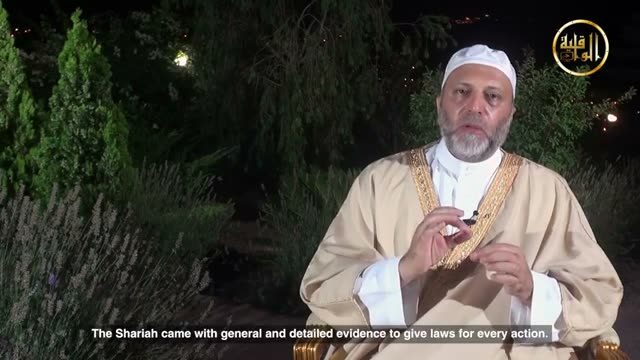
The Islamic Shari’ah has brought general, comprehensive and detailed evidence that provides rulings for all the actions of the servants. The scholars of Islam agree that no action of the servants is without a Shari’ah ruling.
Revelation as the Source of the Shari’ah Ruling
For this ruling to be a Shari’ah ruling, its source must be revelation: the Book of Allah, the Sunnah of His Prophet (saw) and that to which they direct. A ruling is not a Shari’ah ruling that the believer follows—and through which he therefore obeys Allah’s command—unless it is derived, taken, obtained and deduced from the texts of revelation and that to which they direct, namely Allah’s Book and the Sunnah of His Prophet (saw). The Muslim therefore directs all his actions according to Allah’s commands and prohibitions; that is, according to the revelation sent down to Muhammad (saw).
The Connection to Allah in All Actions
This is not possible for anyone other than the believer. In this way, the believer remains constantly connected to Allah ﷻ, whether he is praying, worshipping and devoting himself, conducting commercial relations with people, dealing with family and marital relations, or observing manners and morals. He is constantly connected to Allah ﷻ. Why? Because as long as he directs his actions—even material actions—according to Allah’s commands and prohibitions, on the basis of his awareness of his connection with Allah and his iman in Allah ﷻ as Creator, Regulator, Guide and Legislator, he remains constantly connected to Allah ﷻ.
When he eats and enjoys food, he thanks Allah ﷻ for granting him this blessing and makes sure that his food is halal. In this way, he combines that material action with the spirit—that is, with the connection to Allah ﷻ. He senses the spiritual aspect, and his relationship with Allah ﷻ remains continuous.
The believer therefore adheres to Allah’s Shari’ah out of intellectual conviction and a strong emotional drive: the drive of iman that connects him to Allah ﷻ as his Creator and the One who bestows blessings upon him, and as the One who will hold him accountable on the Day of Resurrection, after which he will go either to Paradise or to the Fire.
This is unique to Islamic law; a person adheres to it out of spiritual impulse rather than awaiting an authority to enforce compliance, as is the case with other legal systems.
The Shari’ah Is Revelation, Not a Product of Reason
What we must strongly emphasise here is that Allah’s Shari’ah is a revealed Shari’ah. It is the product of transmitted evidence; it is the product of revelation, not of reason. It is therefore not valid for the Muslim to make his reason the judge over the Shari’ah, as many people do today. You tell him, ‘This is halal, this is haram, or this is wajib.’ He replies, ‘Convince me.’ You ask him, ‘How should I convince you?’ He replies, ‘Convince me through reason.’ If this person is a Muslim, he has in fact failed to understand the true nature of the Islamic mentality, how thinking takes place in Islam, and what it means for the Shari’ah to come from Allah ﷻ.
When you have iman in Allah ﷻ as Lord, Creator and Regulator, then He is the One who guides you in this life, legislates for you and makes the halal and haram known to you. In that case, you do not give your reason the right to legislate, and therefore do not give it the right to dispute the legislation. Allah’s Shari’ah is not open to discussion or dispute.
You are entitled to ask for the evidence for a Shari’ah ruling and to verify that the ruling you hear has indeed been derived from the Book of Allah and the Sunnah of His Messenger (saw). However, you have no right to judge this Shari’ah ruling by your own mind and say: ‘If I am convinced that riba is forbidden, I will observe the prohibition. But if I am not convinced that it is forbidden, I will not observe it.’
What is the source of conviction regarding Shari’ah rulings? The source of this conviction is knowing that such a ruling originates from Allah, exalted be He. If Shari’ah evidence demonstrates that something is forbidden, obligatory, permissible, disliked or recommended—if it clearly establishes these matters—then that alone suffices to convince you of the necessity of adhering to them:
﴿ وَمَا كَانَ لِمُؤْمِنٍۢ وَلَا مُؤْمِنَةٍ إِذَا قَضَى ٱللَّهُ وَرَسُولُهُۥٓ أَمْرًا أَن يَكُونَ لَهُمُ ٱلْخِيَرَةُ مِنْ أَمْرِهِمْ ﴾
‘It is not for a believing man or woman—when Allah and His Messenger decree a matter—to have any choice in that matter’ [33:36]
Refuting the Separation of Islam from the Shari’ah
Indeed, what many people today boast about—that the Shari’ah is a human endeavour and product; that we are not obliged to adhere to it but only to follow Islam—is false. They draw distinctions between Islam and the Shari’ah, presenting numerous weak excuses and fallacious arguments for this division. These individuals have failed to grasp the true nature of Islam… In truth, many among them are fabricating against Allah’s religion, working to separate Muslims from their Shari’ah.
Someone may say: ‘The Shari’ah is merely the law of the jurists,’ claiming it is a human construct, with jurists prone to error. Therefore, this Shari’ah—accumulated or produced over centuries by them—is simply the product of their own times. We, however, are not bound by what they have produced in our era; instead, we must adhere to Islam’s principles and objectives, determining which legislation suits our time. In truth, this view may amount to disbelief in Allah’s religion, exalted is He. Why? Because one who rejects the Shari’ah as a whole or negates its binding nature—claiming it unnecessary to follow or be constrained by it—has effectively denied what Allah, exalted is He, commanded believers: that they adhere to this Shari’ah.
﴿ ثُمَّ جَعَلْنَـٰكَ عَلَىٰ شَرِيعَةٍۢ مِّنَ ٱلْأَمْرِ فَٱتَّبِعْهَا وَلَا تَتَّبِعْ أَهْوَآءَ ٱلَّذِينَ لَا يَعْلَمُونَ ﴾
‘Then We put you upon a Shari’ah concerning the matter, so follow it and do not follow the desires of those who do not know’ [45:18]
﴿ ثُمَّ جَعَلْنَـٰكَ عَلَىٰ شَرِيعَةٍۢ مِّنَ ٱلْأَمْرِ فَٱتَّبِعْهَا وَلَا تَتَّبِعْ أَهْوَآءَ ٱلَّذِينَ لَا يَعْلَمُونَ ﴾
‘Then We put you upon a Shari’ah concerning the matter, so follow it and do not follow the desires of those who do not know’ [45:18]
Allah’s command must be obeyed, and His prohibition must also be obeyed. Whoever calls for liberation from the Shari’ah—on the false premise that it is a human creation—has committed disbelief in Allah’s legislation as revealed in His Book and the Sunnah of His Prophet (peace and blessings upon him).
Denial of Definitive Rulings
Likewise, whoever denies a specific ruling among the definitive Shari’ah rulings has committed kufr.
Whoever claims that the prohibition of riba is no longer valid for our time, that we are no longer required to observe the prohibition of riba today, and that dealing in riba has become necessary—thereby setting aside Allah’s Shari’ah in this matter—has committed kufr against Allah’s Book. Its verses are definitive in authenticity and definitive in indication that riba is haram.
Likewise, denying the obligation to cut off the thief’s hand, denying the obligation to stone the adulterer, or denying the flogging of the male and female fornicator stipulated in Allah’s Book is kufr. The same applies to denying the obligation of salah, fasting, Hajj or zakah.
There is no distinction between these rulings being in worships or transactions—whether financial, political, social, familial, marital, and so on.
All of these are part of Allah’s Shari’ah. Whoever denies a definitive ruling among the rulings Allah ﷻ legislated in His Book has committed kufr against Allah’s Book.
Allah’s Book was not revealed merely as a field of knowledge, for people to seek enlightenment from some of its contents, or to benefit from it as a book of wisdom and admonition. No.
The Book of Allah, glorified and exalted is He, and the Sunnah of His Prophet (saw) contain guidance, commands, prohibitions and choices from Allah. Decisive commands must be obeyed, while acting upon non-decisive commands is recommended. The believer must refrain from what is decisively prohibited, while an act covered by a non-decisive prohibition is disliked. Where Allah, glorified and exalted is He, has given a choice between doing and refraining, the believer may either act or refrain.
Iman Requires Action
This, then, is the fruit of iman in the Islamic creed: unless the Islamic creed produces adherence to Allah’s commands and abstention from what Allah ﷻ has prohibited, the iman in this case is not genuine iman. There is some defect; some area has been struck or shaken … or has not … or is deficient in the believer, or in the person who declares that he is a believer.
Iman requires action:
﴿ وَٱلْعَصْرِ ﴾
‘By time’ [103:1]
﴿ إِنَّ ٱلْإِنسَـٰنَ لَفِى خُسْرٍ ﴾
‘Indeed, man is in loss’ [103:2]
﴿ إِلَّا ٱلَّذِينَ ءَامَنُوا۟ وَعَمِلُوا۟ ٱلصَّـٰلِحَـٰتِ ﴾
‘Except those who believe and do righteous deeds’ [103:3]
Whoever claims to have iman yet does no good deeds is among the losers mentioned in Surah Al-Asr:
﴿ وَٱلْعَصْرِ ﴾
‘By time’ [103:1],
﴿ إِنَّ ٱلْإِنسَـٰنَ لَفِى خُسْرٍ ﴾
‘Indeed, man is in loss’ [103:2].
The principle is that man is a loser. Imagine him in this life without creed, without iman, without Shari’ah—he is certainly lost before death; he has suffered loss.
We all know that life consists of a fixed span of days. Whenever a day passes, man loses one day. He is like someone who has a sum of money and spends from it: every time he spends, he loses some of it, because the time will come when that sum is exhausted. He is a loser.
Who is not a loser? It is the person who has prepared for what comes after this life, who has prepared and invested the capital he possesses in the form of the days of this worldly life. What is this preparation?
Iman alone? No. Iman is not genuine iman unless it produces Islamic conduct: conduct that adheres to Allah’s Shari’ah. So who are those who have left the category of losers and escaped the multitude who are in loss?
﴿ وَٱلْعَصْرِ ﴾
‘By time’ [103:1]
﴿ إِنَّ ٱلْإِنسَـٰنَ لَفِى خُسْرٍ ﴾
‘Indeed, man is in loss’ [103:2]
﴿ إِلَّا ٱلَّذِينَ ءَامَنُوا۟ وَعَمِلُوا۟ ٱلصَّـٰلِحَـٰتِ ﴾
‘Except those who believe and do righteous deeds’ [103:3].
Iman without righteous deeds is not genuine iman.
A believer may make a mistake and disobey. Adam (peace be upon him) disobeyed, then repented, and Allah accepted his repentance. The Messenger (saw) said: ‘Every son of Adam commits sins, and the best of those who commit sins are those who repent’ [Jamiʿ at-Tirmidhi 2499; Sunan Ibn Majah 4251]. In His Noble Book, Allah praised those who seek forgiveness and repent:
﴿ إِنَّ ٱللَّهَ يُحِبُّ ٱلتَّوَّٰبِينَ وَيُحِبُّ ٱلْمُتَطَهِّرِينَ ﴾
‘Indeed, Allah loves those who constantly repent and loves those who purify themselves’ [2:222]
The errors a believer may commit are what we call shortcomings in conduct. It is natural for a believer to have shortcomings in his conduct: he is not an angel and is capable of being wrong or right.
But can someone live his life while claiming to be a believer, yet live detached from Allah’s commands and prohibitions? Can he fail to make the Islamic Shari’ah, halal and haram the criterion for his actions? Or can he claim that he may have iman in Allah ﷻ and direct worships and rituals to Him, then turn in this worldly life to man-made laws and live according to them? Such a person has not understood the reality of iman, has not comprehended the reality of iman, and is not among those saved from loss:
﴿ وَٱلْعَصْرِ إِنَّ ٱلْإِنسَـٰنَ لَفِى خُسْرٍ ﴾
‘By time. Indeed, man is in loss’ [103:1–2]
﴿ إِلَّا ٱلَّذِينَ ءَامَنُوا۟ وَعَمِلُوا۟ ٱلصَّـٰلِحَـٰتِ ﴾
‘Except those who believe and do righteous deeds’ [103:3].
Counselling One Another to Truth and Patience
The surah does not stop there. Some of the Sahaba, and many of the Tabi‘un and the followers of the Tabi‘un, said about it: ‘Had nothing from the Qur’an been revealed except this surah, it would have sufficed,’ because it is a surah that brings together the meanings of Islam.
﴿ إِلَّا ٱلَّذِينَ ءَامَنُوا۟ وَعَمِلُوا۟ ٱلصَّـٰلِحَـٰتِ وَتَوَاصَوْا۟ بِٱلْحَقِّ ﴾
‘Except those who believe, do righteous deeds and counsel one another to the truth’ [103:3]
Naturally, exhorting one another to truth is part of righteous deeds—it is itself an act of goodness. Yet Allah’s wisdom required that the surah specify this further by adding:
﴿ وَتَوَاصَوْا۟ بِٱلْحَقِّ ﴾
‘And counsel one another to the truth’ [103:3].
Counselling one another to the truth means that people command one another, that the believers command one another, that they enjoin what is right upon one another and mutually forbid what is wrong. Why?
For it is not permissible for a believer to remain content with being merely a believer himself, adhering only to Allah’s commands and prohibitions in isolation. Rather, he bears the responsibility of conveying this trust to all people: by carrying belief to those who are not yet believers, and by enjoining what is right and forbidding what is wrong—both among believers and non-believers.
And
﴿ وَتَوَاصَوْا۟ بِٱلصَّبْرِ ﴾
‘And counsel one another to patience’ [103:3]:
that they counsel one another to remain patient in obeying Allah ﷻ. This iman is the iman that produces Islamic conduct governed by the Shari’ah. It adheres to all of Allah’s commands and prohibitions, so the believer directs his entire life according to Allah’s commands and prohibitions.
The Creed as the Basis of Society, Civilisation and the State
If society is raised upon this concept, Islamic life will come into existence in an Islamic society. The Islamic creed will then be the foundation of the Islamic society, the foundation of Islamic life and the foundation of Islamic civilisation.
Civilisation is a way of life, and a way of life results from a set of concepts about life. The set of concepts about life to which the Muslim society adheres is the set of concepts built upon or emanating from the Islamic creed. The Islamic creed is therefore the foundation of the Islamic society, the foundation of Islamic life and the foundation of Islamic civilisation.
It is the foundation of the Islamic state. This statement naturally confronts the secular creed that schemers seek to entrench in our lands by claiming and promoting that the state may not be founded upon a creed. Rather, all of life must be founded upon the Islamic creed. Establishing Islamic life upon the Islamic creed is not complete unless the state—which applies the systems in society and manages the people’s affairs through them—is itself founded upon the Islamic creed.
The da’wah of the Messenger of Allah (saw) was based on the Islamic creed, and his state was then established on the basis of the Islamic creed. Under this Islamic state, Islamic life came into existence for a Muslim society—an Islamic society founded upon the Islamic creed—and a new, emerging civilisation founded upon the Islamic creed spread throughout the world. It was the greatest civilisation in history and in existence.
This is what the Islamic creed entails; this is what iman entails. Iman entails an Islamic personality founded upon the Islamic creed, which thinks according to the Islamic way and acts and lives according to the Islamic way. It entails an Islamic society whose relationships are founded upon the thoughts, emotions and systems of Islam produced by the Islamic creed. And it entails an Islamic state that rules by what Allah has revealed: by the Shari’ah that emanates from the Islamic creed.
The Islamic creed came, Islam came, the Message of Islam came and the ideology of Islam came in order to establish upon this earth a way of life that contradicts every way of life human beings have invented and devised, through which they have strayed from Allah’s guidance and from the way of life that befits them.
We ask Allah, glorified and exalted is He, to bring to life within us the fruits and meanings of iman, and to enable us to live in accordance with what iman requires. Iman has no meaning unless it produces Islamic conduct and an Islamic life. Praise be to Allah, Lord of all worlds.
Questions and Discussion
I will now move with you to the questions that have been received, if any questions came in during the broadcast.
Scholars’ Differences over Shari’ah Legal Rulings
A question from The Path of Honour: Peace, mercy and blessings be upon you. We love you in Allah’s cause, our teacher Ahmad Al-Qassas—may Allah honour you and reward you with all good—and we pray that He preserves you and opens for you the path of truth. Your question: How do we understand the disagreement among scholars—may Allah have mercy on them—in Shari’ah rulings? One says it is permissible, another forbidden, a third obligatory, yet another disliked, and so forth. May Allah bless you; may He honour you.
Of course, your question is indeed a matter we should discuss. However, I did not address it today because special sessions on the topic of Shari’ah rulings and their evidence will follow. This does not prevent us from answering your question now.
Why do the scholars differ? To begin, let us establish a fundamental principle: the Islamic Shari’ah contains definitive Shari’ah rulings that are not a matter of disagreement among the scholars. No one may claim that the scholars differ over the obligation of salah or over the number of obligatory rak‘ahs in the five prayers. No one may claim that there is disagreement over the obligation of fasting, zakah or Hajj, the prohibition of theft, the obligation to cut off the thief’s hand, or the obligation to flog the male and female fornicator, and so on. There are definitive rulings over which the jurists do not differ.
What is a definitive Shari’ah ruling? It is a Shari’ah ruling obtained and derived from evidence that is definitive in authenticity and definitive in indication. The entire Qur’an is definitive in authenticity. Among the hadiths, some are definitive in authenticity and others are speculative in authenticity. When the evidence is definitive in both authenticity and indication and admits no more than one meaning regarding the ruling, the resulting Shari’ah rulings are definitive and not subject to disagreement. Whoever knowingly and consciously contradicts them has denied the speech of Allah and thereby committed kufr. There is no room to claim disagreement over these definitive rulings. Yet in our time, some who introduce bid‘ah say: ‘For us, the whole Shari’ah consists of changing matters and contains nothing fixed.’ This is clear misguidance.
The other category within the Islamic Shari’ah consists of Shari’ah rulings deduced from speculative evidence, whether the evidence is speculative in authenticity, speculative in indication, or speculative in both authenticity and indication. These are the Shari’ah rulings over which mujtahids and jurists differ and which are subject to ijtihad. What is the position regarding them?
The fact that these rulings are not definitive must not become a pretext for freeing oneself from the Shari’ah rulings. The Muslim must adhere to the Shari’ah rulings in all his actions. He adheres to whatever is definitive without discussion and without investigating which opinion is more appropriate, because there are not two opinions in the first place.
As for Shari’ah rulings that are speculative and subject to ijtihad, if a mujtahid derives them directly from the Book and the Sunnah—meaning that he possesses the capacity for ijtihad—he must adhere to what he considers correct on the basis of preponderant probability. Ijtihad means exerting one’s utmost effort to reach a Shari’ah ruling by deriving it from its detailed evidence. The mujtahid must therefore adhere to the conclusion reached through his ijtihad, for that conclusion is Allah’s ruling for him. There are exceptional cases which we will discuss in their proper place, if Allah, glorified and exalted is He, wills.
As for someone who lacks the capacity for ijtihad, this likewise may not become a means of freeing himself from the Shari’ah rulings. Rather, he must ask the people of knowledge. You may say: ‘The people of knowledge differ on this matter.’ He should then ask someone he trusts or someone from whom it is possible for him to learn. Thus, people used to ask the Sahaba of the Messenger of Allah (saw). Some acted according to the opinion of one Sahabi, while others acted according to the opinion of another. This continued in the age of the Tabi‘un, then the followers of the Tabi‘un, and throughout the eras of Islam. Mujtahids perform ijtihad concerning Shari’ah rulings and adhere to what they reach on the basis of preponderant probability, while others take from these mujtahids because they themselves lack the capacity for ijtihad. This is called taqlid. The highest rank of taqlid is to take a ruling from a mujtahid together with its evidence, while nevertheless remaining a muqallid. If he is classified as a muttabi‘, he takes the Shari’ah ruling from a person whose derivation of it he knows. Allah says:
﴿ فَسْـَٔلُوٓا۟ أَهْلَ ٱلذِّكْرِ إِن كُنتُمْ لَا تَعْلَمُونَ ﴾
‘Ask the people of remembrance if you do not know’ [16:43; 21:7].
This is a matter of consensus among the jurists.
The believer may not free himself from a Shari’ah ruling that he has adopted for his life. If he adopts a ruling from a mujtahid, it becomes Allah’s ruling for him. He may therefore not leave it for another ijtihad except in accordance with Shari’ah conditions that we will discuss at the appropriate time, if Allah, glorified and exalted is He, wills.
However, in every case, all the rulings that the mujtahids derive through ijtihad are Shari’ah rulings. Thus, the opinion of al-Shafi‘i is a Shari’ah ruling, and Abu Hanifah’s differing opinion is also a Shari’ah ruling.
Of course, one of them is correct. The Prophet (saw) therefore said: «Whoever performs ijtihad and errs … Whoever performs ijtihad and reaches the correct ruling receives two rewards, while whoever performs ijtihad and errs receives one reward» [Sahih al-Bukhari 7352; Sahih Muslim 1716a]. Both are rewarded: one receives one reward because he erred, while the other receives two because he reached the correct ruling.
Yet neither of them can state with certainty that his view is correct. A well-known statement attributed to Imam al-Shafi‘i and others is: ‘My opinion is correct but may be wrong.’ This concerns matters of ijtihad: My opinion is correct but may be wrong, while another person’s opinion is wrong but may be correct.
Therefore, a Muslim may not reproach another Muslim for following an ijtihad or taqlid different from his own. This is the position regarding the disagreement of the mujtahids: they did not disagree over legislating rulings, but over understanding what Allah, glorified and exalted is He, intended by what He said in the Qur’an or the Sunnah. Legislators differ in their starting points, their foundations and their legislation because they are legislators. Jurists and mujtahids, however, are not legislators. A mujtahid performs ijtihad to understand Allah’s intent. He investigates what Allah, glorified and exalted is He, intended by this verse and what the Prophet (saw) intended by that hadith, so that he may reach what he considers, on the basis of preponderant probability, to be Allah’s Shari’ah ruling on this question or that event.
The Islamic Mentality and Islamic Disposition
The question from Sister Maryam Badr, after studying ‘The Way to Belief’: Is it natural to see an Islamic personality with an Islamic disposition but without an Islamic mentality? And is the reverse possible? Or is a personality only Islamic when its disposition and mentality are of the same kind as the ideology?
Of course, this is based on the questioner’s knowledge that the Islamic personality consists of an Islamic mentality and an Islamic disposition. Briefly, by the Islamic mentality we mean the Islamic way of thinking: the believer thinks in the manner brought by Islam, adopts the creed in the manner laid down by Islam, and adopts the Shari’ah ruling in the manner laid down by Islam, which we have just discussed. The disposition, meanwhile, is manifested in man’s conduct. If his mentality is Islamic, it is natural for his disposition to be Islamic, meaning that he acts in life so that his conduct is consistent with his mentality, which produced his Islamic culture. A person whose mentality is Islamic but whose disposition is not Islamic cannot be classified as having an Islamic personality. This is not an Islamic personality.
Of course, this Way to Belief leads the believer to iman in the correct manner. It produces Islamic conduct in accordance with Islam’s concepts and rulings. This is what produces a sound Islamic personality.
The Difference Between Evidence for the Creed and Evidence for a Legal Ruling
Brother Abu Qusay: Peace be upon you. And peace, Allah’s mercy and His blessings be upon you. Since Shari’ah rulings are commands and prohibitions from Allah ﷻ, why is a distinction made between the evidence for a Shari’ah ruling and the evidence for the creed? May Allah bless you, dear brother. Why is this distinction made?
Quite simply, the evidence for Shari’ah rulings can only be transmitted evidence. It is not valid for reason to be the judge over Shari’ah rulings. One may not say that the evidence that riba is haram is that reason shows it harms the economy. Nor may one say that the evidence for the obligation of fasting is that reason shows it benefits health and makes the wealthy sympathise with the poor, and so on. Nor may one say that alcohol is haram by reason because it causes the loss of reason and corruption among people, or that zina is haram by reason because it leads to such and such. The evidence for every Shari’ah ruling is: Allah said, and the Messenger of Allah said.
As for the creed, its evidence may be divided between rational proof and transmitted evidence, as we discussed previously. When the subject of an element of the Islamic creed is perceptible, its proof is rational. The proof of the Creator’s existence is rational because the mind senses the created things, which by their nature point to the Creator ﷻ. Created things and the effects of creation are perceptible. The same applies to iman that the Qur’an is the speech of Allah: the Qur’an is perceptible to us, and by examining and thinking about it we conclude that it is the speech of Allah ﷻ. Consequently, iman in the prophethood of Muhammad (saw) is based on rational inference, because once it is established that the Qur’an is the speech of Allah, it is established that Muhammad is the Messenger of Allah. Thus, the evidence for one part of the Islamic creed is rational, while the evidence for the other part is transmitted.
This resembles the inference used for Shari’ah rulings, with one difference: the creed—and here, by creed, we mean the foundation of the creed, without adopting which a person is not a Muslim and denying which constitutes kufr against Islam—must have definitive evidence. Iman in Allah may not be speculative, nor may iman in the Qur’an be definitive, nor may iman in the prophethood of Muhammad (saw) be speculative. Iman must be … iman in Allah, the Qur’an, Muhammad (saw), the Hereafter and the angels may not be speculative. Iman must be definitive and decisive, based on definitive evidence.
As for reports in the Sunnah of the Prophet (saw) concerning unseen matters that have come through speculative reports—that is, solitary reports—the believer must affirm and acknowledge them, without their reaching the level of certainty, because their evidence is not definitive. Whoever denies them is sinful but has not committed kufr. The evidence for the creed must be definitive. Whatever is speculative is not part of the creed, even though affirming it is obligatory.
As for Shari’ah rulings, they are not all required to be definitive. A Shari’ah ruling indicated by definitive evidence is definitive, while a ruling whose evidence is speculative is a speculative Shari’ah ruling. It is obligatory to act upon speculative Shari’ah rulings, as indicated by Shari’ah evidence. Allah willing, we will also discuss this in detail, in stages, in forthcoming halaqaat—in forthcoming halaqaat. This is the distinction between the evidence for the creed and the evidence for legislation.
The Islamic Creed Is a Political Creed
Sister Aisha al-Za’atari: Peace be upon you. And upon you be peace, and Allah’s mercy and blessings. How does Hizb ut-Tahrir present the subject of The Way to Belief as a political subject rather than as a purely creedal and intellectual one?
The issue is not that we present the Islamic creed in one way or another. What is its nature? What is its reality? The Islamic creed is based on rational evidence. It is a definitive thought and consists of definitive concepts. That is one aspect. By its very nature, it also connects man to his Creator, glorified and exalted is He, and is therefore founded on iman in Allah, the Almighty. The starting point for iman in the Islamic creed is thus iman in Allah, glorified and exalted is He. It is therefore a spiritual creed. Then comes the question: why is it a political creed? It is not Hizb ut-Tahrir that views the Islamic creed politically, nor is it a matter of Hizb ut-Tahrir choosing to do so. The point is that the Islamic creed is, by its very nature, a political creed.
What does it mean to say that the Islamic creed is inherently a political creed? A creed that merely links humanity to their Creator—whether correctly or incorrectly—and does not intervene in worldly affairs, societal formation, regulation of human relations, or legislation for society would be purely spiritual and not political. However, when a creed serves as the foundation for comprehensive legislation governing life—particularly political legislation that establishes a society, regulates people’s relationships, and forms a system for life, society, and state—then by its very nature it is a political creed.
Indeed, part of the mission for which the prophets were sent was to be political leaders. The Messenger of Allah (saw) said: «Banu Isra’il were governed by the prophets.» The word tasusuhum is derived from siyasah: sasa, yasusu, sawsan or siyasatan. Thus, the prophets’ work was politics, based on the creed they brought and the Shari’ah revealed to them.
Some of them reached the point of establishing both a society and a state for Islam because people had iman in them and followed them. Legislation was then revealed to them, which they had to observe and by which they established a life in accordance with the legislation of Allah, glorified and exalted is He. Examples are our masters Dawud (as) and Sulayman (as), who were kings ruling people by what Allah had revealed, within a state that implemented Allah’s Shari’ah.
The final example of this is the Messenger of Allah (saw), who established an Islamic state thirteen years after the beginning of his mission. We return to the hadith: «Banu Isra’il were governed by the prophets»—meaning that the prophets took charge of their politics and cared for their affairs. Whenever a prophet died, another prophet succeeded him. In other words, the prophets followed one another in caring for the people’s affairs. «There is no prophet after me. Banu Isra’il were governed by the prophets. Whenever a prophet died, another prophet succeeded him. There is no prophet after me, but there will be caliphs, and they will be many.»
After the death of the Prophet (saw), therefore, care for the people’s affairs passed to the caliphs whom the people choose and give bay’ah. By what do the caliphs care for the people’s affairs after the Prophet (saw)? By the Shari’ah of Allah, the Almighty. «There will be caliphs, and they will be many.» They asked: «What do you command us?» He replied: «Fulfil the bay’ah to the first and then the next, and give them their rights, for Allah will question them about that with which He entrusted them.» [Sahih al-Bukhari 3455; Sahih Muslim 1842a].
That is, they took charge of caring for the people’s affairs after the Prophet (saw), and Allah, glorified and exalted is He, will question them about this care. On what basis will Allah, the Almighty, question the caliphs? He will question them according to His Shari’ah: according to what they implemented of Allah’s Shari’ah. They will be held accountable for what they did not implement, for what they implemented badly, for wronging people, for acting wrongly, for falling short, and so on.
Thus, when a system emanates from the Islamic creed, establishes a civilisation and an Islamic society, and becomes the system and legislation of the Islamic state that cares for the people’s affairs, this creed is, by its very nature, a political creed. It is carried to people as a political creed that changes their reality, replacing every legislation and way of life other than those brought by Islam.
Politics and Backbiting
A question from Brother Nizar Stitia: How should one respond to those who consider an interest in politics to be less important in the Shari’ah than an interest in acts of worship, on the grounds that, in practice, many political discussions contain backbiting that is prohibited by the Shari’ah, whereas acts of worship bring one closer to Allah?
I think what I said in answer to the previous question also answers this question and all such misconceptions, including the claim that taking an interest in politics or engaging in political discussions involves prohibited backbiting. This claim is entirely baseless. Taking an interest in politics in accordance with the Shari’ah and working to establish the rule of Allah’s Shari’ah do not require people to backbite one another. Discussing thoughts, politics and actions that are visible to people has nothing whatsoever to do with backbiting.
Backbiting means mentioning something true of your Muslim brother that he dislikes. That is, it means mentioning something he has concealed and does not want people to discover. If you mention it, you have backbitten him. Intruding into people’s secrets is not part of politics or political discussion. Entering into people’s secrets is not politics at all.
Politics deals with thoughts, systems, legislation, policies, and the practices of rulers, parties and those concerned with public affairs. This has nothing to do with matters to which the concept of backbiting applies. Such claims are made by the foolish and the simple-minded, who strive and exert themselves to separate Islam from life, society and politics.
Conclusion
I think this is the final question we have received. We ask Allah, glorified and exalted is He, to teach us what benefits us, increase us in knowledge, and make our knowledge and deeds sincere for His Noble Countenance. I ask Allah, glorified and exalted is He, that I have presented the subject of The Way to Belief well in this final episode of the series The Way to Belief. If I have done well, it is from Allah, glorified and exalted is He, and through His guidance. If I have done badly, it is from myself, and I ask Allah, glorified and exalted is He, to forgive every shortcoming. Praise be to Allah, and peace and blessings be upon the Messenger of Allah. Peace be upon you, and Allah’s mercy and blessings.