Introduction
In the name of Allah, the Most Merciful. Peace, mercy and blessings of Allah be upon you. All praise is due to Allah, and may prayers and peace be upon the Messenger of Allah, his family, his Companions and those loyal to him.
Welcome, dear brothers, to a new episode of your programme, Halaqa Online.
Today, we continue discussing the Islamic creed after having covered stages in clarifying the steps of inquiry and reflection necessary to attain it. We then proceeded to establish its proofs and evidence.
We wish today to discuss with you a matter from the Islamic creed that appears frequently in many Qur’anic verses and numerous hadiths of the Prophet (saw).
The best-known of these hadiths concerning belief and its pillars is the statement of the Prophet ﷺ: الإيمان أن تؤمن بالله وملائكته وكتبه ورسوله واليوم الآخر وتؤمن بالقدر خيره وشره — ‘Belief is to believe in Allah, His angels, His Books, His Messenger, the Last Day, and to believe in qadar, its good and its evil’ [Muslim 8a].
Some narrations say: ‘and to believe in qadar.’ Some say: ‘and to believe in qadar, its good and its evil.’ Other narrations say: ‘and to believe in qadar, its good and its evil, from Allah, Exalted is He.’
The Topic of This Session and the Meaning of Qadar
Our topic today is belief in qadar. What is qadar? What does the qadar mean that we are commanded to believe in through this hadith, through other hadiths and, before that, through verses in the Book of Allah, Mighty and Majestic?
This subject has confused many people, and they have imagined meanings for it that it cannot bear. They have confused belief in qadar, as mentioned specifically in this hadith and in similar texts, with other meanings of the expression qadar.
When the Shari’ah commands us to believe in something, does it mean believing in the phrase or word itself—or rather in its meaning? Of course, belief is not about words; what is required is belief in meanings expressed by the Shari’ah through specific terms.
Naturally, the terms of the Qur’an and Sunnah are Arabic words. By nature, Arabic contains words that share meanings—so a single word may carry multiple senses in language—but context clarifies which meaning is intended.
At times, a decisive contextual clue specifies the intended meaning among the possible meanings of that word; at other times, the context is merely probable, rendering either the verse or the hadith one whose indication is uncertain: the verse may have an uncertain indication, or the hadith may do so.
However, Qur’anic verses and hadiths concerning belief in qadar collectively define the intended meaning of the word qadar. In Arabic, the word qadar has several meanings. Indeed, I would not be mistaken to say that it has many meanings.
The Qur’an was revealed in the language of the Arabs
﴿ إِنَّآ أَنزَلْنَـٰهُ قُرْءَٰنًا عَرَبِيًّا ﴾
‘Indeed, We sent it down as an Arabic Qur’an’ [12:2],
and likewise, the Hadith of the Messenger of Allah – may Allah bless him and grant him peace – is in the dialect of Quraysh; thus, the meanings of the Qur’an and the Sunnah are understood according to the nuances of the Arabic language.
The only exception is when evidence indicates new meanings that the Shari’ah has assigned to particular words. These are what we call Shari’ah realities: words to which the Shari’ah has given new legal meanings.
Today, we are considering belief in qadar. What is the intended meaning of the word qadar? When the Prophet ﷺ and the Noble Qur’an command us to believe in qadar, are we required to believe in everything called qadar? Of course not.
Here we are discussing qadar in a particular sense. As we have said, the required belief is not belief in words, but belief in meanings indicated by words. What, then, is the specific intended meaning that we were commanded to believe in when we were commanded to believe in qadar, as in the Messenger of Allah’s ﷺ statement: ‘and to believe in qadar’?
Meanings of Qadar in Language and Shari’ah
Let us begin by looking briefly at some of the meanings that the word qadar has in Arabic. We will do so by reading some verses in which qadar occurs. The expression occurs there with several meanings. We can then determine which of these meanings is intended in the Prophet’s ﷺ statement: ‘And to believe in qadar, its good and its evil.’
Excerpt from The Islamic Personality, Volume 1
Today, I would like to read you some lines from The Islamic Personality, Volume One, by its author, Sheikh Taqi al-Din al-Nabhani, may Allah have mercy on him. Under the topic ‘Al-Qadr’, he says: The word qadar came in the Noble Qur’an in many meanings. Allah says:
﴿ وَكَانَ أَمْرُ ٱللَّهِ قَدَرًا مَّقْدُورًا ﴾
‘And the command of Allah is a decree [qadarā] determined [maqdūrā]’ [33:38].
That is, it is an irrevocable matter or definitive inescapable decree. This is one of the meanings of qadar.
And He says:
﴿ فَقَدَرَ عَلَيْهِ رِزْقَهُۥ ﴾
‘Then straightens [qadara] to him his means of subsistence’ [89:16].
That is, then constricts upon him his means of provision. This is another meaning.
And Allah says:
﴿ فَٱلْتَقَى ٱلْمَآءُ عَلَىٰٓ أَمْرٍ قَدْ قُدِرَ ﴾
‘So the water met and rose to the extent that had been decreed [qudir]’ [54:12].
This concerns the flood in the time of Noah, peace be upon him. That is, it rose to the level Allah had decreed in the Preserved Tablet; that is, He wrote it: the destruction of Noah’s people by the flood.
And Allah says:
﴿ وَقَدَّرَ فِيهَآ أَقْوَٰتَهَا ﴾
‘And He measured [qaddara] its sustenance’ [41:10].
And these villages—that is, He made therein the growing of their inhabitants’ provisions; that is, the attribute of growing the provisions.
And He says:
﴿ إِنَّهُۥ فَكَّرَ وَقَدَّرَ ﴾
‘He thought and he determined [qaddara]’ [74:18].
This passage censures al-Walid ibn al-Mughirah, who began thinking and determining what accusation he would make against the Prophet ﷺ and how he would describe the Qur’an:
﴿ إِنَّهُۥ فَكَّرَ وَقَدَّرَ ﴾
‘He thought and he determined [qaddara]’ [74:18].
That is, he thought about what he would say concerning the Qur’an, determined within himself what he would say and arranged it.
And He, Glorified and Exalted, says:
﴿ ٱلَّذِى خَلَقَ فَسَوَّىٰ وَٱلَّذِى قَدَّرَ فَهَدَىٰ ﴾
‘Who has created and given order and proportion, who has measured [qaddara] and guided’ [87:2–3].
That is, He created everything and proportioned it, determined for every living thing the way to its well-being, guided it to this and made known to it the way to achieve this. That is, He made in every living thing, man and animal, needs requiring satisfaction and guided them to the proper satisfaction of their needs. This is like His saying:
﴿ وَقَدَّرَ فِيهَآ أَقْوَٰتَهَا ﴾
‘And He measured [qaddara] its sustenance’ [41:10].
And He, Glorified, says:
﴿ وَقَدَّرْنَا فِيهَا ٱلسَّيْرَ ﴾
‘And between them We had appointed stages of journey in due proportion’ [34:18].
That is, We made in it easiness in journey and made it safe. This refers to the roads between the villages.
And He, Glorified, says:
﴿ قَدْ جَعَلَ ٱللَّهُ لِكُلِّ شَىْءٍ قَدْرًا ﴾
‘Verily, for all things Allah has appointed a due proportion [qadra]’ [65:3].
That is, a proper proportion and planned timing.
And He says:
﴿ إِنَّا كُلَّ شَىْءٍ خَلَقْنَـٰهُ بِقَدَرٍ ﴾
‘Verily, everything We have created in proportion and measure [qadar]’ [54:49].
That is, with due estimation [taqdīr].
And He says:
﴿ إِلَىٰ قَدَرٍ مَّعْلُومٍ ﴾
‘For a period [qadar] determined’ [77:22].
That is, for a determined time.
And He says:
﴿ نَحْنُ قَدَّرْنَا بَيْنَكُمُ ٱلْمَوْتَ ﴾
‘We have ordained [qadarna] death amongst you’ [56:60].
That is, We made the determination of death amongst you with difference and disparity, so your lives differ in being short, medium and long.
And He, Glorified, says:
﴿ وَمَا نُنَزِّلُهُۥٓ إِلَّا بِقَدَرٍ مَّعْلُومٍ ﴾
‘We only send down thereof in due [qadar] and a known measure’ [15:21].
That is, with known measure.
And He says:
﴿ قَدَّرْنَآ إِنَّهَا لَمِنَ ٱلْغَـٰبِرِينَ ﴾
‘We ascertained [qadarna] that she will be among those who lag behind’ [15:60].
The discussion here concerns Noah’s wife, peace be upon him, who perished with those who perished. That is, Our decree was that she would be of those who lag behind—that is, among those who perished.
And He says:
﴿ ثُمَّ جِئْتَ عَلَىٰ قَدَرٍ يَـٰمُوسَىٰ ﴾
‘Then you did come here at the time ordained, O Musa’ [20:40].
That is, you came at a specific time I set for that coming.
The word qadar came in the Hadith with the meaning of the Knowledge of Allah and His Determination [taqdīr]. It has been narrated from Abu Hurairah that he said: The Messenger of Allah ﷺ said: لا تسأل المرأة طلاق أختها لتستفرغ صحفتها ولتنكح، فإن لها ما قدر لها — ‘A woman should not seek divorce of her sister to terminate her page and in order that she be married instead, for hers is what has been ordained [quddira] for her’ [Abu Dawud 2176; Bukhari 5152]. It was narrated by al-Bukhari and others. That is, that which Allah has ordained in the Preserved Tablet; that is, that which He has decreed and knew of. This is similar in meaning to His saying:
﴿ عَلَىٰٓ أَمْرٍ قَدْ قُدِرَ ﴾
‘To the extent that had been decreed [qudir]’ [54:12].
That is, decreed in the Preserved Tablet.
And Abu Hurairah narrated from the Prophet ﷺ that he said: لا يأتي ابن آدم النذر بشيء لم يكن قد قدرته، ولكن يلقيه القدر وقد قدرته له، أستخرج به من البخيل — ‘The solemn pledge will not bring the son of Adam anything that I had not already decreed [qadartuhu], but the qadar lays it out for him and I had already decreed it for him, by which I extract from the miserly’ [Bukhari 6609]. That is, the solemn pledge does not bring the son of Adam anything that Allah had not already decreed and recorded in the Preserved Tablet—that is, in His Knowledge. Rather, He extracts from the miserly through the solemn pledge. Here, ‘I had decreed it’ means: I had decided it and knew of it.
And the qadar here is the determination [taqdīr] of Allah and His Knowledge. This is one of the meanings…
Qadar: Allah’s Eternal Knowledge and Writing in the Preserved Tablet
Here, I shall not prolong the reading. From these examples we have read from the Book of Allah (exalted is He) and the traditions of His Messenger (saw), it becomes clear that the terms qadar and taqdir—as they appear in the Qur’an—are used in their linguistic sense, since the Qur’an was revealed in the language of the Arabs, as previously stated. They occur with multiple meanings.
Does belief in qadar, then, mean belief in every meaning of qadar? Of course not.
There is a specific meaning that we have been commanded to believe in. This does not mean discarding the other meanings found in the Qur’an. But there is a specific belief that we were commanded to hold in the Messenger of Allah’s ﷺ statement: ‘and to believe in qadar, its good and its evil, from Allah, Exalted is He.’
What, then, is meant here by belief in qadar? By examining the verses and hadiths in which qadar occurs and connecting them to determine the intended meaning, we reach the following conclusion: the qadar intended in the Messenger of Allah’s ﷺ statement, ‘and to believe in qadar, its good and its evil’, is what Allah determined from eternity—that is, what Allah knew from eternity and wrote in the Preserved Tablet.
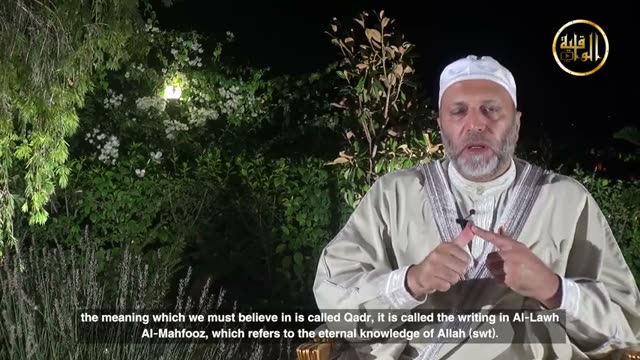
What is required is belief in a meaning indicated by several expressions in the Book of Allah and the Sunnah of His Messenger ﷺ. This meaning, which we must believe in, has been called qadar. It has also been expressed as writing in the Preserved Tablet, what is inscribed in the Preserved Tablet and what was written there. This is an expression of Allah’s eternal knowledge.
Belief in qadar is belief that Allah knew everything before it occurred and has known everything from eternity. Part of the perfection of His attributes is that He knows everything. Allah’s knowledge of a thing does not depend on its occurrence, as though Allah discovered it after it happened. Among the perfect divine attributes of Allah that He has told us about is that He knows everything from eternity.
What He knew from eternity, He wrote in the Preserved Tablet. He created the Pen and said: ‘Write everything that has been and everything that will be’ [paraphrased from Abu Dawud 4700]. Allah therefore wrote in the Preserved Tablet everything He knew. This is the meaning of qadar, or Allah’s determination.
Your belief in qadar is therefore your belief in Allah’s eternal knowledge, which encompasses everything without exception: everything that will occur until the Day of Resurrection and after the Day of Resurrection, and everything He wrote in the Preserved Tablet.
Evidence from the Qur’an and Sunnah for the Meaning of Qadar
Here we will read some of the verses and hadiths that indicate—or whose indications collectively establish—this meaning. Among the verses that… We read some verses indicating this meaning in the lines from The Islamic Personality that we read a moment ago. Here I will specifically read some of the verses and hadiths whose meanings—or rather whose indications—collectively establish the meaning we have mentioned.
Among them is His saying, Exalted is He:
﴿ فَأَنجَيْنَـٰهُ وَأَهْلَهُۥٓ إِلَّا ٱمْرَأَتَهُۥ قَدَّرْنَـٰهَا مِنَ ٱلْغَـٰبِرِينَ ﴾
‘So We saved him and his family, except his wife; We determined that she would be among those who remained behind’ [27:57].
That is, We saved Lot and his family except his wife. We determined that she would be among those who remained behind: We determined from eternity and knew that she would be among those who remained behind—that is, among those who perished with Lot’s people.
In another verse concerning the same story:
﴿ قَالَ فَمَا خَطْبُكُمْ أَيُّهَا ٱلْمُرْسَلُونَ ﴾
‘He said: What is your mission, O messengers?’ [15:57].
These are the words of the Prophet Ibrahim, peace be upon him, to the angels whom Allah sent to destroy Lot’s people. He said, ‘What is your mission, O messengers?’ They said:
﴿ قَالُوٓا۟ إِنَّآ أُرْسِلْنَآ إِلَىٰ قَوْمٍ مُّجْرِمِينَ ﴾
‘They said: We have been sent to a criminal people’ [15:58].
﴿ إِلَّآ ءَالَ لُوطٍ إِنَّا لَمُنَجُّوهُمْ أَجْمَعِينَ ﴾
‘Except the family of Lot; We will certainly save them all’ [15:59].
﴿ إِلَّا ٱمْرَأَتَهُۥ قَدَّرْنَآ إِنَّهَا لَمِنَ ٱلْغَـٰبِرِينَ ﴾
‘Except his wife; We determined that she would be among those who remained behind’ [15:60].
﴿ قَدَّرْنَآ إِنَّهَا لَمِنَ ٱلْغَـٰبِرِينَ ﴾
‘We determined that she would be among those who remained behind’ [15:60].
That is, We knew and wrote from eternity that she would be among those who perished.
Allah, the Exalted, has said:
﴿ مَّا كَانَ عَلَى ٱلنَّبِىِّ مِنْ حَرَجٍ فِيمَا فَرَضَ ٱللَّهُ لَهُۥ سُنَّةَ ٱللَّهِ فِى ٱلَّذِينَ خَلَوْا۟ مِن قَبْلُ وَكَانَ أَمْرُ ٱللَّهِ قَدَرًا مَّقْدُورًا ﴾
‘There is no blame upon the Prophet concerning what Allah has ordained for him. This was Allah’s way with those who passed before, and the command of Allah is a decree determined’ [33:38]
—meaning this is what Allah, the Most High, has decreed for the Prophet, may Allah bless him and grant him peace.
﴿ مَّا كَانَ عَلَى ٱلنَّبِىِّ مِنْ حَرَجٍ فِيمَا فَرَضَ ٱللَّهُ لَهُۥ سُنَّةَ ٱللَّهِ فِى ٱلَّذِينَ خَلَوْا۟ مِن قَبْلُ وَكَانَ أَمْرُ ٱللَّهِ قَدَرًا مَّقْدُورًا ﴾
‘There is no blame upon the Prophet concerning what Allah has ordained for him. This was Allah’s way with those who passed before, and the command of Allah is a decree determined’ [33:38]
—meaning it was a matter of qadar (Allah’s determination), inscribed on the Preserved Tablet, known by Allah, the Most High, since eternity.
In the hadith of the Messenger of Allah ﷺ that we read a moment ago: لا تسأل المرأة طلاق أختها لتستفرغ صحفتها ولتنكح، فإنما لها ما قدر لها — ‘A woman must not ask for her sister’s divorce so that she may empty her bowl and be married instead, for she will have only what has been determined for her’ [Abu Dawud 2176; Bukhari 5152]. The hadith, of course, expresses a prohibition. The Messenger of Allah ﷺ forbids a woman to make the divorce of her sister a condition. ‘Her sister’ does not mean her biological sister; it means any other wife—a co-wife or someone expected to become a co-wife. A woman must not ask for her sister’s divorce so that she may empty her bowl and be married instead: ‘Divorce your wife so that I may marry you.’ She will have only what has been determined for her: what was determined for her from eternity, written for her in the Preserved Tablet and known by Allah from eternity. This is what she will have, neither more nor less. It was narrated by al-Bukhari.
Abu Hurairah narrated from the Prophet ﷺ: احتج آدم وموسى، فقال موسى: يا آدم، أنت الذي خلقك الله بيده ونفخ فيك من روحه، أغويت الناس وأخرجتهم من الجنة. قال: فقال آدم: وأنت موسى الذي اصطفاك الله بكلامه، أتلومني على عمل عملته كتبه الله علي قبل أن يخلق السماوات والأرض؟ قال: فحج آدم موسى — ‘Adam and Moses argued. Moses said: O Adam, you are the one whom Allah created with His hand and into whom He breathed from His spirit. You led people astray and brought them out of Paradise. Adam replied: And you are Moses, whom Allah chose for His Speech. Do you blame me for an act I committed which Allah had written for me before He created the heavens and the earth? Thus Adam defeated Moses in the argument’ [Tirmidhi 2134].
Thus Adam defeated Moses in the argument: he established the proof against him when he said, ‘Do you blame me for an act I committed which Allah had written for me before He created the heavens and the earth?’ You know, Moses, that Allah wrote what I did for me—that is, He knew it and recorded it in the Preserved Tablet; He wrote it there from eternity. The meaning is that Allah knew I would do it, and Allah had the power to prevent me from doing it. Allah’s wisdom therefore willed, and Allah’s qadar was, that what happened should happen. Why, then, do you blame me?
This is some of what has been reported, and I will not continue at length here. Anyone who wishes may return to the specialised references and study the subject more fully. Here I direct you to The Islamic Personality, Volume One.
Among the verses and hadiths in which qadar is expressed as writing in the Preserved Tablet, Allah says:
﴿ وَعِندَهُۥ مَفَاتِحُ ٱلْغَيْبِ لَا يَعْلَمُهَآ إِلَّا هُوَ وَيَعْلَمُ مَا فِى ٱلْبَرِّ وَٱلْبَحْرِ وَمَا تَسْقُطُ مِن وَرَقَةٍ إِلَّا يَعْلَمُهَا وَلَا حَبَّةٍ فِى ظُلُمَـٰتِ ٱلْأَرْضِ وَلَا رَطْبٍ وَلَا يَابِسٍ إِلَّا فِى كِتَـٰبٍ مُّبِينٍ ﴾
‘With Him are the keys of the unseen; none knows them except Him. He knows what is on land and in the sea. No leaf falls without His knowing it, nor is there a grain in the darkness of the earth, nor anything fresh or dry, that is not in a clear Book’ [6:59].
This is from Surah al-An‘am.
Pay close attention with me, my brothers, to this verse—its subject is Allah’s eternal knowledge, may He be exalted. Let us read it again:
﴿ وَعِندَهُۥ مَفَاتِحُ ٱلْغَيْبِ ﴾
‘With Him are the keys of the unseen’ [6:59]
He has knowledge of the unseen.
﴿ لَا يَعْلَمُهَآ إِلَّا هُوَ ﴾
‘None knows them except Him’ [6:59]
So the subject of this verse is indeed Allah’s eternal knowledge,
﴿ لَا يَعْلَمُهَآ إِلَّا هُوَ وَيَعْلَمُ مَا فِى ٱلْبَرِّ وَٱلْبَحْرِ وَمَا تَسْقُطُ مِن وَرَقَةٍ إِلَّا يَعْلَمُهَا وَلَا حَبَّةٍ فِى ظُلُمَـٰتِ ٱلْأَرْضِ وَلَا رَطْبٍ وَلَا يَابِسٍ إِلَّا فِى كِتَـٰبٍ مُّبِينٍ ﴾
‘None knows them except Him. He knows what is on land and in the sea. No leaf falls without His knowing it, nor is there a grain in the darkness of the earth, nor anything fresh or dry, that is not in a clear Book’ [6:59]
The commentators say in their explanation of this verse that Allah’s statement,
﴿ إِلَّا فِى كِتَـٰبٍ مُّبِينٍ ﴾
‘Except that it is in a clear Book’ [6:59],
is like a repetition of the expressions of knowledge repeated several times in the verse: ‘none knows them except Him’, ‘and He knows’, ‘none knows them except Him’. He then says:
﴿ إِلَّا فِى كِتَـٰبٍ مُّبِينٍ ﴾
‘Except that it is in a clear Book’ [6:59].
Writing in the Preserved Tablet—the Clear Book—is therefore an expression of Allah’s eternal knowledge.
Allah, the Exalted, has said:
﴿ وَمَا مِن دَآبَّةٍ فِى ٱلْأَرْضِ وَلَا طَـٰٓئِرٍ يَطِيرُ بِجَنَاحَيْهِ إِلَّآ أُمَمٌ أَمْثَالُكُمْ مَّا فَرَّطْنَا فِى ٱلْكِتَـٰبِ مِن شَىْءٍ ﴾
‘There is no creature on earth or bird flying with its two wings except that they are communities like you. We have omitted nothing from the Book’ [6:38]
—meaning, just as you are nations for whom Allah, the Most High, has determined your sustenance, provisions, lifespans and ages, and so on; likewise, the beasts of the earth, the birds that fly in the sky—they too are nations for whom Allah, the Most High, has determined their share of provision, sustenance, lifespans and ages, and so forth
﴿ مَّا فَرَّطْنَا فِى ٱلْكِتَـٰبِ مِن شَىْءٍ ﴾
‘We have omitted nothing from the Book’ [6:38].
Thus, it is the Preserved Tablet.
Allah, the Exalted, has said
﴿ وَمَا يَعْزُبُ عَن رَّبِّكَ مِن مِّثْقَالِ ذَرَّةٍ فِى ٱلْأَرْضِ وَلَا فِى ٱلسَّمَآءِ ﴾
‘Not even an atom’s weight on earth or in heaven escapes your Lord’ [10:61],
meaning nothing is hidden from Allah, the Most High;
﴿ مِن مِّثْقَالِ ذَرَّةٍ فِى ٱلْأَرْضِ وَلَا فِى ٱلسَّمَآءِ وَلَآ أَصْغَرَ مِن ذَٰلِكَ وَلَآ أَكْبَرَ إِلَّا فِى كِتَـٰبٍ مُّبِينٍ ﴾
‘Not even an atom’s weight on earth or in heaven, nor anything smaller or greater than that, but it is in a clear Book’ [10:61]
so what escapes—meaning nothing is hidden from Allah, the Most High—
﴿ إِلَّا فِى كِتَـٰبٍ مُّبِينٍ ﴾
‘Except that it is in a clear Book’ [10:61],
referring to the writing in the Preserved Tablet, an allusion to Allah’s eternal knowledge.
The same meaning is found in His saying, Exalted is He:
﴿ وَمَا مِنْ غَآئِبَةٍ فِى ٱلسَّمَآءِ ﴾
‘There is nothing hidden in heaven’ [27:75].
Something hidden is concealed from people, but it is not concealed from Allah:
﴿ وَمَا مِنْ غَآئِبَةٍ فِى ٱلسَّمَآءِ وَٱلْأَرْضِ إِلَّا فِى كِتَـٰبٍ مُّبِينٍ ﴾
‘There is nothing hidden in heaven or on earth that is not in a clear Book’ [27:75].
He said: «
﴿ وَمَا مِن دَآبَّةٍ فِى ٱلْأَرْضِ إِلَّا عَلَى ٱللَّهِ رِزْقُهَا وَيَعْلَمُ مُسْتَقَرَّهَا وَمُسْتَوْدَعَهَا كُلٌّ فِى كِتَـٰبٍ مُّبِينٍ ﴾
‘There is no creature on earth whose provision is not with Allah. He knows its dwelling place and its repository. All is in a clear Book’ [11:6]
».
In the debate between Pharaoh and Moses, peace be upon him, Allah, exalted is He, relates to us and says:
﴿ قَالَ فَمَا بَالُ ٱلْقُرُونِ ٱلْأُولَىٰ ﴾
‘He said: Then what of the former generations?’ [20:51].
This was Pharaoh’s question.
﴿ قَالَ فَمَا بَالُ ٱلْقُرُونِ ٱلْأُولَىٰ ﴾
‘He said: Then what of the former generations?’ [20:51]
—meaning, what of the generations before? Moses replied:
﴿ قَالَ عِلْمُهَا عِندَ رَبِّى فِى كِتَـٰبٍ لَّا يَضِلُّ رَبِّى وَلَا يَنسَى ﴾
‘He said: Knowledge of them is with my Lord in a Book. My Lord neither errs nor forgets’ [20:52].
Thus, this verse clearly correlates Allah’s eternal knowledge with the Preserved Tablet.
﴿ قَالَ عِلْمُهَا عِندَ رَبِّى فِى كِتَـٰبٍ لَّا يَضِلُّ رَبِّى وَلَا يَنسَى ﴾
‘He said: Knowledge of them is with my Lord in a Book. My Lord neither errs nor forgets’ [20:52]
And Allah says:
﴿ أَلَمْ تَعْلَمْ أَنَّ ٱللَّهَ يَعْلَمُ مَا فِى ٱلسَّمَآءِ وَٱلْأَرْضِ إِنَّ ذَٰلِكَ فِى كِتَـٰبٍ إِنَّ ذَٰلِكَ عَلَى ٱللَّهِ يَسِيرٌ ﴾
‘Do you not know that Allah knows whatever is in heaven and on earth? Indeed, that is in a Book. Indeed, that is easy for Allah’ [22:70].
Here too, the verse connects Allah’s knowledge with the Book.
And Allah says:
﴿ وَمَا تَحْمِلُ مِنْ أُنثَىٰ وَلَا تَضَعُ إِلَّا بِعِلْمِهِۦ وَمَا يُعَمَّرُ مِن مُّعَمَّرٍ وَلَا يُنقَصُ مِنْ عُمُرِهِۦٓ إِلَّا فِى كِتَـٰبٍ إِنَّ ذَٰلِكَ عَلَى ٱللَّهِ يَسِيرٌ ﴾
‘No female conceives or gives birth except with His knowledge. No one’s life is prolonged or shortened except that it is in a Book. Indeed, that is easy for Allah’ [35:11].
Thus: ‘with His knowledge’ and ‘except that it is in a Book’. Writing in the Preserved Tablet here is an expression of Allah’s eternal knowledge.
Allah says:
﴿ مَآ أَصَابَ مِن مُّصِيبَةٍ فِى ٱلْأَرْضِ وَلَا فِىٓ أَنفُسِكُمْ إِلَّا فِى كِتَـٰبٍ مِّن قَبْلِ أَن نَّبْرَأَهَآ ﴾
‘No calamity befalls the earth or yourselves except that it is in a Book before We bring it into being’ [57:22].
That is, before it was created and before it occurred, Allah knew it and wrote it in the Preserved Tablet.
﴿ إِنَّ ذَٰلِكَ عَلَى ٱللَّهِ يَسِيرٌ ﴾
‘Indeed, that is easy for Allah’ [57:22].
And Allah, exalted is He, has said:
﴿ وَكُلُّ صَغِيرٍ وَكَبِيرٍ مُّسْتَطَرٌ ﴾
‘Every small and great matter is recorded’ [54:53]
These, then, are some texts from the Book of Allah and the Sunnah of His Messenger ﷺ whose indications converge on one meaning: determination, or qadar, means Allah’s eternal knowledge. Allah expressed it—and His Prophet ﷺ likewise expressed it—as writing in the Preserved Tablet:
﴿ وَكُلُّ صَغِيرٍ وَكَبِيرٍ مُّسْتَطَرٌ ﴾
‘Every small and great matter is recorded’ [54:53],
meaning written in this Book.
The Effect of Correct Belief in Qadar
This is the meaning of qadar that we are commanded to believe in through the Prophet’s ﷺ statement: ‘And to believe in qadar, its good and its evil, from Allah, Exalted is He.’ The Messenger of Allah ﷺ also said with this meaning: وتعلم أن ما أصابك لم يكن ليخطئك، وأن ما أخطأك لم يكن ليصيبك — ‘And know that what has befallen you could not have missed you, and what has missed you could not have befallen you’ [Abu Dawud 4699]. Among what is narrated from the Prophet ﷺ is: واعلم أن الأمة لو اجتمعت على أن ينفعوك بشيء لم ينفعوك إلا بشيء قد كتبه الله لك — ‘Know that if the Ummah gathered to benefit you with anything, they could benefit you only with something Allah had written for you.’ Here ‘the Ummah’ means humanity. واعلم أن الأمة لو اجتمعوا على أن يضروك بشيء لم يضروك إلا بشيء قد كتبه الله عليك، رفعت الأقلام وجفت الصحف — ‘And know that if the Ummah gathered to harm you with anything, they could harm you only with something Allah had written against you. The pens have been lifted and the pages have dried’ [Tirmidhi 2516].
Thus, these texts clearly indicate that the intended meaning is what Allah, Exalted be He, has known eternally and decreed since before time, inscribing it in the Preserved Tablet.
You therefore believe that everything occurring in this life, and everything that will occur until the Day of Resurrection and beyond, is entirely within Allah’s knowledge. Nothing will occur; nothing has occurred; and nothing will occur except in accordance with Allah’s eternal knowledge, which… and what Allah determined from eternity and wrote in the Preserved Tablet.
Because Allah, exalted is He, possesses absolute knowledge—no flaw or error touches it
﴿ لَا تَأْخُذُهُۥ سِنَةٌ وَلَا نَوْمٌ ﴾
‘Neither drowsiness nor sleep overtakes Him’ [2:255]
—perfecting His attributes: He knows everything before its occurrence.
This is belief in qadar: belief in Allah’s eternal knowledge and in the writing in the Preserved Tablet.
When correctly understood, this belief has a positive effect on the believer. How does it have an effect? A positive understanding? How does it positively affect the believer? This belief has a positive effect—or is positively reflected—in the believer’s thinking, behaviour, life, reactions and conduct.
When a calamity befalls a believer, for example, or something happens contrary to what he desires, loves, hopes for or expected, he knows that Allah knew it from eternity. Had Allah willed, He could have prevented it. Since Allah knew it from eternity, I submit to what Allah determined for me and what He knew for me, and so it happened to me…
This instils in the believer a state of perpetual tranquillity and complete submission to Allah, the Exalted, in all that has occurred, all that has transpired, and all that has passed.
This is the positive aspect: you look at what happened, whether good or evil. You look at what has passed, whether good or evil. Here, ‘whether good or evil’ means whether it brought benefit or harm, whether it was pleasing to you or burdensome to you.
Regarding everything that has passed, you say: ‘This is something Allah determined. قدر الله وما شاء فعل — Allah determined, and what He willed, He did.’ You submit your affair to Allah and rely upon Him. You neither panic nor become more sorrowful, and you say:
﴿ إِنَّا لِلَّهِ وَإِنَّآ إِلَيْهِ رَٰجِعُونَ ﴾
‘Indeed, we belong to Allah, and indeed to Him we shall return’ [2:156].
قدر الله وما شاء فعل — ‘Allah determined, and what He willed, He did’ [Muslim 2664]. This is the positive aspect that should affect the believer’s inner state, thinking, planning and conduct: he should always remain content with what was written for him among the things that occurred.
The Misunderstanding of Qadar
As for the negative aspect—which the texts do not contain, but which some people imagine belief in qadar to mean—some imagine that belief in qadar means that, through Allah’s qadar, a human being is driven towards a destined place or an inescapable fate even in matters where he can act. When a person imagines that qadar directs and drives him, he no longer takes the necessary means, considers the consequences of his actions and conduct, or seeks the intended results through his deeds. He has then misunderstood belief in qadar, and this misunderstanding has a negative effect on his behaviour.
When you believe in Allah’s qadar, it must never occur to you that qadar means a human being is compelled. This is what we call fatalistic qadarism (al-qadariyyah al-ghaybiyyah).
Someone says: ‘Allah determined everything for me. Through His qadar, He has directed me and will direct me towards my destiny. Why, then, should I exert myself? Why should I tire myself? Why should I take the necessary means? Why should I seek and knock on doors? Why should I strive? Why should I tire myself by addressing people? Why should I strive to command—to prohibit… to enjoin what is right and forbid what is wrong? Why, and why?’
This person has confused the issues and imagined that belief in qadar means that qadar controls the servant’s action. This is incorrect.
For when Allah, exalted be He, decreed from eternity that so-and-so would do such and such, He also decreed that they would do it by their own free choice—and likewise refrain by their own free choice.
When Allah, exalted be He, knew, determined, and inscribed in the Preserved Tablet from eternity that so-and-so would have belief, He also wrote that they would choose to believe; and when He knew that so-and-so would disbelieve, He decreed that they would do so by their own choice since eternity.
Allah knew and determined that one person would kill of his own volition, while another would kill involuntarily. The one who killed of his own volition is held to account, while the one who killed involuntarily is not.
Qadar here does not mean that qadar caused the actions to occur. Qadar is simply Allah’s knowledge, through which everything is disclosed to Allah before it occurs.
It is therefore entirely wrong to imagine that the cause of a believer’s belief is that Allah determined that he would believe. If Allah determined that he would believe, he will certainly believe—not because qadar created the belief, but because qadar cannot be… Allah’s determination can only be true. Allah determines only what has happened and what will truly happen. Nothing occurs contrary to Allah’s knowledge—that is, nothing occurs contrary to Allah’s qadar and what He wrote in the Preserved Tablet. Allah’s knowledge is absolute. From eternity, everything was disclosed to Allah’s knowledge; nothing has been hidden from Him since eternity.
The servants’ actions are disclosed to Allah. He knows them, determines them and writes them in the Preserved Tablet. Thus, the disclosure of the servants’ actions and conduct, the belief of some servants and the disbelief of others—Allah’s determination of these matters is knowledge; more precisely, it is knowledge and determination, not bringing them into existence.
When you say that Allah, the Exalted, has determined that a certain person will believe, this does not mean He created their belief—that is, He did not compel them to believe or force it upon them. Nor does it mean that when Allah’s eternal knowledge and determination established from all time that another would disbelieve: His knowledge and decree caused the disbelief. Rather, it was disbelief by their own free choice, while Allah knew this before it occurred.
Knowledge Does Not Cause Action
Let me clarify the concept for you so that matters remain clear: knowledge is described as a disclosure—when you know something, it means it has been revealed to you and was not hidden. Yet this knowledge exerts no influence over what you have come to know.
We already know that after a few hours the sun will rise, and then after some more hours it will set. Does our knowledge of this affect the sun’s rising or setting? Of course not.
﴿ وَلِلَّهِ ٱلْمَثَلُ ٱلْأَعْلَىٰ ﴾
‘And to Allah belongs the highest example’ [16:60]
It is merely an illustration to make things clearer in people’s minds.
Let us assume a teacher observing his students during an exam, and through his observation he knows that such-and-such will pass and that such-and-such will fail. This knowledge may not be absolute like the knowledge of Allah, exalted is He, but what is intended here is that this teacher’s knowledge did not influence or become the cause behind who passed or failed. The one who passed succeeded through his effort, while the one who failed did so due to lack of effort and laziness. However, their teacher knew this beforehand—before it happened—but his knowledge had no effect on what transpired. I repeat:
﴿ وَلِلَّهِ ٱلْمَثَلُ ٱلْأَعْلَىٰ ﴾
‘And to Allah belongs the highest example’ [16:60]
This is not an analogy (tashbih), but rather a way of drawing closer to the minds for understanding.
Allah’s eternal knowledge established from all time that so-and-so would act thus, another would do likewise, one would abstain, and others accordingly—Allah knows everything.
Allah was capable of compelling anyone to believe but chose not to. When He left them free, what occurred remained within His eternal knowledge and will without any compulsion. This action is by Allah’s will; that one also by His will—this abstention by His will, that abstention likewise. They did not exceed Allah’s knowledge or determination or what was written on the Preserved Tablet. Nor did they act outside His will, for He could have bound them or prevented them but chose to leave them free. Thus, whatever they did came from His leaving them to choose; it occurred within His knowledge, determination and will, in accordance with what was inscribed upon the Preserved Tablet.
It is therefore wrong for a person to rely on belief in qadar and say: ‘I need not take the necessary means, knock on doors, strive or act. Since Allah has determined everything, what He determined will happen.’
For I do not know the unseen, nor do I know what Allah, the Exalted, has determined for the future. What has already occurred—I know that it was decreed by Allah, the Exalted—and I submit to His determination. As for what is yet to come in the future, it is within Allah’s qadar and His eternal knowledge—but it is not within His knowledge.
Allah has not disclosed to any of His servants what will happen in the future, except for some matters that Allah informed us of as His wisdom willed.
As for what tomorrow’s outcome will be: what will I earn tomorrow? Whom will I address tomorrow? Whom will I enjoin to do what is right? Whom will I forbid from doing what is wrong? Who will respond to me, and who will turn away from me? What will I achieve in raising my children? How will I fulfil the duties I owe them? What goals will I achieve in my studies and in my plans?
That is within Allah’s knowledge. What is required of me? I must do what I am commanded to do, refrain from what I have been forbidden to do, and perform the work in the manner that achieves its purpose. Allah says:
﴿ وَٱقْصِدْ فِى مَشْيِكَ ﴾
‘Be moderate in your pace’ [31:19].
An action must have an intention and a purpose. One of the gravest errors was therefore committed by those who discouraged people from work, effort and change under the slogan: what Allah has determined will happen, and we have no part in what will happen.
Otherwise, on what basis would Allah hold people to account on the Day of Resurrection if they had been compelled to act or compelled to refrain from acting? This is in no way part of a correct understanding of belief in qadar, and neither the Qur’an nor the Sunnah brought such an understanding.
Umar ibn al-Khattab and the Plague
Let us pause here at an incident illustrating this meaning: a giant among those raised upon the Prophetic way—one of the Companions of the Messenger of Allah (peace and blessings be upon him): Umar ibn al-Khattab.
When the Commander of the Faithful, Umar ibn al-Khattab, travelled to Greater Syria to meet the commanders of the armies that were conquering those lands, he approached it, reached Greater Syria and reached Palestine. There the commanders met him, including Abu Ubaydah ibn al-Jarrah, Sa’d ibn Abi Waqqas and Shurahbil ibn Hasanah, if I remember the names correctly.
There, Umar ibn al-Khattab (may Allah be pleased with him) was informed that the plague had struck the region, including the city he intended to enter.
Umar ibn al-Khattab stopped there to consult the people. He consulted the Ansar and then the Muhajirun, and gradually narrowed the circle of consultation until he resolved to return, so that the Muslims with him would not perish and he would not bear responsibility for their death from the plague. He told the people: ‘I am returning, so return.’
At this point, Abu Ubaydah ibn al-Jarrah considered speaking to Umar ibn al-Khattab (may Allah be pleased with both of them): ‘Are you fleeing from the decree of Allah, O Umar? Are you fleeing from the decree of Allah, O Umar?’ Umar looked at him in astonishment and said: ‘If anyone other than you had said this, O Abu Ubaydah! If anyone other than you had said this, O Abu Ubaydah… O Abu Ubaydah!’
Consider a man who descends with his camels into a valley with two sides: one fertile and lush, and the other barren. One side has abundant grass, while the other is dry. If he grazes them on the fertile land, is that not by Allah’s qadar? And if he grazes them on the barren land, is that not by Allah’s qadar? He said: ‘Yes, Abu Ubaydah.’
فراراً من قدر الله إلى قدر الله — ‘Fleeing from Allah’s qadar to Allah’s qadar’ [Bukhari 5729].
Whether you enter the city, leave it, or return to it—if this happens, it is by Allah’s qadar; if that happens, it is also by His exalted determination.
Had Umar decided to enter the city and then entered it, we would know that this was what Allah had determined, because nothing occurs contrary to what Allah knew—what Allah knew.
And if he returned—and indeed he did—we would know that Allah had decreed and ordained in His eternal knowledge, writing it upon the Preserved Tablet from all time: Umar ibn al-Khattab may Allah be pleased with him would return.
What Is Intended for Us and What Is Required of Us
Thus, one cannot deduce future events through qadar, for this lies beyond our knowledge—it belongs solely to the eternal knowledge of Allah, exalted is He.
What is required of us? We must assume our responsibilities and attend to what is required of us, not what is intended for us.
Regarding what was intended for us in the past, we have entrusted it to Allah and are content with it. As for what is intended for us in the future, we do not know it. But there is also what is required of us—that is, what Allah has asked us to do. We must therefore do it in the manner that pleases Allah.
This is the meaning of belief in qadar found in the Messenger of Allah’s ﷺ hadith: ‘and to believe in qadar, its good and its evil, from Allah, Exalted is He.’
The Difference Between Belief in Qadar and the Matter of al-Qada’ and al-Qadar
In conclusion, my brothers, I connect this hadith—or this session—with the next one that will come, Allah willing.
Although the meaning of qadar was clear, and the Companions and Followers practised belief in qadar in this manner, cultures from the Greeks, Persians, philosophers, Christians and Jews unfortunately later penetrated Muslim minds. They introduced certain problems and questions into their thinking.
A question was raised for discussion and presented to Muslims at that time as a problem: is the human being compelled or free to choose in his life and actions? At one point, this subject came to be called the matter of al-Qada’ and al-Qadar. Some Muslims then confused it with the belief we have just discussed—belief in qadar. They took a belief established by definitive transmitted evidence, into which reason has no role to intrude—belief in qadar as Allah’s eternal determination through His eternal knowledge, which He wrote in the Preserved Tablet—and confused it with the question raised among Muslims of whether the human being is compelled or free to choose.
The matter was made still more confusing because this new question—whether a human being is compelled or free to choose—had been discussed under headings including freedom of choice, compulsion and choice, and freedom of the will.
This matter was later given the title al-Qada’ and al-Qadar, so many people confused it with belief in qadar, which definitive transmitted evidence commands us to hold. Reason has no role in delving into that belief except to understand, read and master the indications of the Qur’anic verses and Prophetic hadiths.
I therefore tell you now, my brothers: when we discuss the matter of al-Qada’ and al-Qadar in the next session—that new question which arose among Muslims after the era of the Companions, and perhaps after the era of the Followers—take care not to confuse belief in qadar, as we have discussed it now, with the matter of al-Qada’ and al-Qadar. Allah willing, we will strive to give a sound and sufficient answer to that matter. All praise is due to Allah, Lord of all worlds.
Questions and Discussion
Brother Ayman Shuman says: ‘I did not understand this matter of al-Qada’ and al-Qadar until I read The System of Islam. May Allah reward Taqi al-Din al-Nabhani with the best reward, and reward those who succeeded him among the carriers of the da’wah with the best reward.’ May Allah bless you, reward you with every good and keep you firm in obedience to Him. But I repeat: today we touched on the emergence of the matter of al-Qada’ and al-Qadar. We will not enter into it now. Allah willing, we will discuss it in the next session.
The Effect of Misunderstanding Qadar on Muslim Reality
Brother Abdullah Mustafa asks: ‘Do you see a flaw in Muslims’ understanding of qadar today, or is it clear to them without the complications of the old theologians and schools of thought?’
No, dear Brother Abdullah. It is clear from what I said a moment ago, and from how I concluded this session, that many Muslims have unfortunately become confused about this matter. Their misunderstanding led to what is called fatalistic qadarism (al-qadariyyah al-ghaybiyyah). Unfortunately, this fatalism has had a negative role in political life.
That is, many rulers in the past and present who decided to dominate people, usurp their authority and assume rule without the people’s will, their choice or a genuine bay’ah have repeatedly relied on the claim: ‘Allah determined that I should be your ruler. Had Allah not determined that I should be your ruler, I would not be your ruler. Why, then, do you object? Why do you refuse? You must submit to Allah’s qadar.’
Indeed, you can now observe that many Muslims refrain from working toward change and believe they cannot influence reality. Even if some engage in minor actions, they do so as secondary efforts because they despair of achieving any meaningful transformation.
They say: ‘The Ummah’s qadar in this age is to remain under coercive rule. We cannot change it; Allah has determined it.’ This is an unwarranted claim against Allah’s Shari’ah: that Muslims will not rise again and will not establish a new Khilafah until the appearance of the Mahdi.
This is perhaps the most extreme form of fatalistic determinism—claiming that we cannot change anything, cannot replace what exists, cannot establish Allah’s Shari’ah, or overthrow oppressive and misguided rulers to build a Khilafah state governed by His law upon their ruins. Instead, we merely wait for Allah’s qadar as embodied in the emergence of the Mahdi.
It is as though the Mahdi were an angel descending from heaven and saying to people: ‘I am the Mahdi.’ If everyone waited for the Mahdi, the Mahdi would never appear, because the Mahdi is one of the people and would have to wait just as the people wait.
Of course, this thinking reveals a misunderstanding of the creed of qadar—an incorrect understanding of belief in Allah’s determination. Such thoughts stem from despairers, failures, and disheartened individuals who cannot engage in meaningful, positive action in this life.
Why did Allah create people while He knows their deeds?
Brother Al-Hilal asks: Peace be upon you. And peace, mercy and blessings of Allah be upon you.
One may ask: ‘Why does Allah bring people to life in this world when everything they will do is already known?’
Why? Allah has answered with complete clarity. ‘Why, my Lord, did You create us?’ A human being has every right to ask this practical question. It is not a question that presumptuously objects to Allah: ‘For what purpose did You create us, Lord?’
Allah, the Most High, has said:
﴿ ٱلَّذِى خَلَقَ ٱلْمَوْتَ وَٱلْحَيَوٰةَ لِيَبْلُوَكُمْ أَيُّكُمْ أَحْسَنُ عَمَلًا ﴾
‘Who created death and life to test you as to which of you is best in deed’ [67:2]
That is so He may test you. This worldly life is a place of trial and examination, where those who deserve Paradise will attain it through their belief and deeds if they are believers, while those deserving Hellfire will earn it by their disbelief and misguidance if they are disbelievers.
This is the purpose for which the human being was created. It does not conflict in any way with the perfection of Allah’s attributes, one of which is that Allah knows everything before it occurs. This is belief in Allah’s qadar.
Conclusion
My dear brothers, these are the questions we have received so far. We ask Allah to accept from us and from you, benefit us through what He has taught us, increase us in knowledge, and make our knowledge and deeds sincere for His Noble Countenance. I seek Allah’s forgiveness and repent to Him, and I invoke blessings upon Muhammad ﷺ. Peace, mercy and blessings of Allah be upon you.