Introduction: The Distinction Between Belief in al-Qadar and the Matter of al-Qada’ and al-Qadar
Peace and Allah’s mercy and blessings be upon you. In the name of Allah, the Most Gracious, the Most Merciful. Praise be to Allah, and peace and blessings be upon the Messenger of Allah, his family, his Companions and those who follow his path.
Dear brothers, welcome to a new episode of your programme, ‘Halaqa Online’. In this episode, we will be together on a new topic entitled ‘al-Qada’ and al-Qadar’.
Some may wonder: ‘Is this not simply repeating the previous session?’ I hasten to reply: ‘Not at all!’
In the previous halaqa, we spoke about a subject—or about belief in qadar. This is what appears in the Messenger of Allah’s (saw) definition of iman: «الإيمان أن تؤمن بالله وملائكته وكتبه ورسوله واليوم الآخر وتؤمن بالقدر» — ‘Iman is to believe in Allah, His angels, His Books, His Messenger, the Last Day, and to believe in qadar’ [Sahih Muslim 8a]. The belief in qadar that we discussed in the previous halaqa is belief that Allah has determined everything; that is, He knew it and wrote it in the Preserved Tablet from eternity.
We spoke about it, explained it and discussed it at length, and we removed much of the confusion surrounding this subject. In the previous halaqa, I warned against the error of confusing belief in qadar with the issue called ‘al-Qada’ and al-Qadar’—under this name, with these two words together.
This issue emerged among Muslims approximately a century after the mission of the Prophet (saw). At one point, it was given the title ‘al-Qada’ and al-Qadar’. Many people became confused: they conflated it with belief in qadar, and they also conflated it with the word qada’ that occurs repeatedly in the Book of Allah, the Almighty, with several meanings, all of them linguistic.
The Qur’an ‘was revealed in the language of the Arabs’. As for the issue of al-Qada’ and al-Qadar, it is wrong to look for its significance, meanings and content in the Qur’an and Sunnah. In other words, it is wrong to determine what the title ‘al-Qada’ and al-Qadar’ means here by examining the expressions qada’ and qadar that occur in the Book of Allah, the Exalted, and the Sunnah of His Prophet (saw).
Why? Because the issue is not a study of the linguistic meanings of these expressions or of how they occur in the Qur’an and Sunnah; those, too, are linguistic meanings. This resembles someone who today repeatedly hears the word ‘society’ or the expression ‘civil state’, then returns to the Qur’an and Sunnah—and perhaps to old Arabic texts and dictionaries—to determine the meaning of ‘society’, ‘civil state’, ‘socialism’, and so on.
This is the serious error into which many people fall: they imagine that the meaning of this term can only be understood from Arabic dictionaries or from the Qur’an and Sunnah. Yet the term has a newly developed technical meaning that arose after the era of the Qur’an and Sunnah, after the Prophetic era, and indeed after the era of the Companions, may Allah be pleased with them. Therefore…
The Subject of Study and Its Technical Meaning
In today’s halaqa, we shall trace the issue of al-Qada’ and al-Qadar in order to understand how it arose and what its subject is. We shall thereby clarify what the title ‘al-Qada’ and al-Qadar’ means here, give our view of it, and remove the confusion that arose when Muslims conflated this new issue with questions of the Islamic creed found in the Book of Allah, the Exalted, and the Sunnah of His Prophet (saw).
So what is the issue of al-Qada’ and al-Qadar? It did not exist in the time of the Prophet (saw), nor in the time of his Companions, may Allah be pleased with them. There was no issue called al-Qada’ and al-Qadar, and these two expressions did not occur together in this form—‘al-Qada’ and al-Qadar’—in either the Qur’an or the Sunnah. The word qada’ occurred with various meanings, and the word qadar occurred with various meanings, all of them linguistic. In the previous halaqa, I explained a number of the linguistic meanings in which the word qadar occurs in the Qur’an and Sunnah.
The word al-Qada’—or the two words al-Qada’ and al-Qadar together—occurred in one hadith of the Messenger of Allah (saw), reported by al-Bazzar with a hasan chain: «أكثر ما يموت من أمتي بعد قضاء الله وقدره في الأنفس» — ‘Most deaths in my Ummah, after Allah’s decree and determination, occur through the evil eye’ [al-Bazzar; its chain is hasan]. If we examine this single hadith in which the two expressions occur together, we find that they have linguistic meanings that convey a Shari’ah concept. They have no connection with the issue of al-Qada’ and al-Qadar that arose later and acquired other meanings—or other titles.
Among the titles given to this issue were ‘freedom of will’ and ‘compulsion and free choice’. This issue was given several titles, including al-Qada’ and al-Qadar. We therefore do not seek the subject matter of this issue or the meaning of this title in the language or in the Qur’an and Sunnah. We seek it in the discussions introduced by these kalam theologians (Mutakallimun).
The Historical Emergence of This Issue
These kalam theologians emerged about a century after the era of Prophethood. To understand what they discussed under this title, we must recall that Islam had spread beyond the Arabian Peninsula: into al-Sham, Iraq, Persia and North Africa. Islam had reached east and west. In these lands, Muslims carried the Islamic da’wah to people who held creeds, followed religions and possessed cultures by which they had lived and according to which they had acted. The Muslims did not come to peoples devoid of thought and culture. Rather, they opened lands with long histories, cultures, writings and religions, and so on. The Muslims therefore had to roll up their sleeves and work earnestly to invite these people to Islam.
It is well known that inviting people to Islam requires debating them—debate here in its positive sense. Allah, the Exalted, says:
﴿ وَجَـٰدِلْهُم بِٱلَّتِى هِىَ أَحْسَنُ ﴾
‘And debate with them in the manner that is best’ [16:125]
That is, discuss matters with them and engage them in dialogue. If you wish to invite someone to Islam, you begin by showing that his creed, his ideology, his philosophy—the creed he holds—is false. Allah, the Exalted, says:
﴿ فَمَن يَكْفُرْ بِٱلطَّـٰغُوتِ وَيُؤْمِنۢ بِٱللَّهِ فَقَدِ ٱسْتَمْسَكَ بِٱلْعُرْوَةِ ٱلْوُثْقَىٰ لَا ٱنفِصَامَ لَهَا ﴾
‘Whoever rejects taghut and believes in Allah has grasped the firmest handhold, which never breaks’ [2:256]
Belief in Allah can only be based on rejecting taghut: rejecting everything besides Allah, the Exalted, including legislators, religions and philosophies that conflict with the religion of Allah.
The Muslims debated the Christians. They debated the Jews. They debated the dualist Magian Zoroastrians. They debated philosophers and atheists. All of these people were equipped with cultures they had held before. Among the most prominent cultures with which the Christians and Jews were equipped was Greek culture. That culture placed issues and questions under discussion that could create confusion among people. Such questions were put before the Muslims, sometimes with the aim of creating confusion, causing disruption and obstructing the da’wah to Islam. At other times, people raised and discussed them not to confuse Muslims, but because those people had been influenced by them, they continued to affect their thinking, and they wanted answers. Among the issues raised by Greek philosophy that entered Christianity, and perhaps Judaism, was whether man is compelled or free to choose. No one should think that this question came with Islam or that Islam made it an issue for investigation. Islam, however, certainly provides an answer to it.
But the problematic question expressed by the title ‘Is man compelled or free to choose?’ was not raised by Islam or made by Islam into an issue for people. Islam came in harmony with people’s innate nature and brought clear, evident and simple meanings of creed and legislation, without confusion or complexity. Before Islam reached them—I mean the peoples and nations outside the Arabian Peninsula whose lands Islam entered—these peoples had already carried such questions in their minds and cultural circles. They put them before the Muslims for debate and investigation. The Muslims were asked: What do you say about man? Is he compelled or free to choose? Does man choose the actions he performs, or is he compelled in them?
Many jurists answered these questions with simple and clear Shari’ah-based discourse in order to remove the confusion. But the matter was not confined to the answers of scholars and jurists who thought according to the method of the Qur’an and the Prophetic Sunnah—the Islamic method of thinking. In responding to these people, those known as the kalam theologians (Mutakallimun) emerged.
The Mu‘tazilah Perspective
Initially, the most prominent among them were the Mu‘tazilah. It was well known that Wasil ibn ‘Ata’ founded this school of thought. The Mu‘tazilah rushed to address this issue, influenced—somewhat—by Greek culture or philosophy or by the prevailing intellectual climate at the time. Some who embraced Islam had previously carried these cultural influences in their minds and were shaped by them; they sought to understand Islam’s stance on such matters, yet their responses became largely confused: the Mu‘tazilah.
The Mu‘tazilah said: ‘We know that Allah, the Exalted, has commanded man and forbidden him, and that He rewards and punishes him. The matter is therefore neither reasonable nor sound unless man is free to choose in the actions for which he is held accountable. He believes or disbelieves by his choice; he is guided or goes astray, obeys or disobeys, by his choice. He performs by choice every action for which he is legally responsible.’ They also said that a person can perceive the clear difference between the actions he performs by choice and those he does not perform by choice. He performs the former by choice, is responsible for them, and is rewarded or punished for them. Had the Mu‘tazilah confined themselves to this statement, it would have been correct and sound, with no problem. The problem was that they went beyond it to opinions and ideas in which they contradicted Islam and aspects of the Islamic creed.
Among the most important problems raised by the Mu‘tazilah was what is called ‘the issue of Allah’s justice’. They said: ‘We know that one who wills justice is just, one who wills oppression is oppressive, one who wills good is good, and one who wills evil is evil. Only justice can therefore be attributed to Allah, the Exalted. If we said that man disbelieves by Allah’s will, we would be attributing disbelief, misguidance and evil to Allah, and that is not sound.’ On this basis, they said: ‘The human action is by the person’s will, not by Allah’s will.’ They thereby removed voluntary human actions from the will of Allah, the Exalted. They said: ‘A person’s action—his belief, disbelief, guidance and misguidance—is by the person’s will, not by the will of Allah, the Exalted.’ Thus, they removed a category of human actions from the will of Allah, the Almighty.
They then moved beyond the matter of will to another question. They said: ‘Since the person performs his action by free choice, it cannot be said that Allah, the Exalted, determined it for him.’ They therefore said: ‘There is no qadar.’ They denied that Allah, the Exalted, had determined and known human actions in detail from eternity. They said that, from eternity, Allah, the Exalted, knows universals but does not know particulars. In this way, they departed very far from the explicit texts of the Qur’an and the Prophetic Sunnah. They said: ‘The human action is not by Allah’s will and, in the same sense, not by Allah’s volition.’ They said: ‘There is no qadar. Allah, the Exalted, neither determined human actions nor knew them from eternity.’
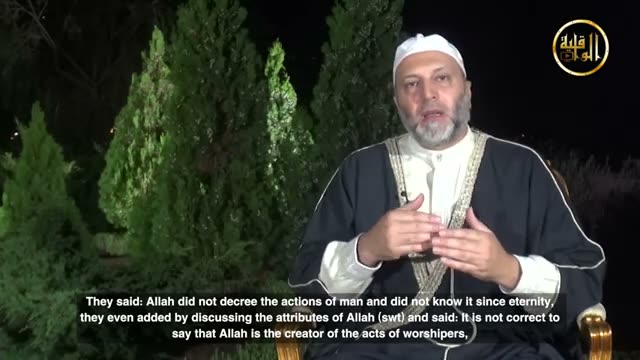
They went even further and addressed another matter: the attribute of creation belonging to Allah, the Exalted. They said: ‘It is not valid to say that Allah, the Exalted, is the Creator of human actions,’ because if Allah created a person’s action, that person would be compelled in it. They therefore said: ‘A person’s voluntary action is created by the person, not by Allah, the Exalted.’ They argued that it is inconceivable for two acts of creation—the person’s creation and Allah’s creation—to combine in one action. They thus removed voluntary human actions from the creation of Allah, the Almighty. They said: ‘A person’s action is created by the person; it is the person’s creation, not the creation of Allah, the Almighty.’
Naturally, these views were shocking and unacceptable to Muslims; neither did the scholarly community of jurists accept them, nor did another kalam group at that time—the Jabriyyah—endorse them.
The Jabriyyah Perspective
This view is attributed to Jahm ibn Safwan. The Jabriyyah said: ‘How can it be said that a human action is created by the person and not by Allah? How can it be said that it is by the person’s will and not by Allah’s will? How can it be said that it is not within Allah’s knowledge or determination? This is not permissible!’ They said: ‘We have read in the Book of Allah, the Exalted:
﴿ وَمَا تَشَآءُونَ إِلَّآ أَن يَشَآءَ ٱللَّهُ ﴾
‘And you do not will unless Allah wills’ [76:30]
Therefore, everything is according to Allah’s volition. We have also read in the Book of Allah, the Almighty:
﴿ ٱللَّهُ خَـٰلِقُ كُلِّ شَىْءٍ ﴾
‘Allah is the Creator of all things’ [39:62]
Human actions are among things, so Allah is their Creator.’
They said: ‘We have read in the Book of Allah, the Exalted, that everything is by qadar, that Allah, the Exalted, wrote everything in the Preserved Tablet, and that Allah, the Exalted, knew all things from eternity.’ On this basis, they rejected and refuted the Mu‘tazilah’s position. They said: ‘Everything is by qadar. Every human action is created by Allah, the Exalted; all of it is known to Allah; all of it is determined by Allah; and all of it is written in the Preserved Tablet until the Day of Resurrection.’
Had they confined themselves to this aspect, too, their statement would have been correct. But they went beyond it. From the beliefs that everything is by Allah’s will and volition, everything is within His knowledge, everything is according to Allah’s determination, human actions are written in the Preserved Tablet, everything is created by Allah, and:
﴿ ٱللَّهُ خَـٰلِقُ كُلِّ شَىْءٍ ﴾
‘Allah is the Creator of all things’ [39:62]
they drew a logical conclusion—not a Shari’ah-based or linguistic conclusion—that these beliefs mean ‘man is compelled, not free to choose’. They said that man has no will by which he acts or refrains from acting. Man does not act by his own will: he does not believe by his own will, disbelieve by his own will, become guided by his own will, go astray by his own will, obey by his own will or disobey by his own will. They therefore said: ‘Man is compelled, not free to choose.’ He is like a feather in the wind or a piece of wood in water, tossed about by the waves.
They began interpreting the Qur’anic verses and hadiths that indicate that man is free to choose in his actions. We thus had two opposing groups: the Mu‘tazilah, who affirmed that man is free to choose and not compelled, and on that basis denied some of the attributes of Allah, the Exalted; and another group, opposed to them, which affirmed those attributes of Allah, the Exalted, and on that basis concluded that man is compelled and not free to choose. Conflict arose between these two groups.
The Ash‘arites’ view on the concept of acquisition (kasb)
A third kalam school then emerged. It was founded by Abu al-Hasan al-Ash‘ari, who had been educated in the Mu‘tazilah school. Abu al-Hasan al-Ash‘ari turned against the Mu‘tazilah and established a new school. Its most prominent question was the issue of al-Qada’ and al-Qadar. He said: ‘I have reached a view that is neither the view of the Mu‘tazilah nor that of the Jabriyyah.’ What was your view, Abu al-Hasan al-Ash‘ari? He said what the Jabriyyah said: that a human action is created by Allah, not created or performed by the human being; that a human action is by Allah’s will, not by the human being’s will or volition; that Allah, the Exalted, determined it from eternity and wrote it in the Preserved Tablet; and that His determination brings actions into existence. He thus affirmed attributes of Allah, the Exalted, as the Jabriyyah had affirmed them. These attributes are, of course, established in the Book of Allah, the Exalted. The problem lies in how they are understood and interpreted and in the conclusions drawn from them.
He said: ‘A human action is by Allah’s creation, Allah’s will, Allah’s volition and Allah’s determination from eternity.’ He was asked: ‘Is this not the view of the Jabriyyah? How does it differ from their view?’ He replied: ‘I add something that the Jabriyyah did not say: man has an attribute called acquisition (kasb).’ What do you mean by acquisition, O Ash‘ari? Al-Ash‘ari said: ‘Acquisition means that man does not perform the action through his will, volition or power. A human action results from Allah’s creation, will, volition and determination. What appears to us as the human being performing his own action is only an appearance. In reality, the action does not proceed from man through his will. Rather, the action occurs from man accompanied by his will.’ ‘Accompanied by his will?’ What does that mean? He said: ‘If we said that man performs his action through his will, volition and power, we would be combining man’s will, power and volition with Allah’s will, volition and power. That is not valid. Two powers, two volitions and two wills cannot converge upon one action. It is therefore not valid to say that man performed his action through his will, volition and power. Rather, Allah, the Exalted, gave man the attribute of will. When man wills, Allah, the Exalted, creates the action at his hands. Man does not perform the action through his will; rather, the action comes from Allah, the Exalted, accompanied by man’s will.’ If we examine their understanding of will as Allah’s will, they understand it as bringing the human action into existence: it is what brought the human action into existence, and Allah, the Exalted, created the human action when it occurred. If we examine their understanding of al-Qada’, or Allah’s determination, as Allah’s judgement that the action occur—not merely His knowledge—we understand from it that the human action resulted from Allah’s will, volition, determination and creation. The Ash‘arite view is therefore a repetition of the Jabriyyah view with the addition of a kalam term called acquisition (kasb).
He naturally took the term ‘acquisition’ (kasb) from the Book of Allah, the Exalted:
﴿ لَهَا مَا كَسَبَتْ وَعَلَيْهَا مَا ٱكْتَسَبَتْ ﴾
‘It will have what it has earned, and against it will be what it has acquired’ [2:286]
There is a vast difference between the linguistic meaning of this verse in the Book of Allah and the technical kalam meaning that the Ash‘arites adopted for this word. In the Book of Allah, the expression has a linguistic meaning:
﴿ لَهَا مَا كَسَبَتْ ﴾
‘It will have what it has earned’ [2:286]
That is, it will receive reward and recompense according to the good it did, or in proportion to the good it did in this world; and against it will be the evil, misguidance, wrongdoing and disobedience it brought upon itself, and so on. In other words, a person receives the benefit of the good deeds he performed and bears the consequences of the bad deeds he performed. But to distort this meaning into a kalam term signifying something found in neither the Qur’an nor the Sunnah is entirely wrong. Who said that ‘acquisition’ means a will accompanied by Allah’s creation of the action? This was a new meaning introduced by Abu al-Hasan al-Ash‘ari, the founder of the Ash‘arite school.
This was the first school to which the term ‘Ahl al-Sunnah wa’l-Jama’ah’ was applied. Previously, the term ‘Ahl al-Sunnah’ had been used in contrast to ‘Ahl al-Bid‘ah’. With the emergence of the Ash‘arite school, Abu al-Hasan al-Ash‘ari adopted the term ‘Ahl al-Sunnah wa’l-Jama’ah’. Islamic currents and schools later disputed the term. Some schools and scholars did not concede to the Ash‘arites that they were Ahl al-Sunnah wa’l-Jama’ah. The term remains disputed to this day among Islamic currents, schools and schools of law. The Ash‘arites say: ‘We are Ahl al-Sunnah wa’l-Jama’ah,’ and they were the first to use this term. Others then told them: ‘No! You are not Ahl al-Sunnah wa’l-Jama’ah.’ We are not now concerned with examining the meaning of the term ‘Ahl al-Sunnah wa’l-Jama’ah’. We are examining the views of the three schools.
Methodological Flaw in Investigating the Issue
The three kalam schools concerned with al-Qada’ and al-Qadar are the Mu‘tazilah, the Jabriyyah and the Ash‘arites. Their shared problem is that they took an issue whose subject is the observable human being—an issue from the witnessed realm. Its subject is the human action: does man perform it by choice or without choice? Is he rewarded or punished for it? Which actions are subject to reward and punishment, and which are not? This inquiry has no connection with the other matters they entered into it and mixed with it. It is not valid to investigate whether a human being is compelled or free to choose, or whether reward and punishment apply to his action, by examining the attributes of Allah, the Exalted. Those attributes belong to the unseen, and our understanding of them is limited to what the texts indicate according to their linguistic meanings. It is not valid to decide whether man is compelled or free to choose by examining Allah’s attributes, as though observable, tangible reality could be viewed through matters of the unseen. Can the tangible be known through the unseen? The problem is that they imagined that their belief in and understanding of these matters required them to give an opinion on this issue, even though belief in these matters does not entail the opinions they gave.
Despite their differences, the Mu‘tazilah, Ash‘arites and Jabriyyah all imagined and assumed that ‘Allah’s will for human actions means that people are compelled’; in this context, will and volition have the same meaning. They also imagined that if we say, ‘Allah, the Exalted, is the Creator of all things,’ this means that if human beings perform their actions themselves, they are the creators of those actions. This is an illusion. They further imagined that if we say, ‘Allah, the Exalted, determined everything, knew it and wrote it in the Preserved Tablet,’ this determination, knowledge and writing in the Preserved Tablet bring human actions into existence. These are illusions. Why? I shall answer briefly without elaboration; perhaps we shall discuss the subject in more detail later. If we say, ‘Everything is by the will of Allah, the Exalted,’ this does not mean that Allah’s will brought human actions into existence.
Will and Volition Do Not Imply Compulsion
Human actions are by Allah’s will and volition—yes. But what does that mean? It means that all human actions are by Allah’s will and volition; in this context, will and volition have the same meaning. It means that man does not do anything against the will of Allah, the Almighty, and that Allah’s will required that man be left free to act. Whether man then does this or that, it occurs by Allah’s will. Allah left man free to choose between belief and disbelief. If he chose belief, Allah, the Exalted, left him free and facilitated it for him, and this occurred by Allah’s will. If he chose disbelief, Allah, the Exalted, left him free for a time and will hold him accountable on the Day of Resurrection. His disbelief therefore occurred by Allah’s will. In this sense, Allah’s will did not bring the human action into existence. It means that Allah’s will left man free to perform whatever he performed. Whether he did this or that, it occurred by Allah’s will. Allah’s will here does not compel the person.
To make the meaning clearer, I shall give an example from our tangible life. Suppose I said to my son: ‘Do not do that particular thing! Do not leave the house this morning.’ I gave him an instruction—or forbade him to leave. I then watched him from behind a screen, concealed from him. Without his noticing me, I saw him open the door, leave and disobey my instruction. I left him to do so for a wisdom and purpose of my own. He left by my will because he did not leave against my will: I was able to stop him, but I left him. He therefore left by my will. My will here was not what made him leave; my will here left him free to leave.
﴿ وَلِلَّهِ ٱلْمَثَلُ ٱلْأَعْلَىٰ ﴾
‘And to Allah belongs the highest example’ [16:60]
This example is only to make the meaning easier to understand.
When Allah, the Exalted, leaves people free to do what they do—neither preventing nor compelling them—and they then act, this occurs by Allah’s will. Whoever obeys does so by Allah’s will, and whoever disobeys does so by Allah’s will and volition. This is the meaning of His saying:
﴿ وَمَا تَشَآءُونَ إِلَّآ أَن يَشَآءَ ٱللَّهُ ﴾
‘And you do not will unless Allah wills’ [76:30]
That is, had Allah, the Exalted, not given you the ability to choose and will, you could neither choose nor will. You chose, willed and acted because Allah, the Exalted, gave you that ability. This is how we understand His saying:
﴿ وَمَا تَشَآءُونَ إِلَّآ أَن يَشَآءَ ٱللَّهُ ﴾
‘And you do not will unless Allah wills’ [76:30]
It does not mean that Allah’s volition and will brought the human action into existence, making the person compelled rather than free to choose. This concerns will and volition.
Determination, Knowledge and Creation Do Not Compel Man
Likewise, when we say that everything is by qadar, we mean that Allah, the Exalted, determined everything and wrote it in the Preserved Tablet. This includes voluntary human actions, people’s belief and disbelief, and their guidance and misguidance. This does not mean in any way that Allah, the Exalted, compelled them or brought their actions into existence through that determination and writing in the Preserved Tablet. It means only that Allah, the Exalted, knew what would occur until the Day of Resurrection—that is, He determined it and wrote it in the Preserved Tablet. Determination and writing in the Preserved Tablet express Allah’s eternal knowledge. I discussed this issue at length in the previous halaqa and will not elaborate on it now. Allah’s eternal knowledge does not affect human actions. Allah’s knowledge did not bring human actions into existence. Rather, this knowledge means that human actions until the Day of Resurrection, and after the Day of Resurrection, are disclosed to Allah, the Exalted. This is part of the perfection of Allah’s attributes.
As for creation, they said:
﴿ ٱللَّهُ خَـٰلِقُ كُلِّ شَىْءٍ ﴾
‘Allah is the Creator of all things’ [39:62]
Allah, the Exalted, also says in His Noble Book:
﴿ وَٱللَّهُ خَلَقَكُمْ وَمَا تَعْمَلُونَ ﴾
‘Allah created you and what you do’ [37:96]
They said that, since Allah, the Exalted, is the Creator of human actions, the action cannot be attributed to the person who performed it. If we say that the person performed his own action, they argued, this means that the person created his action. It is not valid to say that the person is the creator of his action, because:
﴿ ٱللَّهُ خَـٰلِقُ كُلِّ شَىْءٍ ﴾
‘Allah is the Creator of all things’ [39:62]
The Ash‘arites and Jabriyyah therefore concluded that human actions came into existence through Allah’s creation: Allah, the Exalted, created human actions, and human actions are Allah’s doing, not the person’s doing. This understanding of creation is wrong.
﴿ ٱللَّهُ خَـٰلِقُ كُلِّ شَىْءٍ ﴾
‘Allah is the Creator of all things’ [39:62]
Yes.
All human actions are created by Allah—yes, in the sense of bringing them into existence from nothing, and in the sense that Allah, the Exalted, created man and created in him the ability to choose: He placed volition in him and gave him the ability to carry out that volition, not always, but wherever Allah, the Exalted, wills and His volition permits. Man is created by Allah, and man’s will was originally created by Allah. Allah gave him the ability to choose, and He gave him the limbs and ability by which he carries out his will. In this sense, all his actions are created by Allah, the Exalted. That is one question. The question ‘Who performed the action now?’ is another. When a person performs an action, he does not create. When I move my hand now, the question is not who created this action. Everything is created by Allah because Allah, the Exalted, created me, created my hand and created in me the ability to move it. That belongs to Allah’s creation. But when we say that the person acted, we are not attributing creation to the person. We are speaking about what the person did: moving something that Allah created and using an ability and volition that Allah, the Exalted, gave him. Saying that the person acted does not mean that the person created. If I lift this cup, it does not mean that I created anything. The cup is created by Allah, the Exalted, and I am created by Allah, the Almighty. The question about the human action is not a question about who created; it is a question about who directly performed the action now.
The Mu‘tazilah therefore erred when, on the basis of their view that man is free to choose and not compelled, they denied these attributes of Allah, the Almighty. The other group also erred when, on the basis of belief in these attributes, they described man as compelled. This was the serious error. The matter did not end there: the issue of al-Qada’ and al-Qadar did not stop at the question ‘Who performed the action—man or Allah? Who walked? Who struck? Who cut—man or Allah?’ Their discussion did not stop at that question. After the Mu‘tazilah said that man creates his action by his will and volition, not by Allah’s will, volition, determination or creation—after the Mu‘tazilah said this…
The Effects Generated by Actions
They then moved on to another question: ‘This is the human action.’ So what emerges from a human action—does it belong to the creation of man or to Allah, the Exalted? Let me give an example: a person comes and lights a fire; the fire ignites. Is this ignition from man or from Allah, the Most High? The movement originates with man, but the actual ignition is what arises from the human action—is it from man or from Allah? For instance, someone throws paper into the fire, and it burns: does this burning of the paper originate with man or with Allah, the Most High? This was also a point they raised in their discussion.
The person moves his hand upwards with the stone, and the stone flies upwards. Is the stone’s upward movement from the person or from Allah? This is what they asked. Most Mu‘tazilah said that effects generated by human actions are created by the person. They based this on their understanding that Allah, the Exalted, holds the person accountable for what results from his action. If you burn something, you will be questioned about that burning on the Day of Resurrection. Since you will be questioned about it on the Day of Resurrection, it is your action and is not created by Allah, the Exalted. After a person moves his hand and propels a stone upwards, the stone may strike another person in the head and injure him, and the thrower is responsible. On this basis, the Mu‘tazilah said that the stone’s flight or upward movement is created by the person, not by Allah, the Exalted. When they discussed actions and effects generated by actions, the Mu‘tazilah differed among themselves. Some said that some generated effects are not created by the person but by Allah. They adopted many different positions, and their views truly became numerous and intertwined. The name ‘kalam theology’ is clearly exemplified in this subject.
The correct answer: The two spheres of human action
Having shed light on how this issue arose, its subject matter and the error in their method of investigating it, let us now consider the answer to the question: Is the human action from the person or from Allah, the Exalted? Is man free to choose or compelled? The human being is plainly an observable reality. Each of us senses himself and observes how others behave. Setting the other matters aside, we see that man exists within two spheres: a sphere that dominates him and another sphere that he dominates.
A sphere dominates man when the actions that occur within it—what occurs from him or happens to him—lie outside his will. He can neither repel nor prevent them. Within this sphere that dominates man, he is compelled, not free to choose. Concerning the laws of existence—the laws of things—man cannot depart from the laws of life created by Allah, the Exalted, and required by the existential order: the order that Allah, the Exalted, established for this life. Man cannot depart from them and is compelled within them. None of us can decide when to be born or when to die. You are born against your will and die against your will. You cannot choose the colour of your eyes, the colour of your hair or the height of your body. You cannot choose to fly through the air without a machine or to walk with your natural body upon the surface of water. You cannot choose to live without food or drink, or without breathing oxygen. You cannot live on the Moon without artificial breathing equipment. These are requirements of the existential order. You cannot choose them, so you are compelled within them. You are compelled within the laws that Allah, the Exalted, established for how your body lives. You are compelled within the laws surrounding you in this existence; you cannot transcend them and are subject to them. Only what the existential order requires is imposed upon you and compels you.
No. Our lives also contain matters that the existential order does not require, although they do not fall outside that order. The existential order does not require that you have an accident while driving, but such an accident occurs within it. You cannot protect yourself from many such events or accidents; you did not choose them. You may be unable to prevent something from falling on your head and killing you. This is not required by the existential order, but it occurs within it. In many cases, you may be unable to repel a treacherous attacker who kills you from behind, strikes you or harms you. This is not required by the existential order, but it happens to you and you cannot repel it. All this lies within the sphere that dominates man and that he does not dominate. It includes what happens from or to a person, whether it is required by the existential order or is not necessarily required by it but occurs within it. Many actions occur from or to man within the sphere that dominates him. He is compelled within it, not free to choose. He cannot repel what occurs within it or alter or control it. This is a sphere that dominates man, and man is compelled within it.
The other sphere is the one in which man performs his actions by choice. When he wakes in the morning, he sees two garments before him and chooses one. He sees two, three or four foods before him and chooses one, although he could have chosen another. He decides to leave his house, although he could have decided to remain. He goes to work, although he could have stayed away. He goes to the market, where many things are offered to him, and chooses one of them, although he could have chosen none. Far more importantly, thoughts are presented to man, and he accepts some and rejects others. Man is invited to belief: whoever believes does so by choice, and whoever disbelieves does so by choice. Prohibited acts are presented to him: some choose to commit them, while others choose to refrain. Man therefore has many actions of choice, even if they are not the greater number and even though this sphere is, of course, the narrower sphere. Within it, however, he has many options from which he chooses what to do. In an association or university election, he chooses whichever colleague he wants: he may elect one person or another, choose not to elect anyone, or elect someone else.
In many of his actions, then, man is free to choose, not compelled. It should not be said of the actions he chooses that he is like a feather in the wind or that he has no will. In these actions, he does what he wills and chooses, within the ability to choose and act that Allah, the Exalted, has given him. Man dominates the sphere in which he performs his actions by choice. This is the sphere to which reward and punishment apply. Allah, the Exalted, does not reward a person for something he did not decide to do, and He does not punish him for something he did not decide to do or did not decide to refrain from doing. Allah, the Exalted, says:
﴿ لَا يُكَلِّفُ ٱللَّهُ نَفْسًا إِلَّا وُسْعَهَا ﴾
‘Allah does not burden any soul beyond its capacity’ [2:286]
﴿ لَا يُكَلِّفُ ٱللَّهُ نَفْسًا إِلَّا مَآ ءَاتَىٰهَا ﴾
‘Allah does not burden any soul beyond what He has given it’ [65:7]
It is therefore not valid to say that Allah, the Exalted, compelled man to perform an action and then held him accountable for it. When Allah, the Almighty, commands and forbids—before we even speak of reward and punishment—the mere fact that Allah, the Exalted, commanded man and forbade him has a meaning. When He commands you to perform an action, that command assumes that you are able to perform it. If you are unable, He does not hold you accountable for it or blame you for leaving it. When He forbids you to perform an action, that prohibition assumes that you are able to perform it, that He is forbidding you from performing it, and that you will not perform it under compulsion. If you perform it under compulsion, without your will or volition, He will not hold you accountable for it. Commands and prohibitions are based on the reality that man is able to act or refrain from acting. Otherwise, commands and prohibitions would be meaningless. Allah, the Exalted, is infinitely above that.
Likewise, when Allah, the Exalted, rewards a person for his action, it is because he performed it. How could a person be rewarded for something he neither did nor chose? Imagine that a person’s wealth was taken from him against his will and transferred to other people—to the poor—without his will, volition or consent. Would he be rewarded for that? Certainly not. But if a person intended to act and then acted, he is rewarded. If he intended to act but an obstacle prevented him from acting and carrying out his intention, he is also rewarded, because he decided, and that decision is itself a human choice. He decided and acted, so he was rewarded. He decided but something prevented him from acting, and he was also rewarded. A person is therefore rewarded for what he decides and performs by choice, and punished for what he decides and performs by choice.
The matter is therefore entirely clear: man is free to choose here and is situated between two spheres. One sphere dominates him. Reward and punishment do not apply to it. Man is not responsible for what he did not decide. He is not responsible for his appearance, colour, or the names of his father and mother. Nor is he responsible for what occurs through him by mistake: «رُفع عن أمتي الخطأ والنسيان وما استكرهوا عليه» — ‘Mistakes, forgetfulness and what they are coerced into have been lifted from my Ummah’ [Sunan Ibn Majah 2045].
﴿ لَا يُكَلِّفُ ٱللَّهُ نَفْسًا إِلَّا وُسْعَهَا ﴾
‘Allah does not burden any soul beyond its capacity’ [2:286]
and so on. Allah, the Exalted, does not hold man accountable for the sphere that dominates him, which he does not dominate and within which he is compelled. In the sphere where man performs his actions by choice, however, he is rewarded or punished. This, then, is our answer to the question concerning human actions: is man compelled or free to choose? Man exists within two spheres, one for which he is responsible and another for which he is not.
Characteristics of Objects and Human Responsibility
We still need to answer the second question that arose from that discussion as they framed it: what about the effects generated by human actions? In reality, effects generated by human actions result from the characteristics that Allah, the Exalted, placed in objects. Allah, the Exalted, placed in the stone the characteristic that, if propelled, it flies; this relates to gravity, the stone, and so on. Allah, the Exalted, placed in fire the characteristic of burning, in the knife the characteristic of cutting, and in a fired bullet the characteristic of penetrating. Allah, the Exalted, placed in man the characteristics of hunger and thirst, and that ‘if he drinks, his thirst is quenched’ and if he eats, he becomes full. These characteristics in objects, which man triggers or activates through his actions, are created by Allah, the Exalted. The characteristic is from Allah, the Almighty, not from man.
Allah, the Exalted, is He who endowed fire with the attribute of burning. When something burns after a person ignites it, that burning originates from Allah’s creation—yet this does not absolve the human being of responsibility, for it is they who activate and harness this characteristic. Likewise, when a person grasps a knife and cuts with it, the cutting property comes from Allah, as does what is cut by His creation. Yet the individual remains accountable for that action and its consequences, since the knife would not have cut had they not held and wielded it. If someone intentionally throws a stone that strikes another’s head, they are responsible—because without their movement of the stone, no motion or impact would occur. And if such an event happens unintentionally, it is not attributed to them as blame.
The characteristics of objects are therefore created by Allah, the Exalted, and what results from them is created by Allah, the Almighty. All of this is created by Allah, the Exalted, but man triggers and activates these characteristics, and Allah, the Exalted, holds him accountable for doing so. The deliberate killer is therefore held accountable for murder. A person who burns another’s house without right is held accountable, as is a person who stabs another with a knife or fires a weapon, and so on. Man is held accountable for all of this. If he deliberately brings about what results from his action, he is accountable for the result. This is what concerns the effects generated by actions. These effects are created by Allah, the Exalted, but man triggers and activates the characteristics, and things then result from them as consequences of his action. The human action leads to these results, so the person is responsible and accountable for them and bears responsibility for them in this world and the Hereafter.
Summary of the Matter
This is the subject of the issue of al-Qada’ and al-Qadar. From this, dear brothers, it becomes clear that this issue has no connection with belief in Allah’s qadar, which we discussed and explained at length in the previous halaqa. There is only a similarity of words. The title may have arisen because these matters became confused and questions concerning Allah’s attributes were introduced into the discussion. They therefore called it the issue of al-Qada’ and al-Qadar. They gave qada’ kalam definitions unrelated to its linguistic meaning, and gave qadar meanings likewise unrelated to its linguistic meanings and to the texts of the Qur’an and Sunnah. They gave al-Qada’ and al-Qadar technical meanings unrelated to the qada’ and qadar that occur in the Qur’an and Sunnah. It is therefore correct to say that what ‘al-Qada’ and al-Qadar’ means here is human actions and the effects generated by human actions, according to what they raised and investigated in this issue. This is the subject of al-Qada’ and al-Qadar, and this is Islam’s view of the questions they investigated under that title.
As we said, this subject was examined under the title ‘al-Qada’ and al-Qadar’, under the title ‘freedom of will’, and under the title ‘compulsion and free choice’. It is an issue that entered Muslim lands, Muslim minds and Muslim thinking from other cultures, especially Greek culture. Greek culture itself contained two positions resembling the two positions that Muslims adopted, introduced or accepted. Just as the Greeks had views on these matters, Muslims also came to have views on them. The problem with the kalam theologians is that they were influenced by the method of Greek logic when giving their opinions on these questions. They confused the question of human actions—whether man is compelled or free to choose, and for what he is rewarded or punished—with belief in the attributes of Allah, the Exalted. This question must not be examined through those attributes.
‘I say this and seek forgiveness from Allah—for myself and for you all.’ Praise is due to Allah, Lord of the worlds.
Questions and Discussion
I shall now turn to whatever questions may have been submitted during this halaqa.
Brother al-Abid asks: ‘Do you see a flaw among Muslims today in their understanding of the substance of al-Qada’ and al-Qadar, apart from the terminology?’ Yes. Unfortunately, there is a flaw today because the views introduced by kalam theologians hundreds of years ago are still taught in institutes and universities, and many shaykhs, teachers and scholars hold them. Confusion and misunderstanding arise in this subject. A shaykh may tell people: ‘No, man chooses his action and is held accountable for it.’ But when he is asked about the confusion between this issue and the attributes of Allah, the Exalted, he cannot answer properly. Through his explanation of Allah’s will and volition, the attribute of creation, determination, writing, knowledge, and so on, he ultimately drives people towards confusion and conveys to them the idea that man is compelled and not free to choose. This is the problem: the mistaken understanding of al-Qada’ and al-Qadar and the confusion that arose within it.
The Impact of Misunderstanding on Muslim Reality
This has an extremely serious effect on a person’s thinking and disposition. When a person has a firmly rooted conviction that he cannot influence reality because, in his understanding, everything is by qadar, that qadar controls events, and that human beings have no effect on what occurs in this life, this discourages him, frustrates him and prevents him from acting. Such a concept exists even if the person does not express it explicitly. There is an inner conviction that today’s oppressive rulers, tyrants and taghut rulers exist by Allah’s will, volition and determination, and that we cannot change Allah’s will and volition, so we cannot change anything. The person therefore refrains from work and change. He completes this conviction with an imagined superman whom he awaits. They fabricated an imaginary picture from reports about the Mahdi, or Muhammad ibn Abdullah. They collected a group of reports, joined them together, and assumed that Muslims could do nothing and that change would occur only by Allah’s al-Qada’ and His power through the appearance of the Mahdi. Change in the reality of Muslims would thus lie outside human will, and the establishment of the Islamic state, as some claim, would be a favour from Allah, the Exalted, with no human action involved. Allah, the Exalted, says:
﴿ وَعَدَ ٱللَّهُ ٱلَّذِينَ ءَامَنُوا۟ مِنكُمْ وَعَمِلُوا۟ ٱلصَّـٰلِحَـٰتِ لَيَسْتَخْلِفَنَّهُمْ فِى ٱلْأَرْضِ ﴾
‘Allah has promised those of you who believe and do righteous deeds that He will surely grant them succession on earth’ [24:55]
They understood this verse according to their disposition or their method. They said that succession on earth comes from Allah, the Exalted: it is a favour from Allah, not a human action. Consequently, they claim that we must not bring change, work to establish the Islamic state, condemn the tyrants or work to overthrow them, because those tyrants exist by Allah’s al-Qada’ and al-Qadar.
They also claim that Allah, the Exalted, will send the Mahdi through His al-Qada’ and al-Qadar, and then circumstances will change. These concepts combined to produce legions of frustrated failures who discourage people under the headings ‘Allah said’ and ‘the Messenger of Allah said’. How do they pass their discouragement on to people? By claiming that this approach accords with the Islamic creed, the Book of Allah and the Sunnah of the Messenger of Allah (saw). They complete all this with the obligation to obey those in authority, thereby entrenching reality as it is. These criminals who rule the Muslim world today are, of course, not those in authority.
Brother Abdullah says: ‘To tell you the truth, the subject that has affected my life most is al-Qada’ and al-Qadar, and what the learned Shaykh Taqi al-Din al-Nabhani wrote about it. May Allah reward him on our behalf with the best reward.’ Amin.
How do we explain this matter to people?
Yet the question remains: how can this understanding be conveyed to Muslims in a straightforward manner? The wise approach is to address each person’s questions and objections as they stand—what confusion do they actually hold? In today’s session, which has lasted nearly an hour or more, we have addressed the subject from every angle because these very dimensions exist among Muslims. We provide answers accordingly. However, it would be incorrect to assume that whenever someone asks about one of these issues related to this matter, we must expand upon what the Mu‘tazilah, Jabriyyah and Ash‘arites said, thereby resolving all confusion regarding every attribute of Allah the Almighty.
He may ask you: ‘Is not everything by qadar? Is not everything by qadar? Are not all our actions by qadar? Do we not believe, become guided, go astray and disobey by qadar?’ You tell him: ‘Yes.’ He then says: ‘Man is therefore compelled, so how can Allah, the Exalted, hold him accountable?’ Answer only to the extent of his question, and remove only the confusion he has. Explain that qadar is not creation and does not bring anything into existence. By examining the verses and hadiths, we see that qadar means Allah’s eternal knowledge, and that writing in the Preserved Tablet expresses the same meaning. Allah, the Exalted, ‘determined’ and wrote in the Preserved Tablet, meaning that He knew from eternity. That knowledge does not bring the human action into existence, nor is the human action brought into existence through the creation of qadar. Qadar is neither creation nor a bringing into existence. It is knowledge belonging to Allah and all things being disclosed to Allah, the Exalted, as we said earlier. Answer according to the particular confusion of the person asking the question.
Taking Means and Reliance upon Allah
Abu al-Rashid asks: ‘Is there a connection between the subject of al-Qada’ and al-Qadar and the subject of taking the means and reliance upon Allah?’ My dear brother Abu al-Rashid is right to ask this question. In the coming halaqaat, Allah willing, I shall not move immediately from al-Qada’ and al-Qadar to the subject of the Islamic Shari’ah. Rather, I shall discuss matters connected with this subject.
In the next halaqa, Allah willing, I shall discuss guidance and misguidance. These were included within the issue of al-Qada’ and al-Qadar and the question of whether man is compelled or free to choose. Are guidance and misguidance not human actions? The Mu‘tazilah say: ‘They are performed and created by the person.’ The Jabriyyah and others say that guidance and misguidance come from Allah, so man does not choose guidance or misguidance. Rather, the person for whom Allah has written guidance is guided without his will, and the person for whom He has written misguidance goes astray without his will. We have, of course, answered this subject today in general terms. We said that man chooses his actions, including the decision to believe, be guided, go astray, disbelieve, disobey or obey, and so on. But some people remain confused by Qur’anic verses and hadiths concerning guidance and misguidance, so we shall examine them, Allah willing.
This also includes taking the means and reliance upon Allah. We shall devote a halaqa to this subject. But I shall answer briefly: taking the means has no connection with the issue of al-Qada’ and al-Qadar. The inquiry into al-Qada’ and al-Qadar that we have just discussed is an inquiry into human actions: is man compelled or free to choose? The sphere that dominates man, to which the technical term ‘al-Qada’ and al-Qadar’ is applied, lies outside man’s ability. He cannot take means within it because it is not within his ability. Taking the means occurs within the sphere that man dominates, and he must take the means there. Allah, the Exalted, has established laws for these things and for life, and man must understand them so that he knows causes and effects: how he produces one thing from another, how he produces an effect through a word, how he makes a room from wood, how he makes a car from iron, how he produces a new food from a mixture of foods, and so on. Man must take the means. Taking the means occurs within the sphere that man dominates, not within the sphere that dominates man and is technically called al-Qada’ and al-Qadar. Reliance upon Allah, the Exalted, is a different matter, and Allah willing it, too, will have a dedicated halaqa.
Conclusion
Beloved brothers: this concludes today’s session. I ask Allah, the Exalted and Glorified, to reward us for what we have spoken and heard, and I ask Him to increase our knowledge and make beneficial to us all that we have learned today.
If I have spoken well, it is by the grace of Allah, the Exalted. If I have erred, it is from myself. I ask Allah, the Exalted, for forgiveness and for soundness in speech and action. May Allah’s peace and blessings be upon our master Muhammad, his family, his Companions and those who follow his guidance well until the Day of Judgement. Peace and Allah’s mercy and blessings be upon you.