Introduction: The question of who holds provision
Peace and blessings of Allah be upon you all; in the name of Allah, praise to Allah, prayers and peace upon the Messenger of Allah, his family, companions, and those who follow them.
Dear brothers, esteemed followers of al-Waqi’ah channel and all those watching through any means or platform—wherever you may be.
Welcome to a new episode of the programme Halaqa Online.
Today, continuing the discussion on al-Qada’ and al-Qadar and its related issues, we’re addressing this in our live broadcast with you. We hope you’ll engage with us and send any questions you have during this session. We’re focusing on provision—who is the Provider of rizq? Is it in man’s hands or Allah’s, exalted be He? Does rizq fall within the sphere that dominates man, so he has no control over it? Or does rizq belong to the sphere that man dominates—meaning he acquires his own provision, takes charge of obtaining it himself? Is it he who brings about his rizq and sustains himself through it?
The status of wealth and provision in people’s lives
My dear brothers, the matter of provision is one that has occupied people’s minds—indeed, for many, their entire lives revolve around provision, wealth and ownership. In fact, most of those immersed in this world view consider provision itself to be life. When life, in their eyes, means attaining the greatest share of physical pleasures; when their vision of existence is framed purely by material benefit—seeing money as what secures food, guarantees clothing, shelter and healthcare—and as a tool to ward off dangers. Through provision alone, they can boast over others and attain the trappings of this fleeting world. For many people, provision—or, put simply, wealth—has become the very axis of their lives.
How many people have spent their entire lives chasing wealth; how many have stolen for the sake of money; how many have killed for it; how many have strayed into all kinds of corruption because of it; how many have seen life darken before their eyes because they failed to secure the money they wanted or lost the money they had already obtained; how many have lived in humiliation before others for the sake of wealth; how many have shrunk from confronting life’s challenges and facing oppressors for the sake of wealth; how many have looked upon their employer as if he were the Provider and treated him like a god—Allah forbid; how many have envied others over money; how many have lost all meaning in their lives because they never obtained the money they wanted.
The matter of provision is indeed one of the most critical issues a person must give due attention to, so that they approach it with the consideration it deserves. If they view it in the way it truly merits—without falling into either negligence or excess—and engage with the issue of wealth in its genuine form, then they will be among those who navigate this life with dignity and self-respect, their spirits at ease. They will neither deviate nor degrade themselves nor belittle their own worth for the sake of money.
Belief that Allah is the Provider
One of the great wonders of Allah’s sublime religion is that He has made provision—rizq—a matter of creed in Islam; a matter of faith, an article of belief that the Provider—the One who grants rizq—is none other than Allah, exalted be He. Thus, rizq comes from Allah alone: it is Allah’s hand that gives provision, and it is Allah, exalted be He, who sustains mankind. Rizq is not something within the control of man; it does not rest in human hands.
The verses of the Qur’an and the hadiths of the Prophet (saw) state definitively that the One who provides, in whose hands provision lies, who grants provision and who carries out the granting of provision is Allah ﷻ. This creed is one of the definitive creeds in Allah’s Book; it is established by definitive verses.
Let us begin before we expand and elaborate; discussing some doubts that confuse the minds of many people.
The transmitted proofs that provision originates from Allah alone
We read some of the verses in Allah’s Book concerning provision. He says:
﴿ وَكُلُوا۟ مِمَّا رَزَقَكُمُ ٱللَّهُ ﴾
‘Eat of what Allah has provided for you.’ [5:88]
And He says:
﴿ ٱلَّذِى خَلَقَكُمْ ثُمَّ رَزَقَكُمْ ﴾
‘He is the One Who created you, then provided for you.’ [30:40]
And He ﷻ says:
﴿ أَنفِقُوا۟ مِمَّا رَزَقَكُمُ ٱللَّهُ ﴾
‘Spend from what Allah has provided for you.’ [36:47]
And He ﷻ says:
﴿ إِنَّ ٱللَّهَ يَرْزُقُ مَن يَشَآءُ ﴾
‘Indeed, Allah provides for whom He wills.’ [3:37]
And He says:
﴿ ٱللَّهُ يَرْزُقُهَا وَإِيَّاكُمْ ﴾
‘Allah provides for it and for you.’ [29:60]
And He says:
﴿ لَيَرْزُقَنَّهُمُ ٱللَّهُ ﴾
‘Allah will surely provide for them.’ [22:58]
And He says:
﴿ ٱللَّهُ يَبْسُطُ ٱلرِّزْقَ لِمَن يَشَآءُ وَيَقْدِرُ ﴾
‘Allah gives abundant provision to whom He wills and restricts it.’ [13:26]
And He says:
﴿ فَٱبْتَغُوا۟ عِندَ ٱللَّهِ ٱلرِّزْقَ ﴾
‘Seek provision from Allah.’ [29:17]
And He ﷻ says:
﴿ وَمَا مِن دَآبَّةٍ فِى ٱلْأَرْضِ إِلَّا عَلَى ٱللَّهِ رِزْقُهَا ﴾
‘There is no creature on earth whose provision is not upon Allah.’ [11:6]
And He ﷻ says:
﴿ إِنَّ ٱللَّهَ هُوَ ٱلرَّزَّاقُ ﴾
‘Indeed, Allah alone is the Provider.’ [51:58]
This is but a small sample of what appears in Allah’s Book concerning the fact that provision comes from Allah ﷻ, not from anyone among human beings or from anyone else.
﴿ وَمَا خَلَقْتُ ٱلْجِنَّ وَٱلْإِنسَ إِلَّا لِيَعْبُدُونِ مَآ أُرِيدُ مِنْهُم مِّن رِّزْقٍ وَمَآ أُرِيدُ أَن يُطْعِمُونِ إِنَّ ٱللَّهَ هُوَ ٱلرَّزَّاقُ ذُو ٱلْقُوَّةِ ٱلْمَتِينُ ﴾
‘I did not create the jinn and mankind except to worship Me. I seek no provision from them, nor do I want them to feed Me. Indeed, Allah alone is the Provider, Lord of all might, the Ever Mighty.’ [51:56–58]
The Prophet (saw) said: «إِنَّ رُوحَ الْقُدُسِ نَفَثَ فِي رُوعِي أَنَّهُ لَنْ تَمُوتَ نَفْسٌ— أَوْ أَنَّ نَفْسًا لَنْ تَمُوتَ— حَتَّى تَسْتَكْمِلَ أَجَلَهَا وَتَسْتَوْعِبَ رِزْقَهَا، فَأَجْمِلُوا فِي الطَّلَبِ» [Hilyat al-Awliya 10/26] — ‘The Holy Spirit breathed into my heart that no soul will die—or that a soul will not die—until it has completed its lifespan and received its provision in full; therefore seek it in a proper manner.’ So seek it in a proper manner.
Thus, all of this from Allah’s Book and the Sunnah of His Messenger (saw) proves definitively that Allah ﷻ is the Provider; that man does not provide for himself; that his work does not provide for him; and that no human being provides for anyone else.
Seeking provision is a Shari’ah ruling that does not contradict the creed
Some people find this confusing: they must balance their belief that provision is in the hands of Allah alone with what Allah has obligated upon man—seeking provision through effort to obtain it.
Allah ﷻ says:
﴿ فَٱمْشُوا۟ فِى مَنَاكِبِهَا وَكُلُوا۟ مِن رِّزْقِهِۦ ﴾
‘So walk throughout its regions and eat of His provision.’ [67:15]
﴿ فَإِذَا قُضِيَتِ ٱلصَّلَوٰةُ فَٱنتَشِرُوا۟ فِى ٱلْأَرْضِ وَٱبْتَغُوا۟ مِن فَضْلِ ٱللَّهِ ﴾
‘When the prayer has ended, disperse throughout the land and seek Allah’s bounty.’ [62:10]
The pursuit of provision is an obligation; we are thus faced with the creed that Allah, exalted be He, is the Provider, and a legal ruling: that man must work and strive to obtain provision so as to suffice himself and his dependents—this is both our creed and a legal duty.
But is there any contradiction between creed and legal rulings? Of course not—legal rulings in truth stem from the creed, meaning that it is the creed which necessitates adherence to them; it commands, guides, and compels one to uphold these very legal precepts.
How do we resolve the confusion some people experience when they hear that the Provider is Allah, exalted be He, and that provision lies in His hands—while at the same time Allah commands man to strive for his provision?
The clear statement in this regard is that believing provision lies solely with Allah, the Exalted, does not negate a person’s recourse to means of obtaining it—since provision originates from Allah, the Mighty and Majestic, one avenue through which this provision may be obtained is striving to seek it.
Seeking provision is a command from Allah ﷻ. If a person does not have enough to suffice him and spare him from asking people, he must strive to seek provision.
Avenues of provision are circumstances, not causes
Let us note that Allah ﷻ, who commanded people to strive to seek provision, has made avenues for provision—or, in other words, circumstances in which provision is obtained.
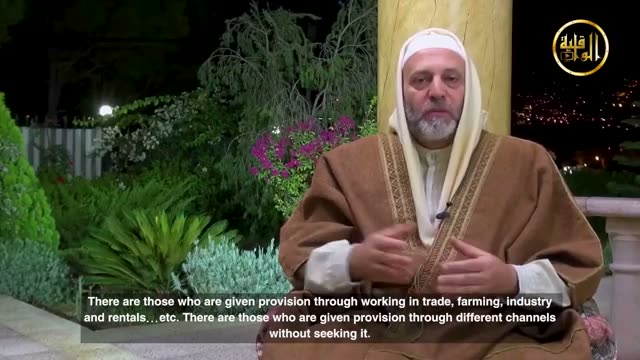
Some receive provision by striving to seek it through trade, agriculture, industry or paid employment, and so on.
There are those who receive provision through other means, without any effort on their part—some inherit wealth, others receive zakat, some benefit from gifts, and others find lost property. Some gain provision from state allocations or acts of generosity by certain individuals, while others obtain it through avenues none of us might anticipate.
If provision comes through various avenues, and it has circumstances—this means there are different ways and conditions for obtaining provision.
As we mentioned in a previous halaqa, death has only one cause: termination of the lifespan (ajal). Yet it has circumstances that people observe.
Likewise, provision has one source and one cause: Allah ﷻ provides for this person and that person and restricts provision for another. Yet this provision comes through different avenues and doors and has different circumstances.
One of the avenues through which provision may be obtained is by seeking or striving to obtain it—so a person knocks at this door, and perhaps it opens for them in terms of provision, or perhaps it does not open for them in that way.
The misconception arising from associating action with provision
Many people, after affirming their faith in the Book of Allah, the Exalted, also accept that the Provider is Allah and that provision lies solely in the hands of Allah, the Exalted.
He failed to examine the true nature of things; in reality, as he perceived it—he observed that when he worked, provision came; but when he stopped working, provision did not come.
He could not reconcile his belief that provision is in Allah’s hands with the tangible reality that appeared to show him that his striving and work brought provision, while refraining from work prevented provision from coming to him.
The truth, however, is that if a person examines the matter closely, he becomes certain that provision is not the result of a cause called striving.
The pursuit of provision is not the cause of provision—why?
The tangible reality negates the causality of striving
Because the tangible reality—which we are discussing now, beyond mere belief in what is revealed in Allah’s glorious Book—thousands of verses clearly indicate that provision rests with Allah alone and that the Provider is Allah, exalted be He—this tangible reality shows us that many people strive to obtain their provision: some succeed in attaining it, while others do not.
If the effort to seek provision were a cause of that provision, then its effect would inevitably follow.
If trade were the cause of provision, then every act of trading would necessarily result in the trader receiving his provision.
If agriculture were the cause of provision, then every act of farming would yield provision for the farmer.
If industry were the cause of provision, then it would inevitably follow that every craftsman would receive his provision from his craft alone.
If employment—where a person works as a wage earner—were the cause of provision, then every individual working for someone else would certainly receive it. Yet the tangible reality—the tangible reality—proves to us that many people have sown but not reaped; that many have produced yet could not sell what they made; that many merchants invested their capital and worked hard with effort, only to fail to profit—and perhaps even incur losses; and that many wage earners worked for an employer who did not pay them, devouring their wages instead.
The reality demonstrates that much of what is assumed to be a cause for provision actually occurs, yet provision does not follow—nor does it arrive.
If these things that people suppose—or that people suppose to be causes of provision—were truly causes of provision, provision would not fail to result from them. That is one aspect of the matter.
On the other hand, we observe that many people have neither worked nor striven to seek provision—yet they receive it through avenues they know of or do not know.
Have you not heard of many people who received provision unexpectedly? One of their relatives died, and his heirs died with him, so that person became the heir. Wealth and provision came to him from where he did not expect.
Did we not hear of many people who stumbled upon treasure in their land, making them wealthy? Yes, indeed.
Have we not heard of many people who are confined and disabled—unable to seek provision—yet find that their provision comes to them through state grants, a generous benefactor’s gift, or obligatory charity due from Muslims?
So when provision arrives without any effort to seek it, this is conclusive proof that seeking is not the cause of provision.
This is tangible, concrete evidence that proves beyond doubt that human effort stems from the fact that seeking is an avenue through which provision may be obtained—yet one cannot guarantee its outcome. So man seeks, and he obtains his provision or does not obtain it.
Therefore, neither striving nor work is a cause of provision. Consequently, man does not provide for himself or anyone else. Work, employment, trade, industry, paid employment, partnership and the like are not causes of provision. They are all circumstances from which provision may come, but it may also not come through them.
The intellect rejects imagined causes while revelation identifies the Provider
The human being must then seek out the true cause of provision. Reason and perception lead him to conclude that what he imagines are causes of provision are not, in fact, its causes.
But reason alone cannot discern who the Provider is. If these material causes—or what are mistakenly assumed to be material causes—are proven not to be a cause of provision, then both reason and perception can conclude that these are not causes of provision. Yet it remains beyond reason’s capacity, on its own, to identify the true cause of provision or the Provider who controls man’s rizq.
Only the believer—the Muslim guided by Allah’s Book—can say that the Provider is Allah ﷻ, because he possesses definitive transmitted evidence informing him that Allah ﷻ is the Provider.
The impact of faith in provision on the soul and conduct
Here, the believer finds himself in this circumstance: his creed—that Allah, exalted is He, is the Provider—distinguishes him from those who drown in the materiality of this world and do not believe that Allah, exalted is He, is the Provider; those who cling to what they imagine are causes and pant after them, panting after these things they suppose are avenues through which provision may be obtained.
Throughout his life, he lives as though he is a slave to the boss of his job—or to his independent profession—which he practices; or to whoever he believes will one day grant him provision.
He remains in constant fear and alarm that some disaster, calamity, fire, destruction or theft may sweep away and destroy his wealth. Why? Because he is attached to the outward features of worldly life that he imagines are causes of provision.
When the believer is assured that provision rests with Allah, the Exalted, he turns to seeking it through avenues where provision may be obtained while relying upon Allah, the Exalted—confident in Him and knowing full well that he will attain only what Allah has decreed and designated for him.
If he gains from his trade, then he praises Allah the Exalted and thanks Him for it, fulfilling the rights of this wealth.
If he does not obtain it, he accepts that and is reassured that Allah ﷻ did not place his provision here and may have placed it somewhere else.
He remembers Allah’s words:
﴿ وَمَن يَتَّقِ ٱللَّهَ يَجْعَل لَّهُۥ مَخْرَجًا وَيَرْزُقْهُ مِنْ حَيْثُ لَا يَحْتَسِبُ ﴾
‘Whoever is mindful of Allah, He will make a way out for him and provide for him from where he does not expect.’ [65:2–3]
﴿ وَمَن يَتَّقِ ٱللَّهَ يَجْعَل لَّهُۥ مِنْ أَمْرِهِۦ يُسْرًا ﴾
‘Whoever is mindful of Allah, He will make ease for him in his affairs.’ [65:4]
This believer does not panic, become angry or lose his mind when he expends effort but obtains no money. Why? Because he believes that Allah ﷻ is the Provider and that work is not the provider.
Look at that man who lived for the material substance of this world—watch him when he loses his wealth; he is struck with panic, hysteria, as they say: How did he lose it? Who stole from him? How could this happen to his money?
It never crossed his mind, even for a moment when he lost his wealth due to any cause, that he should submit—because the Provider is Allah, exalted and glorified. Had this money been destined to remain with him, it would have stayed; but since it was taken from him, he must be certain that Allah, exalted and glorified, had decreed that this wealth was his only up to a known limit—and that He would inevitably remove it, even if temporarily.
He relies upon Allah, and if another provision is decreed for him by the Provider, it will come to him from Allah—whether he knows or does not know its source; whether he anticipates it or not.
The believer does not seek provision through disobedience to Allah
When a person believes that Allah ﷻ is the Provider, he will not turn to seeking provision through disobedience to Allah ﷻ. It has been narrated from the Prophet (saw): «وَلَا يَحْمِلَنَّ أَحَدَكُمْ اسْتِبْطَاءُ الرِّزْقِ أَنْ يَطْلُبَهُ بِمَعْصِيَةِ اللَّهِ، فَإِنَّ اللَّهَ لَا يُنَالُ مَا عِنْدَهُ إِلَّا بِطَاعَتِهِ» [Hilyat al-Awliya 10/26] — ‘Let none of you be driven by the delay of provision to seek it through disobedience to Allah, for what is with Allah can only be attained through obedience to Him.’
The believer—since he believes that the Exalted Allah is the Provider—does not seek provision through disobedience, for he is certain that if his rizq has been decreed, it will come to him. So why would he seek it through forbidden means? Let him seek it in lawful avenues; if his rizq has been decreed, he will attain it. If this rizq was not decreed for him, he will not attain it—neither through lawful work nor through unlawful work.
Seek provision through obedience to Allah ﷻ. Since Allah is the Provider, how can you seek what is with Allah by disobeying Him?
This faith—that the Provider is Allah, exalted be He—is what restrains the believer from disobeying Allah, exalted be He; beyond the commands and prohibitions he adheres to out of fear of Allah, exalted be He. Fear of Allah makes him avoid contradicting Allah’s law or committing sin for wealth. Moreover, his belief that the Provider is Allah, exalted be He, reinforces his assurance that it is neither wise nor rational nor religiously sound in any way to seek provision through disobeying Allah, exalted be He. For man will only attain what Allah, exalted be He, has decreed for him as provision.
From another perspective, when a person believes that provision is in the hands of Allah alone, he does not spend his life fearing people over his rizq—pleasing his boss or supervisor out of disobedience to Allah, transgressing against Allah merely to satisfy his employer for fear of losing his wages. It is as though his employer were the Provider himself.
People flatter others in their trade, swear falsely and cheat—what for? To secure provision. If a person truly believed that the Provider is Allah, exalted be He, they would never flatter people in disobeying Allah, nor cheat, nor obey others in disobeying Allah, exalted be He.
Those who held back from enjoining what is right, forbidding what is wrong and confronting the oppressors—out of fear for their position, fear for their provision, or fear for their trade—have not truly internalised that the Provider alone is Allah, exalted be He, when they abandon His command or commit disobedience through fear for their provision.
The concerns of the Hereafter and those of this world
Beloved brothers, be assured that whoever spends his life solely pursuing provision—turning only to the pursuit of provision in this world—and whoever seeks provision is seeking the worldly life—know that no matter how much provision he may receive, his poverty will remain evident before him.
How many people have been granted vast sums of money, yet they never feel satisfied; nor do they sense that this wealth has brought them what they truly desire.
Listen to the hadith of Allah’s Messenger (saw), which expresses this reality wonderfully. He was the most eloquent of the Arabs (saw), and revelation came to him from Allah ﷻ.
«مَنْ كَانَتِ الْآخِرَةُ هَمَّهُ جَعَلَ اللَّهُ غِنَاهُ فِي قَلْبِهِ وَجَمَعَ لَهُ شَمْلَهُ وَأَتَتْهُ الدُّنْيَا وَهِيَ رَاغِمَةٌ، وَمَنْ كَانَتِ الدُّنْيَا هَمَّهُ جَعَلَ اللَّهُ فَقْرَهُ بَيْنَ عَيْنَيْهِ وَفَرَّقَ عَلَيْهِ شَمْلَهُ، وَلَمْ يَأْتِهِ مِنَ الدُّنْيَا إِلَّا مَا قُدِّرَ لَهُ» [Jami‘ al-Tirmidhi 2465] — ‘Whoever makes the Hereafter his chief concern, Allah places richness in his heart, gathers his affairs for him, and the world comes to him reluctantly. Whoever makes this world his chief concern, Allah places poverty before his eyes, scatters his affairs, and nothing of this world comes to him except what has been decreed for him.’
This is one of the finest expressions from Allah’s Messenger (saw).
Whoever’s sole concern is the Hereafter—who lives in this world yet directs all his efforts towards the Hereafter—Allah grants him wealth of heart.
He may not be among the wealthy, yet Allah, exalted is He, makes him self-sufficient—content with the little provision He has granted him.
Contentment and blessing in provision
This is confirmed by the hadith of Allah’s Messenger (saw): «مَنْ أَصْبَحَ مِنْكُمْ آمِنًا فِي سِرْبِهِ، مُعَافًى فِي جَسَدِهِ، عِنْدَهُ قُوتُ يَوْمِهِ، فَكَأَنَّمَا حِيزَتْ لَهُ الدُّنْيَا» [Jami‘ al-Tirmidhi 2346] — ‘Whoever among you wakes secure in his dwelling, healthy in his body and possessing his food for the day, it is as though the whole world has been gathered for him.’ Or words to that effect, as he (saw) said.
How many people receive little provision of wealth compared to others, yet Allah—exalted is He—has blessed them with it so they are content with what they have.
In contrast, how many people have been granted abundant wealth—yet Allah, the Exalted, has not blessed them with it.
How many people are given abundant wealth, only to spend it on their health, on illness; one spends it on his son’s treatment, on an accident or on a calamity. A person obtains this abundant wealth and builds a luxurious house—a palace—with it, only for a disaster to strike the palace and destroy it. Or he spends his money on some enjoyment of this world, and Allah ﷻ takes it away through a calamity or disaster.
The point is not that a person should receive a great deal of wealth—provision is in Allah’s hands—but that he should make good use of this wealth in obedience to Allah ﷻ. That is why the Prophet (saw) said in the hadith I read a short while ago: Whoever makes the Hereafter his concern, Allah places richness in his heart, because he is content, satisfied and submitted to Allah ﷻ. He is content with the provision Allah ﷻ has granted him, so he finds it sufficient and praises Allah ﷻ for it.
How many people have acquired many times more wealth than that man, yet their eyes still look towards more. Every time one of them acquires wealth, he feels that he wants more, so he behaves as though he were poor and needed a great deal of money. As long as he has not obtained more, he regards himself as deprived.
He therefore remains scattered in this life. As for the believer whose concern is the Hereafter, Allah ﷻ gathers his affairs for him.
Conversely, whoever makes this world their sole concern will find that Allah scatters their affairs.
He has made him in this life lost, wandering, scattered—unable to turn towards himself or the reality of his existence.
As Allah ﷻ says:
﴿ نَسُوا۟ ٱللَّهَ فَأَنسَىٰهُمْ أَنفُسَهُمْ ﴾
‘They forgot Allah, so He made them forget themselves.’ [59:19]
The third point first: Allah made him wealthy in his heart, whereas the second: Allah placed poverty before his eyes. The believer—Allah gathered his affairs for him; as for the one chasing this world, Allah scattered his affairs by His glory and majesty. As for the third…
The believer, then, has the world come to him reluctantly. Why? Because he did not seek it, but Allah ﷻ had written it for him, so it came to him reluctantly.
What Allah ﷻ has written will not fail to happen. Allah ﷻ has written it for you, so it will come to you; it will come reluctantly, although you did not seek it. Allah wrote it for you, so it came to you reluctantly.
That person who lives for this world is panting after it, yet he only reaches what has been decreed for him—what was not decreed for him remains unattainable; he continues to pant after it but never attains it, and from his worldly life, he receives only what has been decreed for him.
The dignity of the believer and his attachment to Allah
Therefore, observe the difference between the believer who has faith that Allah, exalted is He, is the Provider—how he finds contentment in whatever little suffices him.
Look at the person who pants after this world and its pleasures and chases wealth to obtain it.
See how he remains in a constant state of fear, frantic pursuit and anxiety. Whenever he acquires wealth, he fears for it and seeks more. Whenever he reaches one level, he looks at someone above him so that he can reach that level.
Allah’s Messenger (saw) advises the believer to look, regarding the Hereafter, at someone above him and closer to Allah ﷻ. Regarding worldly affairs, he should look at someone below him so that he recognises Allah’s blessing upon him and praises Him for it—glorified and exalted is He [Jami‘ al-Tirmidhi 2512].
Belief that provision is in the hands of Allah, exalted be He, makes the believer noble—noble of soul, never humiliating himself for wealth.
As for believing that striving provides, that provision is in people’s hands, and that provision lies behind employment, a factory, agriculture, an employer, this person or that person, it makes a person servile: servile to his land, his shop, his employer and his master, who bestows scraps of money upon him from time to time.
The impact of the two creeds of lifespan and provision on the Ummah
If the belief that the lifespan is in Allah’s hands and that provision is in Allah’s hands becomes manifest in this Ummah, it will be a defining mark that distinguishes it from all other nations. Conversely, if people become attached to this world and fear death and poverty, they will have made fools of themselves and led themselves to ruin.
Do you remember the hadith of Allah’s Messenger (saw) in which he describes the state of the Ummah in a time of defeat? He said: «يُوشِكُ أَنْ تَدَاعَى عَلَيْكُمُ الْأُمَمُ كَمَا تَدَاعَى الْأَكَلَةُ إِلَى قَصْعَتِهَا». They asked: «أَوَمِنْ قِلَّةٍ نَحْنُ يَوْمَئِذٍ يَا رَسُولَ اللَّهِ؟» He replied: «بَلْ أَنْتُمْ يَوْمَئِذٍ كَثِيرٌ، وَلَكِنَّكُمْ غُثَاءٌ كَغُثَاءِ السَّيْلِ، وَلَيَنْزِعَنَّ اللَّهُ مِنْ صُدُورِ عَدُوِّكُمُ الْمَهَابَةَ مِنْكُمْ، وَلَيَقْذِفَنَّ اللَّهُ فِي قُلُوبِكُمُ الْوَهْنَ». They asked: «وَمَا الْوَهْنُ؟» He replied: «حُبُّ الدُّنْيَا وَكَرَاهِيَةُ الْمَوْتِ» [Sunan Abi Dawud 4297] — ‘The nations will soon summon one another against you as diners summon one another to their dish.’ They asked, ‘Will that be because we are few on that day, O Messenger of Allah?’ He replied, ‘Rather, you will be many on that day, but you will be scum like the scum carried by a flood. Allah will remove fear of you from your enemy’s breasts and cast weakness into your hearts.’ They asked, ‘What is weakness?’ He replied, ‘Love of this world and hatred of death.’
Love of this world entails fearing death; loving the world and hating death; love of the world makes a person attached to wealth, panting after money just to stay alive—because he supposes that wealth alone grants him the power to endure and persist.
These two creeds—faith that the term is in Allah’s hands and faith that provision is in Allah’s hands—make the believer steadfast as towering mountains, his soul at ease and content with what Allah, exalted be He, has decreed and apportioned for him. They elevate him above this worldly life, a master within it rather than its slave.
Prayer and conclusion
Dear brothers, we ask Allah ﷻ to make our souls reassured by Him and by the success He grants, and by the fact that He is the Giver of life, the Causer of death and the Provider.
We ask Allah ﷻ to enable us to remain steadfast in obeying Him and to overcome the illusions and fears that prevent a person from devoting himself to obedience to Allah and from sacrificing for Allah’s religion: sacrificing himself, sacrificing his wealth and sacrificing every worldly possession he owns.
Allah ﷻ made this world only a passage to the Hereafter. The true life—the real life—is in the Hereafter, in a Paradise as wide as the heavens and the earth.
We ask Allah, the Exalted and Almighty, to make us among those who attain it—among the people of the highest paradise. He is the One Who hears all supplications and answers them. All praise belongs to Allah, and peace and blessings be upon the Messenger of Allah.
Questions and discussion
Sister Aisha Zaatari says, ‘Peace, Allah’s mercy and His blessings be upon you.’ And upon you be peace, Allah’s mercy and His blessings.
Is provision limited to money?
Is provision limited to wealth alone, or does it also encompass children and knowledge—for example?
When we examine the verses of Allah ﷻ and the hadiths of Allah’s Messenger (saw), we find that provision originally refers to wealth. Wealth, of course, does not mean only cash, gold or silver. Everything a person owns is called wealth; therefore, provision is used to refer to wealth.
But metaphorically, it is permissible to describe a child as provision from Allah, the Exalted—likewise knowledge is a blessing from Him, which a person attains only after striving to acquire it; this holds true.
However, the discussion of provision that we have just given does not apply to children. What is said about seeking wealth is not said about children, and what is said about seeking wealth is not said about knowledge.
Whoever seeks knowledge acquires it. Although acquiring knowledge requires success granted by Allah ﷻ, seeking knowledge lies within the sphere that man dominates. A person seeks knowledge and acquires it through success granted by Allah ﷻ.
The pursuit of provision, however, may not bring you provision—provision is not within the sphere that man dominates. As for seeking knowledge: when a person seeks knowledge, they learn it; this lies within the sphere that man controls.
A child, however, is from Allah ﷻ. This resembles the matter of provision, but not everything we have said about provision applies to it.
What is the relationship between striving and obtaining provision?
Sister Umm Mani‘ asks: What is the relationship between striving and obtaining provision when the outcome is not inevitable?
I will give an example in this area. Allah ﷻ commanded the believers to prepare for fighting. He says:
﴿ وَأَعِدُّوا۟ لَهُم مَّا ٱسْتَطَعْتُم مِّن قُوَّةٍ وَمِن رِّبَاطِ ٱلْخَيْلِ تُرْهِبُونَ بِهِۦ عَدُوَّ ٱللَّهِ وَعَدُوَّكُمْ ﴾
‘Prepare against them whatever force and war-horses you can, to deter Allah’s enemy and your enemy.’ [8:60]
And He says:
﴿ وَأَنفِقُوا۟ فِى سَبِيلِ ٱللَّهِ ﴾
‘Spend in the cause of Allah.’ [2:195]
That is, spend on arming and equipping yourselves for fighting in the cause of Allah:
﴿ وَأَنفِقُوا۟ فِى سَبِيلِ ٱللَّهِ وَلَا تُلْقُوا۟ بِأَيْدِيكُمْ إِلَى ٱلتَّهْلُكَةِ ﴾
‘Spend in the cause of Allah and do not let your own hands throw you into destruction.’ [2:195]
Thus, Allah ﷻ commanded material preparation, in addition to preparation in faith and morale, for fighting.
By the nature of things and the way events usually unfold, the one with the stronger equipment and preparation usually prevails. Yet a person may prepare but not prevail, while someone with less equipment than his enemy may triumph. Allah ﷻ says:
﴿ كَم مِّن فِئَةٍ قَلِيلَةٍ غَلَبَتْ فِئَةً كَثِيرَةًۢ بِإِذْنِ ٱللَّهِ ﴾
‘How many a small force has defeated a large force by Allah’s permission.’ [2:249]
The believer must take the practical means: he must strive to prepare them and must strive to seek provision. He may strive to seek provision and obtain it, but he may also strive without obtaining it.
He strives in what is an avenue through which provision may be obtained—meaning you knock on the door that is such an avenue.
A person performs many actions without being able to guarantee their outcome or be certain of it. We perform many actions without a guaranteed result, but we think it likely that provision may be found in a particular place, so we knock on that door.
Do you not go to a doctor seeking treatment, while knowing that healing may not come from or through this doctor, because healing is from Allah ﷻ?
The Messenger (saw) commanded us to seek treatment: «تَدَاوَوْا عِبَادَ اللَّهِ، فَإِنَّ اللَّهَ لَمْ يَجْعَلْ دَاءً إِلَّا جَعَلَ لَهُ دَوَاءً»—أَوْ: «لَمْ يَضَعْ دَاءً إِلَّا جَعَلَ لَهُ دَوَاءً» [Sunan Abi Dawud 3855] — ‘Seek treatment, servants of Allah, for Allah has not made a disease without making a remedy for it’—or: ‘He has not placed a disease without making a remedy for it.’
When you fall ill, you seek medicine and go to the doctor, even though you know that healing through this doctor or this medicine is not inevitable, because Allah ﷻ says:
﴿ وَإِذَا مَرِضْتُ فَهُوَ يَشْفِينِ ﴾
‘When I am ill, He is the One Who heals me.’ [26:80]
Healing therefore comes from Allah ﷻ.
But the Almighty Allah has commanded us to seek through the avenue that holds the potential for healing—yet since this avenue is not definitive, we cannot expect definitive healing from it; nor can we expect definitive provision. This proves that such an avenue is not a cause of provision, because the effect never fails to follow its cause.
Thus, we knock on doors that are avenues through which provision may be obtained, hoping to obtain provision. If we do not obtain it, we say that Allah ﷻ did not write this provision for us.
So the human being aligns his faith that provision is in Allah’s hands alone—not merely aligning it, but completing his faith by affirming that the Provider is Allah, exalted and glorified. The command from Allah to man is to strive for provision. The Provider is Allah; seeking provision is a means of attaining it—this method may yield results or may not.
Wealth does not achieve eternal life
My brother Wael al-Sultan also says: Allah ﷻ has pointed out that wealth does not bring immortality. He says:
﴿ وَيْلٌ لِّكُلِّ هُمَزَةٍ لُّمَزَةٍ ٱلَّذِى جَمَعَ مَالًا وَعَدَّدَهُۥ يَحْسَبُ أَنَّ مَالَهُۥٓ أَخْلَدَهُۥ ﴾
‘Woe to every backbiter and slanderer, who amasses wealth and counts it, thinking that his wealth will make him immortal.’ [104:1–3]
Amassing wealth never brings immortality. Although it satisfies a person’s desire for ownership, he must not be deceived by it.
This is a beautiful contribution, not a question—may Allah reward you with the best for this comment and your participation.
Conclusion
We have reached the end of our session, noble brothers; in this gathering we ask Allah, the Exalted, to benefit us from what He has taught us, to increase us in knowledge, and to make our knowledge and deeds sincere for His Noble Face alone. Peace be upon you, and Allah’s mercy and blessings.