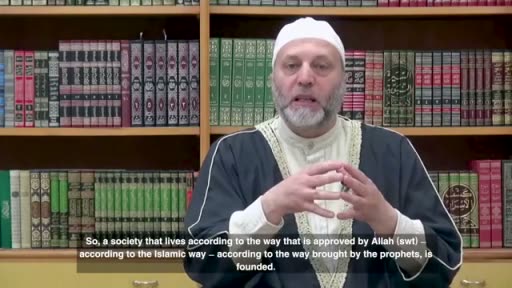
Introduction: Carrying the Da’wah and Achieving Its Objectives
Welcome, noble brothers, to another session of Halaqa Online. For several weeks, we have continued discussing subjects related to how the da’wah is carried. Tonight’s subject concerns carrying the da’wah and achieving its objectives: carrying the Islamic da’wah and achieving its objectives. What is meant by this subject? Among many committed Muslims who care deeply for Islam, spreading it and carrying it to people—Muslims who are zealous for this religion—we observe a group who carry the da’wah and perform the obligation of enjoining what is right and forbidding what is wrong in an open-ended manner, without defining a clear, specific objective. Their carrying of enjoining what is right, Islam and the da’wah, and their enjoining what is right and forbidding what is wrong, consequently achieves no specific, clear and material results on the ground.
They say, ‘We must enjoin people to do what is right and forbid them from what is wrong. We must carry Islam to the people.’ Yet they overlook the need to define a clear objective for carrying the da’wah and to work to achieve it. Many of them believe that establishing authority and a state for Islam on earth is not the Muslims’ responsibility, but a gift from Allah that we cannot know when or how it will come into existence. They say that their duty is merely to enjoin what is right and forbid what is wrong, without working to achieve specific objectives on the ground through which Islam would come into existence in an Islamic State. They do not consider themselves responsible for working to establish Islam’s political entity, which applies the Shari’ah rulings in the Muslim lands and carries Islam as a message to the world. They regard this as a gift from Allah, Glorified and Exalted, whose time, manner and achievement are unknown to them. Some even consider working to establish the Khilafah State—the executive entity of Islam—an innovation. This is the subject I wish to discuss today.
Rulings of the Idea and Rulings of the Method
Noble brothers, let us examine this topic through its foundational principles. The rulings of Islam are naturally divided into two categories based on a specific classification: some Shari’ah rulings can be termed rulings of the Idea, while others fall under rulings of the Method.
All these are rulings from Allah, Glorified and Exalted. We must adhere to them, apply them and worship Allah, Glorified and Exalted, by adhering to and performing them. However, I wish to highlight and draw attention to the fact that one category of rulings—and this comprises most Shari’ah rulings—can be classified terminologically as rulings of the Idea. They were legislated for their own sake, meaning that Allah, Glorified and Exalted, legislated them so that we would adhere to and apply them for their own sake, seeking from them only reward from Allah, Glorified and Exalted, on the Day of Resurrection. They may realise values in this world, such as spiritual value within the human soul, or a humanitarian or moral value. However, no material effect to be realised in this world is expected or sought from them. They are performed to implement the command of Allah, Glorified and Exalted, and are therefore intended for their own sake.
For example, the rulings of worship: Allah, Glorified and Exalted, commanded His servants to pray, fast and perform Hajj. They perform these acts of worship to receive reward and recompense from Allah, Glorified and Exalted, drawing near to and obeying Him. They expect no worldly results from these acts, but seek through them only Allah’s reward and recompense and a Paradise as wide as the heavens and the earth. Prayer is therefore not intended to achieve some goal for a person in this world. It is for Allah; fasting is entirely for Allah. The rulings of the Method are likewise for Allah, Glorified and Exalted. All rulings are observed in obedience to Allah, the Mighty and Majestic. However, this category of rulings is observed for its own sake. Allah, Glorified and Exalted, legislated these rulings for man because they rectify the human soul, treat human problems, satisfy his fitrah and regulate it. It is enough simply to perform them sincerely for Allah, Glorified and Exalted, with the intention devoted to Allah, the Mighty and Majestic, for the Prophet may Allah bless him and grant him peace informed us that deeds are judged by intentions.
«إِنَّمَا الْأَعْمَالُ بِالنِّيَّاتِ، وَإِنَّمَا لِكُلِّ امْرِئٍ مَا نَوَى، فَمَنْ كَانَتْ هِجْرَتُهُ إِلَى اللَّهِ وَرَسُولِهِ، فَهِجْرَتُهُ إِلَى اللَّهِ وَرَسُولِهِ، وَمَنْ كَانَتْ هِجْرَتُهُ لِدُنْيَا يُصِيبُهَا أَوِ امْرَأَةٍ يَنْكِحُهَا…» — ‘Actions are only by intentions, and each person will have only what he intended. Whoever emigrated for Allah and His Messenger, his emigration was for Allah and His Messenger; and whoever emigrated for some worldly gain or a woman he wished to marry…’ [Sahih al-Bukhari 1].
His migration is to that for which he migrated. These righteous deeds implement Shari’ah rulings intended for their own sake. If a believer performs them with an intention devoted solely to Allah, the Mighty and Majestic, he receives their reward in the Hereafter and seeks nothing worldly through them. Although part of Allah’s wisdom may be that they reflect positively upon human life, this matter is not in man’s hands; it is success granted by Allah, the Mighty and Majestic.
This category also includes rulings concerning halal and haram. Allah, Glorified and Exalted, prohibited intoxicants, pork and blood. He commanded obedience to parents, payment of zakah, and so forth. All these are rulings that a Muslim must observe for their own sake, without seeking to achieve worldly objectives through them. He expects only reward from Allah, Glorified and Exalted, in the Hereafter.
Rulings of the Method and the Obligation to Take Their Objectives into Account
There are rulings ordained by Allah which we worship through, yet He has assigned specific goals and objectives to these rulings that must be achieved when enacted—what we term rulings of the Method. For example, Allah legislated rules for combat: jihad in His cause, fighting rebels, repelling aggressors, and defending against attackers. These are part of what is called rulings of the Method, which were not established for their own sake but to achieve the objectives behind them.
Muslims may not fight merely for fighting’s sake. Someone might say, ‘I wage jihad only for reward and recompense,’ without seeking any objectives beyond the fighting. Yet when an aggressor attacks you, you fight him to repel his aggression, not merely to fight him. The Messenger of Allah may Allah bless him and grant him peace said, in meaning, that whoever dies defending himself is a martyr, whoever dies defending his honour is a martyr, and whoever dies defending his wealth is a martyr [meaning; Jami‘ at-Tirmidhi 1421].
Is the objective of this fighting that he should die? No. If he dies in it, he is a martyr. Here, however, he fights to repel the aggressors. He fights those who attacked him to repel their aggression. He must act in a manner that leads to repelling that aggression. He may succeed or may not succeed, but he must take this objective of the fighting into account, for fighting is not sought for its own sake.
When the Islamic State declares jihad against another state or people, this jihad is not sought merely for its own sake but must have a clear objective—as the Qur’an indicates in multiple verses.
For example, Allah the Almighty says in His Noble Book:
﴿ قَـٰتِلُوا۟ ٱلَّذِينَ لَا يُؤْمِنُونَ بِٱللَّهِ وَلَا بِٱلْيَوْمِ ٱلْـَٔاخِرِ وَلَا يُحَرِّمُونَ مَا حَرَّمَ ٱللَّهُ وَرَسُولُهُۥ وَلَا يَدِينُونَ دِينَ ٱلْحَقِّ مِنَ ٱلَّذِينَ أُوتُوا۟ ٱلْكِتَـٰبَ حَتَّىٰ يُعْطُوا۟ ٱلْجِزْيَةَ عَن يَدٍ وَهُمْ صَـٰغِرُونَ ﴾
‘Fight those among the people who were given the Scripture who do not believe in Allah or the Last Day, who do not forbid what Allah and His Messenger have forbidden, and who do not profess the religion of truth, until they pay the jizyah by hand while humbled’ [9:29].
Thus, this verse defines the objective of fighting when Allah the Exalted says:
﴿ حَتَّىٰ يُعْطُوا۟ ٱلْجِزْيَةَ عَن يَدٍ وَهُمْ صَـٰغِرُونَ ﴾
‘until they pay the jizyah by hand while humbled’ [9:29];
and in another verse, He says:
﴿ وَقَـٰتِلُوهُمْ حَتَّىٰ لَا تَكُونَ فِتْنَةٌ وَيَكُونَ ٱلدِّينُ كُلُّهُۥ لِلَّهِ ﴾
‘Fight them until there is no fitnah and the religion, all of it, is for Allah’ [8:39].
Therefore, the goal is that victory belongs to the religion of Allah the Almighty—that humanity’s allegiance and submission be to His religion. Hence, fighting must achieve this objective as defined by Shari’ah when Allah commanded preparing military readiness, saying:
﴿ وَأَعِدُّوا۟ لَهُم مَّا ٱسْتَطَعْتُم مِّن قُوَّةٍ وَمِن رِّبَاطِ ٱلْخَيْلِ تُرْهِبُونَ بِهِۦ عَدُوَّ ٱللَّهِ وَعَدُوَّكُمْ ﴾
‘Prepare against them whatever strength and tethered horses you are able to muster, by which you strike fear into Allah’s enemy and your enemy’ [8:60].
Thus, the purpose of preparation is to instil fear in the enemy—not merely for its own sake—but rather so that the enemy may be deterred. This kind of preparation, which terrifies the enemy, is precisely what achieves the objective of fighting: securing victory and attaining the intended goals. The rulings of the Method were legislated solely to realise such objectives.
Punishments as an Example of the Rulings of the Method
Let me give another example of the rulings of the Method, which were not legislated for their own sake but to achieve other objectives: punishments—such as retaliation and fixed penalties. When Allah commanded flogging for the adulterer and adulteress
﴿ ٱلزَّانِيَةُ وَٱلزَّانِى فَٱجْلِدُوا۟ كُلَّ وَٰحِدٍ مِّنْهُمَا مِا۟ئَةَ جَلْدَةٍ ﴾
‘The woman who commits zina and the man who commits zina—flog each of them with a hundred lashes’ [24:2],
He then said:
﴿ وَلْيَشْهَدْ عَذَابَهُمَا طَآئِفَةٌ مِّنَ ٱلْمُؤْمِنِينَ ﴾
‘Let a group of the believers witness their punishment’ [24:2].
What is the purpose of having a group of believers witness their punishment? The purpose is deterrence: that people learn that whoever commits this indecency will receive this punishment. If this indecency appears openly, people see it and its prescribed punishment is carried out, the objective is to deter people from this indecency. It also declares that this society cannot condone this kind of vice under any circumstances.
Thus, implementing rulings of this type—the rulings of the Method—has objectives in this world. In addition, it is adherence to the command of Allah, Glorified and Exalted, through which reward and recompense from Allah, the Mighty and Majestic, are sought. That is, they are observed as worship of Allah, Glorified and Exalted, while realising the objectives that the Shari’ah seeks through these rulings.
Carrying the Da’wah as One of the Rulings of the Method
Among these rulings is carrying the Islamic da’wah—carrying the da’wah. It is not a ruling of the Idea for its own sake; rather, it was legislated to achieve specific objectives: namely, transforming society from its current state—one that contradicts what Allah approves and Islam ordains—to one that pleases Him and aligns with His Shari’ah.
When the Prophets, peace be upon them, were sent to peoples who were disbelievers, the objective was to bring those disbelievers into Islam. After they entered Islam, they were to submit to the command of Allah, Glorified and Exalted. This would produce a society whose relationships were regulated by Allah’s commands and prohibitions: a society living according to the way that Allah, Glorified and Exalted, approved—the Islamic way brought by the Prophets. An objective must therefore be achieved: transforming people and societies from their way of life that contradicts Islam to the Islamic way of life.
If they were sent among believing peoples where some legal deviations, immoralities or vices had spread, then the focus was on eliminating these and restoring matters to their rightful place.
The Prophet’s Sirah in Working to Achieve the Goal of the Da’wah
The Prophet may Allah bless him and grant him peace was sent in Makkah, whose people were disbelievers. He began calling them to Islam and continued calling the people of Makkah to Islam for years. Dozens of people believed with him. These were the first Companions, most of whom later became Muhajirun. They believed with the Messenger of Allah may Allah bless him and grant him peace and were few, while society remained upon its polytheism and jahiliyyah.
The Prophet’s objective was not merely to call people, for whoever would believe to believe, and then leave the matter there. The Prophet may Allah bless him and grant him peace sought the victory of Islam: that society would be transformed from its jahiliyyah into an Islamic society embodying the Islamic way of life that results when society adheres to the Shari’ah of Allah, Glorified and Exalted.
That is why, after calling the people of Makkah for many years without their society converting or embracing Islam, he began searching for another community that would accept Islam. This was so that there might be an Abode of Islam—a society embodying its Islamic way of life—which could then serve as a launching point for carrying the da’wah to all peoples and the world. When he found that Makkah’s society had rejected him, he turned to other communities.
He first headed toward Ta’if, where he met the chiefs of Thaqif and invited them to Islam, urging them to believe in it and support him. As we know, those criminals at that time repelled the Prophet—may Allah bless him and grant him peace—with extreme hostility; they incited their young men and slaves against him until blood flowed from his feet due to the severe harm inflicted upon him. He was not successful with Ta’if on this occasion—the people of Ta’if were arrogant and mistreated him.
Did he stop there and say, ‘I have fulfilled what is required of me, and I need do no more’? No. He returned to Makkah and waited for the Hajj season. You know that the Arabs used to perform Hajj in Makkah every year during the same season in which we still perform Hajj today. However, they mixed what remained of the rites of Ibrahim, peace be upon him, with the customs of jahiliyyah that had been introduced into them. The idols of all the Arab tribes were gathered in the Ka‘bah in Makkah.
The Prophet may Allah bless him and grant him peace waited for that season. Delegations came to Makkah from throughout the Arabian Peninsula, and he moved among their encampments—the places where they had settled. He instructed and called them to believe in him, support him, support his da’wah and protect him personally. He called them to embrace Islam after presenting the proofs and arguments that he had brought. He called them to protect him so that he could convey his da’wah, and he called them to support Islam itself.
This was so that Islam would have a state and sovereignty. Some even began negotiating with him: ‘Tell us, if we follow you, believe in you and fight the people on your behalf, will authority belong to us after you?’ Among the Arabs at that time, al-amr meant authority. The term ‘state’ was not used then; most expressions we now use to denote a state did not exist at that time. They used the expression al-amr, which occurs in the Book of Allah, Glorified and Exalted, when He said:
﴿ يَـٰٓأَيُّهَا ٱلَّذِينَ ءَامَنُوٓا۟ أَطِيعُوا۟ ٱللَّهَ وَأَطِيعُوا۟ ٱلرَّسُولَ وَأُو۟لِى ٱلْأَمْرِ مِنكُمْ ﴾
‘O you who believe, obey Allah, obey the Messenger and those in authority among you’ [4:59].
That means those who hold legitimate authority. They asked him for authority to belong to them after him, and he told them, ‘Authority belongs to Allah; He places it wherever He wills’ [Ibn Hisham’s Sirah].
He moved among those delegations who had come to Makkah for Hajj. Some rejected him harshly and rudely, some rejected him politely, and some bargained and negotiated with him. We need not expand upon this here. Eventually, Allah, Glorified and Exalted, opened the hearts of a delegation from the Khazraj of Madinah at that time. They came to the Prophet may Allah bless him and grant him peace, heard him and believed. They then returned to Madinah, and what followed then took place.
As a result, after approximately two years, most of the people of Madinah—or the strongest majority among them—embraced Islam. This created public opinion for Islam in Madinah, which qualified them to give the bay‘ah to the Messenger of Allah may Allah bless him and grant him peace and place authority in his hands. The Prophet may Allah bless him and grant him peace came to Madinah after taking from them the Second Pledge of al-‘Aqabah, which was a pledge of authority and governance, indeed a pledge of war, as it stated.
Upon his arrival in the Blessed City of Medina on the twelfth of Rabi’ al-Awwal in the year of migration, that day was marked as when the Islamic State came into being.
Thus, the Prophet may Allah bless him and grant him peace carried the da’wah in the manner through which he sought to achieve its objectives. The objective was to transform society from polytheism to Islam. When society embraced Islam, it gave its allegiance to Allah, the Messenger and the believers and granted authority to the Prophet may Allah bless him and grant him peace. When he assumed authority in Madinah, the legislative rulings were revealed and Islamic life came into existence in the first Islamic society in Madinah. During the lifetime of the Prophet may Allah bless him and grant him peace, this society expanded to encompass the entire Arabian Peninsula. It then expanded under the caliphs who came after him and spread throughout the earth, east and west.
Thus, the Islamic da’wah is carried in a manner that leads it to achieve its objectives. The objective is to transform humanity from a life of misguidance to an Islamic way of life. The objective is to establish the Abode of Islam (Dar al-Islam), whose people embrace Islam and submit to its rulings, so that Islam’s rulings are applied to them and the Islamic way of life is embodied in that society. That society, represented and embodied by its State, then carries the Islamic da’wah to the world through da’wah and jihad in the cause of Allah.
Stage-by-Stage Objectives in Carrying the Da’wah
The Islamic da’wah must therefore be purposeful, have an objective and possess an intention that it seeks to realise. From the time revelation descended upon the Messenger of Allah may Allah bless him and grant him peace, and he announced to people that he was a Prophet receiving revelation from Allah, the Mighty and Majestic, he performed specific, deliberate actions whose objective was to change society.
In the first stage, he had a stage-specific objective: to form a structured group that would carry Islam with him—an ideological political party whose objective was to change society. He spent three years culturing this group of Companions. This culturing had a specific objective: that the first Companions whom he cultured during those three years would form a structured group of Islamic personalities who carried the creed ideologically, were prepared to carry Islam into society, and were prepared to enter the midst of that society through intellectual struggle and political struggle while enduring opposition and hostility, and so forth.
Those three years had a specific objective: creating a structured group—creating a structured group of da’wah carriers who would work with the Prophet may Allah bless him and grant him peace to change society. This is what happened. When this structured group matured and the first stage achieved its objectives, Allah, Glorified and Exalted, revealed the command to the Prophet may Allah bless him and grant him peace:
﴿ فَٱصْدَعْ بِمَا تُؤْمَرُ وَأَعْرِضْ عَنِ ٱلْمُشْرِكِينَ ﴾
‘So proclaim openly what you are commanded and turn away from the polytheists’ [15:94].
After that, when the Prophet may Allah bless him and grant him peace and his structured group entered the midst of the da’wah in Makkah, he engaged society in intellectual struggle and its leaders in political struggle by undermining their legitimacy and prestige, exposing their conspiracies, and so forth.
These actions had specific objectives: to bring down the customs of jahiliyyah, beginning with pagan creeds and extending to every custom that regulated people’s relationships in that society. He targeted every component of that society—its thoughts, emotions and systems—in order to demolish its foundations and replace them with the Islamic components of society: the Islamic creed with its thoughts and emotions. After that, if society embraced Islam, the Shari’ah of Allah, Glorified and Exalted, would regulate people’s relationships.
The Qur’an therefore waged a campaign against creeds, idols, the veneration of forefathers, dishonest measurements, female infanticide, consuming usury, and so forth. The objective was to demolish society’s customs and systems. Allah, the Exalted, said:
﴿ فَمَن يَكْفُرْ بِٱلطَّـٰغُوتِ وَيُؤْمِنۢ بِٱللَّهِ فَقَدِ ٱسْتَمْسَكَ بِٱلْعُرْوَةِ ٱلْوُثْقَىٰ لَا ٱنفِصَامَ لَهَا ﴾
‘Whoever rejects taghut and believes in Allah has grasped the firmest handhold, which will never break’ [2:256].
The Prophet (may Allah bless him and grant him peace) did not merely convey the da’wah to Islam without addressing the existing pre-Islamic reality. Such an approach would lack practical effect. For Islam, as a way of life and a system governing society, community, and state, must be established upon the ruins of that society’s very foundations. Therefore, he targeted their creeds for dismantling, attacked their blind following of ancestors, struck at their idols, and challenged their entire mode of living—all to overthrow it and replace it with Islam. For truth and falsehood cannot coexist; truth must rise upon the ruins of falsehood.
Thus, he aimed to dismantle the components of that society so as to establish Islamic custom—its ideas and emotions—in their place, transforming it from its former pagan life into a new one.
When people embraced Islam, their allegiance shifted to Allah, His Messenger, and the believers. They granted authority to the Prophet (may Allah bless him and grant him peace) so he could govern them by what Allah had revealed, thereby establishing Islamic life as intended. This did not occur in Makkah; instead, Allah facilitated it by opening the hearts of Ahl al-Madinah to Islam, making Madinah the first Abode of Islam.
Carrying the Da’wah Today to Resume the Islamic Way of Life
This is what we must adopt and take into account today when carrying the da’wah. The da’wah must be carried in a manner that leads to changing this reality and resuming the Islamic way of life, not in an open-ended manner without specific objectives. The da’wah must therefore have an ideological political structured group that understands Islam correctly, in an elevated, pure and clear manner. Its purpose is to change the corrupt general custom in this society, which Western and other alien ideas have invaded and which Western man-made systems govern, until the general custom in society is changed. This will result in authority being given to Islam, the carriers of Islam and the carriers of the Islamic project, and the Islamic way of life will then be established.
This da’wah must therefore have as its objective the resumption of Islamic life through establishing an Islamic State. It is not permissible to say, ‘We carry the da’wah but do not attend to achieving objectives, leaving their attainment to Allah, exalted be He.’ This is incorrect. You must work and, in doing so, ensure that you are mindful of achieving those objectives and goals. If the goal is achieved, then you have fulfilled your duty and discharged what was incumbent upon you.
However, this does not mean that every action you undertake will necessarily and inevitably achieve its objective. Let us return to the example given at the beginning of this halaqa: an army that declares a fight and wages a war must take the achievement of that war’s objective into account. It might say, ‘Through this battle, I intend to conquer such-and-such country, destroy such-and-such enemy fortress, deter the enemy from taking military action against us, or occupy the enemy with one battle so that it cannot wage another battle,’ and so forth. You define the objective of the fighting and must take its achievement into account. If you achieve it, that is what is required. However, this does not deny that the objective may sometimes not be achieved, because results are in the hands of Allah, Glorified and Exalted, not man. There is a great difference between taking the achievement of these objectives into account and failing to do so. If you do not take their achievement into account, you will achieve nothing. If you do take it into account, you may achieve them and succeed, or you may not achieve them.
Ultimately, Allah, Glorified and Exalted, has promised the believers that if they support Him, He will support them. They may fail in the first, second or third attempt, but Allah, Glorified and Exalted, has ultimately promised the believers this in His saying:
﴿ إِن تَنصُرُوا۟ ٱللَّهَ يَنصُرْكُمْ ﴾
‘If you support Allah, He will support you’ [47:7]
Allah, exalted be He, has said:
﴿ وَعَدَ ٱللَّهُ ٱلَّذِينَ ءَامَنُوا۟ مِنكُمْ وَعَمِلُوا۟ ٱلصَّـٰلِحَـٰتِ لَيَسْتَخْلِفَنَّهُمْ فِى ٱلْأَرْضِ كَمَا ٱسْتَخْلَفَ ٱلَّذِينَ مِن قَبْلِهِمْ وَلَيُمَكِّنَنَّ لَهُمْ دِينَهُمُ ٱلَّذِى ٱرْتَضَىٰ لَهُمْ وَلَيُبَدِّلَنَّهُم مِّنۢ بَعْدِ خَوْفِهِمْ أَمْنًا ۚ يَعْبُدُونَنِى لَا يُشْرِكُونَ بِى شَيْـًٔا ۚ وَمَن كَفَرَ بَعْدَ ذَٰلِكَ فَأُو۟لَـٰٓئِكَ هُمُ ٱلْفَـٰسِقُونَ ﴾
‘Allah has promised those among you who believe and do righteous deeds that He will surely grant them succession in the land, as He granted succession to those before them; that He will surely establish for them their religion which He has approved for them; and that He will surely replace their fear with security. They worship Me and associate nothing with Me. Whoever disbelieves after that—it is they who are defiantly disobedient’ [24:55]
It is true that you cannot guarantee the results; yet you must ensure your work is conducted in a manner intended to achieve them. Do not say: ‘It is not my responsibility to consider the results—they are neither my concern nor my task.’ Rather, it is your duty and function, regardless of whether you can guarantee outcomes. You must strive to attain these goals.
This is what I wished to highlight in today’s halaqa: carrying the da’wah may not be done merely for the sake of carrying it, without taking results into account. Rather, carrying the Islamic da’wah collectively today must take the achievement of its objectives into account. A plan must combine the Shari’ah Method legislated by Allah, Glorified and Exalted, with permissible, available and effective styles and means capable of achieving those objectives. This is so that the objectives commanded by Allah, Glorified and Exalted, may be achieved: exalting the Word of Allah, making sovereignty on earth belong to Allah’s Shari’ah, and making authority belong to the Islamic Ummah. This can be achieved only by establishing Islam’s executive political entity: the Islamic State, the Khilafah State.
O Allah, we ask You to help us fulfil this trust and guide us to achieving the results for which You have commanded us to work. Indeed, our Lord, You are All-Hearing, the One who answers. All praise belongs to Allah, Lord of all worlds.
Questions and Discussions
I now turn with you to any questions that may have reached us during this halaqa.
What Is the Relationship Between the Da’wah in Makkah and Politics?
The first question is from Brother al-‘Abid. Brother al-‘Abid says: ‘The Messenger may Allah bless him and grant him peace carried the da’wah for the correct creed in blessed Makkah and fought superstitions and corrupt creeds. This is established and clear in the Makkan verses. What does this have to do with politics?’
My dear brother, it is regrettable that most Muslims today do not understand the meaning of the word ‘politics’. They think politics consists only of what a ruler does, and nothing more: the actions of rulers and states. It does not occur to them that political work is also undertaken by groups concerned with what is called public affairs, which hold authority and rulers accountable and work to spread and promote ideas in order to reach authority. Even individuals in an Islamic State may undertake such work.
What is politics? Politics is taking care of people’s affairs. Yes, the state takes care of people’s affairs. However, every action connected to the state that seeks to reach authority, hold authority accountable or spread ideas so that they reach authority and become a system by which people’s affairs are taken care of is political work. Every action that seeks to change public opinion in order to transform society from one way of life to another—and that cannot occur unless the new system is in authority—is likewise political work.
When a structured group of carriers of the da’wah undertakes carrying the da’wah—beginning with creed and extending to life concepts and legal rulings that regulate people’s relationships—they are thereby engaged in political work.
When the Prophet may Allah bless him and grant him peace targeted the foundations of society in Makkah in order to demolish them and establish new foundations for another society, this was political work. When he targeted the system by which people’s affairs were taken care of—that is, by which people were governed—and the Qur’an was revealed in Makkah waging a campaign against dishonest measurements, one of the prevailing customs that regulated people’s relationships, this was political discourse. When it attacked usury in Makkah, that was political discourse because it waged a campaign against the legislation by which people’s affairs were taken care of—that is, by which their affairs were governed. This lies at the heart of political work. Yes, had the Prophet may Allah bless him and grant him peace carried the Islamic da’wah as an individual, spiritual, ‘evangelistic’ call, without addressing the disbelievers’ creeds, attacking their aspirations, their forefathers or their imitation of their forefathers, and without attacking their habits, traditions and general custom, we would say that this was not a political da’wah.
However, when the Prophet may Allah bless him and grant him peace said to people, «يَا أَيُّهَا النَّاسُ، قُولُوا لَا إِلَهَ إِلَّا اللَّهُ تُفْلِحُوا»—‘O people, say: There is no god but Allah, and you will succeed’—and that the Arabs and non-Arabs would submit to them [opening words in Musnad Ahmad; addition in lecturer’s wording], he was carrying the da’wah politically. From the first day, he prayed, in meaning, ‘O Allah, strengthen Islam through one of the two ‘Umars’ [meaning; Jami‘ at-Tirmidhi 3681]. He therefore sought for this da’wah to receive nusrah, prevail and have dominance on earth.
Thus, when he waged a campaign against society’s leaders—and the Qur’an was revealed attacking Abu Lahab by name, Abu Jahl by his attributes, al-Walid ibn al-Mughirah and others—he carried Islam by attacking society’s leaders. He carried the Islamic da’wah politically, not merely by giving glad tidings and leaving it at that.
No one should think that I deny the element of glad tidings in Islam. He, peace be upon him, said: «بَشِّرُوا وَلَا تُنَفِّرُوا» — ‘Give glad tidings and do not drive people away’ [Sahih al-Bukhari 69; Sahih Muslim 1734]. This concerns the style and ethics of the da’wah, but not the meaning and common usage of the term today when it is applied to missionary associations that come to address people only about spiritual matters.
Islam came to dismantle the pillars of pre-Islamic society and rebuild them upon new foundations: Islamic thoughts, emotions, and systems. Therefore, this da’wah has been political in nature from its first day—particularly when the Prophet (may Allah bless him and grant him peace) began forming a structured group to carry it, giving it a collective character. This is at the heart of political work worldwide; every state and society recognises that collective actions targeting general custom or seeking to overthrow existing laws are inherently political—and among the most significant forms of such activity. Thus, yes, Islam’s da’wah from its inception has been political by nature and reality.
A question from Brother al-Hilal al-Shami. May Allah bless you, place it in the scale of your good deeds and reward you well. You reminded us that we are not messengers, and that the Messenger therefore came to be an example for us and teach us how human beings should live in a manner pleasing to Allah, Glorified and Exalted. Had the Prophet may Allah bless him and grant him peace not done what he did, we would neither have known nor acted. He therefore taught us matters great and small, and this is the greatness of Islam.
This is not a question; it is a valuable contribution from my brother al-Hilal al-Shami. May Allah bless and honour you, my brother, for this contribution. Nadhir bin Salih.
How Are the Stage Objectives Determined?
Nadhir bin Salih: ‘Peace be upon you and the mercy of Allah and His blessings.’ And upon you be peace and the mercy of Allah and His blessings. Must specific milestones be established for every goal so that we can say we have achieved it? How does seriousness in thinking manifest when defining goals?
We are not speaking about one objective towards which all work is directed and which is achieved at once. We are speaking about the final objective of carrying the Islamic da’wah in this world: bringing the Islamic way of life into existence in our time by resuming the Islamic way of life through re-establishing the Islamic State. Before that objective is achieved, however, there are stages leading to it. Each stage has an objective that must be achieved before we move to another objective.
The beginning of the Islamic da’wah takes us back to the first model: the example for us, the guiding light by which we determine how to work today—the Sirah of the Prophet may Allah bless him and grant him peace.
The revelation descending upon the Prophet, may Allah bless him and grant him peace, marked the starting point. From that moment onward, the work aimed at establishing a structured group capable of collective action to transform society became the primary objective in this stage: forming such a group.
Thus, we have an initial phase whose goal is to create a structured group of da’wah carriers—comprising strong, firmly rooted Islamic personalities with resolute determination who seek to change reality and are prepared, through their spiritual energy and resolve, to undertake the arduous and difficult trials necessary for achieving their objectives. If this structured group matures and these qualities become evident within it, we shall have achieved our first objective: the existence of such a group.
Of course, before such a structured group can exist, there must first be the culture that forms it. Culture itself is both an endeavour and an objective, for it is through this culture that the structured group originates. Then, using this same culture, the group proceeds to shape society.
After that, we reach the launching point: the point separating the stage of culturing this structured group from the stage of interacting with society. This is the launching point from which the structured group sets out with the da’wah. It must meet certain conditions: the da’wah carriers must knock at society’s door and enter it in a manner that attracts attention so that interaction begins immediately. This produces intellectual struggle against false thoughts. Society will react to this intellectual struggle and the rulers will fight it, creating political struggle against society’s rulers and those responsible for maintaining its pillars.
What is the objective of this? After the da’wah launches and interaction begins, the objective is to transform society—even if through its majority, or through its stronger and more dominant plurality—from jahiliyyah to Islam, so that Islamic public opinion, meaning an Islamic custom, comes into existence in that society.
When the Islamic custom comes into existence, a new objective has been achieved. After that, this Islamic custom must move towards another objective: for Islam to reach governance by convincing the people of power within society to grant authority to this project and those carrying this da’wah. This occurred with the Prophet may Allah bless him and grant him peace in Madinah, when the people of Madinah gave him their authority through that pledge.
After that, work begins towards a new objective: transforming the systems as quickly as possible. Society is transformed by removing the previous systems and laws and applying the Islamic systems and laws carried by the da’wah carriers. This transforms society completely into an Islamic society whose relationships are regulated and woven by Islam—that is, woven by Islam’s thoughts, emotions and systems.
Once this society exists, we turn toward another objective: carrying the Islamic da’wah as a message to the world.
Every action must therefore have an objective. Even when you undertake separate, individual actions, if we decide to perform an action that by its nature is political struggle against rulers, political struggle is not an end in itself. Rather, we must say, ‘We will now attack the ruler verbally, of course, not through material action. We will attack and expose the ruler and speak harshly against him.’ For what objective? To deter him from undertaking an action that conspires against the Muslims, compel him to carry out an action he has neglected, or prompt people to hold that ruler accountable and break the wall of fear, and so forth. No action of the Method—not even a style used in the course of the Method’s actions—may be undertaken unless it achieves an objective. An action may not be performed merely for the sake of the action, because it would then be futile and might achieve objectives that harm the da’wah instead of advancing it.
Does Accepting Protection from Polytheists Conflict with Changing Society?
Brother Abdullah says: The Prophet (may Allah bless him and grant him peace) sought protection under one of the polytheists, even though his uncle—who was also a polytheist—had previously provided him with protection. How does this align with his intention to eliminate disbelief, its creed, and its systems?
This does not contradict that. There is a great difference between dealing with society’s system in order to demolish it, and with the pillars of that system in order to undermine their legitimacy, and receiving protection from individuals.
Following the example of the Prophet’s action that I mentioned, his clan protected him even though most of them were polytheists. At first, only a few members of the Prophet’s clan believed. Banu Hashim therefore protected the Messenger of Allah may Allah bless him and grant him peace. Here, the Arabic word mani‘in means that they guarded him and prevented people from reaching him—that is, they protected him from people.
The matter went so far that Quraysh did what? They besieged Banu Hashim. Who was their enemy? Muhammad may Allah bless him and grant him peace and his Companions who had believed with him. Yet they besieged Banu Hashim. Why? Because Banu Hashim protected the Messenger of Allah may Allah bless him and grant him peace. They prevented people from reaching him and did not allow anyone to harm him. They did of course hurt him personally, but Banu Hashim did not allow them to get at him; rather, they guarded him. This belonged to the nature of the Arabs: out of tribal solidarity, they did not allow other clans to approach and harm one of their members, even when they were not convinced by him. They were not convinced by the Messenger of Allah may Allah bless him and grant him peace or by the Prophet’s da’wah—or at least they were too proud to follow him—except for a few of them.
The Prophet may Allah bless him and grant him peace therefore sought protection through his clan and gained strength through them. Foremost among them was his uncle Abu Talib. When his uncle Abu Talib died, his support and protection diminished.
After Abu Talib’s death, he went to al-Ta’if. When he returned from al-Ta’if, he knew he could not enter Makkah alone because the people would get at him. He therefore entered Makkah under the protection of al-Mut‘im ibn ‘Adi, but stipulated that he would concede nothing of his religion: he would enter under his protection without al-Mut‘im asking anything from him at the expense of his religion. The man agreed. This belonged to the tribal zeal of jahiliyyah at that time. A man would take someone under his protection and say, ‘This person is under my protection; no one may approach him.’ When that man had standing among his people, they refrained from harming anyone under his protection.
This means that da’wah carriers may have people who protect them and ward harm away from them. This is also what the Prophet of Allah may Allah bless him and grant him peace sought from some polytheists to whom he presented Islam. He called them to believe, and also called them to protect him—that is, to repel people’s harm from him and serve as a shield protecting him from harm. He also called them to give him authority and the bay‘ah. This shows that, if possible, it is important and beneficial for da’wah carriers to have individuals possessing strength who protect them, provided this costs them nothing of their religion and they concede nothing, however small, of their religion, da’wah or project.
Thus, Abu Talib protected the Prophet may Allah bless him and grant him peace and stood between him and Quraysh—between him and Quraysh’s harm. When Abu Talib came to present him with the offers that the people had made, what was the response of the Prophet may Allah bless him and grant him peace? He said, ‘By Allah, uncle, if they placed the sun in my right hand and the moon in my left on condition that I abandon this matter or perish defending it, I would not abandon it’ [Ibn Hisham’s Sirah; no established chain of transmission].
This is among the matters… Yes, seeking protection from people, even if they are polytheists or disbelievers, does not conflict with working to change this reality and overthrow its systems. This is what the Prophet may Allah bless him and grant him peace did. Brother Abu Ghazi al-Zayn, may Allah bless and reward you well.
Public Opinion, the People of Power and Seeking Nusrah
May Allah honour you. What minimum level of public opinion arising from public awareness of Islam must be created so that public opinion favouring the establishment of the Rightly Guided Khilafah upon the Prophetic method comes into existence? Is there a particular category of the people of power among whom public opinion for Islam must be created, so that they grant nusrah and the objective of resuming the Islamic way of life through establishing the Islamic Khilafah is achieved? May Allah bless and reward you well.
We must distinguish between two obligatory matters in carrying the da’wah for change: public opinion, and targeting the people of power who hold the keys to authority, in order to convince them of Islam and seek nusrah from them to establish the Islamic State.
Public opinion concerns society generally, so that Islam and governance by Islam become the highest and most accepted idea—indeed, society’s demand. Public opinion must shift away from its non-Islamic allegiances. In our current reality, for example, it must shift away from patriotic and nationalistic allegiances—the artificial allegiances that arose—and away from allegiance to those who rule by other than what Allah revealed and who carry ideas other than Islam’s. Public opinion in society then comes to demand that society be governed by Islam and that Allah’s Shari’ah be applied to it. This is public opinion.
This public opinion can exist only after a sufficient degree of public awareness of the Idea has come into existence. This is the responsibility of da’wah carriers. They work diligently and intensively, night and day, to bring down society’s conviction in the non-Islamic ideas that have spread within it and replace them with the ideas of Islam. This requires long, arduous and difficult work before it is achieved.
When this exists among the majority of society, or among its strongest segment capable of supporting a state when it is established, that constitutes sufficient public opinion for establishing the Islamic State. When sufficient Islamic public opinion exists as a foundation upon which the Islamic State can rest, efforts are directed towards the people of power who can seize authority or grant authority to this project and its carriers, and the Islamic State is then established. This is called seeking nusrah. This is what the Prophet may Allah bless him and grant him peace did when he sought the people of power among tribal leaders. He asked them about the strength and protection they possessed, then called them to Islam and sought their nusrah for Islam. This became known as the Prophet’s seeking of nusrah. Public opinion is therefore the first stage, followed by seeking nusrah so that the Islamic State may be established and rest upon this public opinion, together with the material power possessed by the people of nusrah and the factors of strength available to the da’wah within that state.
How Can the Da’wah Continue to Influence Public Opinion?
Hajar Belhaj Hassan: ‘Peace, Allah’s mercy and His blessings be upon you.’ And peace, Allah’s mercy and His blessings be upon you. May Allah bless you. ‘My question is: one difficulty facing the da’wah carrier is that he can often stir public opinion and direct it towards the correct idea, but this influence is temporary. People then quickly return to a state of apathy, especially because of the containment policy used by those who oppose the Islamic project. How can this be confronted?’
This matter can be confronted through two means.
First, the influence of public opinion must be rooted primarily in the idea itself—the concept. It is well known that people act according to their concepts; their behaviour is shaped by them. If we strengthen a concept among people, it will inevitably dominate their thinking, actions, and stances.
This is the fundamental pillar. The work must then be persistent. Yes, we will perform an action that drives public opinion in a particular direction. Then the wicked people who fight Islam will come and direct society in another direction, especially because they possess the media, means of influencing society and material means, while we possess only the word, the argument and intelligent styles—not material methods. The matter therefore requires persistently hammering away at the corruption of the authorities, laws and general customs. People must always be alerted that when they followed these wicked people and criminals, those people led them to ruin. The matter therefore requires more time and effort. With perseverance, the result must come, by the permission of Allah, the Exalted.
Abu ‘Abbas al-Hishlamun, may Allah bless you. May Allah honour you.
The Responsibility of Scholars and Signs for the Establishment of the Khilafah State
Question: There are signs and indications of the establishment of a Khilafah State. What is the stance of scholars regarding their silence and inaction? Do they bear great responsibility before Allah, the Most High? Yes.
Scholars bear a great responsibility if they neglect conveying the message or warning people, failing to clarify truth for them.
Unfortunately, many who are called scholars today are pillars of authority and supports of the regime—the taghut regime. You see one praising one leader and another praising another leader. Some even go so far as to apply the qualities of Prophets and Messengers to certain rulers. We seek refuge in Allah from that. We do not count such people among the scholars.
We are speaking about sincere scholars, many of whom have not fulfilled their responsibility or duty to carry the da’wah. We urge and instruct them, just as we instruct people. We enjoin what is right upon them, forbid them from what is wrong, call them and encourage them. Yet a true scholar is one who acts upon his knowledge. Whoever does not act upon his knowledge by warning, calling, alerting and guiding people is not truly a scholar. These people are part of the sick society that we are working to treat.
We therefore place our hope in da’wah carriers like the Companions of the Messenger of Allah may Allah bless him and grant him peace. Before Islam, they were not among the cultured or educated, holders of qualifications, poets, writers or authors. Most were ordinary people, while some possessed a high or moderate level of culture, and so forth. Collectively, however, they were skilled da’wah carriers who devoted themselves to Allah, Glorified and Exalted. Through them, the Prophet may Allah bless him and grant him peace changed reality, established the Islamic way of life and established the State of Islam that subsequently changed the course of history.
The signs of the establishment of the Khilafah do indeed exist, and the West knows this. The disbelievers—the enemies of Islam—know this. They therefore devise plans to abort this newborn and bring it down before it is born. The war being waged against the Muslims today in the East and West, and the suppression of the revolution that arose in the Arab region several years ago, are nothing but fear that the Islamic State will be established. Such a state would become a centre of attraction for the Islamic world, unite the Islamic world and bring down the existing international order. They have repeatedly stated clearly that their objective is to prevent the establishment of an Islamic State.
Yes, its signs are present—for the idea of Khilafah has spread among people as the concept of ruling by what Allah has revealed. It has spread across the Islamic world; if an idea takes root among the people, it must manifest in reality. As often said: no one can halt an idea whose time has come.
The fundamental pillar of the Islamic State has come into existence: Islamic public opinion. All that remains is for us to be granted success in bringing this project—the Islamic State project—to people among the people of power who are capable of bringing it to the seat of governance, so that the State rests upon its first foundation and the Islamic way of life comes into existence first. It will then expand throughout the Islamic world and the rest of the world, by the permission of Allah, the Exalted.
This is a promise from Allah the Exalted and His Messenger may Allah bless him and grant him peace, who promised that after this era of coercive rule we endure will come Khilafah on the Prophetic Method [paraphrase; Musnad Ahmad 18406].
Conclusion
I believe these are the last questions we have received. I ask Allah, Glorified and Exalted, to record for us and you the reward of this halaqa, make it a benefit for us and you, and help us gain further knowledge and perform further action for the sake of His Noble Countenance. I invoke blessings and peace upon the Messenger of Allah, his family, his Companions and those loyal to him. Peace, Allah’s mercy and His blessings be upon you.