Introduction: The Patriotic Bond
Whenever the level of thinking declines, the patriotic bond (raabiTah al waTaniyyah) amongst people arises, due to them living in one land and being attached to it. The survival instinct drives them to defend themselves, the country they live in and the land they live off. Hence the patriotic bond arises. This patriotic bond is the weakest and lowest level of bonds. It is present amongst animals and birds as well as human beings. It manifests itself in an emotional way. It comes about in the event of a foreign aggression against the homeland, either when attacked or occupied. The patriotic bond has no effect when the homeland is safe from aggression. It ceases when the foreigner is repelled or banished from the homeland. Therefore, this bond is of a low level.
Therefore, the patriotic bond is unsuitable for the following three reasons: Firstly, because it is a low level bond, which is not good to bind man with man in his quest for revival. Secondly, because it is an emotional bond that arises from the survival instinct of defending oneself. Such an emotional bond is liable to change and alteration, so it is not fit to be a permanent bond between human beings. Thirdly, because it is a temporary bond that exists in the case of defence, but in the state of stability, which is the normal state of man, it does not exist. Therefore, the patriotic bond is not fit to be a bond amongst humankind.
Episode Topic
May Allah’s peace, mercy and blessings be upon you. Welcome, dear brothers, to a new episode of your programme, Halaqa Online. We are now in the second episode of a new series entitled ‘Intellectual Leadership in Islam’. Today we address a matter of great importance—one of the issues that has confused people’s minds, fragmented the Muslims, divided them and multiplied their loyalties according to the political borders that separate the Islamic lands.
Establishing National Borders After the Destruction of the Khilafah
After the Western Allies occupied the Islamic lands and destroyed the Khilafah State following the First World War; and after they succeeded in separating the Arabs from the Turks—even making the two groups fight face to face during the First World War, when hosts of Arabs, under the banner of the Great Arab Revolt led by the Sharif of Makkah, Husayn ibn Ali, joined the European Allied armies to fight the Ottoman army—after all this, the West concluded that it had to continue fragmenting the Islamic lands ever further. Although the Arabs had separated from the body of the Islamic Ummah, they remained a large population numbering tens of millions, extending from the Atlantic Ocean to the Gulf and around the eastern and southern shores of the Mediterranean. There was no doubt that they would pose a threat to Western interests if one state united them. The Allies therefore used the Sykes–Picot Agreement and other agreements to divide the Arab lands into various entities and frail statelets after separating them from the Islamic State. They created states such as Iraq, Syria, Lebanon, Jordan, Palestine, Kuwait, the Emirates and others. To entrench that division before their armies left the lands, they gave each state its own borders, constitution, distinct currency, national flag, national anthem, national army and national institutions, and so on.
Forging National Identity and Pre-Islamic History
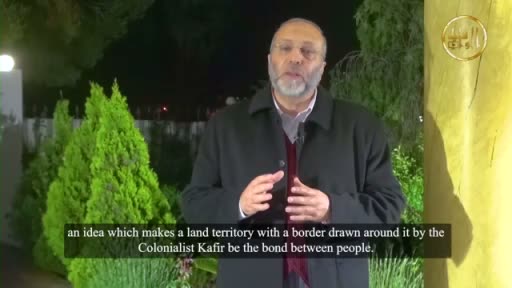
More important than all of this, they invented a new idea and persuaded peoples who were immersed in the darkness of backwardness and decline to accept it. It was an idea intended to make the inhabitants themselves eager to divide their lands and fragment their Ummah: the idea of patriotism, together with the deception called independence. They made a concerted effort to produce large groups of intellectuals, moulding them according to Western civilisation, its culture and its viewpoint. These intellectuals actively promoted patriotism—an idea that makes the bond between people the parcel of land whose borders the colonial disbeliever drew. They also manufactured a history for each homeland in which its inhabitants could take pride.
They told the Iraqi: ‘You possess an ancient history—the history of the Babylonians and Chaldeans.’ They told the Syrian: ‘You possess a glorious history—the history of the Assyrians and Sumerians.’ They told the Lebanese: ‘You are descendants of the Phoenicians, who taught humanity the alphabet.’ They told the Egyptians: ‘You are heirs of the great Pharaohs.’ Thus, each people came to take pride in its land, soil and history of Jahiliyyah instead of taking pride in the Islamic creed, legislation, culture and history. In the eyes of our students and intellectuals, the heroes became Nebuchadnezzar, Adonis, Astarte and Hannibal, whereas we had previously taken pride in Muhammad, the Messenger of Allah, may Allah bless him and grant him peace, the Rightly Guided Caliphs and great commanders such as Khalid ibn al-Walid, Harun al-Rashid, Salah al-Din al-Ayyubi, al-Zahir Baybars and Sultan Mehmed the Conqueror.
Patriotism thus became one of the factors that destroyed the Islamic Ummah’s entity, scattered the Islamic world and served as an instrument of its destruction. Despite that, this idea continues to be promoted and marketed through the media, books and publications, and especially in educational curricula at every stage. The Shari’ah obligation therefore requires us to present the correct view of this idea, just as we presented the correct view of nationalism in the previous halaqa.
Defining Patriotism and the Homeland
Dear brothers, proponents of patriotism present it as a bond that unites people in a particular homeland. But what is this homeland? In reality, those who call to patriotism regard the homeland as the political entity on which a state stands, with borders drawn on the map, regardless of who drew those borders. They therefore speak of Lebanese patriotism, Iraqi patriotism, Egyptian patriotism and so on, corresponding to the many existing entities in the Islamic world. But is this truly the meaning of the word ‘homeland’?
The Linguistic Meaning of Homeland and Its Distortion
Regarding the linguistic meaning of the word watan, the author of al-Qamus al-Muhit says: ‘The place of residence. A watan is the place of residence and where cattle and sheep are tethered. The plural is awtan. Watana bihi, yatinu, and awtana: he resided.’ This is the linguistic meaning of watan. Residence, dear brothers, may be in a village or a city, and so either a city or a village may be called a watan. The broadest meaning of watan, both in the language and in the lived reality that a human being experiences, is therefore the village or city in which the person lives.
As for all other cities and villages, they are equal in relation to him. There is no difference between a city or village within his governorate, emirate or state and another outside it: they are all equal because he does not reside in them. A person living in Beirut, for example, may have his heart attached to Beirut because he lived there, made it his home and became accustomed to it. Yet there is no difference to him between Tripoli in al-Sham and Damascus, between Sidon and Alexandria, or between Baalbek and Baghdad, because they are all cities in which he does not reside.
However, when the advocates of patriotism wanted to invent an idea through which they could entrench the entities that the colonial disbeliever had established in our lands after dividing them into frail statelets, they distorted the word watan so that it came to denote Lebanon, which Gouraud founded in 1920, and the entities of Iraq, Jordan, Palestine, Syria and Egypt, which Western treaties and conspiracies such as Sykes–Picot and San Remo created.
Patriotism Divides the Ummah’s Loyalty
Patriotism thereby becomes the bond that unites the people living within the borders of one of these states and separates them from all the people outside those borders. The Lebanese person thus becomes linked only to other Lebanese people, and the Egyptian only to other Egyptians, until the Ummah is divided and its loyalties and concerns multiply, so that it no longer works together for one cause—the cause of the Ummah. What matters to an Algerian, for example, does not matter to a Tunisian, and so on.
To entrench that concept, malicious and misleading slogans were spread among people, such as ‘Religion belongs to Allah and the homeland belongs to everyone.’ They said that belonging to the homeland takes precedence over belonging to the religion, along with other slogans that conflict with Islam at their roots. How can patriotism be reconciled with the words of the Messenger of Allah, may Allah bless him and grant him peace: «مَثَلُ الْمُؤْمِنِينَ فِي تَوَادِّهِمْ وَتَرَاحُمِهِمْ وَتَعَاطُفِهِمْ مَثَلُ الْجَسَدِ، إِذَا اشْتَكَى مِنْهُ عُضْوٌ تَدَاعَى لَهُ سَائِرُ الْجَسَدِ بِالسَّهَرِ وَالْحُمَّى» — ‘The believers in their mutual affection, mercy and compassion are like one body: when one part of it suffers, the rest of the body responds with sleeplessness and fever’ [Sahih Muslim 2586]?
Patriotism Is Unsuitable as a Bond for Society
Dear viewers, after this explanation, the danger that patriotism poses to the Ummah’s entity and the conspiracy against it are clear. What we said in our previous halaqa about nationalism applies equally to patriotism. In addition, reality proves that land does not unite people or bind them together. It can sometimes act as a temporary bond when the homeland is attacked by a foreign aggressor whom all citizens reject; everyone then bands together until they repel that common enemy. But in a state of peace, which is the natural condition, land cannot unite people or serve as a bond between them.
The greatest evidence of this is that homelands containing a mixture of inhabitants whose thoughts and emotions contradict one another remain in constant tension, and wars prevail within them. They scarcely emerge from one war before entering another. This proves that patriotism is not a bond for society. Lebanon, for example, is classed as one state and one homeland, as they say. Yet differences in thoughts and tribal affiliations caused emotions to differ, the state to be torn apart and the country to remain in constant tension and perpetual failure.
The False Argument Based on Love of Makkah
Yet what is truly astonishing is to find people attributing the idea of patriotism to Islam. They say that Islam encouraged patriotism and strengthened patriotic feeling among Muslims, citing, for example, that when the Messenger, may Allah bless him and his family and grant them peace, was expelled from Makkah, he addressed it, saying: «إنك أحب أرض الله إلي، وأحب أرض إلي، ولولا أن أهلك أخرجوني منك ما خرجت» — ‘You are the part of Allah’s earth that I love most, and the land I love most. Had your people not driven me out of you, I would not have left’ [by meaning; Jami‘ at-Tirmidhi 3925]. They also argue that Islam commanded the defence of homelands and regarded that as jihad in the cause of Allah.
As for the hadith of the Messenger of Allah, may Allah bless him and grant him peace, that is cited as evidence, it has nothing whatsoever to do with patriotism. The Messenger, may Allah bless him and grant him peace, did not love Makkah because it was his homeland; he did not love Makkah because it was his homeland. Rather, he loved it because it is the Sacred City that contains the noble Ka‘bah, and so it is the land most beloved to Allah Most High. What makes this perfectly clear is the very same hadith that they often cite only in part. Ibn Hatim narrated from Ibn Abbas, may Allah be pleased with him, that when the Prophet, may Allah bless him and grant him peace, left Makkah for the cave, he turned towards Makkah and said: «أَنْتِ أَحَبُّ بِلَادِ اللَّهِ إِلَى اللَّهِ، وَأَنْتِ أَحَبُّ بِلَادِ اللَّهِ إِلَيَّ، وَلَوْلَا أَنَّ الْمُشْرِكِينَ أَخْرَجُونِي لَمْ أَخْرُجْ مِنْكِ» — ‘You are the land of Allah dearest to Allah, and you are the land of Allah dearest to me. Had the polytheists not driven me out, I would not have left you’ [Tafsir Ibn Abi Hatim, 47:13]. Thus, the Messenger, may Allah bless him and grant him peace, loved Makkah because it is the land most beloved to Allah Most High.
Defending Islamic Lands, Not Homelands
As for their claim that Islam commanded the defence of homelands and regarded this as jihad in the cause of Allah, it contains much deception and misdirection. Why? Because Islam did not command the defence of the homeland, as they claim. Rather, it commanded the defence of the Islamic lands and Islamic territory, regardless of whether that territory is the homeland of the person fighting or not. On this basis, the obligation of jihad to liberate Palestine from the Jewish State, for example, to liberate al-Andalus from the Europeans, and to defend the lands of Bosnia and Herzegovina, Chechnya and Kashmir in India does not fall only upon the inhabitants of those lands, as long as they cannot repel the aggression alone. Rather, the obligation falls upon all Muslims nearest to them, then those next nearest, until the obligation is fulfilled.
On this basis, a Muslim who lives outside the Islamic lands—such as a Muslim living in Australia or America—is also not obliged to defend that country if war breaks out between the state in which he lives and another state. Rather, he may not fight for it, because that would be fighting for other than the cause of Allah. The Messenger, may Allah bless him and grant him peace, said: «مَنْ قُتِلَ تَحْتَ رَايَةٍ عِمِّيَّةٍ، يَدْعُو عَصَبِيَّةً، أَوْ يَنْصُرُ عَصَبِيَّةً، فَقِتْلَةٌ جَاهِلِيَّةٌ» — ‘Whoever is killed under a blind banner, calling to tribalism or supporting tribalism, dies a death of Jahiliyyah’ [Sahih Muslim 1850].
The Messenger and the Companions Were Not Attached to Homeland Soil
Moreover, the Messenger, may Allah bless him and grant him peace, did not cling to the soil of his homeland, Makkah, from which he and his noble Companions had been unjustly expelled. He could have done so after the Conquest, but he returned to Madinah, the seat and capital of the Islamic State that he had established, and he lived there for the rest of his life. Nor did he instruct the Muslims to bury his pure body in the soil of the homeland, Makkah al-Mukarramah.
This is also what his Companions, may Allah be pleased with them, did after him. The martyrs of Badr and Uhud were buried in al-Baqi in Madinah. Abu Ubaydah ibn al-Jarrah, may Allah be pleased with him, was buried in the Jordan Valley. Abu Ayyub al-Ansari was buried near the walls of Constantinople. Large numbers of the Companions who had memorised the Qur’an were buried on the outskirts of India and by the Caspian Sea during the Islamic conquests. Neither the Messenger of Allah, may Allah bless him and grant him peace, nor his noble Companions ever displayed any sign of patriotism or longing for their homelands. Their foremost concern and vital cause was to raise the word of Allah, spread Islam and bring people out of darkness into light.
The Saying ‘Love of One’s Homeland Is Part of Belief’
Dear brothers, some advocates of patriotism have gone so far as to fabricate hadiths about the Messenger of Allah, may Allah bless him and grant him peace, such as their saying: ‘Love of one’s homeland is part of belief.’ Some people claim that this is a hadith from the Messenger of Allah, may Allah bless him and grant him peace. It is not a hadith, and he did not say it.
The Difference Between Love of One’s Homeland and Patriotism
Add to that—I add to that—that love of one’s homeland is one thing and patriotism is another. How so? Love of one’s homeland is natural and instinctive for many people. A person’s heart becomes attached to the place to which he is accustomed, in which he grew up and with which he has beautiful memories. He therefore longs for the house in which he grew up and loves the neighbourhood, village or city in which he grew up or lived for a period. Yet this instinctive love does not extend beyond the village, city or region in which the person lived.
As for patriotism, which palace intellectuals, regime writers and the West’s disciple promote, they want it to be a bond that unites the inhabitants of one state and separates them from all their other brothers throughout the Islamic world.
The Ruling on Calling to Patriotism
We therefore say that calling to patriotism promotes Western thought that is alien to Islam. The Messenger of Allah, may Allah bless him and grant him peace, said: «مَنْ أَحْدَثَ فِي أَمْرِنَا هَذَا مَا لَيْسَ مِنْهُ فَهُوَ رَدٌّ» — ‘Whoever introduces into this matter of ours something that does not belong to it, it is rejected’ [Sahih Muslim 1718]. Consequently, one who calls to patriotism is sinful before Allah Most High. The obligation requires Muslims to reject all alien ideas and propositions, and once again revive the Islamic bond, so that they may rebuild their life and society on the basis of the Islamic creed. The thoughts, emotions and systems of Islam will then prevail in this society until the Ummah resumes the Islamic way of life and once again becomes the most elevated of the world’s nations.
If the whole Ummah is addressed by this discourse, its intellectuals are the people most deserving of responding. Alien ideas spread within their milieu and then spread through them, so the responsibility for change rests upon their shoulders. I say these words and ask Allah to forgive me and you.