Opening text of the book The System of Islam
The only correct bond, which binds humankind in life, is the bond of rational creed (‘Aqeedah) from which a system emanates; that is the ideological bond (raabiTah mabda’iyyah).
The ideology (mabda`) is a rational creed from which a system emanates. The ‘Aqeedah (creed) is a universal idea about the universe, man and life, what preceded this worldly life, what is to follow it, and the relationship of this worldly life with what preceded it and what is to follow it. As for the system that emanates from this ‘Aqeedah, it is the treatments (mu’alijaat) for man’s problems, the howness (kayfeeyah) of implementing those treatments, preserving the creed and conveying the ideology to others.
Thought as the Basis of Revival and Civilisation
Dear brothers, what leads peoples and nations to revival is the thought they carry, just as thought may also cause peoples to decline. A people rises through the elevation of the thought it carries and declines through that thought’s decline. A society’s civilisation (HaDaarah) is nothing other than the intellectual structure that shapes its mentality, forms its relations and solves its problems. That civilisation’s degree of elevation or decline corresponds to the elevation or decline of that thought.
What, then, is elevated thought, and what is low thought? Elevated thought is comprehensive, integrated and coherent thought. It can give man an opinion about everything connected with his behaviour and a position towards any event. It can provide a system that regulates all relations in society without neglecting any aspect, and does so precisely, consistently and harmoniously. It thereby creates within that society a harmonious pattern of life or mode of behaviour, with a particular style and distinct character. Its treatments do not clash, its rules do not contradict one another, and they do not undermine one another. Such thought can turn the human group that carries it and applies its system into a strong, cohesive society that moves progressively towards revival, because it has coordinated society’s relations and freed it from disorder, contradictions and internal conflicts.
The Intellectual Basis on Which Revival Is Founded
The problem, however, lies in how to obtain that elevated thought which possesses these qualities and is distinguished by such integration and comprehensiveness. Where can societies obtain such thought? Tangible reality and history, as well as enlightened observation and thought, prove that such thought can only exist if it has an intellectual basis: an intellectual basis for all thoughts.
That is because every structure needs a foundation, and an intellectual basis is what can serve as the foundation of that intellectual structure. This intellectual basis—the fundamental thought—can only be a basis if it is a rational creed that provides a universal idea about the universe, man and life. It acquaints man with his origin and destination, and therefore with the nature and purpose of his life. This creed thereby becomes a suitable foundation on which that intellectual structure can be built.
It must also be a political creed, such that systems for life emanate from it, take care of people’s affairs in their society, and accord with the thoughts they hold and the emotions prevalent among them. This makes that society a distinct and unique civilisational entity, while the creed it embraces serves as its intellectual leadership, leading it progressively towards revival.
Ideology and Ideological Thought
This thought is what is called ideological thought; an ideology is a rational creed from which a system emanates.
Medieval Europe and the Absence of Ideology
This ideology is what the peoples of Europe lacked in the Middle Ages; that is, those peoples did not then possess an ideological thought on whose basis they could achieve revival.
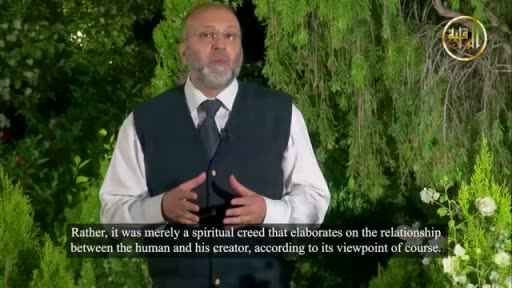
It is true that those peoples followed one religion and one creed, Christianity. However, that creed was neither political nor rational; it was merely an emotional creed that those peoples received by imitating their fathers, monks and priests. It was therefore not capable of serving as a basis for revival-oriented thoughts in society, and consequently no systems for life, society and state emanated from it. It was merely a spiritual creed that, according to its own viewpoint, of course, explained man’s relationship with his Creator and directed him towards a set of morals and spiritual and human values.
Although kings and churchmen ruled in the name of religion and divine mandate, this certainly does not mean that they took care of people’s affairs through laws derived from religion, the Gospel and Christianity. Instead, they applied man-made systems and laws that had no connection with Christianity. These were among the lowest and most oppressive types of systems and became known as the feudal system.
The renowned British historian Will Durant says in ‘Feudal Law’: ‘Custom and law were one and the same under feudal government, where judges and those responsible for enforcing civil law were ordinarily illiterate. Whenever a question arose about law or punishment, the oldest members of the community were asked what customary practice they remembered from their youth.’
Europe and the Arabs in Jahiliyyah
In short, dear brothers, the decline Europe experienced during the Middle Ages was in fact due to the low culture that prevailed there.
The Arabs in Jahiliyyah were in the same position as the European peoples in the Middle Ages. They had no rational political creed to bind them together and strengthen the bonds of their society by regulating their relations. Instead, they carried a traditional priestly creed: the paganism of Jahiliyyah. It was therefore unsuitable as a basis for their thoughts or as intellectual leadership for their society’s movement. That society consequently remained in decline. Tribalism prevailed, turning tribes and clans into hostile, warring societies that continually fought one another for no reason other than revenge and tribal fanaticism. That society thus became known as the society of Jahiliyyah.
Comparison between the Islamic Revival and the European Revival
Despite their severe decline, the peoples of the Arabian Peninsula quickly emerged from the darkness of decline into the light of revival and elevation at the beginning of the seventh century CE, through a sudden, radical transformation. By contrast, decline continued to hang over the European peoples for many centuries during their Middle Ages, which lasted approximately a thousand years until the advent of the modern era. Signs of revival only appeared in the late fifteenth century, and they bore fruit only in the late eighteenth century.
In any event, we shall set aside the time difference between the birth of the European and Islamic revivals and the speed with which each bore fruit, and ask the following question:
The Common Factor in the Two Revivals
What factor was present in these two… in each of these two societies, so that the forces of revival stirred within them and they emerged from decline into elevation?
The answer, dear brothers, lies in the philosophy of revival we set out earlier: in each of these two societies, a rational political creed came into existence and served as an ideology upon which a comprehensive civilisational structure was built, leading society towards elevation.
The Islamic Ideology and the Building of Civilisation and State
In the Arabian Peninsula, Islam emerged as an ideology founded on a rational creed that provides a universal idea about the universe, man and life, about what precedes this worldly life and what follows it, and about its relationship to what precedes and follows it. It is the creed that there is no god but Allah and Muhammad is the Messenger of Allah. From this creed emanated the greatest system for man in his life, society and state.
It regulated man’s relationship with his Creator through the creeds it explained and the acts of worship it prescribed, such as prayer, fasting and Hajj. It regulated man’s relationship with himself through the morals and rulings on food and clothing that it prescribed. It regulated his relationship with other people in society through the systems it prescribed for society and the state.
From that creed emanated a governing system known as the Khilafah system. An economic system also emanated from it, regulating financial relations among people in society and specifying the state’s revenues and areas of expenditure; a social system regulating the relationship between men and women and treating family problems; a system of punishments; and other systems. The emanation of these systems from the Islamic creed took the form of their all being deduced from the Qur’an and the Prophetic Sunnah, which were sent as revelation from Allah Most High to His Messenger Muhammad, may Allah bless him and his family and grant them peace.
The Islamic Creed’s Impact on the Muslims’ Revival
This creed, dear brothers—the creed that there is no god but Allah and Muhammad is the Messenger of Allah—was an intellectual basis upon which the deep-rooted Islamic civilisation was built. On its basis, revival was achieved in the Arab lands. It then expanded to encompass a vast expanse of the inhabited world, spreading at a speed unparalleled in history, from China in the east to the Atlantic Ocean in the west.
The same Durant mentioned earlier describes the Islamic lands under the Khilafah State, which was established on the basis of the Islamic ideology, saying—Will Durant says: ‘The caliphs largely secured people’s lives and the fruits of their labour, opened opportunities to talented people, and spread prosperity for six centuries across regions that never again knew such prosperity after their era. With their encouragement and assistance, education spread, and science, literature, philosophy and art flourished so greatly that Western Asia was the world’s most culturally advanced region for five centuries.’
The Capitalist Ideology and Western Revival
In Europe, the conflict between churchmen on one side and kings and philosophers on the other led to the birth of a new ideology based on the creed of separating religion from life, which they often call secularism. This political creed became the intellectual basis on which contemporary Western civilisation was founded. The capitalist system emanated from it and is based on making man free from every restriction, whether religious or otherwise. This led to the Western revival that continues to this day, working to invade societies and convert them to its way of life.
The Truth of Revival and the Correct Ideology
Dear brothers, this is the true explanation of revival: it is the intellectual elevation embodied in a rational political creed that can serve as a basis for the thoughts of man and society, a source from which its system emanates and a foundation for its civilisation. In short, a nation’s possession of an ideology is the cause of its revival. One final question remains:
Is man’s aim merely to possess an ideology—any ideology—and the revival that results from it—any revival? Does any revival guarantee happiness and tranquillity for the human community? Or must a distinction be made between a true ideology and a false one, and therefore between a correct revival and an incorrect one? The answer, without doubt, is that man’s aim is not merely an ideology—any ideology—nor is his aim a revival—any revival. His aim is the true ideology that leads to the correct revival, which in turn guarantees man’s happiness and tranquillity.
Introduction to the Next Halaqa
How, then, can one distinguish between the two? This will be our subject in the next halaqa, Allah willing, so join us for the next halaqa. I say these words and seek Allah’s forgiveness for myself and for you. I shall return after a short break to answer any questions that may have been received during this halaqa. Peace be upon you and Allah’s mercy.
Audience Questions
Peace be upon you, and Allah’s mercy and blessings. Welcome back to the questions received during our episode.
Is Islam a political creed or a spiritual creed?
Brother Bin Nur asks: Is Islam a political creed or a spiritual creed?
Before answering this question, the viewer and listener have the right to know what both terms mean: what is a political creed, and what is a spiritual creed?
A political creed is a creed from which a system for life, society and the state emanates. If this creed represents a viewpoint towards life and gives man a system that regulates his relations in society, it is a political creed suitable as a basis for society and the state and as a source for legislation.
A spiritual creed, by contrast, establishes a relationship between man and his Creator. ‘The spiritual side’ or ‘the spiritual aspect’ is a term meaning man’s awareness of his relationship with Allah, Glorified and Exalted. Creeds that establish a relationship with Allah Almighty are therefore spiritual creeds.
Based on our definition of political and spiritual creeds, we ask: Is the Islamic creed a political creed or a spiritual creed? In fact, the Islamic creed alone, unlike every other creed existing in the world today, is both spiritual and political at the same time. Why? First, because it establishes a relationship between man and his Creator. Indeed, it acquaints man with his origin and destination, with this worldly life’s relationship to what precedes it—Allah, Glorified and Exalted—and its relationship to what follows it—the Day of Reckoning, the Day of Resurrection. It regulates… it acquaints man with his Creator, Glorified and Exalted, and regulates his relationship with Him through acts of worship. It is therefore a spiritual creed. But it is also a political creed because a system for life, society and the state emanated from it. It created a civilisation, established a state and created a society whose affairs are taken care of through the Shari’ah that emanated from this creed. The Islamic creed is therefore both spiritual and political at the same time.
Unlike the other creeds, the religious creeds that exist today—Christianity, Judaism, Buddhism, Hinduism and other religious creeds—are all purely spiritual creeds. This does not mean that they establish the correct relationship with Allah, but they have proposed and presented a type of relationship between man and his Creator. We reject them, but from this aspect they are spiritual creeds, not political creeds.
As for political creeds, the one present in our world today is the creed of separating religion from life. Some remaining traces of the communist creed—the creed that ‘there is no God and life is matter’—also still exist. At one time in the last century, the twentieth century, it prevailed over a large part of the world and was in conflict with the Western liberal ideology, the capitalist ideology, which was based on the creed of separating religion from life. Thus, these two creeds—the capitalist creed, the creed of separating religion from life, and the communist creed, which denies religion and says that there is no God and life is matter—are political creeds with no connection whatsoever to the spiritual aspect. One denies ruh (awareness of one’s relationship with Allah), denies the spiritual side and denies the spiritual aspect: the communist creed. The other separates spirit from matter and separates man’s spiritual life from his material life in this life. Islam alone, unlike other creeds, is distinguished by its creed being both spiritual and political at the same time.
How is a correct revival measured?
Sister Mona Nazzal: Peace be upon you. And peace be upon you, and Allah’s mercy and blessings.
Sister Mona asks: How is revival measured, and what are the characteristics of correct and incorrect revival? May Allah bless you.
I stated at the end of the episode I presented that this topic is the subject of our next episode. But briefly, and out of respect for my sister who asked the question, I say: correct revival is that which is built on the correct ideology, and the correct ideology is that which is built on the correct creed. Conversely, any false creed that produces a false ideology results in an incorrect revival for human beings. As we said during the episode, the issue is not to reach just any revival; rather, it is to reach a revival that brings man the tranquillity he seeks, the sound satisfaction of his innate nature and, consequently, the happiness he seeks.
What is the criterion for a correct creed, and what is the criterion for a false creed? We discussed this at the beginning of the episodes of Halaqa Online, in The Way to Belief series. We discussed the two criteria of a correct creed and said that it is a creed which accords with human nature and is founded on reason. This is absent from every creed other than Islam. The Islamic creed is the creed that accords with human nature and that Allah, Glorified and Exalted, founded on reason: He made rational evidence the means of establishing the Islamic creed and made the mind the condition for legal responsibility. We shall discuss this subject in detail and at length, Allah willing, in the next episode, next week, Allah Most High willing.
Conclusion
These were the questions received tonight, dear brothers. I ask Allah, Glorified and Exalted, to accept from us all our fasting, night prayer and all other acts of obedience, and to make us among those freed during this noble month. I ask Allah, Glorified and Exalted, to accept from us all. I ask Him, Glorified and Exalted, to increase us in knowledge and action, and to make our knowledge and action sincere for His Noble Countenance. I invoke blessings and peace upon the Messenger of Allah, his family, his Companions and those loyal to him.
In the name of Allah, the Most Merciful, the Most Compassionate.
﴿ وَٱلْعَصْرِ إِنَّ ٱلْإِنسَـٰنَ لَفِى خُسْرٍ إِلَّا ٱلَّذِينَ ءَامَنُوا۟ وَعَمِلُوا۟ ٱلصَّـٰلِحَـٰتِ وَتَوَاصَوْا۟ بِٱلْحَقِّ وَتَوَاصَوْا۟ بِٱلصَّبْرِ ﴾
‘By time! Man is surely in loss, except those who believe, do good deeds, urge one another to the truth and urge one another to patience’ [103:1–3]
Peace be upon you and Allah’s mercy.