Introduction
Peace be upon you, mercy and blessings of Allah. In the name of Allah, the Most Merciful, the Most Compassionate. Praise be to Allah, peace and blessings be upon His Messenger, his family, companions, and those who follow them in truth. Welcome, my dear brothers, to another new episode of your programme Halaqa Online. Today we begin a fresh series exploring how to carry the da’wah in Islam.
Revival of the Ummah through Revelation
In this halaqa, we discuss a topic that we may entitle: The Islamic Ummah’s Revival through Revelation and Its Decline in Proportion to Its Distance from This Revelation. My dear brothers, respected viewers.
The Historical Struggle with Europe
Throughout its long history, the Islamic Ummah has faced countless enemies from every direction. Yet the persistent adversary that has challenged it since the dawn of Islam until this very day is the European states—whether in the form of the Byzantine Empire, which Muslims fought and ultimately overthrew in 1453 CE; or the Catholic kingdoms of Western Europe, whose lands were entered by Muslims through Al-Andalus; or the modern colonial powers founded upon a new civilisational creed: the separation of religion from life. Since these European states lacked any civilisational message to present to the world during the Middle Ages—particularly one to confront Islam—their sole weapon was the Crusades. Thus, they posed no great threat at that time, especially against an Ummah possessing a refined and elevated civilisation like our own. Indeed, those very Crusades would never have succeeded had it not been for the conditions prevailing in the Islamic world: fragmentation, internal strife, and competition over provinces and emirates. As soon as Muslims reunited their ranks, the Frankish Crusaders retreated in defeat back to their lands.
The Western Civilisational Transformation
Yet the true catastrophe unfolded when Western society began reshaping itself upon new foundations—transforming into a novel civilisation equipped with ideas and systems capable of confronting the world at large, particularly an Ummah that had long been Europe’s most formidable adversary across centuries. The contemporary Western civilisation was never destined to triumph over Islamic civilisation, nor could its thought ever surpass Islam’s ideology; for it is Islam alone that rests upon the sound creed, while its system is the one revealed by Allah—exclusively suited to humanity. If the West emerged victorious in this intellectual and civilisational struggle against the Ummah, it did not conquer Islam itself. Islam is the religion of Allah, which prevails without being overcome, with falsehood never approaching from before or behind it. Rather, the West triumphed over Muslims themselves—those who no longer embrace Islam with the same strength, understanding, and awareness as their predecessors.
The Rise of the West and the Decline of Muslims
At the beginning of the nineteenth century, with the outbreak of liberation revolutions in the West—beginning with the French Revolution of 1789 CE—the features of contemporary Western civilisation began to take shape and its intellectual structure became complete. Western society was established upon new ideas and systems embodied in liberal capitalism, after it had been dominated by feudal systems. As that civilisation, as we have said, is based on a rational political creed from which systems for life, society and the state emerge, it brought about in the West a revival which we Muslims do not consider the correct revival. Nevertheless, it was sufficient to confront an Ummah whose thinking had become dull, whose ideas had become rigid, which had misapplied its system and lived on the margins of its great civilisation—I mean, of course, the Islamic Ummah. Here was the West in the nineteenth century: its civilisation flourished, its political institutions were established on a strong foundation, its society became largely stable, and it advanced towards revival. It grew stronger economically and militarily and excelled in material forms, construction and technology. At the same time, the Islamic State was breaking apart, losing one frontier after another. Its political and economic problems and crises worsened; it grew militarily weak, fell behind in material and technological progress, and rapidly descended into decline. In short, the balance began to tip rapidly—at tremendous speed—in favour of Western civilisation.
The Civilisational War
All these conditions, together with the astonishment that struck the Islamic Ummah after it became convinced of its enemy’s superiority over it in this way, left the field open for the West to wage a new kind of war against the Islamic Ummah. It used a weapon more effective than the weapons of the Crusades: a civilisational war whose weapons were ideas, viewpoints and systems of life, and whose arena was culture, knowledge and debate. Since morale is the most important factor in wars, including intellectual wars, the atmosphere from the outset pointed to the West’s victory over the Muslims—not over Islam. Because the Muslims had experienced their own backwardness and their enemy’s superiority, they began to lose confidence in their Islamic concepts and systems. This weakened their morale before an enemy with high morale that took pride in its civilisation, ideas and what it called its modern systems.
The Confusion of Muslims
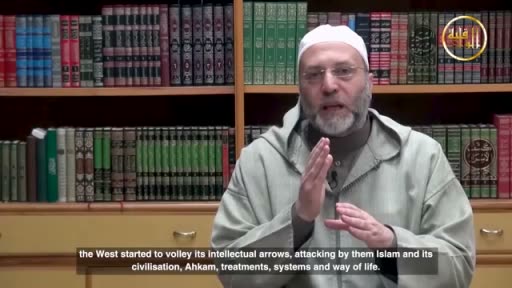
Thus, questions crowded the minds of Muslims: Why did the West revive? Why did we fall behind? Did the West adopt the means to strength while we abandoned them? Could our concepts be incorrect? Perhaps we understood Islam wrongly? Perhaps the West adopted the virtues of our Islam? May we not take from the West the causes of its revival? Did it not take the causes of revival from us after we had been their pioneers? Can Islam and Western civilisation (hadara) be reconciled? May we not adopt some systems from the West? Does Islam forbid benefiting from what others possess? While these questions confused and clouded Muslim minds, the West began firing its intellectual arrows, attacking Islam, its civilisation, rulings, solutions, systems and way of life. Naturally, this placed Western civilisation on the offensive and the Islamic Ummah on the defensive. If only it had been a successful defence that protected Islam.
The Attack on Islamic Rulings
The West attacked the Caliphate system, saying that it was an individual, dictatorial system and that the democratic system was the alternative. It attacked jihad, saying that it was tyranny, the spread of Islam by force of the sword and the denial of peoples’ right to self-determination. It attacked polygamy, saying that it oppressed women and degraded their dignity. It attacked the bond of Islamic brotherhood—the bond of the Islamic Ummah—saying that it was fanaticism and narrow-mindedness, and that the correct bond was nationalism or patriotism. It attacked ruling by the rules of religion, saying that it was reactionary and that religion therefore had to be separated from politics.
Defensive Response and Concessions
How did the Muslims respond? Their response to that attack and those accusations was naturally defensive. The weakness that had afflicted the Islamic Ummah led it to accept the position of the accused and to feel obliged to defend itself against the charges, even though the things the West attacked in Islam were virtues, not vices, and good, not evil. However, because Muslims had lost their vitality of thought and mental sharpness over the preceding centuries, while the door of ijtihad remained closed, they failed to recognise these truths. Instead of defending the Caliphate system by saying that it is the correct system and that leadership can only be individual, and instead of saying that democracy is a misguided system because it gives the right of legislation to the people, whereas that right belongs to Allah alone both rationally and according to our Islamic creed, and that democracy is a deceptive, false idea, they said instead that Islam is based on shura and that shura is identical to democracy.
Instead of taking pride in waging jihad against states and rulers in order to break down the barriers that prevent Islam from being carried as a message to the world—while other nations and states fight and shed blood to control lands, enslave people and plunder their wealth—the Muslims said instead that jihad is only a defensive war and is permissible only to repel aggression against Muslim lands. Instead of standing firmly by Islam’s rulings and insisting that permitting polygamy is the correct system because it comes from Allah, Who created human beings and knows what is good and suitable for them, and that permitting polygamy is the system that prevents the spread of adultery and vice and prevents women from remaining unmarried, they said instead that Islam had restricted polygamy and permitted it only in exceptional cases, along with similar claims.
The Mixing of Islamic Culture with Western Ideas
Thus, the Muslims continued trying to reconcile Western civilisation with Islam until they mixed Islam’s rulings and ideas with the West’s rulings, ideas and systems. Hundreds of years had passed in which Muslims had been influenced only very slightly by the ideas of the civilisations and cultures with which they came into contact. Yet a few decades in which the West waged its civilisational and intellectual war against the Muslims were enough to turn their culture—the Muslims’ culture—into an abhorrent mixture of Islamic ideas and the ideas of Western civilisation.
From Rejecting Material Progress to Accepting Civilisation (Hadara)
In the past, when Muslims still held the West in contempt—its society and civilisation—they refused to adopt even its material achievements or technological innovations. When some rulers attempted modernisation in methods, means, and forms within Islamic lands, they faced opposition from scholars who went so far as to prohibit printing presses and telephones. But once the West surpassed them decisively, threatening the Islamic state while Muslims marveled at its industrial and material progress, the situation changed: all doors were opened to whatever came from the West without distinguishing between civilisation (hadara) and material forms (madaniyya), nor between culture and science.
Western ideas began invading us, one after another: the idea of democracy, public freedoms, nationalism, patriotism and others—all while people claimed to remain committed to Islam. Those imported ideas, Western culture and Western civilisation were then attributed to Islam, although Islam is free of them. Muslims said that democracy came from Islam, that Islam safeguarded public freedoms, that Islam preserved the distinct character and dignity of national groups, and that Islam strengthened patriotic feeling by commanding the defence of homelands. Thus, every idea coming from the West that imposed itself upon public opinion was falsely and deceitfully inserted into Islam through new so-called fiqh maxims that were unknown to the early jurists, and through talk of the flexibility of the Shari’ah and similar claims.
After the Destruction of the Caliphate
However, the concern to reconcile Islam with Western civilisation began to fade after Islam’s authority disappeared and the Islamic Caliphate was destroyed. In the twentieth century, Muslim lands came under governments that ruled by other than what Allah had revealed and established media and educational institutions that promoted Western civilisation as the furthest humanity had reached in development, progress, elevation and so forth, and as the human system suitable for this age. All this led to the conviction that Islam’s system, solutions and rulings were no longer suitable for our time. Most intellectuals therefore abandoned attempts to reconcile Islam with Western civilisation and adopted ideas that clearly and openly contradicted Islam. Sadly, the separation of religion from the state became a prevailing opinion; resorting to man-made systems became normal; and following the coloniser’s policies and slogans became something that caused no embarrassment. The nationalistic bond, followed by the patriotic bond, replaced the bond of Islam. Slogans hostile to Islam, its system and its viewpoint spread, such as: “Leave to Allah what belongs to Allah, and to Caesar what belongs to Caesar”; “Religion belongs to Allah and the homeland belongs to everyone”; and “Islam is too pure to be tainted by politics,” along with similar slogans.
When the hostility of the Western capitalist states and their greed for Muslim lands became apparent, many intellectuals turned towards socialism, its philosophy and its system: Marxism, materialist dialectics and communism. Many individuals even reached the point of boasting about atheism and taking pride in embracing materialist dialectics. Political Islam and Islamic civilisation were no longer subjects of discussion; they had become a historical legacy of the past. Intellectuals no longer cared whether their ideas agreed with Islam or contradicted it. In their view, Islam had nothing to do with life, society, the state or politics. It was merely a relationship between a person and his Creator, for whoever was convinced and wished to believe, and its place was the mosque and the home—not life, society or politics. This, of course, occurred at the lowest point of the Islamic Ummah’s decline and distance from its Islam.
The Return of Islam to the Intellectual Arena
Yet the religion which Allah, Exalted is He, has guaranteed to preserve was never without a group of sincere believers who remained firmly committed to Islam as a religion and a system for life, and who were not swept away by the currents of secularisation and atheism. Their role then came to the fore, and they became pioneers in the intellectual and cultural arena when all the imported propositions and slogans from the West and the communist East collapsed in the Islamic world. Their efforts combined with new political conditions and circumstances to move the Islamic Ummah, from the 1970s onwards, towards renewed adherence to Islam as a religion and a system for life, society and the state, and towards rejecting every orientation, idea and proposition that was hostile or contrary to Islam.
Revelation: The Secret of Islamic Revival
My dear brothers, the revelation sent down to the Messenger Muhammad—may Allah bless him and grant him peace—presented a comprehensive idea of the universe, human beings and life, and legislated systems for life. It thereby established a complete ideology for people: Islam, the only ideology to originate from revelation rather than human beings. This is the secret of the distinctive revival of the Islamic Ummah. Its revival resulted from living according to what divine revelation brought and from adhering to Allah’s commands, prohibitions and ways that He approved for His pious servants. It was therefore the only correct revival: human conduct within it harmonises with the movement of the universe and all other created things, all of which submit to the system Allah has ordained for them without deviating by even a hair’s breadth.
The Universe’s Submission to Allah’s System
Listen to some of Allah’s verses in His Noble Book that establish this truth. Allah, Exalted is He, said:
﴿ وَلَهُۥٓ أَسْلَمَ مَن فِى ٱلسَّمَـٰوَٰتِ وَٱلْأَرْضِ طَوْعًا وَكَرْهًا وَإِلَيْهِ يُرْجَعُونَ ﴾
‘And to Him has submitted whoever is in the heavens and the earth, willingly or unwillingly, and to Him they will be returned.’ [3:83],
and He, the Glorified, said:
﴿ وَٱلشَّمْسُ تَجْرِى لِمُسْتَقَرٍّ لَّهَا ۚ ذَٰلِكَ تَقْدِيرُ ٱلْعَزِيزِ ٱلْعَلِيمِ وَٱلْقَمَرَ قَدَّرْنَـٰهُ مَنَازِلَ حَتَّىٰ عَادَ كَٱلْعُرْجُونِ ٱلْقَدِيمِ لَا ٱلشَّمْسُ يَنۢبَغِى لَهَآ أَن تُدْرِكَ ٱلْقَمَرَ وَلَا ٱلَّيْلُ سَابِقُ ٱلنَّهَارِ ۚ وَكُلٌّ فِى فَلَكٍ يَسْبَحُونَ ﴾
‘The sun runs to its appointed resting place. That is the decree of the Almighty, the All-Knowing. As for the moon, We have determined phases for it until it returns like an old date stalk. The sun cannot overtake the moon, nor can the night outstrip the day. Each floats in an orbit.’ [36:38–40],
and He, Mighty is He, said:
﴿ ثُمَّ ٱسْتَوَىٰٓ إِلَى ٱلسَّمَآءِ وَهِىَ دُخَانٌ فَقَالَ لَهَا وَلِلْأَرْضِ ٱئْتِيَا طَوْعًا أَوْ كَرْهًا قَالَتَآ أَتَيْنَا طَآئِعِينَ فَقَضَىٰهُنَّ سَبْعَ سَمَـٰوَاتٍ فِى يَوْمَيْنِ وَأَوْحَىٰ فِى كُلِّ سَمَآءٍ أَمْرَهَا ﴾
‘Then He turned to the heaven while it was smoke and said to it and to the earth, ‘Come, willingly or unwillingly.’ They said, ‘We come willingly.’ So He completed them as seven heavens in two days and revealed in each heaven its command.’ [41:11–12],
and He, Mighty is He, said:
﴿ تُسَبِّحُ لَهُ ٱلسَّمَـٰوَٰتُ ٱلسَّبْعُ وَٱلْأَرْضُ وَمَن فِيهِنَّ وَإِن مِّن شَىْءٍ إِلَّا يُسَبِّحُ بِحَمْدِهِۦ وَلَـٰكِن لَّا تَفْقَهُونَ تَسْبِيحَهُمْ إِنَّهُۥ كَانَ حَلِيمًا غَفُورًا ﴾
‘The seven heavens, the earth and whoever is in them glorify Him. There is nothing that does not glorify Him with praise, but you do not understand their glorification. Indeed, He is Most Forbearing, Most Forgiving.’ [17:44].
Fitrah and the Law of Revelation
My brothers, among the most important things that harmonise with this conduct and with a life governed by Allah’s Shari’ah—the Shari’ah of revelation—is the human fitrah, which Allah created inclining towards worshipping Him and which He mentioned in His Noble Book:
﴿ فَأَقِمْ وَجْهَكَ لِلدِّينِ حَنِيفًا ۚ فِطْرَتَ ٱللَّهِ ٱلَّتِى فَطَرَ ٱلنَّاسَ عَلَيْهَا ۚ لَا تَبْدِيلَ لِخَلْقِ ٱللَّهِ ۚ ذَٰلِكَ ٱلدِّينُ ٱلْقَيِّمُ وَلَـٰكِنَّ أَكْثَرَ ٱلنَّاسِ لَا يَعْلَمُونَ ﴾
‘So direct your face towards the religion, inclining to truth—the innate nature of Allah upon which He created mankind. There is no changing Allah’s creation. That is the upright religion, but most people do not know.’ [30:30].
Obedience, Blessings and Succession
Hence the many verses that link adherence to Allah’s Shari’ah with the bestowal of blessings, the abundance of good things, and the enjoyment of security, tranquillity and well-being, such as His saying:
﴿ وَأَلَّوِ ٱسْتَقَـٰمُوا۟ عَلَى ٱلطَّرِيقَةِ لَأَسْقَيْنَـٰهُم مَّآءً غَدَقًا ﴾
‘Had they remained steadfast on the path, We would certainly have given them abundant water to drink.’ [72:16]
and His saying, Exalted is He:
﴿ وَلَوْ أَنَّ أَهْلَ ٱلْقُرَىٰٓ ءَامَنُوا۟ وَٱتَّقَوْا۟ لَفَتَحْنَا عَلَيْهِم بَرَكَـٰتٍ مِّنَ ٱلسَّمَآءِ وَٱلْأَرْضِ وَلَـٰكِن كَذَّبُوا۟ فَأَخَذْنَـٰهُم بِمَا كَانُوا۟ يَكْسِبُونَ ﴾
‘Had the people of the towns believed and had taqwa, We would certainly have opened for them blessings from the heaven and the earth. But they denied, so We seized them for what they used to earn.’ [7:96]
Then listen to these noble verses recounting the words of Noah—peace be upon him—to his people, who acted tyrannically and wickedly upon the earth:
﴿ فَقُلْتُ ٱسْتَغْفِرُوا۟ رَبَّكُمْ إِنَّهُۥ كَانَ غَفَّارًا يُرْسِلِ ٱلسَّمَآءَ عَلَيْكُم مِّدْرَارًا وَيُمْدِدْكُم بِأَمْوَٰلٍ وَبَنِينَ وَيَجْعَل لَّكُمْ جَنَّـٰتٍ وَيَجْعَل لَّكُمْ أَنْهَـٰرًا ﴾
‘I said, ‘Seek forgiveness from your Lord; indeed, He is ever Most Forgiving. He will send down rain from the sky upon you in abundance, support you with wealth and children, provide you with gardens, and provide you with rivers.’’ [71:10–12]
And listen to His saying, in which He promises succession on earth to the believers who perform righteous deeds:
﴿ وَعَدَ ٱللَّهُ ٱلَّذِينَ ءَامَنُوا۟ مِنكُمْ وَعَمِلُوا۟ ٱلصَّـٰلِحَـٰتِ لَيَسْتَخْلِفَنَّهُمْ فِى ٱلْأَرْضِ كَمَا ٱسْتَخْلَفَ ٱلَّذِينَ مِن قَبْلِهِمْ وَلَيُمَكِّنَنَّ لَهُمْ دِينَهُمُ ٱلَّذِى ٱرْتَضَىٰ لَهُمْ وَلَيُبَدِّلَنَّهُم مِّنۢ بَعْدِ خَوْفِهِمْ أَمْنًا ۚ يَعْبُدُونَنِى لَا يُشْرِكُونَ بِى شَيْـًٔا ۚ وَمَن كَفَرَ بَعْدَ ذَٰلِكَ فَأُو۟لَـٰٓئِكَ هُمُ ٱلْفَـٰسِقُونَ ﴾
‘Allah has promised those of you who have iman and do righteous deeds that He will surely make them successors in the land, just as He made those before them successors; that He will firmly establish for them their religion, which He has approved for them; and that He will replace their fear with security. They worship Me, associating nothing with Me. Whoever disbelieves after that—it is they who are defiantly disobedient.’ [24:55]
Turning Away and Wretchedness
Conversely, Allah, Exalted is He, threatens societies that turn away from their Lord’s command, act tyrannically upon the earth and act wickedly within it with an evil outcome and the onset of wretchedness. He gives us examples of those societies that their injustice destroyed. Allah, Exalted is He, said:
﴿ وَضَرَبَ ٱللَّهُ مَثَلًا قَرْيَةً كَانَتْ ءَامِنَةً مُّطْمَئِنَّةً يَأْتِيهَا رِزْقُهَا رَغَدًا مِّن كُلِّ مَكَانٍ فَكَفَرَتْ بِأَنْعُمِ ٱللَّهِ فَأَذَٰقَهَا ٱللَّهُ لِبَاسَ ٱلْجُوعِ وَٱلْخَوْفِ بِمَا كَانُوا۟ يَصْنَعُونَ ﴾
‘Allah presents the example of a town that was secure and at ease, its provision coming to it abundantly from every place. But it denied Allah’s favours, so Allah made it taste the garment of hunger and fear for what they used to do.’ [16:112]
The Equation of Revival and Decline
From this, my dear brothers, the revival of the Islamic Ummah resulted from complete adherence to Allah’s commands and prohibitions—or, in other words, from firm attachment to the revelation sent down to Muhammad—may Allah bless him and grant him peace. The degree to which the Islamic Ummah adheres to revelation in thought and conduct is the degree to which it revives and elevates itself. The degree to which it moves away from that pure source is the degree to which it declines and falls. This is a fixed equation that can never be broken. Islamic history is the best witness to this. When the Muslims shaped their lives through Islam in the first Islamic society, during the age of Prophethood and the Rightly Guided Caliphate, they achieved their ideal revival and the best of generations was realised.
Then, when flaws began to affect that unique formation and conduct in Islamic society began to separate from the principles and rulings brought by revelation, decline began to seep into the body of the Islamic Ummah. The extent of that decline corresponded to the size of the breach between society’s conduct and revelation. The wider the breach became, the further the Ummah declined, until the Shari’ah of revelation disappeared from Muslim society and its state and they reached the lowest depth of decline.
The Muslims’ Duty towards Islam and Its Sources
It was therefore the Muslims’ duty to take the greatest care to understand Islam in a pure and untainted manner, so that their adherence to Islam, its ideas and its rulings would be adherence to the revelation Allah sent down to our master Muhammad—may Allah bless him and grant him peace. This requires them to scrutinise their view of the sources of Islamic legislation and to derive their rulings only from the sources brought by revelation from Allah, Exalted is He, to His Prophet—peace and blessings be upon him.
Summary of the Halaqa
In this halaqa, my dear brothers, we discussed a factor—the fundamental factor—the secret of the Islamic Ummah’s revival and, consequently, the causes of its decline and fall. No one… no one is unaware that the Islamic Ummah is still suffering from the state of decline and deterioration in which it has lived for a long time, although it has begun to rise by returning to Islam as a system for life. In subsequent halaqaat, Allah willing, we will discuss how to carry the da’wah and how to work for change in order to resume the Islamic way of life and return to an Islamic Ummah that forms an Islamic society, lives an Islamic life under the Shari’ah of Allah, Glorified and Exalted is He, and carries Islam as a message to the world. I invoke blessings and peace upon the Messenger of Allah, his family, his Companions and those who follow him.
Viewer Questions
I now turn with you, my dear brothers, to any questions that may have been submitted during this halaqa. We have a question from Sister Yusra. Yusra: Peace be upon you and Allah’s mercy and blessings. And peace be upon you and Allah’s mercy and blessings. May Allah bless you for what you present to us on this channel. May Allah honour you.
The Reason for the West’s Superiority in Material Progress (Madaniyya)
My dear brother, the question is: What is the secret of the West’s superiority over the Islamic world in material progress (madaniyya)?
Of course, by the term material progress (madaniyya), the question means progress in modern technology, industry, construction, civil engineering and, that is, everything that falls under the material means used in the affairs of life.
The State That Controls Its Own Affairs
Quite simply, an advanced nation that governs itself and exercises its own authority possesses power. It determines its own purpose and goals and acts on that basis. A political authority exists that develops plans and programmes and mobilises resources to achieve its goals. The West underwent an intellectual revival which we do not consider the correct revival. Rather, we consider it a revival that brings misery to humanity, but it was nevertheless a revival. A state arose there that was in harmony with the prevailing culture of society. There was therefore coherence in society’s way of life: its ideas, emotions and systems were based upon and rooted in a single creed—the creed of separating religion from life. That society determined its way of life and its goals, and established an authority that represented it, provided it with security and worked to realise its interests according to its wishes. That political authority therefore mobilised and organised its resources and opened the way for people to innovate.
Western Hegemony and Dependence
Through their domination of the Islamic world by means of rulers who serve as their watchmen, these same Western states are determined to prevent the Islamic world and most of the world from advancing in technology, material forms (madaniyya) and the material means used in the affairs of life. Why? Because they want these nations and peoples to remain markets for their products and not compete with them in this field. Like all backward peoples, the Islamic Ummah does not control its own affairs, and its governments and authorities do not represent it. It is an Ummah in a state of decline and loss, an Ummah that does not control its own decisions and therefore cannot meet even the most basic requirements of life.
Example: Lebanon
If you now look at the Islamic world, which is ruled by governments that serve the West, you will find that most of it is backward not only in technology but even in the simplest affairs of life. Lebanon, where we live, has the greatest water resources in the region, yet water does not reach people’s homes. It could generate electricity from water, wind and the sun—from solar energy—but it insists on generating it with oil-fired thermal generators, so that enormous sums are paid for oil to oil traders at home and abroad. On top of that, electricity is available only half the time. The state supplies electricity to homes for only half the day, and people buy the remainder from private generator suppliers. The simple fact is that these authorities are subservient and degraded authorities whose function is to secure the interests of the West, not those of the people. The Ummah therefore does not possess its own authority.
Restoring Authority and the Path to Revival
If the Islamic Ummah possessed its own authority, implemented its ideology and lived according to it, there would be a ruler who mobilised its resources and directed it towards revival. He would act on the basis that providing strength for the Islamic Ummah is obligatory, and on the principle that whatever is necessary to fulfil an obligation is itself obligatory. If caring for people’s affairs requires technical progress in many matters, he would act on that basis. There would be a shepherd who cared for people’s affairs because he truly regarded them as his flock. Today’s rulers of the Islamic world, like the rulers of the rest of the backward world, do not regard the people as their flock. They regard them as enemies who must be subdued: either by force or by buying their loyalty, and so forth. The simple fact is that the Islamic Ummah does not control its own affairs. Its governments do not represent it and therefore do not mobilise its resources. It is therefore natural to find this Ummah in a state of backwardness—not only politically, intellectually and in terms of civilisation (hadara), but also in the resulting backwardness in material progress (madaniyya), technology, industry and so forth.
Conclusion
I ask Allah, Glorified and Exalted is He, to accept from me and from you, to increase us in knowledge and action, and to make our knowledge and action sincere for Your Noble Countenance—sincere for His Countenance, Glorified is He. I invoke blessings and peace upon the Messenger of Allah, his family, his Companions and those who follow him. Peace be upon you and Allah’s mercy and blessings.