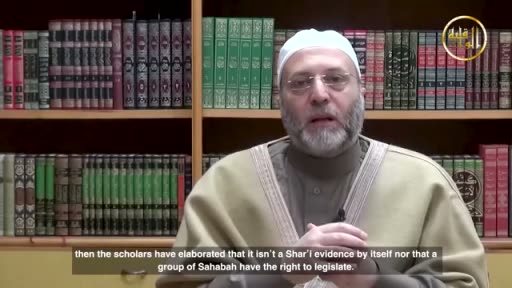
Introduction
In the Name of Allah, the Most Gracious, the Most Merciful. Peace be upon you and Allah’s mercy and blessings; welcome, brothers, to another session of Halaqa Online. We have continued over several sessions discussing how to follow the Shari’ah. Among the topics we covered in this series was ijtihad—meaning the process of deriving legal rulings from the sources of revelation: the Qur’an and Sunnah—and what they indicate. This is the task of mujtahids, and we clarified that a mujtahid does not derive rulings through his own intellect or fabricated theories, as some claim; rather, he exhausts all means to understand the implications of texts in order to discern what Allah means in the verses of the Qur’an and what the Prophet—may Allah bless him and grant him peace—means in the hadith he related to us. Thus, a mujtahid works on understanding the texts and extracting their meanings; this is the work, this task performed by mujtahids.
Rules of Ijtihad and the Emergence of Usul al-Fiqh as a Discipline
This process follows structured rules that begin with identifying the evidences of legislation—namely the Qur’an, Sunnah, and what they indicate. It also involves establishing the principles through which a mujtahid discerns the indications and meanings of texts, in accordance with the wording of those texts, whether the words carry Shari’ah meanings or linguistic meanings. These rules adopted by mujtahids are known as usul al-fiqh, the discipline first systematically codified by Imam al-Shafi‘i—may Allah have mercy on him—when he wrote his first treatise on usul al-fiqh, Kitab al-Risalah. It was the first organised and substantive written work on the principles of usul al-fiqh. Naturally, this field later expanded and its foundations were arranged by specialists known as usulis, or scholars of usul al-fiqh. The discipline reached its peak when the early scholars, from Imam al-Shafi‘i onward, worked on it. It then expanded until a time came—especially in our present age—when its direction changed. It lost its true purpose and acquired another, becoming one manifestation of the intellectual decline that afflicted the Islamic Ummah and, consequently, one factor in the actual decline of Muslim life. Therefore, I have dedicated this session to usul al-fiqh between elevation and decline.
Guidance through the Shari’ah and Servitude to Allah
So I begin with the name of Allah, the Most Merciful, the Compassionate. Allah, the Exalted, says:
﴿ قُلْنَا ٱهْبِطُوا۟ مِنْهَا جَمِيعًا فَإِمَّا يَأْتِيَنَّكُم مِّنِّى هُدًى فَمَن تَبِعَ هُدَاىَ فَلَا خَوْفٌ عَلَيْهِمْ وَلَا هُمْ يَحْزَنُونَ ﴾
‘We said: Descend from it, all of you. Then, when guidance comes to you from Me, whoever follows My guidance shall have no fear, nor shall they grieve’ [2:38],
and He, the Glorified in Might, says:
﴿ فَإِمَّا يَأْتِيَنَّكُم مِّنِّى هُدًى فَمَنِ ٱتَّبَعَ هُدَاىَ فَلَا يَضِلُّ وَلَا يَشْقَىٰ ﴾
‘Then, when guidance comes to you from Me, whoever follows My guidance will neither go astray nor suffer’ [20:123],
﴿ وَمَنْ أَعْرَضَ عَن ذِكْرِى فَإِنَّ لَهُۥ مَعِيشَةً ضَنكًا وَنَحْشُرُهُۥ يَوْمَ ٱلْقِيَـٰمَةِ أَعْمَىٰ ﴾
‘But whoever turns away from My remembrance will have a miserable life, and on the Day of Resurrection We shall raise him blind’ [20:124].
These noble verses contain profound meanings encompassing a range of concepts that summarise human destiny from the time of descent to earth until the Day of Resurrection. There, people are divided into two groups: one believes in Allah and submits to Him, conducting their worldly affairs according to His commands and prohibitions; thus, their end is divine pleasure and the gardens of bliss. The other group disbelieves in Allah, turns away from obedience, and lives without guidance from Him. Their fate is divine wrath, punishment in Hellfire—a wretched abode. If we examine these verses closely—the words just recited—we derive a set of fundamental truths connected to Islamic creed and its core concepts.
One of the most fundamental truths—indeed, the first and foremost truth—is that in this worldly life, a person must embody complete submission to Allah, the Creator of the heavens and earth, may He be exalted. This means being utterly obedient to His commands, avoiding what He has forbidden and prohibited, directing all their actions in accordance with His orders and prohibitions, making lawfulness and unlawfulness the measure for their deeds, surrendering entirely to Allah’s legal rulings in every matter, and placing full trust in Him for all affairs—never turning to any other source for guidance, commands or prohibitions. As He, may He be exalted, has said:
﴿ وَمَا خَلَقْتُ ٱلْجِنَّ وَٱلْإِنسَ إِلَّا لِيَعْبُدُونِ ﴾
‘I created jinn and mankind only to worship Me’ [51:56].
And He—exalted is He—has said:
﴿ إِنِ ٱلْحُكْمُ إِلَّا لِلَّهِ ۚ أَمَرَ أَلَّا تَعْبُدُوٓا۟ إِلَّآ إِيَّاهُ ذَٰلِكَ ٱلدِّينُ ٱلْقَيِّمُ وَلَـٰكِنَّ أَكْثَرَ ٱلنَّاسِ لَا يَعْلَمُونَ ﴾
‘Judgement belongs to Allah alone. He has commanded that you worship none but Him. That is the upright religion, but most people do not know’ [12:40]
He—exalted is He who speaks thus—
﴿ يَـٰٓأَيُّهَا ٱلنَّاسُ ٱعْبُدُوا۟ رَبَّكُمُ ٱلَّذِى خَلَقَكُمْ وَٱلَّذِينَ مِن قَبْلِكُمْ لَعَلَّكُمْ تَتَّقُونَ ﴾
‘O mankind, worship your Lord, who created you and those before you, so that you may attain taqwa’ [2:21];
this is what the first testimony summarises, upon which entry into Islam depends: ‘There is no deity but Allah.’
Secondly, guidance to the straight path in this world that Allah, exalted is He, has made a dwelling place for humanity comes only from Allah—the Creator of man, life and the universe. There can be no human guidance except through Allah’s own guidance to them. This meaning is reinforced by many noble Qur’anic verses, such as His saying:
﴿ مَن يَهْدِ ٱللَّهُ فَهُوَ ٱلْمُهْتَدِ وَمَن يُضْلِلْ فَلَن تَجِدَ لَهُۥ وَلِيًّا مُّرْشِدًا ﴾
‘Whomever Allah guides is rightly guided, and whomever He leaves astray, you will never find for him a guiding protector’ [18:17]
And similarly, as He—exalted is He—says:
﴿ وَمَن لَّمْ يَجْعَلِ ٱللَّهُ لَهُۥ نُورًا فَمَا لَهُۥ مِن نُّورٍ ﴾
‘And one for whom Allah has not made a light has no light’ [24:40]
and as He—glorified is He—says:
﴿ قُلْ إِنَّ هُدَى ٱللَّهِ هُوَ ٱلْهُدَىٰ ﴾
‘Say: Allah’s guidance is the true guidance’ [2:120]
Therefore, no one has the right except Allah—exalted is He—to claim ownership of guidance for humanity and legislate systems or legal codes, since none but He—glorified is He—possesses the true capability to do so. Hence, He—exalted is He—says:
﴿ ٱتَّبِعُوا۟ مَآ أُنزِلَ إِلَيْكُم مِّن رَّبِّكُمْ وَلَا تَتَّبِعُوا۟ مِن دُونِهِۦٓ أَوْلِيَآءَ قَلِيلًا مَّا تَذَكَّرُونَ ﴾
‘Follow what has been sent down to you from your Lord, and do not follow protectors besides Him. How little you take heed’ [7:3]
and He—blessed and exalted is He—says:
﴿ وَلَا تَقُولُوا۟ لِمَا تَصِفُ أَلْسِنَتُكُمُ ٱلْكَذِبَ هَـٰذَا حَلَـٰلٌ وَهَـٰذَا حَرَامٌ لِّتَفْتَرُوا۟ عَلَى ٱللَّهِ ٱلْكَذِبَ إِنَّ ٱلَّذِينَ يَفْتَرُونَ عَلَى ٱللَّهِ ٱلْكَذِبَ لَا يُفْلِحُونَ ﴾
‘Do not say, falsely describing with your tongues, ‘This is lawful and this is unlawful,’ thereby fabricating lies against Allah. Those who fabricate lies against Allah will not prosper’ [16:116]
Human guidance through the commands and prohibitions of Allah, the Exalted, is what takes him by the hand towards his elevation, happiness, security and tranquillity—
﴿ فَمَنِ ٱتَّبَعَ هُدَاىَ فَلَا يَضِلُّ وَلَا يَشْقَىٰ ﴾
‘Whoever follows My guidance will neither go astray nor suffer’ [20:123]
—and this very meaning recurs in other passages of Allah’s Book.
﴿ وَنُنَزِّلُ مِنَ ٱلْقُرْءَانِ مَا هُوَ شِفَآءٌ وَرَحْمَةٌ لِّلْمُؤْمِنِينَ ﴾
‘And We send down from the Qur’an that which is healing and mercy for the believers’ [17:82]
He, the Most High, has also said in the message of Muhammad may Allah bless him and grant him peace:
﴿ وَمَآ أَرْسَلْنَـٰكَ إِلَّا رَحْمَةً لِّلْعَـٰلَمِينَ ﴾
‘And We sent you only as a mercy to all worlds’ [21:107]
This means that a person’s true interest lies solely in following Allah’s Shari’ah, adhering to His commands and prohibitions. Wherever the Shari’ah is applied, there human interests are realised—and it is impossible for a person to attain his own good without Allah’s revealed law. Without the Shari’ah, humanity would never have known its true interests or recognised the path of salvation in this world and the Hereafter. Among the greatest benefits—or meanings—we derive from these verses, which we have just cited at the outset of our discussion is that when a person turns away from Allah’s obedience, His commands and prohibitions, it will inevitably lead to misery and wretchedness in this life, let alone the Hereafter.
﴿ وَمَنْ أَعْرَضَ عَن ذِكْرِى فَإِنَّ لَهُۥ مَعِيشَةً ضَنكًا ﴾
‘Whoever turns away from My remembrance will have a miserable life’ [20:124]
It is not permissible for a Muslim to be deceived by the apparent prosperity and material pleasures enjoyed by many disbelievers and sinners, leading them to suppose that they are truly happy. For happiness does not consist in acquiring worldly blessings or indulging in physical comforts; rather, true happiness is lasting tranquility, which can only be attained through awareness of Allah’s pleasure—exalted be He. This blessing remains beyond the perception of disbelievers and sinners dwelling in this world.
The Islamic Ummah and Revelation
These established truths governed the lives of Muslims during their eras of revival, shaping their thinking and intellect, moulding their conduct, lifestyle, civilisation, and communal character. Thus, they became the most refined society known to history, the finest civilisation witnessed by humanity, the strongest state seen on the international stage, and the greatest nation experienced by peoples. This is because the Islamic Ummah, from its inception, was the only community whose life and relationships were organised through divine revelation from Allah—exalted be He. It built its civilisation upon this revelation: the Qur’an and Sunnah revealed to Muhammad may Allah bless him and grant him peace became the identity of that nation and community, determining their lifestyle and worldview. Indeed, bearing witness that none has the right to worship except Allah and that Muhammad is His Messenger was a genuine foundation for their thought, an effective regulator of their conduct, and a firm principle governing the emergence of their systems.
That is because they understood that the testimony ‘There is no god but Allah’ means that the Legislator is Allah, and that He—exalted be He—is the One who governs over human actions. And it is incumbent upon Muslims to translate this testimony into conduct in their lives by being a community that walks according to the commands of Allah and His prohibitions; just as all other creatures follow the systems and laws that Allah, exalted be He, has placed within them
﴿ وَٱلشَّمْسُ تَجْرِى لِمُسْتَقَرٍّ لَّهَا ۚ ذَٰلِكَ تَقْدِيرُ ٱلْعَزِيزِ ٱلْعَلِيمِ وَٱلْقَمَرَ قَدَّرْنَـٰهُ مَنَازِلَ حَتَّىٰ عَادَ كَٱلْعُرْجُونِ ٱلْقَدِيمِ لَا ٱلشَّمْسُ يَنۢبَغِى لَهَآ أَن تُدْرِكَ ٱلْقَمَرَ وَلَا ٱلَّيْلُ سَابِقُ ٱلنَّهَارِ ۚ وَكُلٌّ فِى فَلَكٍ يَسْبَحُونَ ﴾
‘The sun runs to its appointed resting place. That is the decree of the Almighty, the All-Knowing. As for the moon, We have determined phases for it until it returns like an old date stalk. The sun cannot overtake the moon, nor can the night outstrip the day. Each floats in an orbit’ [36:38–40].
If those creatures were not free to adhere to the divine system, then humanity was honoured with reward and Paradise by choosing the divine system willingly, submitting fully to Allah Most High through their complete will and choice. Muslims understood from bearing witness that Muhammad is the Messenger of Allah that the system which Allah Most High approved for mankind until the Day of Resurrection is the very system revealed through Muhammad may Allah bless him and grant him peace. By following the Shari’ah brought by the Seal of the Prophets may Allah bless him and grant him peace, humanity moves from mere belief and conviction in Allah’s Oneness to putting that into practice in real life. Thus, they single out Allah Most High with worship and single out Muhammad may Allah bless him and grant him peace for following.
﴿ قُلْ إِن كُنتُمْ تُحِبُّونَ ٱللَّهَ فَٱتَّبِعُونِى يُحْبِبْكُمُ ٱللَّهُ وَيَغْفِرْ لَكُمْ ذُنُوبَكُمْ ﴾
‘Say: If you love Allah, follow me; Allah will love you and forgive your sins’ [3:31]
﴿ وَمَا يَنطِقُ عَنِ ٱلْهَوَىٰٓ إِنْ هُوَ إِلَّا وَحْىٌ يُوحَىٰ ﴾
‘Nor does he speak from his own desire. It is only a revelation revealed’ [53:3–4]
Allah says:
﴿ قُلْ إِنَّمَآ أُنذِرُكُم بِٱلْوَحْىِ ﴾
‘Say: I warn you only by revelation’ [21:45]
Muhammad—may Allah bless him and grant him peace—warns and guides people only through revelation from Allah the Exalted; he guides with Allah’s guidance. From this standpoint, a person’s iman is not sound until he accepts the Shari’ah that Muhammad—may Allah bless him and grant him peace—brought from his Lord, and submits to it absolutely, without inserting his intellect or ingenuity into judging its rulings. Allah the Exalted said:
﴿ فَلَا وَرَبِّكَ لَا يُؤْمِنُونَ ﴾
‘But no, by your Lord, they will not believe’ [4:65],
﴿ فَلَا وَرَبِّكَ لَا يُؤْمِنُونَ حَتَّىٰ يُحَكِّمُوكَ فِيمَا شَجَرَ بَيْنَهُمْ ثُمَّ لَا يَجِدُوا۟ فِىٓ أَنفُسِهِمْ حَرَجًا مِّمَّا قَضَيْتَ وَيُسَلِّمُوا۟ تَسْلِيمًا ﴾
‘But no, by your Lord, they will not believe until they make you judge in their disputes, then find no discomfort within themselves concerning your decision and submit completely’ [4:65].
The essence of what has been said is that the Islamic Ummah distinguished itself by following revelation, deriving its legal rulings from it—meaning from revelation—and building its concepts upon it. History bears witness that it flourished and attained elevation to the extent that it adhered closely to that revelation; conversely, it declined and fell as much as it drifted away from or contradicted it.
Sources of Legislation and Their Reference to Revelation
From this perspective, we observe how jurists in the golden age of Islam regulated the Ummah’s life by confining legal rulings to Allah’s address, as they understood it. They defined a legal ruling as the Legislator’s address concerning human actions; and the Legislator is none other than Allah, Exalted be He. Consequently, in this historical discussion, they restricted the evidences of legislation to what revelation brought: the Book—the Qur’an—the Sunnah, the consensus of the Companions, and analogy based on a Shari’ah cause derived from Shari’ah evidence. If we examine these evidences closely, we find that, in reality, they are all expressions of the revelation sent down upon Muhammad—may Allah bless him and grant him peace. Let us now consider the evidences of legislation adopted by Islamic scholars throughout history:
The first source is the Book—the Qur’an. As for the Book, which is the Qur’an, no one among those who uphold monotheism disputes that it is Allah’s speech revealed to Muhammad may Allah bless him and grant him peace in both its words and meaning; thus, it constitutes the primary source of legislation.
As for the Sunnah—which comprises the Prophet’s sayings, actions and tacit approvals, may Allah bless him and grant him peace—it too is divine revelation. Unlike the Qur’an, however, its meaning was revealed, and he conveyed it through his words, actions or tacit approval.
As for the consensus of the Companions: scholars have clarified that it is not a Shari’ah evidence in itself, nor does it grant them legislative authority. Rather, it was recognised as an evidence of legislation because it reveals an implicit legal ruling derived from a saying, action or tacit approval of the Messenger—may Allah bless him and grant him peace—that has not reached us directly. The Companions, whom Allah praised in His Noble Book and whom He entrusted with transmitting the Shari’ah to all people, could never agree on a ruling without a basis in revelation. They were foremost among those who followed the Messenger—may Allah bless him and grant him peace—and they adhered strictly to the Shari’ah evidence.
As for qiyas: it is not what many people understand—namely, a rational deduction or derivation of a Shari’ah ruling from the intellect. No; rather, as scholars of usul al-fiqh define it, it means attaching a new case to an established precedent because both share the same underlying cause (‘illah). This ‘illah is not a rational one but a Shari’ah-based cause indicated by Revelation—whether through Qur’an or Sunnah. Consequently, any legal ruling derived through qiyas rests upon this Shari’ah-based ‘illah, meaning it originates from the same source as Revelation itself.
As for the remaining Shari’ah evidences, Islamic scholars and mujtahids did not treat them as supplementary sources introduced due to any deficiency in the Shari’ah, as some might assume. Instead, they concluded that the textual evidences of the Qur’an and Sunnah guided towards these sources—whether we agree with each scholar’s chosen evidences or not. For instance, scholars who relied on unrestricted interests (maslaha mursala), juristic preference (istihsan), the opinion of a Companion, the revealed law of those before us, consensus of the Ummah after the era of the Companions, and the practice of the people of Madinah—as attributed to Imam Malik, may Allah have mercy on him—along with other disputed sources, did not consider such evidences additional sources imposed by any deficiency in the Shari’ah. Rather, they viewed them as evidences to which both the Qur’an and Sunnah had directed them.
Indeed, many of them consider these evidences to be derived from reasoning with the Qur’an and Sunnah, so that they become branches of those two. This is like one who regards unrestricted interests (maslaha mursala) as one of the routes by which analogy is established, and regards analogy as a form of reasoning from the Qur’an and Sunnah; or one who regards juristic preference (istihsan) as weighing one evidence against another. Likewise, one who uses the revealed law of those before us as evidence regards it as drawing upon the Noble Qur’an, which commands adherence to the previous prophets:
﴿ أُو۟لَـٰٓئِكَ ٱلَّذِينَ هَدَى ٱللَّهُ ۖ فَبِهُدَىٰهُمُ ٱقْتَدِهْ ﴾
‘Those are the ones whom Allah has guided, so follow their guidance’ [6:90].
One who regards the opinion of a Companion as evidence may consider it a Sunnah that the Companion heard or witnessed from the Messenger of Allah—may Allah bless him and grant him peace. One who regards the consensus of the Ummah as evidence does so because the Ummah does not unite upon misguidance, as he said: «الأمة لا تجتمع على ضلالة» — ‘The Ummah does not unite upon misguidance’ [see Jami‘ al-Tirmidhi, 2167; Sunan Ibn Majah, 3950]. Thus, they returned these evidences to the sources of legislation and made them branches of those sources.
In every case, regardless of our view on how far those evidences align with revelation—whether they express it or diverge from it—the rulings derived from these subsidiary evidences were so few that even those who sought to provide examples could not exceed what can be counted on the fingers of both hands. If we examine these examples of rulings deduced from such subsidiary evidences, we find that many scholars and mujtahids traced a significant proportion of them back to one of the four primary evidences: the Qur’an, Sunnah, consensus of the Companions, or analogy (qiyas).
On this basis, we can say that the legislative framework which once shaped Muslim minds, directed their conduct, and formed their way of life during eras of elevation was, in its entirety, derived from the sources of legislation revealed to the Messenger Muhammad may Allah bless him and grant him peace.
The Foundations Upon Which the Usul al-Fiqh Scholars Established Their Science
Beloved brothers, if we examine the researches that eminent scholars of usul al-fiqh established as the foundation for their studies in principles of Islamic jurisprudence—and which they placed at the beginning of their books and treatises upon which they constructed all their opinions and writings—we find them confirming those meanings we have presented and establishing them as settled Islamic truths beyond dispute.
For example, the inquiry into al-hākim (the authority) that appears in the introductions of usul al-fiqh books confirms that the authority over human actions—whether concerning goodness and badness or permissibility, prohibition, obligation, recommendation, or dislike—belongs solely to Allah. Reason has no jurisdiction to pass judgment on such matters regarding human actions; rather, it is Allah Most High who holds this authority.
Similarly, a principle found in the introductions of these books states: there is no legal ruling before the revelation of the Shari’ah. This confirms that human actions carried no Shari’ah ruling prior to the descent of divine revelation with the law. Their definition of the legal ruling further affirms this truth; for they defined it as the Legislator’s address concerning human actions. Thus, a legal ruling is confined solely to what constitutes an address from the Legislator—that is, Allah, Exalted be He—so anything not addressed by Him is not a Shari’ah ruling.
Correct Ijtihad and the Role of Reason
As for ijtihad in its true sense—that is, the exhaustive effort to derive legal rulings from their detailed Shari’ah evidences—it was the gateway by which the Muslim mind sought Allah’s ruling on new issues and matters. The method adhered to by Muslims during their early centuries of elevation, when addressing problems and questions, involved studying each problem or issue in its actual context through meticulous analysis that revealed its true nature and essence—a process known as ascertaining the factual subject matter of the legal ruling (tahqiq al-manat). Following this, one would return to the relevant texts to derive the ruling or rulings indicated by those evidences, then apply them to reality so as to resolve the problem or address the issue through the revelation sent upon the Prophet may Allah bless him and grant him peace. We have previously dedicated a session to this topic.
The role of reason, when it engages in examining treatments or solutions, was never to be a source—or even a partial source—of the legal rulings intended to address reality. Rather, reason was merely a tool used to understand reality and to comprehend Allah’s intent behind the legislative texts revealed through divine inspiration. The mujtahid proceeds with the Shari’ah evidences in accordance with their linguistic indications, their understood and rational implications—and, above all, their legal meanings—until they guide him to the legal ruling. The text is the evidence, not reason; reason follows the evidence rather than the evidence being subordinate to reason. For it is Allah, the Most High, who governs human actions
﴿ إِنِ ٱلْحُكْمُ إِلَّا لِلَّهِ ﴾
‘Judgement belongs to Allah alone’ [12:40].
Respected brothers.
Closing the door of ijtihad and beginning decline
The closure of the door to ijtihad during the Abbasid era—an approach regrettably followed by many Muslim scholars—marked the beginning of the Muslims’ decline. For they shut before themselves the very gateway through which one accesses Allah’s legal ruling on emerging issues and resolves new problems, instead confining themselves to reviving the deductions and rulings previously derived by earlier scholars concerning matters that existed in their own times.
They did not anticipate the future problems that emerged after them. Consequently, once the door to ijtihad was closed, scholars often applied legal rulings and solutions to new issues and matters for which they were neither appropriate nor fitting. This meant that many of society’s challenges in Islamic life ceased to receive proper or adequate resolution. Problems and crises would only worsen over time without anyone addressing them properly—leading inevitably to the decline of society.
For any society, the worsening of its problems alongside the loss of effective solutions and remedies will inevitably lead to its regression and decline, no matter what system it follows or upon what foundation it is built. When we further consider how Islamic thought became stagnant and rigid as a result of closing the door to ijtihad, we can fully grasp the grave danger that threatened the future of the Muslim Ummah.
Muslims failed to recognise the decline that had been creeping through their community over centuries. While Islamic history does record some reformist scholars who sensed regression and fragmentation in society, we find that very few identified its true cause. The efforts of these individuals were like a cry in a desolate valley—individual awareness never rising to collective consciousness.
Thus, when some scholars called for the resumption of ijtihad, their efforts did not produce any tangible results during their own times. These internal calls were insufficient to alert Muslims to the danger that threatened them or to highlight the necessity of reopening the door of ijtihad in order to revitalise the Ummah’s mindset, reorganise society, and resolve its problems and crises from every direction.
Perhaps the reason for this was that when decline first began to afflict the Muslim community, there was no other nation on earth comparable to them in terms of their elevation and stature—despite the fractures within their society and the defeats they had suffered. From a civilisational perspective, the Islamic Ummah was the most advanced civilisation on Earth; no other civilisation could rival or match it. Politically and militarily, the Ummah triumphed over its adversaries—the Crusaders, Byzantines, Tatars, and Mongols—and its army became the strongest in the world until it earned the reputation of an unconquerable force during the Ottoman era.
The Challenge of Western Civilisation
The time eventually came when the external danger materialised. Western states embodied a new civilisation that competed with Islamic civilisation through its foundational ideas, way of life and outlook on existence. They built an industrial and urban infrastructure that surpassed the stagnant and weakened material foundations of the Muslim world. They also possessed military power that repeatedly threatened to invade the Muslim world.
What concerns us in this discussion, my brothers, is the cultural and civilisational—indeed, intellectual—onslaught that the Western world has launched against the Islamic Ummah.
For the West established a foundational intellectual principle upon which its modern civilisation, culture and concepts are built, and from which its systems emerged. By this I mean the creed—by this I mean the creed of separating religion from life—or what is termed secularism.
The West has begun attacking Islamic civilisation, elevating its own while disparaging Islam’s systems and legal rulings. It seeks to prove the validity of its own systems and rulings by belittling Islamic concepts, replacing them with those it extols.
The Muslim world’s suffering from decline—stemming from its deviation from a correct understanding of Islam and neglect in conducting productive practical study of it—made it fertile ground ready for the infidel coloniser to till and sow his cultural seeds there. He hoped thereby to harvest a generation of intellectuals enchanted by Western civilisation, thus extinguishing the Ummah’s identity, its distinct character, the source of its revival, and its strength.
Reactions to the Intellectual Assault
My noble brothers, this relentless cultural and intellectual assault launched by the West against the Islamic world has been met with confused, disorganised responses. Yet Muslims love their Islam, detest misguidance, hold dear their Shari’ah, and refuse to allow it to be sullied or dishonoured.
Yet at the same time, they recognised the stark contrast between their own painful reality—marked by decline and backwardness—and the West’s emerging state of revival, elevation, strength, and prosperity that surrounded it.
When they observed that the West had reached its current state through its civilisation, ideas and systems, they concluded that these elements were essential for any nation to achieve elevation and progress. It was beyond comprehension in their view that Islam would oppose adopting such components—key drivers of strength—while overlooking the fact that Western civilisation, with all its ideas and systems, is founded on principles entirely at odds with those underpinning Islamic civilisation.
Calls began to rise for reopening the door of ijtihad. But what kind of ijtihad did they intend? Certainly not the Shari’ah legal inquiry understood by the early Muslims, but rather a form that leads to reinterpretation of texts and distortion of evidence until rulings are extracted that supposedly align with the spirit of the age and its developments—as they claim. Voices also grew louder insisting that Islam must be flexible and evolving.
Studies were then composed attempting to force Shari’ah research into Western frameworks, so that Islam might appear as a mere counterpart of Western civilisation. Some even repeated the claim that Western civilisation was borrowed from Islam and returned to us as our own property. Many authors now seek to present every foreign idea or legal concept as harmonising with Islam, until Islamic culture became an oversized garment accommodating any notion imported from the West.
There have been efforts to reconcile Islam with Western civilisation, such as the claim that consultation (shura) is identical to democracy, that Islam upholds public freedoms in the same manner as Western systems do, that socialism originates from Islam, and that jihad is merely defensive warfare—not for carrying the da’wah. Other claims include that polygamy is subject to conditions and divorce is restricted.
The situation has reached the point where we find many Islamic studies—even those of sincere intent—affected by that current and direction. Among these studies, this one is the most dangerous.
Between the Strength of Evidence and the Pressure of the Age: Studies in Usul al-Fiqh
Studies in usul al-fiqh are concerned with the principles of Islamic jurisprudence; there is a fundamental distinction between the early Islamic studies conducted by scholars who engaged in thorough research and many contemporary studies on the same subject.
When we examine the foundation upon which studies in usul al-fiqh were based during the early Islamic eras, we find that this foundation rests solely on the strength of evidence.
When they investigated the sources of legislation, their primary concern was identifying those sources that reflect revelation and express it in a structured manner—leaving no room for deriving legal rulings from anything other than revelation. The majority agreed that the Qur’an, the Sunnah, the consensus of the Companions, and analogy were the legislative sources. Those who adopted additional secondary sources did so based on their conviction that these had been guided to them by the Qur’an and the Sunnah—as we have previously mentioned—not out of a desire to multiply the sources or expand their scope for deriving rulings. They were firmly convinced that Allah, exalted is He, revealed in His revelation upon the Messenger may Allah bless him and grant him peace sufficient guidance to derive all legal rulings pertaining to any issue that might arise within scholarly inquiry.
When they examined the rules of deduction and comprehensive legal principles, their focus was likewise on determining the strength of evidence and what the texts indicate according to their Shari’ah and linguistic meanings—along with their understood and reasonable implications—without straining or imposing arbitrary interpretations.
However, if we examine many modern studies of usul al-fiqh—contemporary principles of Islamic jurisprudence—we find that the strength of evidence is not the foundation upon which authors base their research. Instead, they are accompanied in these studies by an obsession with expanding the Shari’ah and its sources, rendering its texts flexible, and multiplying its comprehensive legal principles so as to establish that the Shari’ah’s suitability for every time and place remains valid.
For instance, in discussions on Shari’ah evidences or sources of legislation, we find these usul al-fiqh studies strive to affirm most—if not all—the legislative evidences adopted by earlier mujtahids, whether strong or weak, without considering the strength or weakness of each evidence. Instead, they focus solely on one matter: that it is essential to adopt all those sources so that the Shari’ah remains expansive enough for deriving additional legal rulings necessary for this age. This leads them to endorse a collection of legislative sources that no single mujtahid adopted in full; rather, each mujtahid relied upon some according to his own conviction and reasoning.
Updated Rules and Expanding the Meanings of Comprehensive Legal Principles
But if we turn to the section on rules of deduction and comprehensive legal principles in these modern contemporary studies, we will again find that same preoccupation accompanying the researcher: where are the rules that guarantee flexibility, development, and breadth within the Shari’ah? This is done while ignoring entirely whether those rules themselves are strong or weak.
In contemporary studies, we have found comprehensive legal maxims that were not present in the works of earlier scholars, whether in their wording or number. For example, a new maxim has emerged stating: ‘Changes in legal rulings with changes in times are not to be denied.’ Another, unknown to Islamic scholars throughout history, asserts that contracts are assessed by their intended purposes and meanings rather than by their wording and forms. A closer examination reveals that this maxim is taken from Western constitutions. They claim these are Shari’ah maxims, such as: ‘When a matter becomes constrained, it expands,’ or: ‘Whoever hastens something before its time is punished by being deprived of it.’ Another states: ‘Wherever there is an interest, there is the law of Allah.’ Yet none of these have defined parameters or Shari’ah evidences to support them. Some may correctly describe aspects of the Shari’ah through induction, but they cannot serve as foundational principles from which legal rulings are deduced.
They turned to established Shari’ah rules—even those with precise meanings—and expanded their scope far beyond what they originally intended. For instance, the principle that “necessities permit prohibitions” was not articulated in this exact form by earlier generations; however, its meaning had always been limited. Now it is used as evidence to justify permitting numerous prohibitions that fall outside its original scope.
They also cited the principle that “the default status of things is permissibility” to argue for the adoption of secular systems and laws, classifying legislation among permissible matters. Indeed, in its final years, the Ottoman State abolished hudud penalties by invoking this very rule. All these efforts sought to prove that the Shari’ah’s suitability for every time and place arises from the abundance and flexibility of its legislative sources and principles—supposedly enabling it to issue a ruling on every circumstance or problem.
Strength of Evidence as the Correct Foundation
Beloved brothers, today we confront a fundamental issue regarding contemporary studies in usul al-fiqh. The core question upon which these studies must rest is this: Is it the strength of evidence? Or is it expanding and developing the Shari’ah to increase its flexibility so that it may be made suitable for every time and place?
The correct answer, without doubt, is the strength of evidence. We are entrusted with following it—following means diligently examining the strength of evidence and what it directs.
As for the attributes of the Shari’ah—the qualities that make it suitable for every time and place—and the practical outcomes that arise from its application, these are not our responsibility to create or determine. Rather, they belong to Allah’s wisdom in revealing the Shari’ah. We recognise them only after understanding the Shari’ah according to strong evidence and applying it with precision.
The Shari’ah’s suitability for every time and place does not come from the actions of scholars or mujtahids—rather, it is a quality that Allah Most High has endowed within it. It is Allah Most High who legislated and revealed it to His Messenger may Allah bless him and grant him peace; He alone granted this quality to the Shari’ah, and it is not the task of the mujtahid. Allah Most High says:
﴿ ٱلْيَوْمَ أَكْمَلْتُ لَكُمْ دِينَكُمْ وَأَتْمَمْتُ عَلَيْكُمْ نِعْمَتِى وَرَضِيتُ لَكُمُ ٱلْإِسْلَـٰمَ دِينًا ﴾
‘Today I have perfected your religion for you, completed My favour upon you, and approved Islam as your religion’ [5:3]
Therefore, we must be firmly convinced that the Shari’ah is suitable for every time and place once it has been derived from its sources—and only after ensuring reliance exclusively on those sources definitively proven by conclusive evidence to be legislative. However, if we seek to understand what makes the Shari’ah suitable for all times and places, or how a legal ruling can be deduced for any event or issue in any era and location—despite the limited number of sources and texts—we must clarify that this does not imply development of the Shari’ah. The law of Allah is fixed and unchanging: what is lawful remains lawful until the Day of Resurrection, and what is unlawful remains unlawful until the Day of Resurrection. Nor does this reflect flexibility in the Shari’ah—for flexibility implies movement and transformation, which would mean the Shari’ah itself changes. By no means can that be the case.
The Secret of the Shari’ah’s Suitability for Every Time and Place
The Shari’ah’s suitability for every time and place stems from two primary reasons. The first is that the Legislator of this Shari’ah is Allah, exalted be He—the Wise, the All-Knowing, the Subtle, the All-Aware—who created humanity and knows what stirs within their souls in terms of instincts and organic needs. These are the foundation of human actions, movements, and vitality; from them arise humanity’s problems and concerns that require regulation and resolution. No one but Allah, exalted be He, is privy to the secrets of this human soul. He—exalted be He—is its Creator, Originator, and Sustainer, knowing what benefits it and what corrupts it. Allah, may He be glorified, says:
﴿ وَلَقَدْ خَلَقْنَا ٱلْإِنسَـٰنَ وَنَعْلَمُ مَا تُوَسْوِسُ بِهِۦ نَفْسُهُۥ ۖ وَنَحْنُ أَقْرَبُ إِلَيْهِ مِنْ حَبْلِ ٱلْوَرِيدِ ﴾
‘We have certainly created man and know what his own self whispers to him, and We are closer to him than his jugular vein’ [50:16]
And He, exalted in might, says:
﴿ أَلَا يَعْلَمُ مَنْ خَلَقَ وَهُوَ ٱللَّطِيفُ ٱلْخَبِيرُ ﴾
‘Does He who created not know, while He is the Most Subtle, the All-Aware?’ [67:14]
Thus, when Allah the Almighty legislated His Shari’ah for humanity, He did so for man in his capacity as a human being—man has been and will remain man from the creation of Adam until Allah inherits the earth and all upon it. Consequently, this Shari’ah is suitable for every time and place. This contrasts with human systems established by legislators who lack insight into the depths of the human soul or knowledge of what benefits or corrupts it. Instead, they address temporary problems that present themselves before their eyes—problems which are, in truth, mere surface-level manifestations of humanity’s deeper struggles rather than its core issues. As a result, these systems find themselves requiring constant revision: updating laws, replacing them entirely, and adding new ones whenever fresh challenges emerge from human difficulties. This is not the case with Allah’s Shari’ah, which aligns with the innate nature of man in both ancient and modern times. As Allah says:
﴿ فَأَقِمْ وَجْهَكَ لِلدِّينِ حَنِيفًا ۚ فِطْرَتَ ٱللَّهِ ٱلَّتِى فَطَرَ ٱلنَّاسَ عَلَيْهَا ۚ لَا تَبْدِيلَ لِخَلْقِ ٱللَّهِ ذَٰلِكَ ٱلدِّينُ ٱلْقَيِّمُ وَلَـٰكِنَّ أَكْثَرَ ٱلنَّاسِ لَا يَعْلَمُونَ ﴾
‘So set your face towards the religion, inclining to truth—the fitrah of Allah upon which He created mankind. There is no changing Allah’s creation. That is the upright religion, but most people do not know’ [30:30]
As for the second aspect—the second foundation—it is that the very breadth of the Shari’ah texts from the Qur’an and Sunnah ensures their sufficiency to provide a legal ruling for every new issue. This is because the wording of these texts was not entirely rigid. Rather, they contained many general expressions pointing to comprehensive principles. They also included explanatory terms from which broad rules could be deduced—rules applicable to numerous particulars—and from which effective causes (‘ilal) for legal rulings are derived. Thus, a ruling exists where its effective cause is present and ceases when the cause is absent, in any time or place.
This does not mean that the Shari’ah is flexible or evolving—that legal rulings change between times or places. Rather, it means the Shari’ah is vast and comprehensive, encompassing all legal rulings that address every new occurrence.
When a specific new circumstance arises and we find that a legal ruling applies to it, this does not mean the legal ruling itself has changed. Rather, it means only that each matter has its own distinct legal ruling which remains fixed.
Submission and Following: The Path to Elevation
My dear brothers, adherence to this foundation in studies of usul al-fiqh is the correct application of absolute submission to Allah alone in divinity and legislation, and of following Muhammad—may Allah bless him and grant him peace—alone.
﴿ قُلْ إِن كُنتُمْ تُحِبُّونَ ٱللَّهَ فَٱتَّبِعُونِى يُحْبِبْكُمُ ٱللَّهُ ﴾
‘Say: If you love Allah, then follow me; Allah will love you’ [3:31].
That is because submission entails following, and following entails seeking out the evidence. This discipline also leads to the revival of the Islamic nation—the revival you desire and which pleases Allah, exalted be He. Adherence to the evidence results in a correct understanding of what Allah, exalted be He, intends; this correct understanding leads to proper conduct and righteous behaviour. And it is the correct Shari’ah-based conduct in the life of the Ummah that brings about its elevation
﴿ وَأَلَّوِ ٱسْتَقَـٰمُوا۟ عَلَى ٱلطَّرِيقَةِ لَأَسْقَيْنَـٰهُم مَّآءً غَدَقًا ﴾
‘Had they remained steadfast on the path, We would certainly have given them abundant water to drink’ [72:16].
This is the discipline that must govern and regulate our studies in usul al-fiqh—without allowing contemporary civilisational and cultural pressures to divert us from the path taken by the early generations. That path is the Shari’ah methodology, as prescribed in the verses of the Qur’an and the hadiths of the Prophet may Allah bless him and grant him peace. I say this, seeking forgiveness from Allah for myself and for you all—praise be to Allah, Lord of the worlds.
Questions from the Audience
Now, brothers, I turn to any questions that may have arisen during this halaqa.
The Meaning of the Shari’ah’s Flexibility and Its Development
Brother al-‘Abid asks: It is said that terminology is not a matter for dispute. Why, then, do you overanalyse the phrase ‘flexibility of the Shari’ah’ as though those who use it are violating Allah’s law?
We did not focus on the literal wording or this expression; rather, we considered the term itself—an expression coined to convey the intended meaning by those who introduced it.
Those who used the term ‘flexibility’ made their position perfectly clear. Many of them explained it and stated what they meant. Among the expressions they used to convey the same idea was reliance on a maxim stating: ‘Changes in legal rulings with changes in times and places are not to be denied.’ Thus, when they speak of changing rulings, they mean that what was lawful in the past now becomes… or that what was forbidden in the past becomes lawful today. Perhaps what was obligatory in the past becomes permissible today, or what was permissible becomes obligatory. By ‘flexibility’, they mean that the Shari’ah can adapt, change its form and develop in accordance with changing reality.
They also employed another term: the development of Shari’ah. Naturally, this widely adopted concept among certain people has given rise to a completely different understanding of the Qur’an in our time. I am justified in calling it a new religion. We now have what is claimed to be a new faith—its adherents assert that it is Islam and that they interpret the Qur’an through an evolved understanding, saying:
The Qur’an is revelation from Allah, the Exalted. Its text remains fixed; however, interpreting the Qur’an—that is, understanding it—develops over time. Each era has its own comprehension: in the Prophet’s time (may Allah bless him and grant him peace), people understood the Qur’an in a specific way and applied it accordingly, consistent with that age. As time progressed, certain jurists allegedly evolved their interpretation of the Qur’an; thus, this age too must have an advanced understanding of the Qur’an aligned with contemporary needs.
Under this premise, they constructed a wholly distinct understanding—one that is, in truth, a new religion with its own legal system. They claim it derives from the Qur’an, yet it has no connection to it at all.
Naturally, these are those we previously addressed—those who deny the Sunnah as a source of legal rulings. By this, I mean that those who reject the Sunnah comprise movements and sects. Among them is an unfortunate contemporary faction misleading many people today. They speak of ‘contemporary reading’ of the Qur’an. The Book—they distinguish between the Book and the Qur’an, and between the Messenger and the Prophet. They claim we must read the Qur’an in a modern way because interpretation through the Qur’an evolves with human development over time.
Thus, here lies the danger of using terms. Here lies the danger of using terms—here lies the danger of using terms that carry implications, implications entirely at odds with Islamic Shari’ah meanings. Our objection is not merely to the term ‘flexibility’ or the term ‘development’; our fundamental objection is to the meaning intended by this term, by this expression: flexibility or development.
If someone says to us, “By flexibility, we mean the breadth of the Shari’ah,” we respond that this term is poorly chosen. There must be a connection between its linguistic meaning and its technical usage; while the technical sense takes precedence over the literal one, once a word is adopted for a specific concept, it retains some link to its original meaning. The term flexibility suggests change or transformation—yet the accurate expression for the Shari’ah’s reality and its suitability for every time and place is that it is broad. We speak of the breadth of the Shari’ah, not its flexibility or development. This matter was discussed in earlier sessions.
The Method of Establishing the State and Variable Styles
Sister Mona Balhaj asks: Some wonder where the party acquired the method by which our Prophet established his state, for no such ijtihad is recorded from the four jurists. If Islam allows development, why must we look backward instead of inventing a new and advanced approach? We await your response; may Allah bless you and reward you. May He honour you.
The question has two aspects. Regarding the first part: earlier jurists did not address how to establish an Islamic state. The answer is straightforward: they were practical men, concerned only with matters of practical benefit. When some jurists delved into hypothetical questions with no practical application, the majority of jurists censured them as the ‘what-if?’ school (al-ara’aytiyyun), as they were called. Jurists performed ijtihad and derived rulings only for practical issues that people needed in life.
For centuries, they lived in Dar al-Islam under an Islamic way of life. Perhaps none of them imagined that a day would come when the Muslim world would have no Dar al-Islam at all. The Islamic Ummah did lose vast territories that were occupied by disbelievers, and some countries became Dar al-Kufr. Yet the Muslim world never completely lost a Dar al-Islam from which mujahideen could launch campaigns to liberate Islamic lands and return them to Islam—that is, to Dar al-Islam. The complete absence of any Dar al-Islam from the entire Muslim world had never occurred.
Consequently, they did not examine how to resume the Islamic way of life, establish Dar al-Islam and restore the Islamic Caliphate. This is why earlier jurists did not discuss this matter at all.
As for inventing a new, advanced method: Shari’ah legal rulings do not evolve or innovate; they remain fixed. The current question concerns how to establish an Islamic state—that is, resuming the Islamic way of life through establishing such a state—and this aspect has two parts in terms of methodology. One part falls under binding Shari’ah legal rulings that come under obligation (wajib), while other aspects fall within what is permissible (mubah).
This matter pertains to the Prophet’s own actions—may Allah bless him and grant him peace. When he established the Islamic State, he worked to establish it during the Makkah phase until it came into being in Madinah. Upon examining the Prophet’s life, we find that some of his actions were obligatory; Allah Almighty commanded him to perform them. Whatever was obligatory upon the Prophet—may Allah bless him and grant him peace—is obligatory upon us, because Allah’s address to the Prophet is an address to us. Allah, Exalted be He, says:
﴿ لَّقَدْ كَانَ لَكُمْ فِى رَسُولِ ٱللَّهِ أُسْوَةٌ حَسَنَةٌ ﴾
‘Indeed, in the Messenger of Allah you have an excellent example’ [33:21].
What the Prophet—may Allah bless him and grant him peace—was obliged to do in working to establish Dar al-Islam, bring Islamic life into existence and establish the Islamic State is, all the more, obligatory upon us.
The Prophet—may Allah bless him and grant him peace—performed some actions in establishing the Islamic State on a permissible basis. We place these under the category of styles (asalib), which are permissible: one may adopt them or leave them. The binding method is what the Prophet—may Allah bless him and grant him peace—did as an obligation, because Allah, Exalted be He, commanded him to do it. Just as Allah bound him to it, we must also adhere to it. What the Prophet—may Allah bless him and grant him peace—did on a permissible basis falls under styles. All the means he used were permissible. They remain permissible for us as well: we may adopt them, leave them or use other means instead.
At one stage in his mission, the Prophet—may Allah bless him and grant him peace—adopted the open proclamation of the da’wah as part of the binding method. This is obligatory for us too at this stage of the Prophet’s method: we must openly proclaim the da’wah. His styles ranged from standing on a mountain, addressing people in markets and visiting them in gatherings, to marching in two rows through Makkah’s mountain passes, streets and neighbourhoods—different styles of openly proclaiming the da’wah. We are not bound by those specific styles because they were permissible; he chose whichever suited his circumstances. Today, we likewise choose suitable means: this programme through communication media, appearing on television channels if possible, publishing magazines, newspapers and books, delivering lectures, or distributing leaflets in the streets, and so forth. These are all permissible styles and means. Since the binding method was obligatory upon him, it remains obligatory upon us.
Someone may object: “But reality has changed.” I reply that the Prophet may Allah bless him and grant him peace worked to transform society. Just as humanity—from when Allah created Adam until the Day of Resurrection—remains fundamentally unchanged in constitution, instincts, and organic needs, so too does society retain its essential nature.
The society is people united by ideas, emotions and systems. The society of Makkah into which the Prophet (may Allah bless him and grant him peace) was sent, along with Arab societies, were groups bound together by shared ideas, emotions and systems; today we live in a society likewise held together by these same elements. Therefore, changing society requires altering its ideas, emotions and systems. How does this method itself change? Indeed, the essence of society remains rooted in its fundamental composition.
The Prophet’s (may Allah bless him and grant him peace) community had its own set of ideas, emotions and systems; our contemporary society possesses different ideas, emotions and systems. This necessitates that we identify which ideas, emotions and systems require transformation so that Islamic ideas, Islamic emotions and Islamic systems may emerge—thus establishing the Muslim community and resuming the Islamic way of life.
As for the method of engaging with society to effect change: society has its own structure. How do we alter this society while operating within that very structure? The core method remains unchanged, but the address must account for the nature of the community’s culture, its prevailing customs and systems. In Islam, we examine what confronts us and seek to transform it.
The method itself is the same. Here, however, we examine what prevails in society’s culture, its common customs and its systems, so that we may address them with suitable Islamic ideas.
We do not speak to people today about abolishing the worship of Hubal or Manat, nor about burying daughters alive, for these no longer exist. Instead, we address them by refuting the Western laws that have entered our lands and the Western concepts that have infiltrated our minds, such as nationalism, patriotism, separating religion from life and public freedoms. We present the Islamic alternative to these. This discourse is a particular style of addressing people with Islam, while the other matter concerns Islam’s thoughts themselves confronting new thoughts. However, the method for changing the structure of society must be the method employed by the Prophet—may Allah bless him and grant him peace. There may be later sessions, Allah willing, under the title How to Carry the Da’wah.
The Change in the Madhhab of Imam al-Shafi‘i
Brother Abdullah says: It is narrated that al-Shafi‘i revised his legal rulings when he moved from Iraq to Egypt. Does this not indicate the influence of the new reality or an expansion in his understanding, which led him to uncover what he had not realised before? Consequently, it would appear that Allah’s legal rulings changed for him. Apply this analogy to how people’s lives have developed greatly today, especially after the world became like a small village.
I discussed this very example in earlier halaqaat, so I shall of course repeat it now. One thing calls another to mind.
Brothers, when Imam al-Shafi‘i’s madhhab changed and he moved from one madhhab to another, what are known as his old madhhab and his new madhhab emerged. This coincided with his move from Iraq to Egypt; it was not caused by that move.
Let me share a story here—one with a lesson or a touch of wit: it is said that a boy would ask his father for permission to go out and play in the garden. The father would look through the window, and if he saw the tree swaying rapidly from the wind, he would say, ‘The wind outside is strong. Look at how the tree moves—stay inside and do not come out.’ Of course, the movement of the tree was evidence to the father of the wind, perhaps even a stormy one. But for the boy, his prohibition from going out became associated with the moving tree itself. He directly attributed the restriction to the tree alone, so he set about cutting it down—so that it would no longer stop him from leaving.
This connection is a crude, simplistic one—nothing more than the tree’s movement coinciding with his failure to leave. It makes him think that the tree’s motion itself prevented him from going out. This is superficial reasoning.
The claim that when Imam al-Shafi‘i moved to Egypt, he was influenced by its environment and society—thus altering his legal rulings—is unworthy of the Imam himself or of Islamic jurisprudence. This is an insult both to Shari’ah law and to him personally. The Imam did not derive his legal rulings from worldly reality.
What actually occurred was that, at the beginning of his scholarly life, Imam al-Shafi‘i studied the school of hadith—the people of tradition—who were from Madinah. He became a student of Imam Malik—may Allah have mercy on him—and thus grew up in the school of Ahl al-Hadith. Later, he moved to Iraq, where he encountered another school known as the school of opinion: the school of Abu Hanifah, Sufyan al-Thawri and others. That school showed particular excellence in juristic analogy (qiyas).
Consequently, Imam al-Shafi‘i became acquainted with these two schools. He had first followed the school of Imam Malik and the people of hadith and tradition. Then, after studying the school of opinion, he ceased to adhere to any particular madhhab or remain a student. Instead, he reassessed matters independently and established his own methodology based on what he derived from the evidences. He drew upon both schools’ approaches, established foundations for usul al-fiqh and wrote al-Risalah.
As a result, he produced new jurisprudence based on those principles—not influenced by any environment (whether Egypt’s, Iraq’s, or Arabia’s), nor by blending environments. Rather, it stemmed from his elevated knowledge and perspective. He founded a school grounded in his own deductions, returning to ijtihad anew to derive legal rulings upon them, thereby establishing his distinct madhhab.
The issue is not about temporal or spatial development, or even societal change. Rather, this man elevated himself in knowledge and the sciences until he was no longer bound by the school of hadith and tradition (Ahl al-Athar), nor by the school of opinion in Iraq. Thus, his madhhab became uniquely distinguished. From another perspective, I say that the school of Imam al-Shafi‘i—may Allah have mercy on him—is among the greatest and most elevated methods of deduction and reflection on texts known in the Islamic world.
The issue is not one of development. If people were simply influenced by their environment and adapted accordingly, how can we explain the spread of the Maliki school—originating in the deserts of the Arabian Peninsula—to al-Andalus? This land shares no history, environment, culture or language with Arabia; what meaning does it hold that the Maliki school should spread there? Similarly, the same Maliki school persisted for centuries after its emergence and then spread to parts of the Malay lands within the Eastern Islamic world. And how can we account for the Shafi‘i school’s adoption across the Indonesian archipelago and other regions of the world?
What actually happened is that Maliki jurists travelled to the Islamic Maghreb and al-Andalus, where their school spread due to these scholars transmitting it. Likewise, the Shafi‘i school spread in Indonesian islands because Shafi‘i jurists arrived there teaching people accordingly. Thus, this matter has nothing to do with development or environmental influence at all.
The Shari’ah texts are fixed and their meanings are fixed; reality is what changes. What is required, therefore, is not to change the legal rulings, but to search within the Shari’ah and its basis—the evidences of legislation—for rulings that apply to the new reality. When reality changes, the legal ruling does not change. Rather, one ruling ceases to apply and another ruling related to that reality takes effect, because every ruling has its factual subject matter (manat al-hukm)—that is, its reality. The legal ruling itself has not changed. Reality changed; this ruling ceased to apply and another took its place. What people call ‘changing rulings’ is an expression, even when they sometimes intend a correct meaning. The matter is not a change in rulings. It concerns a change in reality: rulings cease to apply, other rulings take effect, and yet other rulings take effect. That is the subject of changing reality—changing reality, not changing legal rulings.
Conclusion
My honourable brothers, I thank you for following along. I apologise for keeping you at length. May Allah the Exalted record reward for me and for all of you, increase us in knowledge, and make our learning and deeds sincere solely for His Noble Countenance. May Allah’s blessings be upon our master Muhammad, his family, his Companions and all who followed his guidance with excellence until the Day of Judgement. Peace and Allah’s mercy and blessings be upon you.