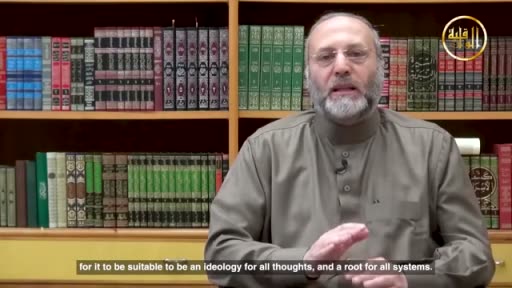
Opening passage from The System of Islam
The Islamic da’wah should be carried today as it was delivered in the past and should proceed following the example of the Messenger (saw), without the slightest deviation from that method in its universals and particulars. No regard should be given to the difference between the epochs, because what has changed is the means and forms, while the essence and the meaning have not, and will not, change, regardless of the passing of ages and changing of peoples and places. Thus, carrying the da’wah demands frankness, courage, strength, thought and to challenge all that contradicts the Idea and Method (fikrah and Tareeqah) of Islam by facing it and exposing its falsehood, irrespective of the consequences and situations.
Introduction
Peace be upon you, and Allah’s mercy and blessings. In the name of Allah, the Most Gracious, the Most Merciful. Praise be to Allah, and blessings and peace be upon the Messenger of Allah, his family, his Companions and those loyal to him. Welcome, dear viewers, to a new episode of your programme, Halaqa Live. In these episodes, we continue to discuss how to carry the da’wah today. We are addressing the core subject: the method of carrying the da’wah and the method of changing society in order to resume the Islamic way of life and establish a society that lives an Islamic way of life.
Dear brothers, when we speak about how to carry the da’wah, we do not mean just any call. We must specify what carrying the da’wah is intended to achieve. The aim may be to convince someone of Islam so that they embrace it. It may be to convince a Muslim to change their conduct so that it conforms to Shari’ah legal rulings. There may also be other aims.
The Intended Meaning of Changing Society
Our subject is how to carry the da’wah in a non-Islamic society in order to transform it into an Islamic society that lives an Islamic way of life. By ‘non-Islamic society’, we do not mean a society made up of people who are disbelievers. No. We mean the Islamic Ummah, which has not apostatised from Islam as a whole but which, after the fall of its state and the spread of the culture of Western civilisation within it, departed from the sphere of Islamic life and consequently became a non-Islamic society. What, then, is the Shari’ah method of carrying the da’wah within the Islamic Ummah to resume the Islamic way of life and transform it once again into an Islamic society that lives an Islamic way of life?
Understanding Society’s Reality Before Changing It
There is no doubt that Islam has shown Muslims the path to establishing Islamic society. In other words, Islam has set out the method for bringing about revival in their society through Islam.
However, this method cannot be understood or applied before the reality of society as a society is understood. As we explained in an earlier episode devoted to Islam’s method of addressing problems, Islam’s method of addressing problems and providing solutions can be summarised again as follows:
First: understand reality precisely and deeply in order to identify the true nature of the problem to be addressed. Scholars of usool call this tahqiq al-manat. Second: return to the legislative texts and understand, from a legislative perspective, those texts that relate to this reality and problem. The aim is to know Allah’s ruling on the matter and derive the treatments and solutions from the revelation sent down to the Messenger of Allah (saw). Third: apply these Shari’ah treatments to that reality in order to solve the problem with an Islamic solution.
It is therefore first necessary to understand the reality of human society as a society. In other words, society must be defined.
Why is defining society merely as a group of individuals insufficient?
Many people look at society in a superficial and fleeting way. They therefore define it incorrectly, with a definition that does not match its reality. They say that society is merely a collection of individuals. On the basis of this definition, they form a view of how to elevate or reform society. They say: ‘Reform the individual and society will be reformed.’ Let us examine this definition.
For a definition to be correct, it must be both comprehensive and exclusive. It is comprehensive when it applies to every society, and exclusive when it does not apply to anything other than society. If we apply this description, which they think defines the reality, to the reality of society, we find it comprehensive but not exclusive. It is comprehensive because every society necessarily contains a group of people. However, it is not exclusive because it applies to things other than society: a mere group of people does not necessarily form a society, even if they gather in one place. Let us give an example.
A group of people on the same ship do not form a society, however numerous they may be—even if they number thousands. Everyone agrees on this. Are they not a group of individuals? Why, then, do they not form a society? This shows that the definition is inadequate and therefore incorrect. While thousands of people aboard a ship do not form a society, a few hundred people in a small village do. Everyone also agrees on this.
The Correct Definition of Society
The correct definition is the one that discerns the fundamental difference between those who constitute a society—whether numbering hundreds in a village—and those who merely gathered at some point without forming such a community, even if numbering tens of thousands.
The fundamental difference lies in the fact that among villagers, enduring relationships have formed which preserved their cohesion and made them a cohesive unity. These relationships endowed their collective—not its individual members—with a distinctive personality, so this group acquired a defined identity. Meanwhile, passengers on an ocean liner numbering thousands are merely fellow travellers bound by no lasting ties; they will disperse immediately upon reaching the quay. Thus, society is a gathering of people united by enduring relationships through which that society functions and distinguishes itself: if these relationships are elevated, then the society is elevated; if they are lowly, it is degraded. Moreover, the nature of these relationships determines this community’s identity and way of life—whether we encounter a pre-Islamic society, a capitalist one, or an Islamic one, among other types.
Here arises the following question: how can these relationships be elevated? How can they become degraded? And what gives them their distinctive pattern that defines this society’s identity and way of life?
Components of relationships in society
The answer lies in understanding the factors that govern these relationships. A profound examination of societal reality reveals that three components control people’s relations within it: concepts, emotions, and systems.
As for concepts, a person’s conduct follows the concepts they hold. They do what they consider right and refrain from what they consider wrong. For relationships to arise between people, they must share one set of concepts on which they agree. People come together around an interest that they regard as an interest. A relationship between them can exist only if they share the same concept of that interest. If their concepts of it differ, the relationship will not arise. Concepts are therefore the basis on which relationships, and consequently society, are formed.
As for emotions, the concepts people hold are linked to emotions of the same kind. For a relationship to arise among them, they must share the same feeling towards the interest that brought them together. They all rejoice at what they consider right, and they all become angry and disturbed at what they consider wrong. These ideas and emotions constitute the general custom (al-urf al-aam) in society—society’s culture.
As for systems, every society has an authority that takes care of its affairs, regulates its relationships and settles its disputes. It does all this according to a system that it adopts, applies and imposes on every member of society. The system therefore has a major effect on society’s relationships. Everyone can see this in their own life: the systems in force control people’s relationships and imprint them with their own character, whether people like it or not.
Identity of the Society and Cohesion of Its Components
It thus becomes clear that society consists of people bound together by a set of ideas, emotions and systems. Society is classified according to those ideas, emotions and systems. If they are capitalist, for example, the society is capitalist. If they are communist, the society is communist. If they are Islamic, the society is Islamic.
For such a society to possess a specific identity and distinct character, that set of ideas, emotions and systems must be harmonious so that they do not contradict one another. If we suppose that a society carries a mixture of capitalist and Islamic ideas—as is the case in most Muslim countries today—it will have neither a particular colour nor a defined identity. Consequently, as long as it remains in this state, it will not experience revival in any form.
The contradiction between general custom and systems
The same applies if a rift arises in a society between its general custom—that is, its culture—and the systems applied to it. This occurs when rulers apply systems that contradict society’s concepts and emotions, as is the case in most of the Islamic world today. Such a society will certainly be unstable, with hostility burning between rulers and ruled. It is therefore far removed from elevation or revival.
A society rises when its ideas, emotions and systems rise, and it declines when they decline. These ideas, emotions and systems can be elevated only if they are built on a single intellectual basis. This basis must be a rational creed that gives a comprehensive view of the universe, humanity and life, so that it can serve as the basis of every idea and the source of every system.
The Rational Creed as the Basis of Revival
In summary, a society is revived only when its general custom—its ideas and emotions—is built on a rational creed and its systems emanate from that creed. The creed then becomes the foundation on which society rests and the intellectual leadership that guides it towards revival. If we wish to establish a society that enjoys true revival, this can therefore be achieved only by establishing an Islamic society. This is our conviction as Muslims: we must establish a society based on the Islamic creed, so that all its ideas, emotions and systems are Islamic. The Islamic creed alone is true; everything else is false.
The Reality of Today’s Muslim Society
When we examine the reality of Muslim society today in light of the preceding discussion, we regrettably find that it deserves to be described as a low society. Although many of its ideas are Islamic, a large proportion are foreign, non-Islamic ideas. Most came to us from Western civilisation, such as the separation of religion from life, public freedoms, democracy and similar ideas.
The same applies to emotions. Although the Ummah has preserved many of its Islamic emotions, many low emotions that contradict Islam—such as nationalism, patriotism, tribalism and sectarianism—have spread through society.
As for systems, most of those applied in Muslim lands—as we all know—are taghut systems imported from man-made laws, especially the systems of the West.
Thus, the society in which Muslims live—the society of the Muslims—has become a mixture of Islamic and non-Islamic ideas, emotions and systems. This has made it a low society that experiences no revival.
This also means that although most people in the society are Muslims, the description ‘Islamic society’ does not apply to this society. In other words, it is not an Islamic society because it does not live an Islamic way of life.
Following the Prophet (saw) in Changing Society
Now that we have understood the reality of society in general and the current state of our own community—the Muslim Ummah—and recognised how it diverges from the true Islamic society that must be established, we move on to discuss the method of carrying the da’wah intended for resuming the Islamic way of life. That is, transforming the Ummah once again into an Islamic society.
The criterion in this matter is His saying:
﴿ لَّقَدْ كَانَ لَكُمْ فِى رَسُولِ ٱللَّهِ أُسْوَةٌ حَسَنَةٌ لِّمَن كَانَ يَرْجُوا۟ ٱللَّهَ وَٱلْيَوْمَ ٱلْـَٔاخِرَ وَذَكَرَ ٱللَّهَ كَثِيرًا ﴾
‘There is indeed an excellent example for you in the Messenger of Allah—for whoever hopes for Allah and the Last Day and remembers Allah often’ [33:21]
And His saying:
﴿ قُلْ هَـٰذِهِۦ سَبِيلِىٓ أَدْعُوٓا۟ إِلَى ٱللَّهِ ۚ عَلَىٰ بَصِيرَةٍ أَنَا۠ وَمَنِ ٱتَّبَعَنِى ۖ وَسُبْحَـٰنَ ٱللَّهِ وَمَآ أَنَا۠ مِنَ ٱلْمُشْرِكِينَ ﴾
‘Say: This is my path. I call to Allah with clear insight—I and those who follow me. Glory be to Allah, and I am not one of the polytheists’ [12:108]
The Prophet (saw) was the first to carry the da’wah in a non-Islamic society in order to transform it into an Islamic society. What method did he follow in this work, in this great historic mission?
The Three Stages of Establishing Islamic Society
The Messenger (saw) was sent in a jahili society dominated by jahili concepts, emotions and systems. His mission was to transform this society into an entirely different society—not by changing its individuals, removing them or replacing them with other individuals, but by changing its concepts, emotions and systems: removing the ideas, emotions and systems of disbelief and establishing Islamic ideas, emotions and systems.
A careful and inductive study of the life of Allah’s Messenger (saw) shows the following. His biography is part of his Sunnah, which is one of the sources of legislation that Allah has prescribed for us—the second source after Allah’s Book. The Prophet’s (saw) actions form part of his Sunnah, and the Prophetic biography is precisely a collection of his actions from the day he was sent until the day he was raised to the Highest Companion.
A careful and inductive study of the Prophet’s (saw) biography from the beginning of revelation shows that his work to establish Islamic society—a society that lives an Islamic way of life—can be divided into three stages:
Stage one: preparing a structured group of da’wah carriers on the basis of Islam and culturing it with Islamic culture. Stage two: proclaiming the da’wah openly and engaging with society. Stage three: applying Islam in practice through the Islamic State. The details follow.
Stage One: Culturing and Preparing the Structured Group
The first stage—the stage of culturing and preparing the structured group—lasted for three years from the Prophet’s (saw) mission. During this period, he instilled the creed in the hearts of the Companions (ra). He strengthened their iman through decisive rational evidence, taught them the rulings of Islam and cultured them with a living Islamic culture. He presented evidence of the corruption of jahili creeds, concepts and systems, and encouraged them to remember Allah and reflect on the universe so that their certainty in Allah and obedience to Him would increase.
He awakened spirituality within them through prayer, recitation of the Qur’an and night prayer. He removed jahili emotions, such as jahili pride and tribal partisanship, from their hearts and awakened Islamic emotions that accorded with true Islamic concepts. He accustomed them to loyalty to Allah, the Messenger and the believers, and forbade them from giving loyalty to Satan and his allies, even if they were their fathers, brothers, sons or relatives.
He sharpened their resolve to establish the truth and eradicate falsehood until they reached a state in which they could not bear for the ideology to remain confined within them. The creed boiled in their hearts, and the true concepts crowded their minds.
The reality—with its corrupt, worn-out and decaying convictions, customs, traditions and systems; unbearable injustice and intolerable corruption; domination by the worst people and outcasts from every quarter; the tyranny of despots; oppression of the weak; the burial alive of infant girls; giving short measure; preying upon people through usury; and fighting for tribal partisanship—spurred them to struggle against it in order to correct it.
The Messenger (saw) continued in this stage until he had prepared a structured group of Companions who had matured in Islamic culture. The Islamic mentality had formed within them, and their disposition had become Islamic. He was therefore reassured that he had formed a structured group of mature Islamic personalities connected to Allah Most High, with no connection to jahili society. He was certain that the group was ready to proclaim the da’wah and confront the existing society with all its jahiliyyah. This was the Prophet’s task in the first stage.
Stage Two: Proclaiming the Da’wah and Engaging with Society
The second stage was the stage of proclaiming the da’wah openly and engaging with society.
During this stage, the Messenger (saw) continued to build his structured group, culture it and increase its numbers. He added several tasks that were among the most dangerous, difficult and severe in the life of the da’wah lived by the structured group of Companions—the Prophet’s (saw) group. These tasks can be listed as follows:
First: the open mass da’wah to spread Islam and create Islamic public opinion. Second: the intellectual struggle against the creeds, systems and ideas of disbelief, as well as corrupt customs, erroneous ideas and mistaken concepts, in order to expose their falsehood and call for their abandonment. Third: political struggle against the leaders of Quraysh because they persisted in disbelief, ruled people with the systems of disbelief and opposed the Islamic da’wah during this stage of open proclamation.
The Mass Da’wah, Intellectual Struggle and Political Struggle
The Messenger (saw) carried the da’wah and openly presented the structured group that carried it with him, openly and defiantly. Moreover, this da’wah itself entailed struggling against Quraysh and Makkan society because it called for the oneness of Allah and worshipping Him alone, abandoning idol worship and giving up the corrupt system according to which they lived. It therefore clashed completely with Quraysh. The Messenger (saw) dismissed their ideas as foolish, belittled their gods, condemned their base way of life and denounced their unjust means of living.
The Qur’an would be revealed to him, attacking them and telling them plainly:
﴿ إِنَّكُمْ وَمَا تَعْبُدُونَ مِن دُونِ ٱللَّهِ حَصَبُ جَهَنَّمَ أَنتُمْ لَهَا وَٰرِدُونَ ﴾
‘Indeed, you and what you worship besides Allah are fuel for Hell. You will enter it’ [21:98]
It then fundamentally and fiercely attacks the usury on which they lived. Allah Most High says in Surah al-Rum:
﴿ وَمَآ ءَاتَيْتُم مِّن رِّبًا لِّيَرْبُوَا۟ فِىٓ أَمْوَٰلِ ٱلنَّاسِ فَلَا يَرْبُوا۟ عِندَ ٱللَّهِ ﴾
‘Whatever you give as usury so that it may increase through people’s wealth does not increase with Allah’ [30:39]
He also warns those who give short measure and weight. Allah Most High says:
﴿ وَيْلٌ لِّلْمُطَفِّفِينَ ٱلَّذِينَ إِذَا ٱكْتَالُوا۟ عَلَى ٱلنَّاسِ يَسْتَوْفُونَ وَإِذَا كَالُوهُمْ أَو وَّزَنُوهُمْ يُخْسِرُونَ ﴾
‘Woe to those who give short measure: those who, when they take measure from people, take in full, but when they measure or weigh for them, give less’ [83:1–3]
Quraysh therefore began opposing him and harming him and his Companions: at times through torture, at other times through boycott, and through propaganda against him and his Deen, distortion of his da’wah and lies about it. Yet he continued to attack their creed and way of life. He continued to combat false ideas, demolish corrupt creeds and struggle to spread the da’wah. He called to Islam with complete openness. He neither concealed his message nor merely hinted at it. He neither softened nor submitted, flattered nor compromised, despite the many forms of harm Quraysh inflicted on him and the hardships he endured.
Although he was an unarmed individual with no helper or supporter among the people, no equipment and no weapon, he came openly and defiantly, calling to Allah’s Deen with strength and faith. No weakness entered him as he endured the costs of the da’wah and shouldered its immense burdens. All this helped him overcome the obstacles that Quraysh placed before him to prevent him from reaching the people. The Messenger (saw) succeeded in reaching the people and conveying the message to them. They turned to Allah’s Deen; the strength of truth began to rise above falsehood; and the light of Islam spread further among the Arabs each day. A number of idol worshippers embraced Islam. Even the leaders of Quraysh began listening to the Qur’an, and their hearts yearned for it, but they were too arrogant to submit to the truth.
The Impact of Publicly Proclaiming the Da’wah in Makkah
This stage revealed a struggle between one thought and another, between Muslims and disbelievers. It began with the structured group of Companions who carried the da’wah under the leadership of the Messenger of Allah (saw). From that time—when the Prophet (saw) proclaimed his da’wah openly—he carried the da’wah to all people, openly, in broad daylight and defiantly.
This mass da’wah and collective culturing affected Quraysh. Their hatred increased, and they sensed the danger approaching. They began taking serious measures to resist after initially paying no attention to Muhammad (saw) or his da’wah. Political struggle therefore became increasingly evident.
The Noble Qur’an was revealed denouncing Abu Lahab by name—the Prophet’s uncle and one of Mecca’s leading figures—and the following words of Allah Most High were revealed:
﴿ تَبَّتْ يَدَآ أَبِى لَهَبٍ وَتَبَّ مَآ أَغْنَىٰ عَنْهُ مَالُهُۥ وَمَا كَسَبَ سَيَصْلَىٰ نَارًا ذَاتَ لَهَبٍ ﴾
‘May the hands of Abu Lahab perish, and may he perish. His wealth and what he earned did not benefit him. He will burn in a blazing Fire’ [111:1–3]
The Qur’an was revealed attacking al-Walid ibn al-Mughirah by his attributes. He had undertaken the intellectual and media campaign against the da’wah. Allah Most High said:
﴿ كَلَّآ ۖ إِنَّهُۥ كَانَ لِـَٔايَـٰتِنَا عَنِيدًا سَأُرْهِقُهُۥ صَعُودًا إِنَّهُۥ فَكَّرَ وَقَدَّرَ فَقُتِلَ كَيْفَ قَدَّرَ ثُمَّ قُتِلَ كَيْفَ قَدَّرَ ثُمَّ نَظَرَ ثُمَّ عَبَسَ وَبَسَرَ ثُمَّ أَدْبَرَ وَٱسْتَكْبَرَ فَقَالَ إِنْ هَـٰذَآ إِلَّا سِحْرٌ يُؤْثَرُ ﴾
‘No indeed! He has been stubbornly hostile to Our signs. I shall burden him with a steep ascent. Indeed, he thought and calculated. May he be destroyed—how he calculated! Again, may he be destroyed—how he calculated! Then he looked, then frowned and scowled, then turned away and acted arrogantly, and said: “This is nothing but magic handed down”’ [74:16–24]
﴿ فَقَالَ إِنْ هَـٰذَآ إِلَّا سِحْرٌ يُؤْثَرُ إِنْ هَـٰذَآ إِلَّا قَوْلُ ٱلْبَشَرِ سَأُصْلِيهِ سَقَرَ ﴾
‘He said: “This is nothing but magic handed down. This is nothing but the word of a human being. I will cast him into Saqar”’ [74:24–26]
That is: ‘I will cast him into Hell.’
The harm and persecution of the Prophet (saw) and his Companions (ra) increased. The mass da’wah carried it to a wider horizon, although it also brought its carriers hardship, torment and the endurance of many forms of harm. The Prophet’s attacks on the oppression, cruelty and enslavement that prevailed in Makkah, and his exposure of the disbelievers’ conditions and deeds, further inflamed the anger of the leaders of Quraysh. This was one of the hardest stages and one of the greatest phases of the da’wah.
Changing general custom and establishing Islamic public opinion
From the time the Messenger (saw) established the structured group of Companions that proclaimed the da’wah to Islam with him, he sought to change the prevailing general custom (al-urf al-aam) in Makkah from a jahili general custom into an Islamic general custom. Changing that general custom is the most important step—the most important step—in changing society and moving it from jahiliyyah to Islam.
The general custom is, in reality, the sum of society’s ideas and emotions, which shape its conduct, relationships and attitudes. If Islam spreads in Makkah and the majority embrace it, they will have adopted its ideas and its emotions will have taken root within them. The general custom will then have formed on the basis of Islam, even if only in a general way. This will produce a public opinion, a common stance and a general direction that seeks Islam in its positions and views.
Only one obstacle will then remain between society and its becoming Islamic: the system of Islam must be put into practice through authority and governance. Either those who hold authority and power embrace Islam and bring it to power themselves, or society removes them by force after public opinion in Makkah has become Islamic and seeks an Islamic way of life. Makkah can thereby become the first nucleus of Islamic society.
Searching for a New Society
However, this was not achieved for the Messenger (saw) in Makkah. Although the number of Makkans who entered Islam increased during that stage, they did not reach the point at which the general custom—and consequently Makkan public opinion—could be described as Islamic. They numbered only in the dozens. The prevailing general custom remained jahili, and public opinion remained that of the people of jahiliyyah.
The situation in Makkah reached the point at which society became rigid and hardened like stone in the face of the Messenger (saw). No interaction remained between the da’wah and the people because of the terror that Quraysh’s leaders directed against Islam and anyone who considered entering the new Deen.
This prompted the Messenger (saw) to seek a new society in which he could try to spread Islam, in the hope that it would become an alternative to Makkah—a focal point for the da’wah—where it could move from the stage of da’wah to the stage of practical implementation through governance. He approached Thaqif in Ta’if, called them to Islam and asked them to support it, but they rejected him in the harshest manner. He neither wavered nor stopped. He began presenting his da’wah to the tribes that came to Makkah during the Hajj season, until Allah Most High honoured the people of Yathrib by making them the people who supported Islam and the Messenger (saw).
Mus‘ab ibn ‘Umayr and the Formation of Public Opinion in Madinah
This occurred when a delegation from Madinah embraced Islam through the Messenger (saw) during the Hajj season in the tenth year of the Prophethood. They returned to Madinah to call their people to Islam and to return to Makkah the following season with more people whose hearts had opened to Islam’s guidance. They pledged allegiance to the Messenger (saw), who sent with them the noble Companion and accomplished da’wah carrier Mus’ab ibn ‘Umayr (ra). He was to teach them Islam, give them a deep understanding of it, spread Islam in Madinah and call those who had not yet believed to iman.
Less than a year had passed since Mus‘ab arrived in Madinah—less than a year had passed since Mus‘ab arrived in Madinah—when an Islamic general custom had formed in the city after its leaders and the majority of its people entered Islam. The majority of its inhabitants, the people of Madinah, entered Islam. The Islamic general custom in Madinah thereby provided the foundation upon which the Islamic State could rest. All that remained was for the Messenger (saw) to come to Madinah and put the Islamic systems into practice through authority and governance. The first Islamic society would thereby be established.
Stage Three: Implementing Islam through the State
Thus, the second Pledge of al-‘Aqabah and then the Messenger’s (saw) migration to Madinah crowned the process of establishing Islamic society. From the moment he arrived, he began applying the systems of Islam in every sphere: governance, economics, social affairs, education, punishments, and domestic and foreign policy. The Messenger (saw) thereby reached the third stage: the practical application of Islam through governance and authority—that is, through the state, the Islamic State.
Thus the Prophet (saw) established the Islamic way of life. The establishment of the Islamic State was the pivotal step that led to applying the system of Islam and strengthening Islamic culture in Madinah—strengthening Islamic concepts and emotions—until the first Islamic society emerged. The Prophet (saw) said of it: «خير الناس قرني» — ‘The best people are my generation’ [Sahih al-Bukhari 2652], namely the generation of the Companions (ra).
Applying the Prophet’s Method Today
This is the Prophet’s (saw) method of carrying the da’wah to change society, and this very method must be adopted today when carrying the da’wah to change the present society into an Islamic society. We must take account of the differences between that society and this one—the differences in their ideas, emotions and systems. Today, we do not struggle against the idols Hubal, Manat and al-Lat, or against the burial alive of infant girls. Instead, we struggle against the ideas of secularism, democracy, dictatorship, capitalism, nationalism, patriotism and public freedoms that have spread through our society and corrupted its identity. Nor is our political struggle limited to the Abu Jahls and Abu Lahabs who exercise tyranny over people. Rather, we go beyond politically opposing the rulers in our lands to struggle against the colonialism that installed them as its guards and placed them in positions of rule and authority. The method adopted remains the method of the Prophet (saw), without deviating from it by even a hair’s breadth. Allah Most High says:
﴿ قُلْ إِن كُنتُمْ تُحِبُّونَ ٱللَّهَ فَٱتَّبِعُونِى يُحْبِبْكُمُ ٱللَّهُ وَيَغْفِرْ لَكُمْ ذُنُوبَكُمْ ۗ وَٱللَّهُ غَفُورٌ رَّحِيمٌ ﴾
‘Say: If you love Allah, follow me; Allah will love you and forgive you your sins. Allah is All-Forgiving, Most Merciful’ [3:31]
Praise be to Allah, Lord of all worlds.
Viewers’ Questions
Now let us turn to the questions that may have been raised during this halaqa.
Did the Mujtahids Differ over the Method of Changing Society?
Brother Nadhir ibn Salih asks: Did the mujtahids differ over the method of changing society?
My dear brother, if the question refers to the earlier mujtahids in Islamic history, from the beginning of Islam and over the course of hundreds of years, I would say this: the issue of establishing a new Islamic society and a new Islamic State that rules by what Allah has revealed and creates an Islamic society that lives an Islamic way of life did not arise for the earlier mujtahids. Why? Because they lived under an Islamic State that ruled by what Allah had revealed and in a society that lived an Islamic way of life. During many periods, it experienced some deviation, some misapplication of Islam and some regression. However, those earlier Muslims and mujtahids never knew a period without a Dar al-Islam that lived an Islamic way of life.
If you examine the books of the earlier jurists and mujtahids, you will therefore find no discussion of how to establish the Islamic State. Nor will you find any discussion of how to establish Dar al-Islam anew. Their questions were: How do we expand Dar al-Islam by carrying the Islamic da’wah to the world? Or how do we liberate land that was Dar al-Islam but was conquered by the disbelievers and turned into Dar al-Kufr? Their concern was to expand Dar al-Islam and liberate it if it was occupied. They did not examine how to establish Dar al-Islam or resume the Islamic way of life anew. You will therefore find no study among them comparable to the one we undertake today: How do we change society from a non-Islamic society into an Islamic society when no Islamic State exists to incorporate it into Dar al-Islam, so that through people embracing Islam it becomes an Islamic society living an Islamic way of life? There is therefore no answer to this question, because the earlier mujtahids did not address this subject at all.
Today, we are careful to address this subject according to the Islamic method—Islam’s method of solving problems. We call on everyone working for this cause to adopt this method, even if they disagree with us on individual matters of ijtihad. Unfortunately, many who declare that they carry the Islamic da’wah follow approaches in which they do not take the Messenger of Allah (saw) as their example. They do not even accept that changing society must follow a binding Islamic method.
They say: ‘This method is discretionary, not prescribed. We may change society by any approach we consider suitable without adhering to the method of the Prophet (saw).’ Some prominent figures among them have even said that the biography of the Prophet (saw) was a human experience and that none of it binds us at all. They went further and said that what binds us is the Prophetic Sunnah, not the Prophetic biography. I do not know how anyone can distinguish between the biography of the Prophet (saw) and his Sunnah, when everyone knows that the Sunnah of the Prophet (saw) is everything that issued from him in the form of a statement, action or approval. Is the biography of the Prophet (saw) anything other than a collection of his actions that the transmitters recorded and conveyed to us, from which we accept what is authentic and leave what is not?
Today, we need efforts to come together and those working to resume the Islamic way of life to compete in applying the Shari’ah method of research that the mujtahids used when deriving all Shari’ah legal rulings from the Book and Sunnah. We strive and exert our utmost effort to adhere to this method so that we may deserve victory from Allah Most High.
Does differing reality change the method?
Brother Salim al-Bahith says: Peace be upon you, and Allah’s mercy and blessings. And peace be upon you, and Allah’s mercy and blessings.
He says: There is a difference between the reality in which the Messenger of Allah (saw) lived and our reality. The Messenger of Allah (saw) addressed disbelievers, whereas we live among Muslims. Does this not cause the method of changing society to differ? My dear brother Salim, I believe you must have noticed what I said at the end of the episode about the need to take account of the differences between that society and this one.
What does not differ is that the Prophet (saw) dealt with a society, and we deal with a society: a society made up of ideas, emotions and systems. He sought to replace them with Islamic ideas, emotions and systems. We do the same today. Makkah was Dar al-Kufr, and Madinah was Dar al-Kufr. He worked to transform them, and he transformed Madinah into Dar al-Islam. Today, we work to transform our lands into Dar al-Islam after the systems of disbelief gained ascendancy within them. The method of changing society is one.
The difference between the culture prevailing in that society and the culture prevailing in this one does not change the method. It changes only the discourse—its content. The Prophet (saw) struggled against a jahili culture. He struggled against idol worship, veneration of the forefathers, the burial alive of infant girls and giving short measure. The Prophet (saw) struggled against one jahili culture, while today we struggle against another culture.
Our concern today is not to say to people:
﴿ وَإِذَا ٱلْمَوْءُۥدَةُ سُئِلَتْ ﴾
‘and when the girl buried alive is asked’ [81:8]
Nor is our concern to attack idol worship. Indeed, our concern is not to call people to Islam, because we live among Muslims. Rather, our concern is to launch a campaign against the ideas, emotions and systems that have penetrated Muslim life, changed it from an Islamic life into a non-Islamic life, and transformed society from an Islamic society into a non-Islamic society.
We launch an intellectual campaign against the Western culture that has spread through our lands. We launch a campaign against the creed of separating religion from life, against secularism, capitalism and the idea of public freedoms that came to us from the West and influenced us, against patriotism, which divided the Muslims’ loyalty, and likewise against nationalism, which divided the Muslims’ loyalty. We launch a campaign against the man-made systems and laws imposed upon us, which the West and its agents have worked to strengthen and make people comfortable with.
What has changed is naturally the content of the discourse. It is an Islamic discourse, but one that confronts the ideas that prevailed in our society and changed its identity from an Islamic identity into another, non-Islamic identity. We consequently came to live a non-Islamic life, and our society became non-Islamic, with non-Islamic systems applied within it. The method does not change, but the content of the discourse changes.
The Prophet (saw) likewise waged political struggle against the leaders of Quraysh who opposed the da’wah. Those leaders were not subordinate to foreign states or foreign colonialism.
Today, what dominates our lives, from behind a veil or without one, is colonialism. It installed these rulers as watchmen who represent it and safeguard its interests instead of taking care of the people’s interests and affairs.
Political struggle must not stop at the rulers who govern us by other than what Allah has revealed, betray this Ummah, conspire against it and offer it as a sacrifice to the disbelievers. We must go beyond them to struggle against the colonialism that imposes the policies applied in our lands. We must expose to the people the political conspiracies that come from colonial states through our rulers. Here, political struggle goes beyond the local rulers to the real rulers abroad—to colonialism.
This is where the difference lies. It is not a difference in the method itself, but in applying the method to the concrete reality—the reality to which the method is applied. The discourse must take this difference into account. It varies according to the treatment and Islamic discourse that the reality requires. This is what differs between our reality and the reality in which the Prophet (saw) was sent.
Was the Method Specific to the Prophet (saw)?
The question is from Brother Hilal: ‘Peace be upon you, and may Allah bless you.’ And upon you be peace, and Allah’s mercy and blessings. May Allah bless you and us.
Some people claim that this method was specific to the Messenger. But Mus’ab ibn ‘Umayr was not a prophet, yet he secured nusrah (support) while isolated and with nothing but guidance in his mind.
Yes. I understand Brother Hilal’s comment to mean that if the Prophet’s (saw) method had been specific to him and a matter of his own choice, Mus‘ab ibn ‘Umayr would not have adhered to it. However, we find that Mus‘ab adopted the same method as the Prophet (saw). Just as the Prophet (saw) worked to spread Islam in Makkah, Mus‘ab did the same. Just as the Prophet (saw) approached the people of power and called on them to support Islam, Mus‘ab did the same in Madinah. He approached the people of power—the leaders of Madinah—and called them to Islam. They supported Islam, and the people of Madinah thereby earned the honour of being named by Allah Most High the Ansar, who supported Allah and the Messenger (saw).
Does political struggle create enemies for the da’wah?
Brother Nizar Sitti says: Some people say that political struggle has made certain groups or individuals enemies instead of allies of the Islamic da’wah. What is your response to this objection?
If political struggle had come at the beginning, before those people became hostile to Islam, this claim would have been correct. Consider what Allah Most High said to Moses and Aaron (peace be upon them) at the beginning, when He sent them to Pharaoh:
﴿ فَقُولَا لَهُۥ قَوْلًا لَّيِّنًا ﴾
‘Speak to him gently’ [20:44]
This is how the discourse must begin. You seek the person’s guidance. The Prophet (saw) began by addressing the disbelievers of Quraysh in a concerned, friendly and calm manner because he sought their guidance. Whenever they sought to debate him, he debated them in the best manner, in compliance with the words of Allah Most High:
﴿ وَجَـٰدِلْهُم بِٱلَّتِى هِىَ أَحْسَنُ ﴾
‘and debate with them in the best manner’ [16:125]
But when they fought the da’wah, heaped abuse and propaganda upon it, and tortured its followers, was the discourse addressed to them still required to remain subdued, timid and flattering? No, of course not.
Political struggle begins only after the rulers declare hostility towards the da’wah. We begin with a concerned, calm and friendly discourse so that they may embrace Islam, embrace this da’wah and carry this cause. If they refuse—and more than that, if they declare hostility towards it, persist in fighting Allah, His Messenger, Islam and the Islamic Ummah, become a thorn in the side of the Muslims and the Islamic Ummah, and insist on implementing the disbelievers’ plans in Muslim lands, shall we then continue to take them as allies or—meaning—establish affection between us and them? Allah Most High says:
﴿ وَدُّوا۟ لَوْ تُدْهِنُ فَيُدْهِنُونَ ﴾
‘They wish that you would compromise, so they too would compromise’ [68:9]
That is, they want you to yield so that they can open the door to one concession after another. This is unacceptable under any circumstances.
If this had been unwise, the Prophet (saw) would not have practised it. Indeed, Qur’an was revealed during the Makkan stage—such as the verses we read shortly before—launching a campaign against Abu Lahab by name, against Abu Jahl by his attributes, against al-Walid ibn al-Mughirah by his attributes, and against others who undertook to oppose Islam, wage war against Islam and the Muslims, and harm the Prophet (saw). The purpose of political struggle is to undermine these rulers’ legitimacy and every claim that they represent legitimacy, the right to rule people, or legitimate authority to rule people. This is indispensable.
Does Reforming the Individual Reform Society?
A question from Noor al-Qur’an: ‘Peace be upon you, and Allah’s mercy and blessings.’ And upon you be peace, and Allah’s mercy and blessings.
Many people repeat the saying: ‘Reform the individual and society will be reformed.’ Does this saying actually change society?
I think I have devoted this entire halaqa to answering this statement. I explained society’s reality, its limits and its definition in detail. Society is not merely a group of people, such that it can be changed by changing its members one by one.
Society is a fabric woven by people. Just as threads gathered in one place without being woven do not form cloth, the same applies to society and people. If we gather many individuals in one place and keep them together there for a long time without weaving them together, they do not form a society.
I explained that this fabric is a system of ideas, emotions and systems; that society is formed by this system of ideas, emotions and systems; that its character is defined by their character; that it rises through their elevation; and that it declines through their decline.
Our cause is not to change individuals one by one. Rather, our cause is to reweave this society with Islamic ideas, emotions and systems. This begins by establishing an Islamic public opinion upon which an Islamic State can rest. The state then undertakes to strengthen Islamic culture and Islamic emotions and to apply the systems of Islam, thereby making this society an Islamic society that lives an Islamic way of life and carries Islam as a message to the world.
Dar al-Islam expands, and the systems of Islam are applied. People learn about Islam’s rulings as ideas and through their practical application. They enter Allah’s Deen in multitudes, and Islamic society expands.
This is the method of the Prophet (saw). Anyone who insists on keeping the da’wah individual, addressing people one by one without aspiring to change the systems imposed by the authorities that shape society, and the media apparatuses that control people’s minds and brainwash them—anyone who insists upon this approach insists upon dispersing energies, wasting efforts and failing to reach the intended objective.
Conclusion
These were the questions received during this episode. I ask Allah Most High to accept from me and from you, to increase me and you in knowledge and action, and to make our knowledge and actions sincere for His Noble Countenance. I send prayers and peace upon the Messenger of Allah, his family, his Companions and those loyal to him. Peace be upon you, and Allah’s mercy and blessings.