Introduction from The System of Islam
The Islamic intellectual leadership is positive since it establishes the mind as the basis for the belief in the existence of Allah ﷻ. It draws man’s attention to the elements of universe, man and life to conclusively and decisively establish the existence of Allah ﷻ, the Creator of these things. It defines for man the absolute perfection which he innately searches for, and does not exist in him, the life, or the universe and directs man’s mind to Him so as to realise His existence and believe in Him. The Capitalist intellectual leadership however, is based upon a compromise solution reached after a bloody struggle between the clergy and the intellectuals, which had lasted for many centuries and it resulted with the idea of separation of the religion (deen) from the state.
Political Creeds and the Mind
Peace be upon you and Allah’s mercy and blessings. Welcome, dear brothers, to another episode of your programme Halaqa Online. We remain in the series titled ‘Intellectual Leadership in Islam’. In this session, we address a topic of paramount importance: political creed and reason.
The proponents of materialist ideologies—capitalists, communists, secularists, and atheists—claim that their thought is rational, that their creeds are based on reason, and that their perspective on life, society, and the entire universe is a product of rational thinking. Conversely, they assert that Islam, like all other religions, does not accord reason its due weight, does not construct its creed upon it, defies reason entirely, and instead relies on an affective, traditional creed founded upon texts devoid of any rational evidence. How accurate is this claim?
Are the Capitalist and Communist Creeds Founded on Reason?
The truth is that this claim is entirely the reverse. Neither the capitalist creed—the creed of separating religion from life—nor the communist creed—‘there is no god and life is matter’—is founded on reason. Why? Let us refute each one separately, then move to the Islamic creed to see whether it is founded on reason. As for the secularists’ creed—the capitalist creed, the creed of separating religion from life, society and state—is it truly a rational creed in the sense that it was founded on reason? The truth is that it was not. The creed of separating religion from life was built on the compromise solution. Yes, it was built on the compromise solution; it was not built on an idea produced by the mind or an idea reached through sound rational inference.
Creed of Separating Religion from Life and the Compromise Solution
When we say that this creed was built upon a compromise solution, we mean the middle ground between the clergy—the European Church—and thinkers who ranged from atheism to denial of religion, revelation, and prophecy.
Europe lived for hundreds of years—nearly a thousand—in an era they called the Middle Ages; they described it as ages of darkness—ages shrouded in ignorance. During these times, the Church exerted considerable influence over people’s thoughts, societal thinking, human conduct, and relationships, while also playing a pivotal role in the political systems of that period.
Of course, for long epochs spanning centuries, kings ruled under the doctrine of divine right—that is, the king governed by mandate from Allah, appointed by none but deriving his legitimacy not from any human being among creation, but solely from Allah. Consequently, no one had the right to rebel against the monarch or even suggest that he acted wrongly. The Church endorsed this theory and granted it legal authority; often, kings reinforced their rule by securing divine mandate through the Church itself: the Pope of Rome—who claimed to hold the Papal See—would confer this mandate upon these kings and rulers.
Indeed, at one point in what is called the Age of Enlightenment—the era known as such in modern history—philosophers emerged who began to rebel against this theory and the system that had prevailed during the Middle Ages. Consequently, theories arose whereby European philosophers started questioning religion from its very foundations; some moved towards denying the Creator, exalted be He, while many others proceeded to affirm His existence. Yet even with their affirmation of the Creator’s existence, they denied revelation, thereby rejecting prophethood and divine scriptures.
Here, a conflict erupted between these philosophical currents—or those known as Enlightenment philosophers—and the clergy.
Many of these philosophers believed that society must abandon religion to achieve elevation and progress. They insisted that people should follow a path that severed their connection with religions they claimed had led to societal decline—particularly Christianity at the time. Meanwhile, the Church clung to its dominance over life, society, and its influence in the state, leading to a clash between what was termed faith and atheism: one group sought to maintain life built upon faith according to their interpretation of it, while others aimed to eliminate religion from people’s lives entirely because, in their view, it was the cause of societal decline.
What, then, was the result? Through some of its philosophers and thinkers, European society arrived at what is called the compromise solution. It said: We are not obliged to deny religion or to establish it as the basis of life. Conversely, we are not obliged to make religion control life. We neither deny religion nor make it control life, society and state. Let religion, the religious question and the question of belief concerning the origin of existence—what preceded it, what follows it, man’s relationship with what preceded it, and so forth—be an individual matter that everyone answers as they wish. We, however, will build this life on the basis of separating it from religion; that is, we will not organise this life according to a particular creedal opinion or viewpoint.
They declared: “We separate religion from life,” meaning that neither do they deny nor affirm religion. They would not force anyone to reject faith nor compel anyone to embrace it, but rather keep this matter distinct from public life, society, legislation, politics, and state affairs.
Why Was the Capitalist Creed Not Founded on Reason?
The idea of separating religion from life, society, and the state emerged as a compromise solution to resolve the crisis European society faced after centuries under the control of the Church, religious leaders, and kings who ruled by divine mandate over the community.
Of course, this creed cannot be said to have been founded on reason. Why? Because reason still needs answers to these questions: What is the origin of the universe, man and life? Where did man come from, and where is he going? What is man’s relationship in this worldly life with what preceded it, and what is his relationship with what follows it? These are the questions upon whose answers man must build. They form the biggest knot: if it is untied, the rest of man’s knots are untied. Reason requires answers to these questions so that man may build his life upon them. How can you determine your viewpoint towards life when you do not know the origin of this life, how it came into being, who brought it into being, what will follow it and what the purpose of its existence is?
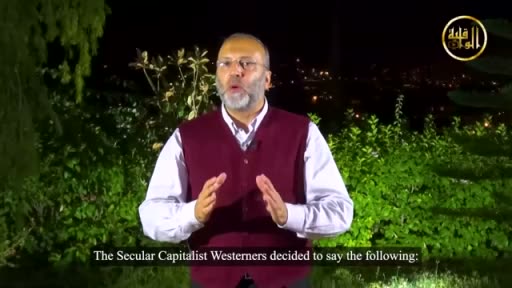
The Westerners—the capitalists and secularists—decided to say the following: This is a matter on which we cannot reach a definitive answer. Let us therefore set it apart from life and build our lives on the basis that we exist in this life and that its purpose is benefit. Let us assume that happiness is attaining the greatest possible share of physical, sensory pleasures. They proceeded to build their thinking and their lives—their thinking about life, and consequently their way of living—upon this basis.
Thus, the creed is not one that separates religion from life based on reason. Rather, it is founded upon fleeing the truth—the avoidance of rational judgement concerning reality: creation, humanity and existence. This is the capitalist creed: a separation of religion from life.
They are liars when they claim to have abandoned a Christian creed that defies reason for one rooted in rationality. What mind is this that asserts we can live in this life without knowing its purpose, detached from knowing its origin and end, or how it relates to what preceded it and what follows? This is not a rational creed; these are not rational perspectives. The creed of separating religion from life was never built upon reason—not in any form.
Capitalist Legislation and Historical Reactions
Consequently, if we move from the creed of separating religion from life—the very foundation upon which Western civilisation was established, shaping its way of living and society—this foundational creed gave rise to a system of life: capitalism, public freedoms, democracy. Their systems and legislations emerged directly from this adopted creed, that of separating religion from life. Just as this creed is not grounded in reason, so too are these legislations in no way rational. They do not stem from definitive rational judgement regarding the meaning of human existence; rather, they belong to the same nature as this creed itself.
Just as the creed represents a compromise solution—a means of escaping questions about religion, the origin of creation, humanity and life—so too were those legislations reactions. Just as the political creed of separating religion from life was a reaction against the authority exercised by the clergy and kings in the name of divine mandate, so too have been the legislations upon which the West has lived for over two centuries until this day.
For example, the democratic idea, which makes sovereignty belong to the people and regards the people as the source of authority, was a reaction against the Church’s control over society. It was also a reaction against the kings who monopolised rule in the name of divine right. They said: No one has sovereignty over society—not the Church, the kings or any family. Sovereignty belongs to the people. The people choose their way of life and choose who governs them, and the ruler is their employee.
Likewise, the idea of public freedoms, which is a foundation of Western legislation, was a reaction against the restriction of freedoms and the tyranny practised by the political partnership of the monarchy and the clergy—the Church. It was a reaction expressed in the claim that people are free in what they do and decide for themselves how to live. This produced freedom of belief, freedom of opinion, freedom of ownership and personal freedom.
It was therefore a reaction against those conditions. The capitalist system, alongside other causes, was also in one respect a reaction against the feudal system, which regarded all land—the basis of production—as the king’s property. That concludes the discussion of the creed of separating religion from life, the political creed that dominates the world today.
The Communist Creed and Its Material Basis
The communist creed, as you know, attempted in the last century to challenge the creed of separating religion from life by proposing a new way of living, another society, and a new system. The communists also claimed they were rationalists and that their creed was produced by reason—but this is false.
The communist creed—one that denies God while asserting life as mere matter—is not founded on reason, even though the mind produced it based on false premises. The mind generated this doctrine upon invalid axioms; how then could such a creed be grounded in reason?
The communists assumed from the outset that matter is the origin of everything and that it is the first existent, with nothing preceding it—an entity whose existence is necessary. If we say that Allah, exalted be He, is the Necessary Existent with no beginning to His existence, then the communists claim that matter itself is this Necessary Existent: nothing preceded it, nor can its non-existence be conceived in eternity or forever. They thus made matter the origin of all things.
Then, when they turned to the question of the mind, they said that the mind is nothing but a product of matter. When they defined it, they said that the mind is the reflection of matter upon the brain. They thus made the mind merely a reflector of matter and consequently made matter the basis. Upon what, then, did they build their creed? They built it upon matter, not upon reason.
If they had made their intellect the judge in matters concerning creation, humanity, and life—specifically in this fundamental question—they would have concluded that matter, with all its tangible attributes and perceptible qualities derived from observable reality, cannot be eternal. It is limited, powerless, and deficient; therefore, it must have come into existence at a particular time. Consequently, there exists a Creator who brought it forth: Allah, exalted is He. This is the judgement of reason.
The intellect cannot assert that matter, which is subject to a law it cannot transcend and is limited, weak, and deficient, could be the origin of all things or the Necessary Existent. Therefore, communist creed was not built upon reason, and it must never be claimed that the legislation adopted by communists—particularly their economic system—is founded on rational evidence.
The Islamic Creed and Building Belief on Reason
The Islamic creed is the only creed which—although it is neither a human product nor a product of the mind, but the result of revelation sent down to Allah’s Messenger, may Allah bless him and grant him peace—Allah, exalted be He, nevertheless built upon the human mind. How?
When the Qur’an—Allah’s Book and Allah’s speech—addressed man with belief, it did so by building that belief upon his mind. That is, it addressed his mind, presented rational proofs and made them the basis for accepting this belief. How? The foundation of belief in Islam is belief in Allah, exalted be He.
When we examine the verses of the Noble Qur’an that call people to faith in Allah, the Exalted, we find that many of these verses present rational and sensory proofs that engage the human intellect—the faculty of reason within man. Thus does Allah, the Most High, say
﴿ أَفِى ٱللَّهِ شَكٌّ فَاطِرِ ٱلسَّمَـٰوَٰتِ وَٱلْأَرْضِ ﴾
‘Is there any doubt about Allah, the Creator of the heavens and the earth?’ [14:10],
and thus says Allah, the Exalted
﴿ أَمْ خُلِقُوا۟ مِنْ غَيْرِ شَىْءٍ أَمْ هُمُ ٱلْخَـٰلِقُونَ أَمْ خَلَقُوا۟ ٱلسَّمَـٰوَٰتِ وَٱلْأَرْضَ ۚ بَل لَّا يُوقِنُونَ ﴾
‘Or were they created from nothing, or were they themselves the creators? Or did they create the heavens and the earth? Rather, they are not certain.’ [52:35–36],
and thus says Allah, the Exalted
﴿ إِنَّ فِى خَلْقِ ٱلسَّمَـٰوَٰتِ وَٱلْأَرْضِ وَٱخْتِلَـٰفِ ٱلَّيْلِ وَٱلنَّهَارِ وَٱلْفُلْكِ ٱلَّتِى تَجْرِى فِى ٱلْبَحْرِ بِمَا يَنفَعُ ٱلنَّاسَ وَمَآ أَنزَلَ ٱللَّهُ مِنَ ٱلسَّمَآءِ مِن مَّآءٍ فَأَحْيَا بِهِ ٱلْأَرْضَ بَعْدَ مَوْتِهَا وَبَثَّ فِيهَا مِن كُلِّ دَآبَّةٍ وَتَصْرِيفِ ٱلرِّيَـٰحِ وَٱلسَّحَابِ ٱلْمُسَخَّرِ بَيْنَ ٱلسَّمَآءِ وَٱلْأَرْضِ لَـَٔايَـٰتٍ لِّقَوْمٍ يَعْقِلُونَ ﴾
‘Indeed, in the creation of the heavens and the earth, the alternation of night and day, the ships that sail through the sea with what benefits people, the water Allah sends down from the sky, giving life thereby to the earth after its death and dispersing in it every kind of creature, and the directing of the winds and the clouds controlled between the sky and the earth are signs for people who use reason.’ [2:164],
﴿ إِنَّ فِى خَلْقِ ٱلسَّمَـٰوَٰتِ وَٱلْأَرْضِ وَٱخْتِلَـٰفِ ٱلَّيْلِ وَٱلنَّهَارِ لَـَٔايَـٰتٍ لِّأُو۟لِى ٱلْأَلْبَـٰبِ ﴾
‘Indeed, in the creation of the heavens and the earth and the alternation of night and day are signs for those of understanding.’ [3:190].
Those endowed with understanding are those who possess minds capable of reflection. When we examine the Qur’an and read it, we find within it numerous verses that address human reason to prove to him the existence of the Creator, may He be exalted
﴿ أَفَلَا يَنظُرُونَ إِلَى ٱلْإِبِلِ كَيْفَ خُلِقَتْ وَإِلَى ٱلسَّمَآءِ كَيْفَ رُفِعَتْ وَإِلَى ٱلْجِبَالِ كَيْفَ نُصِبَتْ وَإِلَى ٱلْأَرْضِ كَيْفَ سُطِحَتْ ﴾
‘Do they not look at the camels—how they were created; at the sky—how it was raised; at the mountains—how they were firmly set up; and at the earth—how it was spread out?’ [88:17–20].
These verses—and others like them—prove that the Qur’an establishes faith in Allah, exalted is He, upon the foundation of human intellect. The Islamic creed is not a product of human reason; rather, it is embraced by humanity on the basis of rational evidence, and thus this creed is built upon human intellect.
Belief in the Unseen and Rational Evidence
Someone may argue that belief in the Creator does not require a divine revelation—so how can you demonstrate what you believe about the unseen through rational proof alone?
We say to them: Our belief in the unseen is based solely on the explicit text of the Book of Allah, the Exalted. It is a report from Allah, the Almighty, conveyed through His Prophet may Allah bless him and grant him peace. Is there rational evidence that Muhammad’s message may Allah bless him and grant him peace—and his account—originate with Allah, the Almighty? Yes.
Here the rational evidence follows in succession: Allah, exalted is He, sent His message to mankind and convinced them through both rational and sensory proofs that they cannot live a truly sound life or find guidance without a revelation from Him. For it is Allah who says:
﴿ قُلْ هَلْ مِن شُرَكَآئِكُم مَّن يَهْدِىٓ إِلَى ٱلْحَقِّ ۚ قُلِ ٱللَّهُ يَهْدِى لِلْحَقِّ ۗ أَفَمَن يَهْدِىٓ إِلَى ٱلْحَقِّ أَحَقُّ أَن يُتَّبَعَ أَمَّن لَّا يَهِدِّىٓ إِلَّآ أَن يُهْدَىٰ ﴾
‘Say, ‘Are there among your partners any who guides to the truth?’ Say, ‘Allah guides to the truth. So is the one who guides to the truth more worthy to be followed, or the one who cannot find guidance unless he himself is guided?’’ [10:35]
Thus this constitutes rational evidence from Allah that man cannot attain guidance except by the guidance of Allah, exalted is He;
﴿ ٱتَّبِعُوا۟ مَآ أُنزِلَ إِلَيْكُم مِّن رَّبِّكُمْ وَلَا تَتَّبِعُوا۟ مِن دُونِهِۦٓ أَوْلِيَآءَ ﴾
‘Follow what has been revealed to you from your Lord, and do not follow allies besides Him.’ [7:3]
The Qur’an presents cumulative proofs addressed to reason, declaring: O mankind, you are incapable of living and finding true direction in this life—of sustaining a guided existence aligned with your own well-being, happiness, and inner peace—without receiving divine guidance from Allah, the Almighty.
﴿ مَن يَهْدِ ٱللَّهُ فَهُوَ ٱلْمُهْتَدِ ۖ وَمَن يُضْلِلْ فَلَن تَجِدَ لَهُۥ وَلِيًّا مُّرْشِدًا ﴾
‘Whoever Allah guides is truly guided; but whoever He lets go astray, you will never find for him a protecting guide.’ [18:17]
Therefore, this rational evidence demonstrates that human beings require Allah’s guidance. How does this divine guidance manifest? It comes through the message of Muhammad may Allah bless him and grant him peace, and the prophets who preceded him. Today, we stand before the final revelation from Allah—Islam.
The Qur’an as Proof of the Message
The message of Islam came from Allah, the Exalted, with an unmistakable seal confirming it as His message: the Qur’an, which is not merely a book conveying guidance but in itself proof that Muhammad may Allah bless him and grant him peace was Allah’s Messenger, and this Book is Allah’s Book containing His words.
How? The Qur’an came forth and challenged people to produce the like thereof; if they had succeeded, it would have been within human capability. But since they failed to do so, it is not of human origin. We have addressed this matter in a dedicated session that anyone who wishes may return to and listen to in detail.
However, here we present evidence that Islam is built upon reason. When Allah, exalted be He, addressed people inviting them to believe in the message of Muhammad (may Allah bless him and grant him peace), who proved his mission through the Qur’an, He said
﴿ وَإِن كُنتُمْ فِى رَيْبٍ مِّمَّا نَزَّلْنَا عَلَىٰ عَبْدِنَا فَأْتُوا۟ بِسُورَةٍ مِّن مِّثْلِهِۦ وَٱدْعُوا۟ شُهَدَآءَكُم مِّن دُونِ ٱللَّهِ إِن كُنتُمْ صَـٰدِقِينَ فَإِن لَّمْ تَفْعَلُوا۟ وَلَن تَفْعَلُوا۟ فَٱتَّقُوا۟ ٱلنَّارَ ٱلَّتِى وَقُودُهَا ٱلنَّاسُ وَٱلْحِجَارَةُ ۖ أُعِدَّتْ لِلْكَـٰفِرِينَ ﴾
‘If you are in doubt about what We have sent down to Our servant, then produce a surah like it and call your witnesses besides Allah, if you are truthful. But if you do not—and you will never do so—then fear the Fire whose fuel is people and stones, prepared for the disbelievers.’ [2:23–24].
Thus, it was established by rational evidence. The Qur’an addresses people with reason to prove to them that this Qur’an is the Word of Allah, exalted be He. No one has been able to produce or refute the rational proofs that establish the Qur’an as the speech of Allah, exalted be He.
The Unseen and Legislation after the Confirmation of Revelation
Once it is established that the Qur’an is the speech of Allah, exalted be He, and that Muhammad is thereby His Messenger, then it follows that we possess news—indeed, multiple accounts—from Allah, glorified and exalted, conveyed through His Messenger. The Prophet’s report concerning his Lord is a matter of certainty. For if he informed us about unseen matters from his Lord—such as the angels, the Day of Judgment, Paradise, Hellfire, or the origin of creation, humanity, life, and its ultimate destiny—then we have received this knowledge directly.
All of this stems from faith in unseen realities grounded in reason, for it is established by transmitted evidence whose authenticity has been confirmed through rational proof; reason itself establishes that the Qur’an is Allah’s speech and that Muhammad may Allah bless him and grant him peace is His Messenger.
Consequently, what Muhammad may Allah bless him and grant him peace brought is the Qur’an and the Sunnah; and the Sunnah is revelation just as the Qur’an. It has been established that what Muhammad may Allah bless him and grant him peace brought was truth and sincerity.
Similarly, faith in the unseen also relies on rational evidence, since it is grounded in what reason has established. Likewise, the legislation brought by Muhammad may Allah bless him and grant him peace establishes a way of living worthy of humanity in this life—because it is the method that Allah, exalted be He, has approved for His servants.
The commitment of the believer—and indeed the commitment of the Islamic community—was that Muslims in their state should adhere to the Islamic Shari’ah, for reason itself demands it. Reason has demonstrated that the Qur’an is Allah’s speech, that Muhammad may Allah bless him and grant him peace is His Messenger, and that Islam is Allah’s message; hence, humanity must live according to this Shari’ah.
Islamic Shari’ah is neither a product of the mind nor of human invention nor of any existing reality; rather, Islamic Shari’ah originates from revelation revealed to Muhammad may Allah bless him and grant him peace. However, it is reason itself that establishes the necessity of adhering to it, following its precepts, and living in accordance with it—because reason concludes that this is the law of Allah, exalted be He.
Summary of the Topic
This, dear brothers, is a concise statement that allows for much further elaboration on political creeds and the mind. We have established that the claim made by secularists and communists—that their creeds are rational and founded on reason, while the Islamic creed is not founded on reason but is merely affective—is sheer falsehood. We have established that the truth is exactly the opposite. I invoke blessings and peace upon the Messenger of Allah, his family, his Companions and those who follow him. Praise be to Allah, Lord of the worlds. Peace be upon you and Allah’s mercy and blessings.
Questions and Discussions
Welcome back for the answers to the questions you sent during this episode. I continue to remind you that we are in the programme Halaqa Online, reading from Imam Taqi al-Din an-Nabhani’s book The System of Islam—may Allah have mercy on him.
Why do some Islamic thinkers cling to secularism?
The first question, from Brother Abdullah, says: Since secularism is not founded on reason and is a decrepit idea, what is the reason so many Islamic thinkers cling to it? Is it lack of understanding, intellectual defeatism, collaboration, or what?
Since you have specified that your question concerns Islamic thinkers, I will say simply: this is not a matter of misunderstanding. Muslims clearly understand that secularism constitutes disbelief—both in its separation of religion from life and in its denial of the Shari’ah legal rulings that regulate human relationships within society and the state through laws enforced by the state.
Secularism—meaning, more precisely, the most moderate form of secularism—is that which holds that religion must not intervene in politics; that legislation should not be derived from religious sources; that sovereignty belongs to the people; and that religion should not serve as a reference for lawmaking or hold supremacy within the state.
Thus, all those who have studied Islam, embraced it as both their creed and system—indeed for decades now—have long known and openly declared that secularism is disbelief in Allah’s religion.
What is astonishing, however, is that some of those who now claim to be Islamic symbols or represent Islamic currents have begun to draw a distinction between extreme atheistic secularism—which they reject—and moderate non-atheist secularism—which they accept—on the grounds that Islam maintains an equal distance from all religions, as they claim. This assertion, however, is entirely false.
The secret lies in Allah’s statement:
﴿ فَتَرَى ٱلَّذِينَ فِى قُلُوبِهِم مَّرَضٌ يُسَـٰرِعُونَ فِيهِمْ يَقُولُونَ نَخْشَىٰٓ أَن تُصِيبَنَا دَآئِرَةٌ ﴾
‘You see those in whose hearts is disease hastening towards them, saying, ‘We fear that a turn of fortune may strike us.’’ [5:52];
this is the secret—that these people believe they cannot provoke the international community, the architects of Western civilisation. Under the slogan ‘We do not live alone in this world’, they insist that we must satisfy the international community. We must appease the American and European authorities; thus, we have no choice but to conform to them and flatter them by claiming acceptance of what they term moderate secularism.
This is misguidance—may Allah protect us from it.
Does the rational judgement rule over transmitted evidence in the original creed?
Brother Abu al-Rashid asks whether, from what I have said, it follows that reason judges transmitted evidence in establishing the Islamic creed.
The mind provides the evidence that proves the Qur’an is the speech of Allah. Therefore, the proofs for the Islamic creed are either rational proofs—such as proof of faith, proof of Allah’s existence, and proof that the Qur’an is His word—and consequently, that Muhammad may Allah bless him and grant him peace was His Messenger.
These creeds, which serve as the gateway to Islam, are derived through rational evidence.
The Qur’an itself argued with people about these matters using rational evidence. As we mentioned earlier in the episode, the Qur’an presented rational evidence that Allah is true and that the Qur’an is the speech of Allah, and consequently that Muhammad—may Allah bless him and grant him peace—is the Messenger of Allah.
Now that it has been established that the Qur’an is the Word of Allah, it follows that all its accounts are true, since the Messenger (may Allah bless him and grant him peace) conveyed them from Allah, the Exalted.
The reports concerning the unseen—the evidence for belief in unseen matters—are based on transmitted evidence. Yet this transmission, namely the Qur’an, was established by reason. The creed as a whole is therefore founded on reason, and its evidence is either reason or transmission whose source was established by reason.
The Product of the Mind and a Creed Based on Reason
Brother Nadhir bin Salih says: ‘Peace be upon you and Allah’s mercy and blessings.’ And upon you be peace and Allah’s mercy and blessings.
Why do we not regard any creed as a rational creed—even if the outcome of that reasoning is incorrect and results in a false creed?
This is a good and well-placed question; indeed, this is what we say: the communist creed is a rational creed. We also say that the capitalist creed—the separation of religion from life—is likewise a rational creed, and so too is Islam a rational creed. By ‘rational creed’ here, we mean it is not an affective creed adopted by humans through imitation and transmission, as is the case with other religious creeds.
But even though we assert that both the communist creed and the capitalist creed are rational creeds—meaning that the mind reached these conclusions—that the mind reached these conclusions.
But these two creeds were not founded upon a judgement of reason. Here, among such people, reason was used as an instrument to invent a creed that reason itself had never judged. You can now use your mind to prove false thoughts; thus, reason is not the foundation here, but merely a tool for a false idea—an idea built without rational evidence.
The Communists used their minds merely to justify and legitimise a creed that they had originally founded upon materialism—not reason. Reason was never the foundation of the Communists’ creed.
Likewise, capitalists formulated with their minds a creed whose foundation is not reason—that is to say, they adopted a compromise solution between the clergy and philosophers, using reason merely as an excuse to justify a creed they accepted but constructed upon grounds other than reason itself.
As for the Islamic creed, it is a rational creed that Allah, exalted be He, established upon reason—that is to say, He made reason the criterion by which one attains it. For Allah, exalted be He, addressed humanity with faith and commanded them to accept this faith through reasoning and evidence. He provided rational proofs and convinced people through such proofs, so that a person would, by their own intellect, be convinced that Allah is true, that the Qur’an is His Book, and that Muhammad may Allah bless him and grant him peace was His Messenger. Thus, all that has been revealed in the Qur’an and conveyed through the tongue of the Prophet may Allah bless him and grant him peace is true, for it is a report from Allah, exalted be He.
The intellect is the foundation upon which the Islamic creed was established. Communist creed, though a product of the intellect, is built upon materialism as its basis; capitalist creed, also a product of the intellect, rests instead on a compromise solution rather than being founded directly upon reason itself.
The Difference Between a Political Creed and a Clerical Creed
Brother Hamzah Baradi asks: What is the distinction between a political creed and a clerical creed—if such terminology is correct?
A political creed is a creed from which a system for life emanates. Since that system’s function is to care for people’s affairs and regulate relationships among people in society—that is, to administer people’s affairs—its function is political. Since the system emanates from that creed, the creed is political.
For the communist creed produced a life-system—namely, the socialist system. Hence, it is a political creed rather than a spiritual one.
The capitalist creed is a political creed because a political system emanated from it: the capitalist system, the system of public freedoms, the democratic system, and so forth. The legislation Westerners apply in their lives today emanated from the creed of separating religion from life. Thus, as long as a system for life, society and state has emanated from this creed, it is a political creed because it leads to caring for people’s affairs, whether its system is true or false.
The Islamic creed is both spiritual and political. It is spiritual because it establishes a relationship between the servant and Allah, glorified and exalted be He. It affirms that the universe, man and life are created by a Creator. Indeed, it made this an intellectual basis for the Muslim, Islamic life and Islamic society. By affirming the spiritual aspect of the universe, man and life, the Islamic creed is spiritual. At the same time, it is also political because a system for life, society and state emanated from it, through which people’s affairs are cared for—and caring for people’s affairs is politics.
As for other religious creeds—such as Christianity, Buddhism, Hinduism, and all clerical spiritual creeds—they are spiritual creeds rather than political ones. Observe the distinction between political creeds and spiritual creeds: you will find that Islam alone unites both aspects.
The Islamic creed is a spiritual creed that establishes a relationship between the Creator and the servant: a relationship of worship and obedience, and a relationship of following and being guided by Allah’s guidance. It is also a political creed because a system for life, society and state emanated from it: the Islamic Shari’ah.
Conclusion
These, dear brothers, are the questions received up to this moment. I thank you for listening attentively, and I ask Allah, glorified and exalted be He, to reward me and you with the best reward. I invoke blessings and peace upon the Messenger of Allah, his family, his Companions and those who follow him. Until we meet in a coming episode, Allah willing. Peace be upon you and Allah’s mercy and blessings.