Introduction to the topic
Peace and blessings of Allah be upon you. In the name of Allah, the Most Merciful, the Compassionate. Welcome, honourable brothers, to this new session of your programme, “Live Halaqa”.
We continue this halaqa discussing the topic of legal rulings (Hukm Shar’i). After defining the types of legal ruling in the previous session, we now speak with you and invite your interaction through questions at the end or during the session.
Levels of Shari’ah legal rulings
In this episode, we discuss the levels of Shari’ah legal rulings. Shari’ah legal rulings do not all have the same level of certainty or probability. The address of the Legislator has come to us through definitive evidence and through speculative evidence. A Shari’ah legal ruling may therefore be definitive or probable.
Both types—or both categories—of Shari’ah legal rulings are binding upon us. The Muslim is accountable for adhering to the Shari’ah’s rulings, responsible for fulfilling every Shari’ah legal ruling relevant to their actions, and responsible for carrying Islam in all its details regarding these rulings, alongside matters of creed—whether they are definite or probable. All of it constitutes religion; all of it originates from Allah’s legislation, exalted is He.
The meaning of a definite Shari’ah ruling and a probable Shari’ah ruling
What do we mean by a definitive Shari’ah legal ruling, and what do we mean by a probable Shari’ah legal ruling? A definitive Shari’ah legal ruling is one indicated by definitive evidence. A probable Shari’ah legal ruling is one whose evidence is not fully definitive.
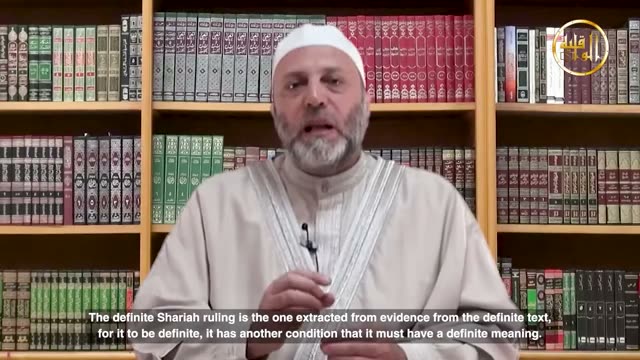
For a Shari’ah legal ruling to be definite, it must derive from evidence that is definitive in authenticity and definitive in indication. What do we mean by definitive in authenticity? And what do we mean by definitive in indication? Conversely, what constitutes speculative in indication, and what does speculative in authenticity entail?
Definitive authenticity of the Qur’an’s transmission
Regarding authenticity, the legal proofs are the Book and the Sunnah, along with what they indicate. We know that the entire Book of Allah—exalted is He—is definitive in its authenticity; there is no doubt about any verse of the Noble Qur’an, nor even about any word within it being from Allah—exalted is He.
The Qur’an was recited by the Prophet may Allah bless him and grant him peace to a gathering of believers that reached the threshold of mass transmission, exceeding its minimum requirement. Since the time of the Prophet may Allah bless him and grant him peace, it has been preserved by a vast number of people, including Companions of the Messenger may Allah bless him and grant him peace. This Qur’an has passed down from the era of the Prophet may Allah bless him and grant him peace to our present day through mass transmission alone, conveyed generation after generation among Muslims throughout history.
The Qur’an that Muslims have transmitted since the time of the Messenger may Allah bless him and grant him peace—preserved by mass transmission—was also written during his lifetime. The documents recorded in his era are those from which today’s copies were transcribed, including the very copy we read now: the Mushaf compiled by ‘Uthman may Allah be pleased with him.
Thus, the Qur’an was preserved in hearts as it was preserved in writing.
The mass transmission that has characterised the entire text of the Noble Qur’an from the time of the Prophet may Allah bless him and grant him peace until this day definitively establishes that the whole Qur’an is authentically conveyed from the tongue of the Messenger of Allah may Allah bless him and grant him peace.
And since there is definitive evidence that Muhammad is indeed the Messenger of Allah, then the Noble Qur’an becomes definitively the Word of Allah. We are absolutely certain without any doubt that every verse, word, and letter in the Qur’an we possess—all of it—is the speech of Allah the Exalted, just as it was revealed to the Messenger may Allah bless him and grant him peace. Thus, the entire Qur’an is definitive in its authenticity.
Levels of authenticity in Prophetic tradition
As for the Prophetic Sunnah, it has two levels: the sound Prophetic Sunnah. In this discussion, we have excluded everything transmitted from the Messenger of Allah, may Allah bless him and grant him peace, that has not been established; everything more likely than not to be unsound; and everything whose soundness or lack thereof cannot be judged. We have excluded every report attributed to the Messenger of Allah, may Allah bless him and grant him peace, that we know with certainty is false, that is more likely than not to be false, or whose truth or falsity we cannot determine.
These three categories lie outside the process of legal reasoning in Islamic Shari’ah.
These are the two recognised levels according to all Muslim scholars, without exception. No consideration is given to the groups or scattered individuals who claim that the Sunnah is not a source of legislation and that revelation consists only of the Qur’an; Allah willing, we may later devote a session to answering them. The sound Prophetic Sunnah has two divisions: one is definitive in authenticity, which is what has reached us through mass transmission; the other is speculative in authenticity, which is what has reached us through solitary transmission.
A Hadeeth narrated from the Messenger of Allah may Allah bless him and grant him peace by a group whose collusion in lying is impossible, then transmitted to us through successive stages of transmission by groups likewise beyond suspicion of such collusion—this constitutes mass transmission (tawatur). We are certain it is true; we are certain it originates from the words of the Messenger of Allah may Allah bless him and grant him peace.
The Sunnah is a revelation from Allah
The words of the Messenger of Allah, may Allah bless him and grant him peace, concerning legislation and religion in general are revelation from Allah Almighty. He says:
﴿ وَمَا يَنطِقُ عَنِ ٱلْهَوَىٰٓ إِنْ هُوَ إِلَّا وَحْىٌۭ يُوحَىٰ ﴾
‘Nor does he speak from his own desire. It is only a revelation revealed’ [53:3–4]
The distinction between the Book (the Qur’an) and the Sunnah lies in this: the Book of Allah is divine revelation from Almighty Allah in both its wording and meaning. Its very words—let alone their meaning—are a direct revelation from Him. As for the Sunnah, its meanings were revealed to the Prophet may Allah bless him and grant him peace, but he conveyed them through his own words, actions, or tacit approval.
Of this Sunnah, what has been transmitted to us through mass transmission is definitive in authenticity (qati’ al-thubut), while what was conveyed via solitary reports remains speculative in authenticity (zanni al-thubut).
The obligation to act upon solitary reports
When addressing Shari’ah legal rulings—the legislative domain and practical matters—there is no disagreement whatsoever among Islamic scholars regarding the obligation to act upon a solitary report from the Messenger of Allah may Allah bless him and grant him peace.
If a Hadeeth of the Messenger of Allah, may Allah bless him and grant him peace, comes through a sound chain from its highest link to its lowest, and through a sound, uninterrupted chain from its lowest link to its highest, and is free from anything that impairs its authenticity, then it is affected by no hidden defect and is not irregular.
This Hadeeth must be acted upon. All Shari’ah legal rulings—every category of ruling without exception—are derived from it: whether they are hudood penalties, worships, financial legislation, or marital matters such as marriage and divorce. There is no exception at all. All Shari’ah legal rulings come from authentic Prophetic Hadeeths, whether definitive in authenticity—the mass-transmitted—or speculative in authenticity—the solitary report.
Definitive indication and speculative indication
A definitive Shari’ah legal ruling is one derived from evidence that is definitive in authenticity. A further condition is required for the ruling to be definitive: the evidence must also be definitive in indication. In other words, the evidence indicating this Shari’ah legal ruling must be definitive in indication as well as definitive in authenticity.
What do we mean by evidence that is definitive in indication, and, conversely, by evidence that is speculative in indication? Evidence that is definitive in indication can bear only one meaning for the Shari’ah legal ruling: it can indicate only one Shari’ah legal ruling and only one understanding of that ruling.
If the text used as evidence comes from the Book of Allah, may He be exalted, or from the Sunnah of the Prophet may Allah bless him and grant him peace, or from the consensus of the Companions may Allah be pleased with them—and if it admits no meaning other than one—then there is no room for speculation in its interpretation. It is definitive in indication, whether it is Qur’anic, Prophetic Sunnah, or a matter of consensus.
If the evidence can bear more than one meaning, the mujtahids may understand the text in different ways. The Shari’ah legal ruling is then probable. To make the picture clearer:
Examples of definite Shari’ah rulings
We provide examples of definite Shari’ah rulings and probable Shari’ah rulings among Muslims. There are many examples of a definite Shari’ah ruling.
There is absolute consensus—no disagreement whatsoever—that prayer is obligatory, fasting is obligatory, Hajj is obligatory for those who can perform it, zakat is obligatory, honouring parents is obligatory, theft is forbidden, fornication is forbidden, usury is forbidden, and ruling by what Allah has revealed is obligatory.
These are some of the definite Shari’ah legal rulings that cannot be doubted in any way, nor can it ever be claimed that there is room for ijtihad or speculation regarding them.
Anyone who denies that prayer is obligatory, or doubts that it is obligatory, is a disbeliever. The same applies to all the examples I gave a moment ago, such as fasting, Hajj, zakat, the prohibition of usury, the prohibition of fornication, the prohibition of theft, and so on.
Why? Because these legal rulings are supported by definitive-in-authenticity evidence. All of them have been established in the Qur’an, and every indication from the Noble Qur’an regarding these rulings is definitive in meaning—admitting neither doubt nor speculation.
The texts that command prayer are definitive in indication—they admit no speculation, ambiguity, or dual meaning; they convey only one clear meaning. The same applies to all the examples I have provided.
These legal rulings were not merely derived but extracted from evidence that is definitive both in authenticity and indication.
The Five Prayers and Their Number of Rak’ahs
The rest are probable Shari’ah legal rulings. Let me first give an example of a definite Shari’ah ruling before addressing the probable ones—this one comes not from the Qur’an but from the Prophetic tradition. The obligation of prayer is explicitly stated in the Qur’an, whereas there is no definitive evidence in the Qur’an specifying the five daily prayers: Fajr, Dhuhr, Asr, Maghrib and Isha.
Likewise, the number of rak’ahs for these prayers is not indicated by any verse regarding how many rak’ahs Allah, may He be exalted, prescribed—these are among Islam’s pillars: that Fajr prayer consists of two rak’ahs, Dhuhr four, Asr four, Maghrib three, and Isha four. The Qur’an contains no verse pointing to this, but the Sunnah transmitted through mass transmission (tawatur) from the time of the Prophet may Allah bless him and grant him peace until today clearly establishes these five prayers along with their respective rak’ah counts.
Whoever doubts the obligation to perform these five prayers—not merely the general duty of prayer, but specifically doubts the obligation to observe them with their prescribed number of rak’ahs—has departed from Islam. This is because they reject what has been definitively transmitted concerning the Messenger of Allah may Allah bless him and grant him peace, who was revealed to by Allah the Exalted.
Thus, this category is clearly one where the Shari’ah legal ruling is definitive. It is supported by evidence that is definitive both in authenticity and indication.
Reasons for a probable Shari’ah legal ruling
In Shari’ah, there are probable legal rulings for one of three reasons: either because they were deduced or inferred from evidence—whether a single piece of evidence that is definitive in authenticity but speculative in indication, or definitive in indication but speculative in authenticity, or from evidence that is speculative both in authenticity and indication. Examples include:
The effect of speculative indication on levying the jizyah tax
The amputation of the hand for theft is obligatory. The evidence—definitive in both authenticity and indication—establishes that theft requires cutting off the thief’s hand.
As for the details, some jurists differ upon them.
Similarly, the definitive evidence—both definitive in authenticity and definitive in indication—indicates that it is obligatory to take jizyah from dhimmis within an Islamic state.
However, the jurists differed over how this jizyah is to be collected, because one part of the verse commanding the collection of jizyah is speculative in indication. It is Allah’s saying:
﴿ وَهُمْ صَـٰغِرُونَ ﴾
‘while they are humbled’ [9:29]
One group of jurists said that abasement must be made visible upon those who pay the jizyah. Another group said that abasement here means submission: by merely paying the jizyah, they are submitting, so there is no need to display humiliation when the jizyah is paid.
Some said it must be called jizyah, while others held that there was no objection to calling it ‘double zakat’.
This is what has been narrated about our master Umar ibn al-Khattab, may Allah be pleased with him, regarding his dealings with certain tribes who requested that jizyah be referred to as a doubled zakat.
Here, the verse in which this command appears—Allah’s saying,
﴿ وَهُمْ صَـٰغِرُونَ ﴾
‘while they are humbled’ [9:29]
—is definitive in authenticity. However, the indication of
﴿ وَهُمْ صَـٰغِرُونَ ﴾
‘while they are humbled’ [9:29]
is speculative. The evidence for this particular matter was therefore speculative, so disagreement over this Shari’ah legal ruling was permissible: How is the jizyah to be paid?
The word quru’ and the divorced woman’s waiting period
As another example, Allah says:
﴿ وَٱلْمُطَلَّقَـٰتُ يَتَرَبَّصْنَ بِأَنفُسِهِنَّ ثَلَـٰثَةَ قُرُوٓءٍۢ ﴾
‘Divorced women shall wait by themselves for three quru’ periods’ [2:228]
The word quru’ can have two meanings in Arabic: it can mean menstruation, or the period of purity from menstruation. The jurists therefore differed over the waiting period of a divorced woman: is it three menstrual periods or three periods of purity?
This text is definitive in its authenticity but speculative in its indication; thus, jurists disagreed among themselves regarding its precise meaning.
Touching women and the nullifiers of wudu
Another example is a Shari’ah legal ruling taken from Qur’anic evidence that is definitive in authenticity but speculative in indication.
This concerns touching among the acts that invalidate wudu. Allah says concerning the acts that invalidate wudu:
﴿ أَوْ لَـٰمَسْتُمُ ٱلنِّسَآءَ ﴾
‘or you have touched women’ [4:43]
One group of jurists said that “you touched” means direct physical contact—that is, skin touching skin. Another group said that touching here is a figurative expression for sexual intercourse.
One group argued that the verse indicates that touching invalidates wudu, while another held that it specifies sexual intercourse as what breaks wudu.
This legal ruling is a probable Shari’ah ruling. That is: does touching invalidate wudu or not? It is a probable Shari’ah ruling because the evidence pointing to it is speculative in indication.
The verse cited by one group of jurists is nevertheless definitive in authenticity, for it is the word of Allah in His Almighty Book.
This is an example of a probable Shari’ah legal ruling derived from evidence definitive in authenticity but speculative in indication, making the ruling itself probable. Consequently, it was classified through ijtihad as a matter of disagreement among mujtahids and jurists, allowing differing opinions on it.
A ruling definitive in indication but speculative in authenticity
A probable Shari’ah ruling may be taken from evidence that is definitive in indication, yet the ruling is probable because the evidence itself is speculative in authenticity: It is a report transmitted from the Messenger of Allah, may Allah bless him and grant him peace, through solitary transmission. An example is the Shari’ah legal ruling that forbids men to adorn themselves with gold and wear silk. The Hadeeth of the Messenger of Allah, may Allah bless him and grant him peace, is definitive in authenticity and definitive in indication; it cannot bear two meanings. He said: «إِنَّ هَذَيْنِ حَرَامٌ عَلَى ذُكُورِ أُمَّتِي، حِلٌّ لِإِنَاثِهِمْ» — ‘These two are prohibited for the males of my Ummah and permitted for its females’ [Musannaf Ibn Abi Shaybah 24060]. The wording is clear, explicit and definitive in indication that gold and silk are prohibited—both are prohibited for men—and permitted for women.
The evidence here is definitive in indication but speculative in authenticity, since the hadeeth was transmitted through a solitary report. Therefore, this Shari’ah legal ruling is probable rather than definite. It must be noted that even if the evidence is speculative in authenticity, this does not always mean disagreement over it is permissible.
Speculative authenticity does not mean lack of obligation
If the jurists agree that a Hadeeth is authentic, even on the basis of preponderant belief, they agree that acting upon it is obligatory. Evidence being speculative in authenticity is not a basis for abandoning the Shari’ah legal ruling, releasing oneself from it, or saying that the ruling is not binding. A Shari’ah legal ruling may be probable, yet still be the sole ruling of Islam on the matter.
It is correct that the report indicating the prohibition of gold and silk for men relies on evidence speculative in authenticity. However, since this hadeeth—and others pointing to this legal ruling—are agreed upon as sound by preponderant opinion, then this Shari’ah legal ruling is an unchallenged ruling of Islam, and disagreement over it is impermissible because there is no dispute about the obligation to act on a solitary report.
However, scholars have differed regarding the authenticity of this Hadeeth: some maintain it is authentic, while others consider it weak. In such a case, one who deems the Hadeeth weak would be excused from acting upon it—indeed, they must abandon it entirely. It is impermissible for them to act on a Hadeeth where their preponderant opinion holds that it is weak and unauthentic. Thus, if someone confirms its authenticity, they may rely upon it; but if they do not confirm it, they should refrain from acting upon it.
If a Hadeeth is established—even by preponderant opinion—it is agreed to be authentic, even if not mass-transmitted, and acting upon it becomes obligatory. Should its indication be definitive, the legal ruling derived from it is the legal ruling of Islam; but if it is speculative in indication, then whoever opposes it commits sin. Therefore, here the speculative nature of the ruling does not justify abandoning or neglecting adherence to it.
The legal rulings of Islam and the ijtihadi Shari’ah ruling
The ruling of Islam is not necessarily… When we say “the ruling of Islam” and “an Islamic ruling”, there is the ruling of the Shari’ah and there is a Shari’ah legal ruling. When we use the expression “the ruling of the Shari’ah”, it means that the Shari’ah contains no other ruling or ijtihad on the matter.
The legal ruling of Islam regarding gold and silver is that it is prohibited for Muslim males. Although this ruling is speculative rather than definitive, there is no competing evidence or alternative proof that challenges or undermines it. From this perspective, if there remains no scope for ijtihad—meaning the evidence pointing to this ruling is not open to reinterpretation—and if there is no doubt regarding its authenticity, even if the Hadeeth in question is considered authentic by preponderant opinion, then Islam’s legal ruling stands.
As for matters where there is room for disagreement among jurists—whether due to differences in the authenticity of a hadeeth, or because one hadeeth is given precedence over another, or because the indication of a hadeeth—or hadeeths—is speculative—then it can be said about such cases: this Shari’ah legal ruling has an opposing Shari’ah legal ruling. Thus, each mujtahid had their own understanding: one mujtahid understood one Shari’ah legal ruling, while another mujtahid understood a different Shari’ah legal ruling.
Disagreement among jurists on touching a woman
I give an example of this as I mentioned earlier. When the Shafi’is state that if a man touches a woman or a woman touches a man, it invalidates wudu’, then this is a Shari’ah legal ruling—but it cannot be said to be the ruling of Islam or of the Shari’ah, because it is based on their ijtihad. It is Allah’s ruling for those who undertook such inquiry.
Others, such as the Hanafis, state that if a man touches a woman or a woman touches a man, this does not invalidate wudu’. This too is a Shari’ah legal ruling, though it is not the sole Shari’ah legal ruling. The ijtihad of the Shafi’is is Allah’s ruling for them, and the ijtihad of the Hanafis is Allah’s ruling for them. Thus, one is a Shari’ah legal ruling, and the other is also a Shari’ah legal ruling.
Even though the correct view is, in principle, confined to one opinion—to one ijtihad, not two. Allah willing, we will discuss this further at a later time.
Fasting six days in Shawwal
The remaining example concerns a probable Shari’ah legal ruling, as it is derived from evidence that is both speculative in authenticity and speculative in indication. Fasting six days of Shawwal is such a ruling—it is recommended by a broad spectrum of jurists, indeed representing the preponderant opinion among them.
However, this Shari’ah legal ruling is probable because its evidence is speculative in authenticity and speculative in indication. It is not speculative in indication. I apologise to the honourable brothers: the Hadeeth is clear in its meaning; the Hadeeth is definitive in indication.
The Messenger of Allah may Allah bless him and grant him peace said: ‘Whoever fasts Ramadan with faith and seeking reward, then follows it with six days from Shawwal, will be like one who fasted the entire year.’ [see Sahih Muslim 1164].
This Shari’ah legal ruling was reported in a Hadeeth that is speculative in authenticity but definitive in indication. It is therefore a probable ruling.
For this reason, it was reported that Imam Malik did not accept this Hadeeth because, among his sources of legislation, may Allah have mercy on him, were the consensus of the people of Madinah—or their established practice.
The people of Madinah were those who lived alongside the Prophet may Allah bless him and grant him peace and his noble Companions. Imam Malik, may Allah have mercy on him, stated: I never saw the people of Madinah fast six days in Shawwal. This led him to doubt this Hadeeth, which is a solitary report.
Leasing agricultural land
To correct myself: the prohibition on leasing agricultural land is a Shari’ah legal ruling derived from evidence that is speculative in authenticity and speculative in indication. The evidence reported from the Messenger of Allah, may Allah bless him and grant him peace, concerning the leasing or renting of agricultural land consists of solitary reports, not mass-transmitted reports. Not all of these solitary reports have been questioned; some of these Hadeeths are agreed to be authentic.
However, scholars differed over the indication of these Hadeeths. One group of jurists held that leasing agricultural land is not permissible—leasing agricultural land is impermissible. Another group maintained that leasing agricultural land is permissible. The Shafi’i school ruled that renting agricultural land is permissible, whereas the Hanafi school ruled that renting agricultural land is impermissible.
Summary of the Hierarchy of Shari’ah Legal Rulings
This discussion highlights… it demonstrates the ranks of Shari’ah legal rulings. There are definite Shari’ah legal rulings derived from evidence that is definitive both in authenticity and indication, while other Shari’ah legal rulings are probable because they originate from evidence that may be speculative either in authenticity or in indication—or even speculative in both.
The purpose of categorising Shari’ah legal rulings
This detailed classification does not imply: whatever is definitive, we adhere to it; and whatever is speculative, we are free to disregard. No—absolutely not. Everything derived from legal evidence, whether through definitive or speculative deduction, constitutes Shari’ah legal rulings.
Definite Shari’ah rulings are not subject to ijtihad
However, the purpose of this classification is to remind us that Shari’ah legal rulings derived from evidence that is definitive in authenticity and indication are therefore definite rulings. Such rulings do not permit ijtihad.
Whoever doubts these rulings—like someone who doubts that prayer, fasting and Hajj are obligatory; that usury and fornication are prohibited; that the thief’s hand must be cut off; or that the fornicator must be flogged—and whoever doubts or denies these definitive rulings has disbelieved in the Law of Allah Almighty. They are called upon to repent. If they do not repent, the prescribed punishment for apostasy is carried out against them, because they have denied something definitive in the religion.
Dealing with probable Shari’ah rulings
Regarding probable Shari’ah legal rulings derived from speculative evidence—whether speculative in indication or speculative in authenticity—disagreement is permissible only where there exists a genuine scholarly divergence. Where no disagreement has been established, such disagreement is impermissible.
I gave an example of this: the prohibition of gold and silver for males. Whoever denies this agreed-upon Shari’ah legal ruling is sinful, even though it is based on evidence that is speculative in authenticity. It cannot be said that a person has the right to deny this ruling because it is probable, for it is the ruling of Islam. As for a matter over which there is disagreement, some may adopt one opinion and others may adopt the other.
Nor may this be used as a means of releasing oneself from the Shari’ah legal ruling. If jurists differ over detailed rulings concerning prayer, for example—how to pray, how to fast or how to perform Hajj—a Muslim must adopt one of these ijtihads, because no action of a believer may be without a Shari’ah legal ruling.
It is not permissible for a Muslim to argue that the Shari’ah legal ruling in this matter has been disputed by scholars and say: “I am absolved of all these opinions.” No, it is absolutely impermissible because no act of a Muslim can be devoid of a Shari’ah legal ruling legislated by Allah, the Exalted. If the ruling is probable, he must adopt what gives him confidence through the legitimate methods we will discuss, God willing, in subsequent sessions. He must rely on some opinion.
Recitation of Surah al-Fatihah behind the Imam
If mujtahids have differed over reciting Al-Fatihah behind the imam, one may adopt this opinion or that. At times, it becomes impossible to reconcile both views. For instance, the Shafi’is hold that it is obligatory for the follower to recite Al-Fatihah behind the imam—whether he reads aloud or silently—and prayer is invalid without doing so, even if recited behind him. This applies even when the imam recites aloud in prayers such as Maghrib, Isha’, Fajr and Jumu’ah.
As for the Hanafis, they cite evidence that it is not permissible for the follower to recite Al-Fatihah behind the imam; instead, he remains silent, whether the imam reads aloud or silently. Thus, a Muslim must either adopt this view or its alternative.
Alternatively, one may adopt a third opinion held by the Malikis, may Allah have mercy on them. They say that when the imam recites aloud, the follower remains silent; when the imam recites silently, the follower recites Al-Fatihah.
These are three opinions. Disagreement over an issue like this cannot be an excuse for a Muslim to say, “I am not bound by any of these opinions because they are all ijtihadi opinions.” Rather, you must adopt one of them, and it becomes Allah’s ruling with respect to you. No action of a servant may be without a Shari’ah legal ruling to which he adheres, because Allah Almighty will question the Muslim on the Day of Resurrection about every one of his actions.
Summary of the session
This, my honourable brothers, is today’s detailed explanation of the levels of Shari’ah legal rulings. May Allah, exalted be He, grant that we have performed this well and that it benefits us and you alike. O Allah, teach us what profits us, benefit us with what You have taught us, and increase us in knowledge—You are the Most Merciful of those who show mercy.
A question on reviewing Hadeeths
My brother Jamil Hafiz asks: You will certainly have heard the reports about the Saudi Crown Prince’s call to review the Prophetic Hadeeths. My question is: is this permissible? Do these well-known Prophetic Hadeeths, documented in the books of Sunnah, need to be reviewed?
Ijtihad in authenticating and grading Hadeeth
Regardless of who is calling for this—and he is not trustworthy—yes, we have heard the report that an academy for the noble Hadeeth has been established. Leaving that event aside, let us discuss the subject of reviewing the Prophetic Hadeeths.
The Hadeeths among us are sourced from collections: beginning with Sahih al-Bukhari and Sahih Muslim, followed by Sunan Ibn Majah, Sunan al-Tirmidhi, Sunan Abu Dawud, the Musnad of Imam Ahmad, and the Musnad of al-Shafi’i. There are many sources for noble Hadeeths.
Not every Hadeeth in these sources is automatically accepted. The people who collected and recorded these Hadeeths did not themselves claim that they had judged all of them to be authentic.
After reliable scholars examined al-Bukhari and Muslim, they said: We found that the conditions set by al-Bukhari and Muslim for their two Sahih collections, and their application of those conditions, showed after investigation that all these Hadeeths are authentic. Therefore, in the overwhelming majority of cases, a Muslim accepts the Hadeeths in these two Sahih collections without examining their chains of transmission or their authenticity, because their authenticity has already been established through detailed examination.
Apart from these two sources, no collection of Hadeeth is accepted on the basis that everything it contains is authentic, whether the reports are from the Messenger of Allah, may Allah bless him and grant him peace, or from others. These sources include the Sunan works, chains of transmission and Musnad collections. They contain reports from the Messenger of Allah, may Allah bless him and grant him peace, reports from the Companions, and reports from the Followers.
These reports are subject to scrutiny, examination, and verification—this is what scholars and jurists have done for hundreds of years. This depends on a vast discipline known as the science of hadith terminology, which primarily relies on narrator studies: who among them was just? Who was trustworthy and who lacked trustworthiness? Who was both just and reliable, and who was neither?
This work—has it reached its conclusion? Has it fulfilled its purpose and ended? No. This matter remains open until the Day of Resurrection.
If someone judges a Hadeeth to be authentic, his judgement is not automatically accepted, for it is a human ijtihad. Likewise, if someone judges a Hadeeth to be weak, his judgement is not automatically accepted.
Just as the door of ijtihad remains open until the Day of Resurrection and no one may close it, so too does ijtihad encompass examining the authenticity of a hadeeth—whether it is authentic or not. It cannot be claimed that those who preceded us have exhausted this subject through research, definitively determining what is authentic and what is not.
Indeed, there are certain narrations that scholars have unanimously excluded due to their agreed weakness. There is also a substantial body of hadeeths they have unanimously authenticated. However, there remains an intermediate category: some reports from the Messenger of Allah may Allah bless him and grant him peace and his Companions—may Allah be pleased with them—that hadith specialists and meticulous scholars differ over in terms of their authenticity. This disagreement will endure as long as Allah wills.
Consequently, it cannot be said that this matter is closed or that reviewing the authenticity of these hadeeths is no longer acceptable.
Conclusion
Honourable brothers, we will content ourselves today, in this session, with what has been discussed. We ask Allah Almighty to help us complete this series and guide us to what He loves and is pleased with. I invoke Allah’s blessings and peace upon the Messenger of Allah, upon his family and Companions, and upon all who follow his guidance with excellence until the Day of Judgement. Peace and Allah’s mercy and blessings be upon you.