Introduction
Peace be upon you and Allah’s mercy and blessings. In the name of Allah, the Most Merciful, the Compassionate. All praise is due to Allah, and prayers and blessings be upon the Prophet Muhammad—may Allah bless him and grant him peace—and his family, his companions, and those who follow them in righteousness.
Welcome, honourable brothers, to a new session of your programme, ‘Live Halaqa’. We continue discussing topics from the book The System of Islam. We hope you will follow us, engage with us and send us your questions so that we can answer them at the end of this session.
Topic of This Session: Receiving Shari’ah Legal Rulings
In the previous session—and the one before it—we discussed the definition of the Shari’ah legal ruling, the types of Shari’ah legal rulings and their different degrees.
Today we proceed to discuss a topic: who receives the Shari’ah legal rulings? How does a Muslim receive these rulings so that he may act upon them and call others to do likewise?
The sources of Shari’ah legal rulings
As previously stated, the Shari’ah legal ruling is the address of the Legislator—Allah, the Most High—and pertains to the actions of the servants. Its source is the Book and the Sunnah, along with what they guide towards. Therefore, receiving a Shari’ah legal ruling can only come from its original source: the revelation that Allah, the Most High, has communicated. This revelation is manifested in the Qur’an and the Sunnah of His Messenger may Allah bless him and grant him peace. Thus, for Muslims, the reception of Shari’ah legal rulings is confined to the revealed texts—what Allah, the Most High, has communicated through the Book and the Sunnah.
The Book and the Sunnah are Shari’ah texts revealed in Arabic—Arabic texts:
﴿ إِنَّآ أَنزَلْنَـٰهُ قُرْءَٰنًا عَرَبِيًّۭا ﴾
‘Indeed, We have sent it down as an Arabic Qur’an’ [12:2].
The Prophet, may Allah bless him and grant him peace, was also an Arab and the most eloquent of the Arabs.
What was revealed to the Prophet, may Allah bless him and grant him peace, could be revealed from Allah, the Most High, in both wording and meaning—this is the Qur’an. Alternatively, the meaning could be revealed to him and the Prophet, may Allah bless him and grant him peace, would express it through his words, actions or tacit approval. In both cases, the sources of Shari’ah legal rulings are Arabic texts to which one refers to receive these rulings.
The address of the Legislator to people and believers regarding legal rulings
Consequently, since Allah, the Most High, addressed people in these texts, saying:
﴿ يَـٰٓأَيُّهَا ٱلنَّاسُ ٱعْبُدُوا۟ رَبَّكُمُ ٱلَّذِى خَلَقَكُمْ وَٱلَّذِينَ مِن قَبْلِكُمْ ﴾
‘O mankind, worship your Lord, who created you and those before you’ [2:21].
He also addressed the believers specifically concerning Shari’ah legal rulings, saying:
﴿ يَـٰٓأَيُّهَا ٱلَّذِينَ ءَامَنُوا۟ ٱتَّقُوا۟ ٱللَّهَ ﴾
‘O you who believe, be mindful of Allah’ [59:18]
﴿ يَـٰٓأَيُّهَا ٱلَّذِينَ ءَامَنُوا۟ كُتِبَ عَلَيْكُمُ ٱلصِّيَامُ كَمَا كُتِبَ عَلَى ٱلَّذِينَ مِن قَبْلِكُمْ ﴾
‘O you who believe, fasting has been prescribed for you as it was prescribed for those before you’ [2:183].
And so on. The fundamental principle is that believers are addressed by Allah’s sublime address so that they adhere in all their actions to the Shari’ah’s commands and prohibitions.
The Muslim therefore directs his actions according to Allah’s commands and prohibitions. The fundamental principle is that every Muslim refers to the Book and the Sunnah to receive the Shari’ah legal rulings from them, so that his actions proceed according to the Shari’ah.
Differences among Muslims in understanding texts
Yet the reality is that not all people—not all Muslims—are able to refer directly to the Book and the Sunnah to derive Shari’ah legal rulings from them.
People differ in their ability to understand Arabic generally, and thus they also vary in their capacity—or even their ability—to comprehend the texts of the Book and the Sunnah.
This extraordinary capacity exists in some people, while being limited—or even absent—among many Muslims. In particular, when discussing non-Arab speakers, those who do not perceive, understand or comprehend anything of the Arabic language cannot possibly grasp any verse of Allah’s Book or any hadith of the Messenger may Allah bless him and grant him peace without someone else interpreting it for them.
It is therefore impermissible to insist obstinately that every Muslim must derive Shari’ah legal rulings directly from the Book and the Sunnah.
Mujtahids and Muqallids
Thus, Muslims are divided into two groups: One group possesses the ability to understand Shari’ah texts—the legislative texts from the Book and Sunnah—and to deduce legal rulings from them. These individuals are referred to as mujtahids.
There is another group who are unable to comprehend the texts of the Qur’an and Sunnah—or at least lack the capacity to deduce Shari’ah legal rulings from them. Such individuals must derive their rulings from those capable of deduction, namely mujtahids.
This group—those who take their legal rulings from mujtahids, whether directly or through those who transmit the mujtahids’ opinions—are called muqallids.
Thus, Muslims are divided into two categories regarding the reception of Shari’ah legal rulings: mujtahids and muqallids.
In this session, we lack the time to address both groups—we shall begin with the mujtahids.
The legal meaning of ijtihad
We begin by defining ijtihad in its technical sense. Linguistically, it means exerting all possible effort and energy to acquire something that demands strenuous endeavour to attain or achieve. However, we are not discussing ijtihad here in its linguistic meaning but rather in its Shari’ah legal sense.
He, may Allah bless him and grant him peace, said: «إِذَا حَكَمَ الْحَاكِمُ فَاجْتَهَدَ ثُمَّ أَصَابَ فَلَهُ أَجْرَانِ، وَإِذَا حَكَمَ فَاجْتَهَدَ ثُمَّ أَخْطَأَ فَلَهُ أَجْرٌ» — ‘If a judge gives a ruling after exercising ijtihad and is correct, he will have two rewards; and if he gives a ruling after exercising ijtihad and errs, he will have one reward.’ [Sahih al-Bukhari 7352].
Here the Prophet may Allah bless him and grant him peace speaks about ijtihad in its legal sense.
The focus here is on deducing Shari’ah legal rulings. Ijtihad has been defined as exhausting one’s capacity—exhausting all effort to seek the preponderant opinion regarding a practical legal ruling.
Exhausting one’s capacity means that the mujtahid deploys every ability he possesses in ijtihad, reaching the point where he cannot exert any more effort than what he has already done—he is unable to give beyond what he has given. Thus, he exhausts his capacity: he devotes everything within him to seeking the preponderant opinion—to seeking the preponderant opinion.
Ijtihad in Probabilistic Matters
Why did we say ‘seeking probable opinion’?
For what is certain in faith does not fall under ijtihad—knowledge or certainty about such matters is not part of ijtihad. This is because Allah, exalted be He, has made obligatory prayer, fasting, pilgrimage, zakah and jihad, and prohibited usury, fornication, theft, and other matters; these are definitive rulings in the religion that do not require ijtihad.
Ijtihad applies to issues for which there is no definitive evidence in the Shari’ah texts of the Book and the Sunnah. The available evidence is probable, either in its transmission or in its meaning, particularly in its meaning.
A mujtahid may face texts that allow more than one interpretation and a body of Shari’ah evidence that must all be studied together, rather than taking only one piece of evidence as the basis for deducing the Shari’ah legal ruling.
Conflicts are resolved by giving precedence to one evidence over another. Distinctions are made between abrogating and abrogated texts, general and specific texts, unrestricted and restricted texts, ambiguous and clarified texts—and so on.
This process requires diligent effort in seeking the preponderant opinion to determine or understand a practical Shari’ah legal ruling from detailed evidence—whether derived from the Book of Allah or the Sunnah of His Messenger may Allah bless him and grant him peace.
Ijtihad cannot occur outside of Shari’ah evidence
Consequently, searching for a legal ruling outside the Shari’ah’s evidence—outside the Book and the Sunnah—is not ijtihad. It is like someone issuing a fatwa based on their own reasoning or deriving a Shari’ah legal ruling from reason alone, relying on principles unrelated to the revealed law. They may claim: “I am seeking public interest,” so wherever they find what appears beneficial, they declare it Allah’s law—detached entirely from the evidence of His Book and the Sunnah of His Messenger may Allah bless him and grant him peace. This is not ijtihad; rather, it is ruling by other than what Allah has revealed.
In other words, legislation belongs to the Legislator alone, while the mujtahid is neither a legislator nor one who enacts law. Rather, he is someone who understands Allah’s Shari’ah and deduces its rulings from it.
Ijtihad, in this precise sense, is work undertaken by a mujtahid who fulfils the conditions of ijtihad. Its purpose is to obtain or deduce, through preponderant opinion, the detailed Shari’ah legal ruling that the Muslim must observe and follow so that his actions conform to Allah’s Shari’ah. This is the mujtahid.
The distinction between ijtihad and applying legal rulings to actual cases
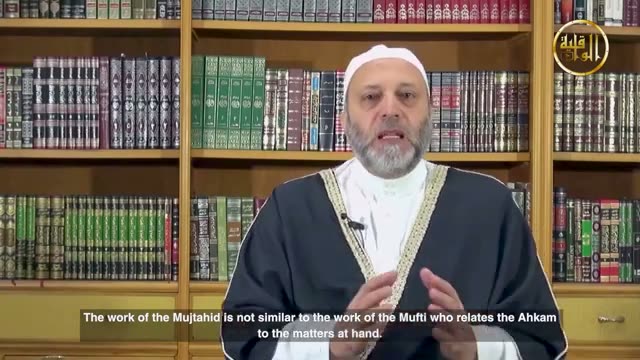
The work of this mujtahid differs from that of a mufti who applies legal rulings to specific cases.
Some people may confuse the application of legal rulings to similar issues as ijtihad itself, or even mistake it for analogy (qiyas). No—that is incorrect.
If a mujtahid’s deduced Shari’ah legal ruling is received by a Muslim—whether scholar, jurist, student, or imitator—and then applied to similar cases, this constitutes the application of legal rulings to actual circumstances, not ijtihad.
For example, examining canned meat products to determine whether they are permissible or forbidden is not ijtihad.
The Shari’ah legal ruling is already established. The scholars have deduced that pork is forbidden, carrion is forbidden and meat slaughtered by a polytheist is forbidden.
When we apply these established legal rulings to canned meat products—for instance, declaring some permissible and others impermissible—this is not ijtihad. Rather, it falls under applying the originally deduced legal rulings to their analogous cases.
Deduction from the Book and the Sunnah
Ijtihad consists of directly deriving a Shari’ah legal ruling from the Qur’an and the Sunnah. Therefore, deducing Shari’ah legal rulings without reference to Allah’s Book or the Prophet’s Sunnah—such as when someone derives legal rulings from the words of a Companion, a Successor, or even another mujtahid—is not ijtihad. What is derived in this manner does not constitute a Hukm Shar’i; thus, the derivation of a Shari’ah legal ruling must only come from the revealed texts: Allah’s Book and the Prophet’s Sunnah.
The one who imitates a Companion from among the Companions—or a Successor from among the Successors—or any mujtahid in any era is imitating a legal ruling that was previously deduced through ijtihad by another mujtahid, not extracting the legal ruling directly from so-and-so’s statement. There is a clear distinction between these two cases.
Yet there remains a difference: when a mujtahid deduces a legal ruling—where such a ruling can only be derived from the statements of Allah and His Messenger may Allah bless him and grant him peace—and when an individual who is a student, follower or layperson turns to a legal ruling deduced by a Companion, Successor or any mujtahid across history and imitates it. This is not ijtihad in any sense; rather, they are a muqallid (one who follows by imitation). It is permissible for someone lacking the qualifications for ijtihad to rely upon such rulings, and indeed, it becomes obligatory upon them to do so as long as they remain incapable of performing ijtihad themselves.
This is the legal ruling. This is the reality of ijtihad. This is its definition. This is the reality of a mujtahid.
The legal ruling on ijtihad in Islam
What is the legal ruling regarding ijtihad in Islam? Is it obligatory, permissible, or does it shift between being obligatory in some eras and permissible in others?
The matter has become unclear to many people; The Shari’ah legal ruling regarding ijtihad is that it constitutes a collective obligation in every age, such that no era may be without a mujtahid. Why?
Because believers are commanded to follow the law of Allah, the Exalted.
Allah, the Mighty and Majestic, has established Shari’ah legal rulings for every matter. These matters may arise anew from day to day.
It is possible for new issues to arise on any given day for which previous mujtahids did not provide a legal ruling.
Therefore, it is impermissible for any time or era to lack a mujtahid who deduces the legal ruling from the Book and Sunnah.
Thus, there must be at least one mujtahid—and this is the absolute minimum—though in reality, there should be far more than that.
The obligation is that in every age there must be at least one mujtahid, ensuring ijtihad remains a collective obligation that never ceases to exist throughout time.
The invalidity of closing the door to ijtihad
From this point alone, those who claimed centuries ago that it was time to close the door of ijtihad in any era were mistaken.
Some scholars concluded—or imagined—that no issue remained which the mujtahids had not addressed, that every issue had been fully researched and examined, and that Islamic jurisprudence was complete.
Consequently, they claimed there was no longer any need to continue ijtihad. Some therefore said that the door to ijtihad had to be closed. In reality, this claim has no evidence and is absolutely impermissible in Shari’ah.
Receiving Shari’ah legal rulings remains obligatory until the Day of Resurrection. As new issues can arise at any time, any such issue may arise.
There are new cases, fresh issues—and we have witnessed many matters emerging in this age alone due to inventions, contracts, transactions, relationships and dealings that necessitate ijtihad on questions the earlier mujtahids and jurists never addressed.
Ijtihad and the Ummah’s Intellectual Elevation
Thus, the legal ruling regarding ijtihad is a collective obligation; there must be at least one mujtahid in every age.
The natural state of affairs is that the ummah should always have an abundance of mujtahids.
Whenever the Ummah rises—and an Ummah rises through intellectual elevation—the Islamic Ummah rises by elevating its thinking and its understanding of the Islamic creed and Islamic Shari’ah.
There is therefore an inseparable link between the Ummah’s elevation and the abundance of mujtahids within it.
Likewise, there is an inseparable link between the Ummah’s decline and the scarcity of mujtahids within it. Review history and you will find this connection.
Honourable brothers, this is the reality of the ruling; this is the Shari’ah legal ruling on ijtihad.
The ranks of mujtahids
We now turn to another matter: namely, the status and conditions of mujtahids. The status of mujtahids is that they fall into three ranks—three distinct levels.
The absolute mujtahid
There are mujtahids whose ability qualifies them to exercise ijtihad on every issue and in every matter. They fulfil all the conditions of ijtihad and can therefore exercise it on every issue within the Islamic Shari’ah. This group or rank is conventionally called mujtahid mutlaq (absolute mujtahids).
The absolute mujtahid—this is the one who fulfils all the conditions for ijtihad.
Conditions of Ijtihad
The conditions of ijtihad can be divided broadly, without going into excessive detail, into two aspects. The first is the mujtahid’s knowledge of the Shari’ah evidence: the texts from the Book and the Sunnah relating to practical Shari’ah issues. A mujtahid cannot exercise ijtihad without relying on the Shari’ah evidence that indicates the legal rulings. The first requirement is therefore knowledge of the relevant texts from the Book and the Sunnah from which the rulings are deduced.
Exaggerating the Conditions of Ijtihad
We should point out the exaggerations promoted by some people: that a mujtahid must memorise tens of thousands of hadiths, memorise the entire Qur’an, and be an exceptional authority on language, and so on—as though this closes the door to ijtihad once again.
Ijtihad is work based on conditions. When these conditions are fulfilled, ijtihad becomes possible.
Some scholars even say—and I recall reading this in a book by Abu Hamid al-Ghazali—that a mujtahid is not required to have memorised all the verses containing legal rulings. It is enough for him to know where those verses are so that he can consult, examine and read them when needed. Likewise, he must be able to consult the hadiths relating to the issues in which he exercises ijtihad.
Thus, the first essential requirement is his knowledge and capacity to refer back to the evidence and texts from which Shari’ah legal rulings are deduced.
Facilitating reference to texts in the modern era
In this respect, we all recognise that the present age has made it easy for those qualified to perform ijtihad to consult these texts.
For decades now we have had a dictionary to facilitate the mujtahid’s easy reference back to whichever Qur’anic verse he requires: The Indexed Dictionary of the Qur’an’s Lexicon.
Now, however, matters are far more convenient and straightforward. Modern technology enables readers, followers, and mujtahids to swiftly retrieve and recall the texts they seek from the Book and the Sunnah.
The collection of the original hadith sources, and the present ease of consulting them, have made ijtihad easier. Leading mujtahids of the past did not have this facility.
The tools of the early mujtahids—and the limits of their access to hadith
We know that eminent mujtahids such as Abu Hanifah, Sufyan al-Thawri, al-Shafi’i, al-Awza’i and Malik had access to a number of hadiths transmitted from the Messenger of Allah, may Allah bless him and grant him peace, but not all of them. The compilation of the Prophetic Sunnah had not yet been completed at that time.
This is why some of them repeatedly said: ‘If the hadith is authentic, then it is my school; cast my opinion aside.’ In other words, if any of you finds a hadith that did not reach me, which I did not find or hear, and that hadith contradicts what I said, then the hadith is my school—if it genuinely invalidates that mujtahid’s ijtihad.
Today, however, we have the original hadith sources: all the books in which the hadiths of the Messenger of Allah, may Allah bless him and grant him peace, were compiled. Moreover, immense effort has been devoted to scrutinising these hadiths, authenticating the sound and grading the weak as weak. We have books on narrators, hadith terminology, and so on. All this has made the tools of ijtihad far more accessible to mujtahids than they were to the earlier mujtahids—may Allah have mercy on them and reward them on our behalf with every good.
Knowledge of the Evidence and Understanding the Texts
This, then, is the first pillar: knowledge of the evidence—the practical Shari’ah evidences that address practical matters and from which practical Shari’ah legal rulings are deduced.
The second pillar is the ability to understand these texts. This ability depends on two fundamental pillars: first, knowledge of the legal meanings conveyed by the terms in the texts; and second, the capacity to comprehend both the legal meaning of the Book and the Sunnah and their linguistic meaning.
This is because the Book and the Sunnah were revealed in Arabic. These Arabic terms—whether from the Qur’an or the Sunnah—carry legal meanings specific to Shari’ah.
Meaning that the Shari’ah introduced certain terms with legal meanings that did not previously exist in the Arabic language or the customary understanding of the Arabs.
Furthermore, there are Arabic texts whose meanings remain tied to their original linguistic usage and conventions as understood by the Arabs in their language and customary practice.
Thus, it is essential for such a mujtahid to have an in-depth knowledge of both the legal implications of texts and their linguistic meanings. This depends on two disciplines: principles of Islamic jurisprudence (usul al-fiqh), which includes rules of deduction and interpretation of textual indications, as well as Arabic linguistics.
The methodology of an absolute mujtahid
These conditions must be fulfilled by the mujtahid, particularly the mujtahid mutlaq. As mentioned earlier, a mujtahid mutlaq can exercise ijtihad on every issue without exception. He has this ability even if he has not actually exercised ijtihad on every issue. He has also established his own method of deduction through his own ijtihad.
Divergence in the foundational methodologies of the established schools
We know that the founders of the schools of jurisprudence—those who meet the description of mujtahid mutlaq—differed regarding the Shari’ah evidences, though not all of them. They differed over subsidiary, detailed and supplementary evidences, and over the principles of deduction.
Most of them agreed that the legislative evidences are the Book, the Sunnah, consensus and analogy. They then differed over the evidences to which the Book and the Sunnah point.
Some relied on juristic preference (istihsan), others on unrestricted interests (maslaha mursala), some on the revealed law of those before us where no abrogating text exists in our Shari’ah, and yet others on the practice of the people of Madinah.
Here we observe a divergence in approach among those mujtahids who founded the schools of jurisprudence, and differences also exist between them regarding the principles of deduction—particularly in their consideration of abrogating and abrogated texts, unrestricted and restricted texts, general and specific texts, and other methods of reasoning, including the various forms of justification applied to these matters.
We find that each mujtahid has a distinct method for deducing Shari’ah legal rulings.
From this, we observe principles of Islamic jurisprudence attributed to the Shafi’i school, principles attributed to the Hanafi school, and principles attributed to the Maliki school—and so on.
The mujtahid who relies on principles in order to deduce Shari’ah legal rulings is described as a mujtahid mutlaq.
Mujtahid within a school of jurisprudence
In reality, this absolute mujtahid established a school of jurisprudence, whether or not that school continued.
He had disciples who attained the rank of ijtihad. Yet they remained—remained—they stayed as mujtahids among his students, continuing to follow his method of deduction.
They may differ from him in certain Shari’ah legal rulings; they exercise ijtihad therein because they are mujtahids—but they rely on his method of deduction.
That is, they rely upon the principles of Islamic jurisprudence that he relied upon—whether this mujtahid documented these principles or did not document them.
Al-Shafi’i recorded the principles of Islamic jurisprudence on which he relied. Indeed, he was the first to record the principles of Islamic jurisprudence and proceed according to them. His students after him followed these same principles.
Abu Hanifah relied on certain principles that he held in his mind but did not record. Those who came after him followed his method and recorded those principles by inferring or extracting them from his ijtihads.
Thus, those who followed Shafi’i’s method of deduction were mujtahids within the Shafi’i school. Similarly, those who followed Abu Hanifah’s method of deduction and ijtihad became mujtahids within the Hanafi school—and so on.
This group is called—or this rank is known as—a mujtahid within a school. A mujtahid within a school is one who exercises ijtihad in legal rulings on specific issues. He may even differ from his teacher, the founder of the school, but he remains grounded in its foundational principles.
For example, among the Shafi’i mujtahids within a school of jurisprudence are the renowned Imam Nawawi and Abu Hamid al-Ghazali.
Among the famous mujtahids of the Hanafi school are Abu Yusuf and al-Sarakhsi, the author of al-Mabsut, and others. These are called mujtahids within a school of jurisprudence.
Issue-specific mujtahid
The third remaining rank is that of the issue-specific mujtahid.
A Muslim may not fully possess all the conditions required for ijtihad; they are not well-versed in every legislative evidence, nor thoroughly acquainted with all principles of Islamic jurisprudence, nor familiar with all linguistic matters that enable them to comprehend texts.
But on a particular issue, he may find himself able to trace the different opinions, their evidence and their lines of reasoning. He identifies and precisely defines the point of disagreement, then finds himself able to weigh the views by examining that point because, for example, he is knowledgeable in this particular field.
The disagreement arose between schools of jurisprudence over an issue due to their differing assessments of a hadith’s authenticity—or because one school rejected it while another accepted it.
He found within his means the ability to assess whether that hadith was authentic or weak. Since the dispute hinged on evaluating its authenticity, and he possessed the capacity to determine its validity, this became an entry point for him to prefer one view over another in this matter. He then leaned toward one opinion rather than another—and this is known as issue-specific ijtihad.
Or perhaps this person may be well-versed in grammar—a specialist in language, and today we have highly skilled linguists who excel in grammar, rhetoric, and other linguistic fields.
When an issue arose that was a point of disagreement among mujtahids, he examined its source and found it stemmed from linguistic, grammatical or rhetorical differences—among other factors. He then judged himself capable of forming a preference, so he did; thus, this made him an issue-specific mujtahid.
The natural situation is that the Ummah should have many issue-specific mujtahids. This form of ijtihad does not require the same vast knowledge or deep mastery of usul al-fiqh, Arabic and related disciplines.
Summary of the Ranks of Mujtahids
These are the types of mujtahids—or rather, their ranks: from the absolute mujtahid to the mujtahid within a school of jurisprudence, down to the issue-specific mujtahid.
The correctness of the mujtahid’s deduction and its potential error
Finally, noble brothers; in this session we cannot exhaust all matters related to mujtahids during today’s halaqa. I will therefore leave one aspect of this topic for the next gathering—but what I conclude with today is the matter of the mujtahid.
Is the opinion of the mujtahid always correct? Or can the opinion of a mujtahid be incorrect? In reality, if his opinion were always correct, it would not constitute ijtihad. Nor would mujtahids differ among themselves; mere discussion of ijtihad implies that a mujtahid’s view may be right or wrong—that is, he could attain the truth or fail to do so.
It cannot be said that all the mujtahids attained the truth—attained what Allah intended—because Allah’s intended meaning in His address is one. Allah and His Messenger, may Allah bless him and grant him peace, cannot have intended two contradictory legal rulings in their address.
The text’s indication of what Allah, the Most High, intended—or what the Messenger of Allah, may Allah bless him and grant him peace, intended—may, however, be probable. This is why mujtahids disagree.
Disagreement may also arise from assessing whether the hadiths of the Messenger of Allah, may Allah bless him and grant him peace, are sound or weak. In many cases, disagreement arises from different understandings of what a text indicates, whether it is an ayah or a hadith of the Messenger of Allah, may Allah bless him and grant him peace. The mujtahid therefore exhausts his capacity to reach the correct conclusion and what Allah, the Most High, intended.
The Correct Position Is One, While Both Ijtihads Are Shari’ah-Compliant
It cannot be said that both mujtahids’ opinions are correct. No: the correct opinion is one, but both opinions are Shari’ah-compliant.
An example of reciting Surah al-Fatihah behind the imam
When al-Shafi’i disagrees with Abu Hanifah, al-Shafi’i says that reciting al-Fatihah is a pillar of prayer and that prayer is not valid without reciting it in every rak’ah—even behind an imam and even when the imam recites aloud. Abu Hanifah, however, says that reciting al-Fatihah is not a pillar; rather, it is obligatory in an individual prayer, and the follower may not recite al-Fatihah behind the imam. These are two contradictory opinions, and one of them must be correct: either al-Shafi’i’s opinion or Abu Hanifah’s opinion.
But can anyone definitively assert which of these two opinions is correct? No; if someone could be certain, then this would not constitute ijtihad—it would not be a matter of conjecture. Either the first opinion is correct or the second one is.
My Opinion Is Correct but May Be Wrong
The principle is therefore that the mujtahid says: ‘My opinion is correct but may be wrong, while another’s opinion is wrong but may be correct.’
If I reach the correct conclusion and my opinion is correct—that is, if my ijtihad is correct—I receive two rewards.
And if my opinion did not conform to what Allah, the Exalted, wills—that is, if I failed to deduce the correct legal ruling—meaning if my ijtihad was erroneous—I am still rewarded with one reward.
The reward of the mujtahid
This is indicated by the hadith of Allah’s Messenger, may Allah bless him and grant him peace: «إِذَا حَكَمَ الْحَاكِمُ فَاجْتَهَدَ ثُمَّ أَصَابَ فَلَهُ أَجْرَانِ، وَإِذَا حَكَمَ فَاجْتَهَدَ ثُمَّ أَخْطَأَ فَلَهُ أَجْرٌ» — ‘If a judge gives a ruling after exercising ijtihad and is correct, he will have two rewards; and if he gives a ruling after exercising ijtihad and errs, he will have one reward.’ [Sahih al-Bukhari 7352].
In every case, the mujtahid is correct in his work insofar as he has not contravened the Shari’ah, and what he has deduced is a Shari’ah legal ruling—whether it is correct and agrees with what Allah intended, or mistaken and contrary to what Allah and His Messenger, may Allah bless him and grant him peace, intended.
The Companions’ ijtihad regarding the Banu Qurayza
Here I will give a practical example from the life of the Messenger of Allah, may Allah bless him and grant him peace: After the Battle of the Trench, the Prophet, may Allah bless him and grant him peace, instructed his Companions: «من كان سامعاً مطيعاً فلا يصلين العصر إلا في بني قريظة» — ‘Whoever hears and obeys must not pray ‘Asr anywhere except at Banu Qurayza’ [see Sahih al-Bukhari 4119]. This meant an order to attack Banu Qurayza, because they had conspired with the polytheists against Allah’s Messenger, may Allah bless him and grant him peace, and the Muslims. They had been bound by a covenant but had broken it. «من كان سامعاً مطيعاً فلا يصلين العصر إلا في بني قريظة» — ‘Whoever hears and obeys must not pray ‘Asr anywhere except at Banu Qurayza.’ The Companions therefore set out for Banu Qurayza.
While they were on their way, they were close to missing the time for the ‘Asr prayer and might perhaps also miss the time for Maghrib.
Here, the Companions disagreed. One group said that the Messenger of Allah, may Allah bless him and grant him peace, did not intend them to miss the ‘Asr prayer. He merely wanted them to hurry, so they should pray and then continue. The other group said that the Prophet, may Allah bless him and grant him peace, had ordered them to pray ‘Asr at Banu Qurayza. They should therefore pray it there, even after the time for ‘Asr had passed, after Maghrib or even after the time for ‘Isha.
The Companions therefore differed in their understanding of what the Messenger of Allah, may Allah bless him and grant him peace, intended. Some understood that the Prophet, may Allah bless him and grant him peace, meant to urge them to hurry and did not intend them to delay the ‘Asr prayer. Others understood that the Prophet, may Allah bless him and grant him peace, had ordered them to pray ‘Asr at Banu Qurayza, regardless of when they arrived.
The Prophet may Allah bless him and grant him peace intended one of these two meanings—not both simultaneously. His intention was singular, but the Companions differed in their understanding of what he meant: one group acted according to their interpretation, while the other followed theirs.
One group performed ‘Asr prayer while still on the road and continued their journey. The other group delayed the ‘Asr prayer until they reached Banu Qurayza.
When they returned to the Messenger of Allah, may Allah bless him and grant him peace, and told him what had happened, he approved both groups—he approved both. This was not because both groups had correctly understood what the Prophet, may Allah bless him and grant him peace, intended, but because both had exercised ijtihad and their ijtihad was Shari’ah-compliant. Both groups were rewarded, and both acted according to a Shari’ah legal ruling based on what they understood.
The legal ruling of Allah concerning the mujtahid
Thus, the Shari’ah legal ruling concerning the mujtahid is whatever conclusion their ijtihad leads them to; or more precisely: Allah’s legal ruling for the mujtahid is whatever conclusion their own ijtihad reaches. Likewise, Allah’s legal ruling for another mujtahid is whatever conclusion their ijtihad determines.
The legal ruling from Allah, as deduced through the ijtihad of al-Shafi’i, is that reciting Surah al-Fatihah is an obligatory component in every prayer and in every rak’ah behind an imam—whether the imam recites aloud or silently. This remains the legal ruling from Allah for all those who follow al-Shafi’i’s school.
The legal ruling from Allah, as deduced through Abu Hanifah’s ijtihad, is that Surah al-Fatihah is obligatory in prayer but may not be recited behind the imam—whether he recites aloud or silently.
Allah’s legal ruling for Imam Malik was what his ijtihad led him to: al-Fatihah is obligatory in prayer, and the follower recites it behind the imam when the imam recites silently; if the imam recites aloud, the follower remains silent. This is likewise Allah’s legal ruling for anyone who follows Imam Malik—may Allah have mercy on him.
Summary of Correctness and Error
This is the reality of mujtahids being right or wrong. Everything the mujtahids deduce through ijtihad is a Shari’ah legal ruling, even when they disagree. Al-Shafi’i’s opinion is a Shari’ah legal ruling, and Abu Hanifah’s opinion is a Shari’ah legal ruling. But the correct opinion—the correct opinion—is the one that agrees with what Allah intended. No one can establish this with certainty because the issue is based on probable ijtihad.
Whoever reaches the correct conclusion receives two rewards, and whoever errs receives one. In every case, the mujtahids are rewarded. They are correct insofar as they acted in accordance with Allah’s Shari’ah, even if they did not attain precisely what Allah, the Most High, intended in every ruling on which they exercised ijtihad.
What will be covered in the next session
We shall postpone one issue to the next session—namely: we have stated that Allah’s legal ruling concerning the mujtahid is whatever conclusion their ijtihad leads them to. But are there exceptional cases where a mujtahid would abandon their own opinion in favour of another’s? This matter will be discussed in the next session, if Allah wills.
All praise is due to Allah, and blessings and peace be upon the Messenger of Allah, his family, his Companions and those loyal to him.
How does a Muslim distinguish issues requiring ijtihad?
I will now address any questions that may have arisen during this session.
Brother Abu Qusay asks how an ordinary Muslim can determine whether an issue falls within ijtihad, and how he can distinguish ijtihad from ordinary opinions, claimed interests, or fatwas through which some sheikhs seek favour with rulers, for example.
Definitive issues are not subject to ijtihad
Firstly, regarding distinguishing issues of ijtihad from others: when the texts are clear and decisive, even someone with minimal knowledge of Arabic can understand them and recognise that they do not fall under ijtihad.
If a person is not familiar with Shari’ah legal rulings or with Arabic—pardon me—he can still clearly recognise that reliable Muslim scholars agree that the issue is not open to ijtihad. All the scholars of the Ummah agree that prayer is obligatory, fasting is obligatory, theft is forbidden, backbiting is forbidden and fornication is forbidden. No one is excused for being ignorant of these matters or for claiming an inability to establish that they are definitive rather than open to ijtihad.
Distinguishing the trustworthy scholar
As for the steadfast, reliable scholars of Islam—honourable brothers—there is no doubt that we must agree it is possible to distinguish the pious, trustworthy individual from others through his conduct and entire life.
For example, there can be no doubt that a scholar who works for a ruler and is always at the ruler’s door is not among the reliable and trustworthy scholars.
If a scholar comes to us who is accustomed to being in the court of an oppressive, tyrannical ruler—a tyrant—he issues legal rulings permitting interest-based loans from banks or what are called savings certificates bearing usurious profits.
Or he may issue a ruling permitting reconciliation with the Jewish state, or rule that it is permissible to fight Muslims, or permit allegiance to disbelievers and judge according to anything other than what Allah has revealed. These are clear, unambiguous proofs that this scholar is not trustworthy, and it is impermissible to rely on him for issuing legal rulings in matters of Shari’ah.
Thus even a non-Arab who cannot read Arabic well can examine the scholar: Is he one whose knowledge has been dedicated entirely to serving this Shari’ah, keeping himself distant from all fleeting and false worldly pleasures that contradict Allah’s law? Or is he among those who have sold Allah’s verses for a paltry price [see 9:9] and sought to appease the ruler in defiance of Allah? This is an issue where the believer must rely entirely on piety to reach a sound conclusion.
Conclusion
Honourable brothers, I will stop here. We ask Allah, the Most High, to accept this from us, to guide our words and deeds, to make them sincere for His Noble Countenance, to help us carry this trust and message, and to increase us in knowledge, action and obedience. He is indeed the All-Hearing, the One who answers. Peace be upon you and Allah’s mercy and blessings.