Introduction
In the name of Allah, the Most Gracious, the Most Merciful. Praise be to Allah, and may blessings and peace be upon the Messenger of Allah, his family, his Companions and those who support him.
Welcome, dear brothers, to a new episode of your programme, Halaqa Online. In these halaqaat we are still discussing matters relating to the Shari’ah legal ruling. We have discussed the types and ranks of the Shari’ah legal ruling, and we have discussed those who derive Shari’ah legal rulings from their sources—the Book and the Sunnah—namely, the mujtahids.
Topic of the Halaqa: Taqlid and the Muqallidun
Today we shall discuss taqlid and the muqallids.
Every Muslim Is Addressed by the Shari’ah Legal Rulings
It is well known to us as Muslims that every Muslim is addressed by the Shari’ah legal rulings. Every Muslim is charged with duties that Allah, exalted is He, has commanded: he is commanded to perform obligations and recommended acts, forbidden to commit prohibited and disliked acts, and given a choice among permissible acts.
For a Muslim’s actions to accord with the commands and prohibitions of Allah, exalted is He—for him to follow the law of Allah, mighty and majestic is He, obey Him and live this life in the manner Allah, glorified and exalted is He, has approved for him—he must know Allah’s rulings, especially those connected with his own actions.
Seeking Knowledge: Individual and Collective Obligations
The Messenger of Allah, may Allah bless him and grant him peace, said: «طَلَبُ الْعِلْمِ فَرِيضَةٌ عَلَى كُلِّ مُسْلِمٍ» — ‘Seeking knowledge is an obligation upon every Muslim.’ [Ibn Majah, 224] It is clear from this hadith that the knowledge meant here is the obligatory Shari’ah knowledge connected with a person’s actions.
Seeking knowledge other than Shari’ah knowledge is not an individual obligation. In some circumstances it may be permissible, while in others it may be a collective obligation. Some Shari’ah knowledge is a collective obligation, and some is an individual obligation. The collective obligation—the collective obligation in seeking knowledge—is the knowledge that goes beyond what relates to the actions of each one of us.
The presence—the presence—of scholars who know the matters of the Shari’ah in general is therefore a collective obligation, so that they may give fatwas to people who wish to learn the Shari’ah legal ruling. There must be Muslims who learn Shari’ah legal rulings beyond those that concern the scholar personally and individually. Scholars must exist who know the Shari’ah sciences in general so that they may give fatwas to people. If a society or an age were devoid of people who could give fatwas on the Shari’ah legal rulings, people would be unable to know Allah’s rulings and therefore unable to adhere to the Shari’ah legal rulings. This knowledge of the Shari’ah sciences is a collective obligation.
There is also knowledge that is an individual obligation upon every Muslim personally: the Shari’ah matters he needs to know in order to adhere in his life, conduct and actions to the commands and prohibitions of Allah, exalted is He.
The Knowledge Obligatory for Every Muslim
Every Muslim must learn the rulings of prayer, and every Muslim must learn the rulings of purity and impurity. Every Muslim who is able to fast must learn the rulings of fasting. Anyone preparing to marry must learn the rulings of marriage. Every Muslim who intends to perform Hajj to Allah’s Sacred House must learn the rulings of Hajj.
Every Muslim who intends, for example, to begin trading in gold and silver must learn the Shari’ah rulings governing the sale of gold and silver. Every Muslim who decides to establish a company and enter into a partnership with someone else in trade, industry or something similar must learn the Shari’ah rulings relating to that transaction, so that his actions remain upright and in accordance with the law of Allah, glorified and exalted is He.
An ignorant person is not excused by his ignorance, because a Muslim may not undertake an action before knowing Allah’s ruling on it. Seeking knowledge in this sense—the specific knowledge that is an individual obligation—is therefore obligatory upon every Muslim. It is obligatory: a person who neglects it sins, and a person who does not seek the knowledge directly connected with his actions sins.
Muslims Are Either Mujtahids or Muqallids
As we said previously, people fall into two categories. The first consists of those who can derive Shari’ah legal rulings directly from their sources—that is, the Book, the Sunnah and what they indicate. They are the mujtahids, whom we discussed in detail in two previous halaqaat.
The other group consists of those who lack the ability to exercise ijtihad. In other words, they do not possess the ability and knowledge that qualify them to understand the Shari’ah texts in their legislative and linguistic dimensions and thereby derive Allah’s rulings directly from them. Not everyone knows Arabic; not everyone knows the fine details of Arabic grammar; and not everyone knows the principles of usul al-fiqh. Only a small number of people can therefore derive Shari’ah legal rulings from their sources. We call them the mujtahids.
Inability to Exercise Ijtihad Is No Excuse
Can a person who lacks this ability—who lacks the capacity and is not qualified to derive Shari’ah legal rulings from the Book and the Sunnah—use that as an excuse to free himself from adhering to the Shari’ah legal rulings? Of course not. Allah, glorified and exalted is He, addressed all people—all believers—by requiring them to adhere to the Shari’ah legal rulings.
Allah, exalted is He, says:
﴿ يَـٰٓأَيُّهَا ٱلَّذِينَ ءَامَنُوا۟ ٱتَّقُوا۟ ٱللَّهَ ﴾
‘O you who believe, be mindful of Allah.’ [2:278; 3:102; 5:35; 9:119; 33:70; 59:18]
Being mindful of Allah means fulfilling the obligations, performing as many recommended acts as one wishes, avoiding every prohibition and avoiding as many disliked acts as the believer wishes. After belief, being mindful of Allah means adhering to what is lawful and unlawful. Of course, every believer is required to be mindful of Allah.
When Allah, exalted is He, addressed the believers with the Shari’ah legal rulings, He addressed all believers without distinguishing between a scholar and a non-scholar, or between a mujtahid and a non-mujtahid.
If a Muslim is unable to exercise ijtihad—that is, unable to derive Shari’ah legal rulings directly from their sources—he must take them from the mujtahids. This is what is known as taqlid.
The Meaning and Ruling of Taqlid
Taqlid is taking a Shari’ah legal ruling from a mujtahid without binding proof. This means that the person cannot argue for the Shari’ah legal ruling he has taken from the mujtahid; he cannot substantiate it with evidence by saying that Allah said this and the Messenger of Allah said that, because he does not possess that ability.
Is it permissible for a person—is it permissible for a Muslim—to imitate a mujtahid and take Shari’ah legal rulings from him? Yes, it is permissible.
Evidence for the Permissibility of Taqlid
Allah, exalted is He, says:
﴿ فَسْـَٔلُوٓا۟ أَهْلَ ٱلذِّكْرِ إِن كُنتُمْ لَا تَعْلَمُونَ ﴾
‘Ask those who possess knowledge if you do not know.’ [16:43; 21:7].
Those who possess knowledge are the people who know Allah’s Book, whether they belonged to the earlier nations—which is the occasion addressed by the verse—or are Muslims. Since Muslims are also among those who possess knowledge, this verse clearly states that if a person does not know, he must ask someone who does know:
﴿ فَسْـَٔلُوٓا۟ أَهْلَ ٱلذِّكْرِ إِن كُنتُمْ لَا تَعْلَمُونَ ﴾
‘Ask those who possess knowledge if you do not know.’ [16:43; 21:7].
The Hadith ‘The Cure for Ignorance Is to Ask’
It is reported in the Prophet’s Sunnah that a man was struck by a stone which gashed his head. He then had a wet dream and asked, ‘Do I have an excuse to perform tayammum because my head is injured?’ Those who were asked told him, ‘We find no excuse for you.’ The man performed ghusl and died. When the news reached the Messenger of Allah, may Allah bless him and grant him peace, he said: «ألا سألوا؟ ألا سألوا إذ لم يعلموا؟ ألا إن شفاء العي السؤال» — ‘Why did they not ask? Why did they not ask when they did not know? Indeed, the cure for ignorance is to ask.’ [Abu Dawud, 336; Ibn Majah, 572] They should have asked instead of deciding by their own opinion without knowledge. Since they were unable to exercise ijtihad on this issue and derive it directly from the Book and the Sunnah, they were obliged to ask someone who knew: «ألا سألوا إذ لم يعرفوا» — ‘Why did they not ask when they did not know?’ Or, as he, may Allah bless him and grant him peace, said: «ألا إن شفاء العي السؤال» — ‘Indeed, the cure for ignorance is to ask.’ [Abu Dawud, 336; Ibn Majah, 572].
Issuing and Seeking Fatwas in the Time of the Companions
It was well known in the time of the Companions, may Allah be pleased with them, that one group of Companions issued fatwas while another group sought fatwas. In a previous halaqa, we related from al-Sha‘bi that six of the Companions of the Messenger of Allah, may Allah bless him and grant him peace, gave fatwas to people, and that three of them would leave their own opinion for the opinion of the other three. Thus, some people gave fatwas and others sought them—that is, they received a fatwa and acted upon it. The Companions who gave fatwas did so because they were mujtahids. But this does not prevent, as we shall discuss shortly, someone who has not exercised ijtihad on an issue from giving a fatwa on it when he has taken it from a mujtahid. Every mujtahid is a mufti, but not every mufti is a mujtahid.
The Shari’ah Meaning of Taqlid, Not Its Linguistic Meaning
These, then, are evidences that a person who lacks the ability to exercise ijtihad may imitate the mujtahids. The discussion here is not about the indication—the linguistic indication—of the word taqlid, but about its Shari’ah meaning. Someone may say, ‘Taqlid is what monkeys do; it is what animals do,’ and so on. This is rejected, because we are not discussing the linguistic meaning of the word taqlid or its linguistic applications. We are discussing the Shari’ah meaning of this expression: a group that lacks the ability to exercise ijtihad asks the mujtahids or takes rulings from them so that its actions accord with the Shari’ah legal rulings.
When Does Taqlid Become Obligatory?
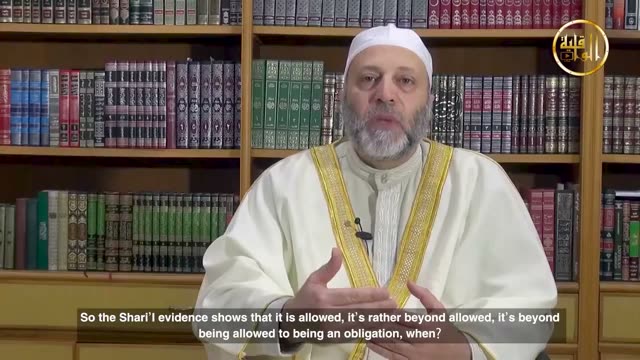
The Shari’ah evidences therefore establish that taqlid is permissible. Indeed, the matter goes beyond permissibility to obligation. When? When it concerns an action that the Muslim must perform in accordance with Allah’s commands and prohibitions—that is, according to the law of Allah, mighty and majestic is He. If he does not ask, he cannot adhere to the law of Allah, glorified and exalted is He, because knowledge precedes action.
Allah, exalted is He, says:
﴿ وَٱتَّقُوا۟ ٱللَّهَ ۖ وَيُعَلِّمُكُمُ ٱللَّهُ ﴾
‘Be mindful of Allah, and Allah teaches you.’ [2:282]
﴿ وَٱتَّقُوا۟ ٱللَّهَ ۖ وَيُعَلِّمُكُمُ ٱللَّهُ ﴾
‘Be mindful of Allah, and Allah teaches you.’ [2:282]
What this means, O believers, is: be mindful of Allah—that is, adhere to what Allah, exalted is He, has commanded you and refrain from what Allah, mighty and majestic is He, has forbidden you.
It is as though this address required the believer to ask, ‘How do I remain mindful of Allah?’ The completion of the verse—or the continuation of the verse—was therefore:
﴿ وَٱتَّقُوا۟ ٱللَّهَ ۖ وَيُعَلِّمُكُمُ ٱللَّهُ ﴾
‘Be mindful of Allah, and Allah teaches you.’ [2:282]
That is, Allah, glorified and exalted is He, teaches you the Shari’ah legal rulings. Through what He has taught you, He enables you to be mindful of Him. You therefore learn so that you can be mindful of Him, for knowledge precedes action in both rational and practical order.
Thus, when Allah, exalted is He, says:
﴿ وَٱتَّقُوا۟ ٱللَّهَ ۖ وَيُعَلِّمُكُمُ ٱللَّهُ ﴾
‘Be mindful of Allah, and Allah teaches you.’ [2:282]
it means: be mindful of Allah, exalted is He, according to the Shari’ah legal rulings He has taught you. If you are unable to exercise ijtihad and derive directly from the Book and the Sunnah, what becomes obligatory here? You must ask the people of knowledge.
When a Muslim is about to perform an action and wishes to adhere in it to the law of Allah, glorified and exalted is He, but cannot derive the ruling directly from the Book and the Sunnah, he must ask the people of knowledge. He thereby becomes a muqallid—that is, he takes the Shari’ah legal ruling from another mujtahid.
The Shari’ah principle states that whatever is necessary to fulfil an obligation is itself obligatory. You cannot adhere to the law of Allah, exalted is He, without taking from the mujtahids. You are therefore obliged to take from the mujtahids.
It is not permissible—it is not allowed—for someone who lacks the ability to exercise ijtihad to free himself from the Shari’ah legal rulings on the pretext that he cannot understand the Book and the Sunnah:
﴿ فَسْـَٔلُوٓا۟ أَهْلَ ٱلذِّكْرِ إِن كُنتُمْ لَا تَعْلَمُونَ ﴾
‘Ask those who possess knowledge if you do not know.’ [16:43; 21:7]
This is the reality of the muqallids, and this is what is meant by imitation.
Ranks of the Muqallids
These muqallids are not all of one rank. One muqallid is not necessarily like another. Just as the mujtahids have ranks, which we enumerated in a previous halaqa, the muqallids are likewise not equal. We can divide them into at least two groups—divide them into two groups.
The Follower and the Lay Imitator
The follower—the muttabi’. There is the follower, and there is the lay imitator. What is the difference between them?
In the terminology of the scholars of legal theory, the follower is the person who takes a Shari’ah legal ruling from a mujtahid after learning the Shari’ah evidence for it. Suppose the muqallid learns that visiting graves is permissible or recommended, and learns that the evidence for this ruling, as he received it from the mujtahid, is the saying of the Messenger of Allah, may Allah bless him and grant him peace: «كنت قد نهيتكم عن زيارة القبور، ألا فزوروها» — ‘I had forbidden you from visiting graves; now visit them.’ [Muslim, 977] If he takes the Shari’ah legal ruling from a mujtahid together with the evidence used by that mujtahid, he is a follower: he has taken the Shari’ah legal ruling from the mujtahid together with its evidence.
The lay imitator, by contrast, is the muqallid who takes a Shari’ah legal ruling from a mujtahid without knowing its evidence—without knowing the verse, hadith or collection of verses and hadiths from which that Shari’ah legal ruling was derived. Such a person is called a lay imitator. No one should condemn this group of people.
The Reality of the Need for Taqlid
We know that large numbers of Muslims do not know Arabic at all. If we counted the non-Arab Muslims who understand no Arabic and compared them with the Arab Muslims who understand Arabic, or some of it—those called Arabs today on account of their language—we would find that the proportion of non-Arabs who understand no Arabic is far greater.
Even among those called Arabs today—those who speak what remains of Arabic and speak colloquial dialects—people hear many verses and hadiths and may memorise many of them without understanding their meanings. We should not make matters difficult for such people by telling them, ‘You must learn Arabic so that you can understand the verse and its meaning, or the hadith and its meaning.’ Some people are only able to take the Shari’ah legal ruling: they seek a fatwa, receive it and act upon it.
The Merit of Knowing the Evidence
This is the reality of people. There is no doubt, however, that the person who takes a Shari’ah legal ruling together with its evidence—which is called following—is of a higher rank and more beloved to Allah, exalted is He, because he follows the evidence more closely. Allah, exalted is He, commanded us to follow the truth, and the truth lies in the evidence. The more familiar a believer is with the evidence, the closer he is to knowing the truth. If a Muslim is able to take the Shari’ah legal ruling together with its evidence, he should do so rather than confining himself to the ruling—seeking a fatwa, receiving it and acting upon it without asking about the Shari’ah evidence.
Does Knowing the Evidence Make the Follower a Mujtahid?
So this is the follower, and this is the lay imitator. Someone may say: ‘A person who takes the Shari’ah legal ruling together with its evidence is not a muqallid. How can he be a muqallid when he has taken the ruling together with its evidence?’ I reply: the decisive point is not merely that he knows the evidence for the Shari’ah legal ruling.
If a person seeks a fatwa on the Shari’ah legal ruling of an issue and learns its evidence, that does not mean that he is a mujtahid or take him outside the sphere of taqlid. Ijtihad means personally deriving the Shari’ah legal ruling directly from the Shari’ah evidences, not merely knowing the ruling together with its evidence.
There is a great difference between personally deriving a Shari’ah legal ruling from its evidence—even after reading the opinions of jurists and mujtahids, examining their evidence and arguments, preferring a particular opinion and thereby personally deriving the Shari’ah legal ruling after considering the evidence and assessing the arguments of those who cite it—and turning to a mujtahid and taking from him a Shari’ah legal ruling together with the evidence he gives you. In the first case, you have exercised ijtihad, even if only on one issue. In the second, you have not personally derived the Shari’ah legal ruling directly from the Shari’ah evidence. That is not ijtihad; you remain within the sphere of taqlid. You are a follower, not a lay imitator.
There Is No Third Category Beyond the Mujtahid and the Muqallid
It thus becomes clear to us, brothers, that a Muslim is one of two: either a mujtahid or a muqallid. There is no third possibility. Either you have taken the Shari’ah legal ruling directly from the Book and the Sunnah through your own derivation and ijtihad, in which case you are a mujtahid; or you have taken the Shari’ah legal ruling from a mujtahid. If you took it with its evidence, you are a follower; if you took it without its evidence, you are a lay imitator. In both cases, you are a muqallid.
A Person May Combine Ijtihad and Taqlid
A Muslim is therefore one of two: either a mujtahid or a muqallid. He need not, however, be a mujtahid in every situation and, consequently, he need not be a muqallid in every situation. He may be a mujtahid on some issues and a muqallid on others.
Some Muslims can exercise ijtihad on every matter. They are always mujtahids and do not accept imitating another mujtahid. Others may be able to exercise ijtihad on every issue but trust certain mujtahids more than they trust their own ability. We discussed this in a previous halaqa. In that situation, they may imitate someone whose ability to exercise ijtihad they trust more than their own ability—more than they trust themselves to exercise ijtihad.
A mujtahid may therefore be a mujtahid in some situations and a muqallid in others. But on every individual issue, he is either a mujtahid or a muqallid; there is no third state. This is the subject of taqlid.
The Mujtahid’s Ruling on What He Has Derived
We said previously—and we repeat and emphasise—that if a person may exercise ijtihad on certain issues, this does not mean that he is thereafter obliged to exercise ijtihad on every issue, whether or not he is capable of doing so.
If a mujtahid exercises ijtihad and reaches a particular ruling, that ruling becomes Allah’s ruling for him. He may not take another person’s ijtihad, because that other person’s ijtihad is Allah’s ruling for the person who derived it, not for him. The exceptions are the circumstances mentioned in a previous halaqa in which a mujtahid may leave his own opinion for another person’s opinion: in word and action, in word but not action, or in action but not word. Anyone who wants the details of this issue may return to the previous halaqa.
Allah’s Ruling for the Muqallid
As for the muqallid, if he imitates a mujtahid on a particular issue, then the ruling on which he has imitated that particular mujtahid becomes Allah’s ruling for him, because he has acted upon it. Since Allah’s ruling on the issue is one, Allah’s ruling for him can only be one.
If he imitates the Shafi‘i school in the rulings of prayer, al-Shafi‘i’s ijtihad concerning prayer becomes Allah’s ruling for that muqallid. He may not then choose between the ijtihad of al-Shafi‘i and that of Abu Hanifa, because Allah’s ruling is one and he must therefore adhere to one ruling. Once he imitates the ijtihad of a particular mujtahid, this ijtihad and this imitation—his imitation of that ijtihad—becomes Allah’s ruling for him. The other mujtahid’s ijtihad is a Shari’ah legal ruling for that other mujtahid and for those who imitate him.
Moving from One Mujtahid to Another
Are there circumstances in which a muqallid may move from imitating one mujtahid to imitating another? Yes. There are circumstances in which this is permissible; at times it is even recommended—preferable—for him to leave the imitation of one mujtahid for that of another. This matter requires detail.
With the help of Allah, glorified and exalted is He, we shall leave those details for a future halaqa in which we discuss the muqallid’s movement between mujtahids. I say these words and ask Allah to forgive me and you.
Questions and Discussion
I now turn with you to the questions that may have been submitted during this halaqa. Sister Hajar Belhaj Hassan: ‘Peace be upon you, and Allah’s mercy and blessings.’ And peace be upon you, and Allah’s mercy and blessings.
Moving Between Mujtahids on the Same Issue
May Allah bless you. My question is: may a muqallid move, on the same issue, from imitating one scholar to another when they are at the same level?
Yes, dear sister. I ended my halaqa by saying that a muqallid may move from imitating one mujtahid to imitating another, subject to conditions and in particular circumstances.
I shall not discuss those circumstances now. Instead, I shall discuss what is impermissible when moving from one mujtahid to another. There are Shari’ah considerations—Shari’ah considerations—on the basis of which the muqallid makes preferences that he is capable of making. These are not the kind of preferences made by a mujtahid. We shall discuss them in a later halaqa, Allah willing. On their basis, movement from one school to another is permissible.
What is categorically impermissible is to move from imitating one school or mujtahid to imitating another on the basis of whim or desire.
For example, a person may adhere to al-Shafi‘i’s opinion that touching a woman invalidates wudu. He then learns that Abu Hanifa holds that touching a woman does not invalidate wudu and says, ‘This is easier, and I am free to imitate any mujtahid.’ He therefore leaves the first imitation for the second merely to follow whatever is easier—whatever opinions please him.
This is called following one’s whims. Allah, glorified and exalted is He, forbade following whims, commanded us to follow the evidence, commanded us to follow the truth and forbade following whims.
Moving between mujtahids on the basis of desire, or choosing whichever is easier, is impermissible because Allah’s ruling on the issue is one.
Once he commits himself in his action to a Shari’ah legal ruling, it becomes Allah’s ruling for him. He may not move to another mujtahid except on the basis of Shari’ah preferences that he is able to apply in his capacity as a muqallid.
Concessions, Firm Rulings and Seeking the Easier Option
Someone may say, ‘Did the Shari’ah not permit us to take concessions?’ The Messenger of Allah, may Allah bless him and grant him peace, said: «إن الله يحب أن تؤتى رخصه كما يحب أن تؤتى عزائمه» — ‘Allah loves that His concessions be taken just as He loves that His firm rulings be observed.’ [Ahmad, 5866; Ibn Hibban, 3568] And did he, may Allah bless him and grant him peace, not say: «ما خُيِّرت بين أمرين إلا اخترت، إلا اخترت أيسرهما» — ‘Whenever I was given a choice between two matters, I chose—I chose—the easier of them’? [meaning-based citation; al-Bukhari, 3560; Muslim, 2327].
We say that this is another subject which has nothing to do with imitation. The subject of the concession and the firm ruling concerns a situation in which the Shari’ah evidence shows that the Muslim may choose between two actions, between two matters.
The issue here is not that the jurists and mujtahids differed, with one mujtahid reaching one ruling and another disagreeing and reaching a different ruling. No. When the first mujtahid reached his ruling, he said, ‘This is Allah’s ruling for me. It is correct but may be mistaken.’ The second likewise said, ‘This is Allah’s ruling for me. It is correct but may be mistaken.’ Each of them is seeking what is correct.
One of these two opinions is Allah’s ruling. As for concessions and firm rulings, the Shari’ah evidence indicates that… because these are two Shari’ah rulings between which the Muslim has been given a choice by the Shari’ah. For example, during travel that is neither tiring nor arduous, the Muslim may choose between fasting in Ramadan and breaking the fast. Fasting during non-arduous travel is the firm ruling, while breaking the fast is the concession.
Likewise, on a rainy day the Shari’ah gives the Muslim a choice between performing the prayers at their prescribed times and combining Dhuhr with ‘Asr and Maghrib with ‘Isha’. The firm ruling is to perform each prayer at its time, while the concession is to combine Dhuhr with ‘Asr and Maghrib with ‘Isha’ on a rainy day or night. Here, the Shari’ah has established both the concession and the firm ruling and given you a choice between them. This is where the following saying of the Messenger of Allah, may Allah bless him and grant him peace, applies:
«إن الله يحب أن تؤتى رخصه كما يحب أن تؤتى عزائمه» — ‘Allah loves that His concessions be taken just as He loves that His firm rulings be observed.’ [Ahmad, 5866; Ibn Hibban, 3568] The same applies when choosing between permissible things. The Shari’ah shows that this is permissible and that the other is permissible. Here it applies—here we may act upon the saying of the Messenger of Allah, may Allah bless him and grant him peace: «ما خُيِّرت بين أمرين إلا اخترت أيسرهما» — ‘Whenever I was given a choice between two matters, I chose the easier of them.’ [meaning-based citation; al-Bukhari, 3560; Muslim, 2327].
You may be given a choice between going to this mosque and that one. Going to this mosque is permitted, and going to that mosque is permitted, so you may choose the easier route, the nearer mosque or the one whose route is easier. You may be given a choice between seeking provision in one way and seeking it in another. If you find one way easier and choose it, you may do so. This has nothing to do with choosing between mujtahids.
Do you take the opinion of this mujtahid or that one? Once your action follows your imitation of a particular mujtahid, that becomes Allah’s ruling for you because you have acted upon it. You may not thereafter move to imitating another mujtahid merely because of a whim in yourself or a desire for physical ease. That would be following whims, which is impermissible. What are the permitted circumstances? I repeat: we shall discuss the circumstances in which one may move between mujtahids in the next halaqa, Allah willing.
The Difference Between a Mufti and a Mujtahid
Here I want to add an important point: the distinction between a mufti and a mujtahid. I mentioned it briefly, and I shall now return to it and clarify it.
A mujtahid is someone who derives the Shari’ah legal ruling himself from the Book and the Sunnah because he has the ability to do so. He also gives people fatwas based on that Shari’ah legal ruling.
A person need not be a mujtahid to give a fatwa on an issue. We know that many jurists are not mujtahids, but they have learnt Shari’ah legal rulings and taken them from mujtahids, or from muftis who took them from mujtahids. They may therefore give fatwas based on those rulings.
Anyone who has learnt the Shari’ah legal rulings correctly, and is trustworthy, upright and precise in what he transmits, may issue fatwas. We therefore seek fatwas from people whose piety, accuracy, sound reading of the books of fiqh and reliable transmission from the jurists we trust. We ask them because we trust their knowledge. A mufti may therefore issue fatwas without being a mujtahid.
When you seek a fatwa from a particular mufti, that does not mean that you have imitated the mufti. Rather, you have imitated the mujtahid from whom that mufti took the ruling on the issue. This is the difference between fatwa and ijtihad.
The Meaning of ‘Consult Your Heart’
My brother Wael al-Sultan asks: What is meant by his saying, may Allah bless him and grant him peace: «استفت قلبك، وإن أفتاك الناس» — ‘Consult your heart, even if people give you fatwas’? [Ahmad, 18028; al-Darimi, 2533] Does this hadith permit a muqallid to leave a mujtahid’s fatwa merely because he does not feel reassured by it?
This hadith certainly does not mean—as all scholars agree—that a Muslim may consult himself and his heart without referring to the evidence, whether he refers to the evidence directly because he is a mujtahid, or indirectly through the mujtahids by imitating a mujtahid. The basic rule is that a Shari’ah legal ruling must be taken from its source: from the Book and the Sunnah if the person is a mujtahid, or from a mujtahid if the person is a muqallid.
This does not, however, eliminate the Muslim’s role in recognising and preferring the opinion in which he has greater confidence. You may receive one fatwa from one person and another fatwa from someone else. You know that the first person is a trustworthy scholar and that the second is also a trustworthy scholar. You lack the ability to exercise ijtihad or prefer one fatwa over the other, yet you find within yourself something that gives you greater confidence in one of the opinions.
You then feel that your liability is more fully discharged and that you are more free of blame before Allah, exalted is He, if you take that opinion. In this case, you have consulted your heart after consulting the people of knowledge and obtaining the Shari’ah legal ruling through its correct Shari’ah route. Consulting the heart can never replace taking the Shari’ah legal ruling through its proper Shari’ah route, whether by ijtihad or taqlid.
Elevating the Muqallids Towards the Ranks of the Mujtahids
Brother al-Abid says: In a previous halaqa you said that a large number of mujtahids in the Ummah means that the Ummah is elevated, and vice versa. How, then, can the muqallids be elevated so that they draw closer to the ranks of the mujtahids?
The way to achieve this is for us to live an Islamic life under an Islamic State that applies Allah’s law, with everyone, without exception, graduating from schools that teach Islamic curricula.
Consider the great difference between schools under secular systems, which direct all the student’s effort towards studying non-Islamic subjects and fields of knowledge, while devoting very little time and attention to Islamic knowledge and concerning themselves only with peripheral, subsidiary and marginal Islamic issues. Without striving to form Islamic mentalities, establish the foundations of Islamic thinking and develop the students’ juristic faculties—the juristic faculty—under an Islamic State.
The curricula would be distributed fairly among the Islamic disciplines that produce for us an Islamic personality with a mentality—a mentality that thinks according to the Islamic method. And an Islamic disposition that thinks—or acts—and produces Islamic behaviour for us, and also…
This culture—this education and cultivation—would take care of the students and develop their juristic faculty by teaching them. Introductory matters in usul al-fiqh, introductory matters in hadith terminology, introductory matters in tafsir, introductory matters in the sciences of hadith and introductory matters in the sciences of language—indeed, more than introductory matters in the sciences of language—would then produce for us…
Of course, these disciplines would be taught alongside non-Islamic fields of knowledge, such as the sciences and related subjects, so that talents become apparent in primary and secondary education.
Some of them would then specialise according to the introductory Shari’ah sciences in which they excelled. They would specialise in Islamic studies at the postgraduate level, and we would produce cohorts of mujtahids of various ranks.
Of course, this requires an Islamic State that gives the young an Islamic upbringing and raises them upon Islamic culture. These faculties would be developed in them and qualify them to become scholars. That is the reality of the matter.
In the present reality, however, few people have the time to devote themselves to studying the Shari’ah sciences and acquiring a deep understanding of them.
Even if you examined today’s Islamic universities closely, you would find that the rulers’ corruption, interference, degradation of their status and lowering of their standards have affected them.
You would find that they graduate people who do not deserve to be called scholars, preachers or teachers. Sadly, when we enter the mosques to perform the Friday prayer and fulfil its obligation, we hear preachers—and I do not mean all preachers: We hear from many preachers things that make the ears recoil because of the many errors in language and grammar, the assaults upon the language and the distortions of it, quite apart from the shallow level at which Islamic and Shari’ah issues are addressed.
Why? Because even the Islamic universities and schools are supervised by these secular regimes, which attach no value to Allah’s Book, the Sunnah of Allah’s Messenger, Allah’s Shari’ah or Islam as a whole.
Thus, the way forward is to move to an elevated Islamic life which includes elevated Islamic curricula that produce cohorts of scholars in all fields.
Imitating the Scholars of the Rulers
Brother Abdullah says and asks: Many Muslims imitate their sheikhs. Some of these sheikhs support oppressors, are sheikhs of the rulers, or make interest a source of legislation.
How, then, can we blame the people who imitate their opinions, when they lack the ability to exercise ijtihad or at least examine the evidence? Will these muqallids’ imitation suffice before Allah?
Thank you for this question. It may have closed a gap in our halaqa, dear brother—dear brothers.
To take knowledge from a mujtahid or a mufti, it is not enough that we trust his knowledge and his level of understanding of the evidence or reading of the fiqh texts. Ijtihad and issuing fatwas are among the highest forms of testimony.
One person testifies that someone married; another that someone killed; another that someone stole; and another that someone divorced. Then there is the person who testifies that Allah, exalted is He, has legislated in His Shari’ah that this is lawful and that is unlawful.
He gives testimony to people that Allah, glorified and exalted is He, has prohibited this, permitted that, made this obligation mandatory, recommended that and disliked something else, and so on. This mujtahid and this mufti bear one of the greatest forms of testimony.
If a witness must be upright when testifying about subsidiary matters of life, people’s actions and their contracts, then it is even more important that the mujtahid who is imitated and the mufti who is consulted be known for uprightness and piety. He transmits from Allah, exalted is He, or from someone who transmitted from Allah, mighty and majestic is He, and His Messenger, may Allah bless him and grant him peace.
Consequently, if we know that this mufti works for the ruler, strikes with his sword and issues fatwas for his money, or gives fatwas out of fear of him, or seeks to please him through his fatwas, no Muslim is excused for taking a fatwa from him.
Someone may say: ‘How was I to know? He took responsibility for that fatwa permitting investment certificates and placed it upon his own neck.’ No. You know that this mufti issued the fatwa for the ruler and gave the ruling the ruler demanded. His uprightness has therefore been compromised, if it has not been lost altogether.
You will therefore have no excuse before Allah, exalted is He, for imitating him. No Muslim, even a lay imitator, is excused for taking from an official mufti a fatwa permitting reconciliation with the Jews, rule by other than what Allah has revealed, or gradual implementation of the Shari’ah under the pretext of gradualism—or that it is permissible.
A ruler may not rule by other than what Allah has revealed on the pretext of gradually implementing the Shari’ah legal rulings. Nor may he be obeyed when he issues a fatwa permitting interest from usurious banks, so-called investment certificates or savings bonds, or when his fatwa permitting service in the army of the disbelievers is followed. We heard such a fatwa years ago: Muslims in the West, under the heading of the necessity of integration, were told that they may fight beneath a blind banner—indeed, that they may fight Muslims if their army, the army they joined, fights the disbelievers. Or a girl in Europe is told that she may remove her Shari’ah dress on the pretext that she has to study at a particular school, and so on and so forth. In all these cases, one cannot say that the lay imitator is excused because he took the ruling from a scholar. This scholar’s imitation does not suffice—seeking his fatwa does not discharge one’s liability—because you know that he is one of the scholars of the rulers: the ruler’s scholar, the ruler’s jurist, who issues fatwas at the ruler’s request. Such a person is not trustworthy, and you must not take fatwas from him. The Path of Honour.
Are Translations of the Qur’an and Sunnah Sufficient for Ijtihad?
A question from The Path of Honour: ‘Peace be upon you, and Allah’s mercy and blessings.’ And peace be upon you, and Allah’s mercy and blessings. ‘May Allah grant you success, our esteemed brother Ahmad al-Qasas, and honour you. I asked previously, but you did not have the opportunity to answer. Perhaps my question will reach you today.’
‘You previously said that understanding Arabic is necessary for ijtihad. What about non-Arab peoples, such as those living in Europe? Is ijtihad based on a translation of the Qur’an, or translations of the hadith and fiqh, considered valid?’ No, of course not. A mujtahid can never become a mujtahid through translated texts of the Book and the Sunnah. What are called translations of the Qur’an are not the Qur’an at all. The most that may be said is that they are translations of meanings from the Qur’an; they may not even be called translations of the meanings of the Qur’an.
The meanings of the Qur’an are far too broad to be contained by literal translations that translate word for word. These works are translations of Qur’anic meanings. It is permissible—it is permissible—to translate basic, initial meanings from the Qur’an into other languages, thereby producing the books that people call translated mushafs.
But under no circumstances is such a work the Qur’an. It cannot be said that a non-Arab who reads those translated texts from the Qur’an or the Sunnah is a mujtahid. Of course not. A mujtahid must possess more than an ordinary knowledge of Arabic. Merely speaking Arabic at a certain level, as I am speaking it now, is not enough to make a person a mujtahid.
He must possess a deep knowledge of Arabic that qualifies him to derive rulings from the Book and the Sunnah—a deep knowledge of Arabic that enables him to understand the fine details of meaning.
Of course, this discussion concerns the absolute mujtahid, the school mujtahid and the issue-specific mujtahid, if his ijtihad on that issue requires knowledge of the language.
However, I previously said that a person may be able to exercise ijtihad on a particular issue if he possesses what qualifies him to exercise ijtihad on that issue.
Preference in this issue may depend on knowing which of the hadiths used as evidence by the two differing parties is more authentic. In that case, the issue does not necessarily depend on linguistic questions.
Or he may have studied the language and specialised in Arabic, and may consider himself able, specifically in this issue, to prefer one of the two ijtihads when the disagreement is based on a difference in the linguistic understanding of the text of a verse or hadith.
Thus, to the extent that he possesses ability in language or another field, he can prefer between the ijtihads of the mujtahids and thereby be an issue-specific mujtahid.
As for claiming that some non-Arabs read translations of the Qur’an and hadith and exercised ijtihad through them, that is not ijtihad in any sense whatsoever.
Conclusion
These are the questions we received today. We ask Allah, glorified and exalted is He, to accept from us and from you, to teach us what benefits us, to benefit us through what He has taught us, to increase us in knowledge, to make our knowledge into action and to make it for His Noble Face. I say these words and ask Allah to forgive me and you.
I invoke blessings and peace upon the Messenger of Allah, his family, his Companions and those who support him. Peace be upon you, and the mercy of Allah and His blessings.