Introduction
In the name of Allah, the Most Merciful, the Bestower of Mercy. Peace, the mercy of Allah and His blessings be upon you. Welcome, dear brothers, to a new episode of your programme Halaqa Online. We are still studying chapters from the book Nizam al-Islam and subjects concerning how to follow the Shari’ah of Allah, the Exalted.
Today, I address a topic of great importance: Islam’s method for treating human problems. How does Islam call upon Muslims to resolve these challenges? How are such problems addressed?
It is well known that all people agree that human behaviour gives rise to problems that require treatment. By nature, people seek to achieve their aims by satisfying their desires, organic needs and instincts, and so forth. To achieve their aims and satisfy their needs, people gathered in societies and established lasting relationships through which they exchange interests. Societies therefore came into being, and with them came the need to regulate relationships among people. A relationship that needs regulation is a human problem that needs a solution.
From this, people agreed on the necessity of legislation—laws—which society adopts and enforces through authority: the state, governance. Call it what you will. People agree that human behaviour and relationships within society are matters requiring regulation; relationships needing order; problems arising that demand treatment. As these relations evolve, new problems constantly emerge, always necessitating solutions.
Different Methods for Treating Problems
How do people treat these problems? Societies differ in how they treat their problems according to their viewpoint towards life. What way of life has a society adopted? The way of life a society adopts, which is linked to its viewpoint towards life, determines a particular kind of treatment for human problems—that is, it determines a particular kind of law and legislation. Laws, legislation and systems therefore differ among human societies because their ways of life, concepts about life and viewpoints towards life differ.
Specialised bodies usually arise in societies to enact legislation that they consider consistent with the way of life the society has chosen or accepted—or, at least, the way of life chosen by the strongest ruling group in that society. This, as we have said, is why systems and legislation differ.
How do legislators proceed to establish laws? As we have said, they set down foundational rules and principles for legislation—principles that guarantee society achieves its method of living, or at least, as I mentioned earlier, the way of life preferred by those in power.
What objective does the group that imposes legislation seek? Whether it represents society or imposes itself upon society, it enacts legislation on the basis of the objective it has set. This is the case in man-made systems, and I shall give examples.
Foundations of Legislation in Western Civilisation
The closest example comes from the civilisation that dominates the world today: Western civilisation, which separates religion from life and has produced democracy—a system where sovereignty belongs to the people after the authority of both the Church and the king who ruled by divine mandate was removed.
In Western society, sovereignty has passed to the people—even hypothetically. Sovereignty belongs to the people; they are the ones entitled to legislate.
As a result—or in reaction—to the system that had subjected people to the teachings of the Church, Western society moved toward the concept of public freedoms and overthrew the feudal system, which made the economy subordinate to the king. He alone owned all means of production, particularly agricultural land.
Western capitalist society transitioned into a capitalist system; these are the fundamental principles upon which legislation in the West is founded.
When Western society decided to separate religion from life and make sovereignty belong to the people, it created the democratic system. This principle controlled the formation of its system of governance. Its system of governance was established to achieve the objective that sovereignty belongs to the people. Besides choosing the ruling authority—even if only in theory—the people also choose the legislation they want. How do they choose legislation? By choosing councils and bodies that represent them in legislating.
Legislative, Executive and Judicial Authorities
From this emerged what they call the legislative authority, embodied in parliaments—or sometimes a parliament alongside a senate, and so forth. To ensure these councils—these legislative authorities—truly reflect the people rather than the ruling power (which might monopolise, tyrannise or abuse authority), they insisted on separating executive and legislative powers. The legislative authority is distinct from the executive authority and does not submit to it.
They also argued that there must be judicial bodies—whether one or multiple—to resolve disputes among people, whether between individuals in society or between citizens and the state. Thus, the judicial authority must remain separate from both legislative and executive powers. This gave rise to the concept of three distinct authorities: the executive, the legislative, and the judiciary. This model of governance stems from a fundamental perspective on life—the principle that underpins contemporary Western society—namely, the separation of religion from life.
Personal Freedom
In the social system of Western societies, personal freedom was made the foundation. The legislation enacted and approved by the legislator or legislative authority is intended to achieve the broad objective that society has set for itself: personal freedom. Legislation therefore has no right to impose a particular way of life or conduct upon people. They may eat and drink what they wish without anyone imposing anything upon them or the authority preventing them. A person may marry or not marry, cohabit, commit adultery, engage in homosexual acts, drink alcohol or take drugs, and so forth. This is personal life founded upon personal freedom, which no one has the right to violate. Legislation is therefore enacted to guarantee this principle. A principle and a theory were established upon which the social system was built.
Freedom of Ownership
In economic systems too, the foundation is individual freedom in ownership: a person has the right to acquire property as they wish, develop it as they see fit, and dispose of it freely. Their freedom ends only where another’s begins.
From this perspective, the sole prohibition in financial and economic relations is direct aggression—direct aggression against others’ wealth: theft, robbery, plunder, embezzlement. All of these could perhaps be summarised as seizing others’ property without their consent.
Everything else is permissible. A person may earn and develop wealth through any means, including riba, gambling and prostitution; all these are permitted. The forms of contract people invent have no limit, because the issue is that people agree among themselves upon these contracts and relationships. The foundation upon which Western economic legislation was built is freedom of ownership—freedom of ownership.
The Western economic legislator established a single objective for his system: the development of wealth. His sole concern is wealth accumulation, leaving individuals in society to distribute it among themselves through what they call free competition. The state does not intervene in distributing this wealth or ensuring any balance in its distribution—this is their concept of economic freedom.
Thus, those societies set objectives for themselves and legislated accordingly.
The Role of the State: Protecting Freedoms
A theory of governance was established: the sole function of authority is to protect freedoms. The role of the executive—its only duty—is to safeguard public liberties. The ruler serves as an agent of the people, tasked with enforcing laws that inherently exist to defend these freedoms. As they claim, the state has no other purpose.
Legislation concerning governance was constructed on this principle. In economics, freedom of ownership became the foundation for legal rulings. In social matters, personal liberty formed the basis upon which man-made legislation was established—structured to achieve the objectives of that society as we have outlined. I will not elaborate further with examples from other civilisations or systems, as it would extend this discussion unnecessarily.
Islam’s Method for Treating Problems
Now, in this session, we focus on Islam’s method for treating human problems. The example I began with clearly illustrates the stark contrast between Islam’s approach to addressing human challenges and the methods employed by legislators of man-made systems.
Islam is founded upon the Islamic creed. The Islamic Shari’ah, which came to treat people’s problems, emanates from the Islamic creed: from Muslims’ belief; from their testimony that there is no deity but Allah and that Muhammad, may Allah bless him and grant him peace, is the Messenger of Allah; and from their belief in Allah, His angels, His books, His Messengers, the Last Day and divine decree. Thus, Islamic legislation emanates from Islam’s foundation, namely the creed. Its source, therefore, is what the Islamic creed requires, while the source from which the Islamic creed itself came is revelation.
The testimony that there is no deity but Allah includes, among its definitive meanings, that the One who organises human affairs and guides them—the One who legislates for them what regulates their lives—is none other than Allah, the Exalted.
One meaning of ‘there is no deity but Allah’ is that there is no legislator and no guide for people except Allah, the Exalted. The second testimony, that Muhammad, may Allah bless him and grant him peace, is the Messenger of Allah, completes the answer and the meaning: the legislation brought by Muhammad, may Allah bless him and grant him peace, is the practical application of the testimony that there is no deity but Allah.
Muhammad, may Allah bless him and grant him peace, came from Allah, the Mighty and Sublime, with a Shari’ah. If people adhere to it and apply it in their lives, they will have treated all their problems—all their problems. Allah, the Exalted, says:
﴿ ثُمَّ جَعَلْنَـٰكَ عَلَىٰ شَرِيعَةٍ مِّنَ ٱلْأَمْرِ فَٱتَّبِعْهَا وَلَا تَتَّبِعْ أَهْوَآءَ ٱلَّذِينَ لَا يَعْلَمُونَ ﴾
‘Then We placed you upon an ordained way concerning the matter, so follow it and do not follow the desires of those who do not know’ [45:18].
The Shari’ah of Allah and Human Whims
Notice here that, opposite the Shari’ah of Allah, exalted is He, Allah did not say, ‘Do not follow human minds.’ He did not say, ‘Do not follow human ideas—human legislation.’ Allah, exalted is He, called His Shari’ah a Shari’ah:
﴿ ثُمَّ جَعَلْنَـٰكَ عَلَىٰ شَرِيعَةٍ مِّنَ ٱلْأَمْرِ فَٱتَّبِعْهَا وَلَا تَتَّبِعْ أَهْوَآءَ ٱلَّذِينَ لَا يَعْلَمُونَ ﴾
‘Then We placed you upon an ordained way concerning the matter, so follow it and do not follow the desires of those who do not know’ [45:18].
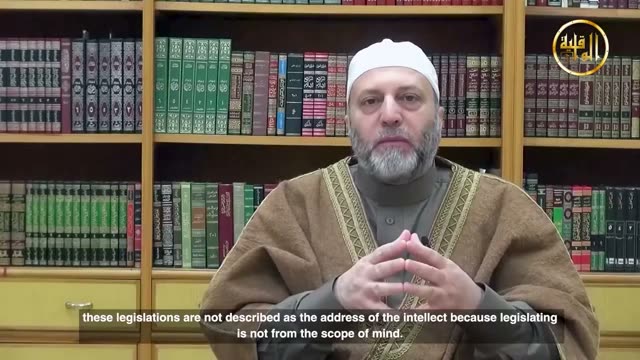
This indicates that when human beings legislate, their legislation cannot be described as the address of reason, because legislation lies outside reason’s remit.
Legislation is not merely an act of perceiving reality; rather, it involves addressing a human problem that is unseen and intangible. This problem manifests in hidden aspects of human nature: innate tendencies, organic needs, and instincts that produce human behaviour. These are not observable facts for the human mind to comprehend, let alone determine how to resolve their challenges.
Consequently, when legislators enact laws—whether capitalist, socialist, or feudal—they are merely following their own desires. Their claims of “science” and “correct thinking” are not grounded in observable reality; they do not represent judgments based on tangible facts. Instead, these are mere personal inclinations arising from those who construct theories to found legislation upon, leading people to adopt diverse legal systems.
The truth is that the One who created humanity—exalted and glorified is He—is the only One who knows what benefits humanity. It is He who created them, shaping their innate nature, instincts, and organic needs. Only Allah, exalted is He, understands the deepest secrets of human existence; it is He alone who knows what treatments suit their problems—that is, what Shari’ah legal rulings truly benefit them.
No Legislators or Legislative Authority in Islam
From this perspective, there are no such things as legislators or legal theorists in Islam—as some people like to claim today.
There is no legislative authority in Islam because no one has the right to legislate. Yes.
An Islamic state has—and must have—a Council of the Ummah and people of influence and representation (ahl al-hall wa-al-‘aqd). They express the people’s opinions, demands and complaints, and they carry out the appointment of the head of state or take part in that process, and so forth. They are not, under any circumstances, a legislative authority. There are no legislators, no legislative authority and no holders of legislative theories.
The scholars and mujtahids of Islam do not hold such theoretical positions as some cultural circles claim—particularly among certain intellectuals who appear to carry the Islamic thought but speak about the “legislative theories” of the fuqaha’. They attempt to discuss supposed legislative theories of Abu Hanifah, al-Shafi‘i, Malik, later scholars, and even al-Shatibi. This is a common claim: that the fuqaha’ had theories that formed their schools—but this has no basis in truth.
Indeed, the founders of Islamic legal schools were absolute mujtahids.
Branches of the Science of Usul al-Fiqh
They established principles—not theories—in producing legislation. These were not principles they devised themselves; rather, their effort was directed towards understanding the indications of Shari’ah texts and linguistic evidence. In essence, what is known as usul al-fiqh divides into three branches.
The first branch examines the evidences of legislation. They agreed upon the Book and the Sunnah but differed over what these two indicate. The majority agreed upon the Book, the Sunnah, ijma‘ and qiyas. They later differed over other sources, not on the basis of theories of their own, but on the basis of what they understood the Book and the Sunnah to indicate as Shari’ah evidences. We may devote a later session to this, if Allah wills.
The second branch of usul al-fiqh discusses how Shari’ah legal rulings are extracted—deduced—from their Shari’ah evidences: the Book, the Sunnah and what they indicate. These are rules of deduction, not rules of legislation.
Rules of Deduction, Not Rules of Legislation
Diligent scholars (mujtahids) do not legislate; rather, they exhaust their efforts to derive practical Shari’ah legal rulings from detailed evidences.
Their effort is not spent creating theories upon which to construct Shari’ah legal rulings. No—their work lies entirely in understanding texts so that they follow the indications of those texts where they lead, not where their own inclinations take them.
Differences arise among them because their understanding varies, because they differ in understanding texts whose speculative indications allow more than one meaning, or because they differ over the authenticity of the evidences they use—specifically hadiths transmitted from the Messenger of Allah, may Allah bless him and grant him peace.
The third branch of usul al-fiqh discusses the status of mujtahids and muqallids, a subject to which we previously devoted separate sessions. Muslim fuqaha therefore have no legislative theories, despite what some claim. They had no theory of governance upon which they built a form of governance that was then adopted in Islamic history. No. They had no economic theory upon which the fuqaha and mujtahids built Islam’s rulings concerning wealth and economics. No. They had no social theory concerning relations between men and women upon which they built the social system and what is now called personal status law. No. Nor did the fuqaha develop or adopt a theory upon which to build Islam’s foreign policy. The fuqaha did not derive Shari’ah legal rulings from theories: they neither devised such theories themselves nor, as some imagine, extracted theories from Shari’ah evidences and then built Shari’ah legal rulings upon them. No. The idea of a legislative theory does not exist in Islam.
A Shari’ah Legal Ruling for Each Action Individually
So then, what method has Islam prescribed for treating human problems? Islam’s approach is this: human behaviour consists entirely of actions; every action carries a Shari’ah legal ruling—no action lacks one. The Islamic Shari’ah, through its evidences—the Qur’an and Sunnah—does not classify human actions as people do, even by technical terminology. It did not come to say, “These are economic actions; address them according to this method,” or “These are political or governance-related actions; resolve them based on such-and-such theory.” Nor did it categorise social interactions—between men and women, family relations, or their consequences—and prescribe, “Address these according to that theory or objective.” Islam also did not present a framework for foreign policy actions by declaring, “Resolve these based on this particular theory.”
Islam’s texts came to provide a Shari’ah legal ruling for every human action, so each action takes its ruling individually. As I mentioned in the previous session, a ruling may apply to an action through what a text states explicitly, what is understood by implication from the text, or the rationally understood import of the text. Alternatively, the action may fall under a comprehensive legal principle—not a political, economic or social principle, but one concerning human actions—or under a general legal principle. Thus, texts apply to actions, with each action considered individually.
If a new problem arises for people—Muslims seeking to address it—a fresh issue emerges that is viewed purely as a human action, not classified as political, economic, social, worship-related, or penal—these classifications are technical terms we will discuss shortly and are not Shari’ah classifications. This does not mean they lack validity; we will address this topic later. It means these classifications have no role in the process of deducing legal rulings—that is, deriving solutions to human problems.
Each action is examined as a human problem requiring resolution and treatment. The mujtahid then searches the Shari’ah evidences—the Qur’an and Sunnah—for any evidence pertaining to that action as an action alone, nothing else. He examines these evidences.
The evidences determine the ruling for an action. If they give it the ruling of obligation, it is obligatory; if they give it the ruling of recommendation, it is recommended; if they give it the ruling of prohibition, it is prohibited; if they give it the ruling of dislike, it is disliked; and if they give it the ruling of permissibility, it is permissible. A Shari’ah legal ruling deduced from a Shari’ah evidence is applied to a human action to determine its ruling and solve or treat its problem.
For example, when a new issue arises within people’s financial and economic relationships, the faqih does not say, ‘I shall refer to Islam’s economic theory or to the objectives of Islamic economic legislation so that I can give this action a ruling that achieves that objective or is based upon, or consistent with, Islam’s economic theory.’ This has no place in Islam’s method for treating problems. It is the method of legislators, not the method of Islam’s mujtahids and fuqaha. Islam has no legislators and no holders of legislative theories.
Example: Joint-Stock Companies
Consider, for example, the new issue of joint-stock companies. This type of company did not exist, so earlier fuqaha and mujtahids did not discuss it. A new ijtihad must deduce its ruling from the legislative evidences: the Book, the Sunnah and what they indicate. The action is examined simply as an action. What Shari’ah evidences concern the rulings on companies—not economic theory? What are the conditions of a company in Islam? If this company meets those conditions and contains none of the forms of transaction that Islam prohibits, it is permissible. If it does not meet the conditions of a company in Islam, it is prohibited. Objectives, necessities, the demands of the time, the age or present reality play no part in this process.
For Shari’ah rulings are deduced solely from their legislative evidences. This Shari’ah—with all its legislation—must shape reality and govern time and space; it is not for time, space, customs, or realities to dictate terms to this Shari’ah.
Examples of New Medical Issues
Similarly, if a new medical issue arises—for example, cloning, test-tube babies, or blood donation—these were unknown in the past. How are solutions provided for these emerging problems? Each is considered individually, and Shari’ah evidences relevant to this matter are reviewed. A legal ruling is then issued for this issue as a human problem, not as one that must be constructed upon a general approach to medical or biological matters in Islam, as legislators do.
Every such action therefore receives its treatment through examination and research of the Shari’ah evidences and texts that concern the issue. A Shari’ah legal ruling is deduced from them, applied to the reality and used to treat it, regardless of whether the problem is economic, social, medical, governmental or otherwise. This is Islam’s method.
From here, no one can say that Islam—or that mujtahids and scholars derive rulings in one domain by a particular method and others by another method. No.
One Method of Deduction Across All Fields
The mujtahids derive legal rulings on worships through the same method they apply to rulings concerning wealth; governance; social affairs; and foreign policy—whether in warfare, penalties or adjudication. There is one unified approach: examining the factual subject matter of the ruling—the term scholars of usul al-fiqh use for this is manat al-hukm—the reality that requires resolution. How do we address this problem? The manat al-hukm must be identified, and then we refer to Shari’ah texts—the Book and the Sunnah—to locate relevant texts on the matter. We interpret them in their legislative and linguistic meanings according to legal and linguistic indications; from this, we derive the ruling and apply it to that reality. Thus, this reality is resolved.
Worships, Transactions and Shari’ah Causes
Someone may ask: what, then, about the statement that worships are tawqifiyyah while transactions are tawfiqiyyah? Incidentally, this wording is not found among the early scholars and mujtahids. These are recent terms, and we shall not now enter into what those who use these expressions intend by them.
Yet the correct position is that legal rulings for all human actions are derived from Shari’ah evidences—yes, through the same method.
When we conduct an inductive survey of Shari’ah evidences and legal rulings after these rulings emerge—after deriving them and extracting them through examination—we observe that most worships-related rulings lack explicit ‘illah (Shari’ah cause); most, not universally, because the Shari’ah never originally classified legal rulings into categories of worships and transactions. Yes, this is a conventional classification permitted by scholars, but it does not originate from the Shari’ah—that is, the Shari’ah did not divide rulings in this manner so that there would be distinct principles or rules for worships-related rulings, others for transactions, penalties, and so on.
No. These divisions are not indicated by the Shari’ah; they are permissible conventional classifications. We can even see rulings that the fuqaha conventionally classified under worships but that overlap substantially with transactions. Is zakat not classified among the rulings on worships? Yet it is also part of the economic rulings. Economic relations are supervised by the state and managed by the Islamic state, so zakat forms part of the circulation of wealth in Islamic life.
On what basis, then, can it be said that worships have one method for deducing rulings while transactions have another? No. The method is the same. As we said, an inductive survey shows that most worships are not based upon an ‘illah, though if a Shari’ah evidence establishes an ‘illah for a matter classified under worships, we follow the evidence. An ‘illah is established only by Shari’ah evidence. Qiyas can therefore apply to matters classified under worships.
Through an inductive survey, we found that many—or a large section—of the rulings on transactions are based upon an ‘illah, but not all of them are. If a Shari’ah evidence establishes the ‘illah, it is accepted. If no Shari’ah evidence establishes an ‘illah, assigning one through reason is not permissible. This does not mean that worships have one method for deducing rulings and transactions another. The method is the same.
Look at the books of usul al-fiqh, from its beginnings with Al-Risala by Imam al-Shafi‘i, may Allah have mercy on him, to books written hundreds of years later. Do you find principles of deduction and Shari’ah evidences specific to worships, and others specific to transactions? No such distinction exists at all. There are general principles for understanding legislative texts and deducing rulings from them, without saying that some principles concern worships while others concern transactions, punishments and so forth. This distinction does not exist.
Conventional Classification of Fiqh Subjects
Thus, my brothers, this is Islam’s method for treating human problems. A person may ask—and has the right to ask—where the classification of Islamic legislation into subjects and types came from: subjects devoted to worships, others to transactions with further subdivisions, punishments and morals. Where did this division come from? I say that it is neither a Qur’anic nor a Prophetic division. It does not come from the Shari’ah. It is one of the permissible conventions that people may adopt to classify and organise Shari’ah legal rulings so that they are easy to consult. It is therefore natural for books of fiqh to classify rulings under worships, with separate subjects for purification, prayer, fasting, zakat and Hajj, and then to place many classifications under transactions. These are conventional classifications used to organise rulings so that they are easy to consult. They have no effect whatsoever on how rulings are deduced, and no connection whatsoever to what are claimed to be the legislative theories of the fuqaha.
Rules of Governance Derived from Its Rulings
Likewise, it is the right of a questioner to ask: did we not say that Islam’s system of governance is founded upon four principles—four foundations? Did we not state that Islam’s system of governance rests on four principles? The first principle is that sovereignty belongs to the Shari’ah; the second, that authority belongs to the Ummah. The third is the necessity of appointing a Khalīfah who alone adopts Shari’ah legal rulings—the necessity of appointing a Khalīfah for the Muslims, meaning one who adopts Shari’ah legal rulings and administrative laws. Only the Khalīfah has the right to adopt these Shari’ah legal rulings and administrative regulations.
Where did these principles originate, if not as a theory or foundation upon which the system of governance was constructed? I say: no, they did not.
The jurists did not deduce these principles in order to subsequently build Islam’s system of governance upon them—that is not how it occurred. Rather, what happened was that after extracting the rulings related to governance and authority within Islam—the Islamic state apparatus—these rulings were deduced, collected, and examined. It then became clear that they were founded upon these very principles and foundations.
According to what Allah, exalted is He, has legislated—not according to what the jurists have legislated (between brackets). The jurists did not legislate these principles; rather, we came to know them after studying the Shari’ah legal rulings related to governance and state institutions in Islam. We found that these rulings were founded upon these very principles: sovereignty belongs to the Shari’ah, authority belongs to the Ummah, the necessity of appointing a Khalīfah, and that the sole right to adopt Shari’ah legal rulings belongs to the Khalīfah alone.
No, it was not the jurist who deduced these principles first and then built legislation upon them. Rather, the Shari’ah evidences pointed to these rulings, and after examining them closely, we found that they were established upon these very foundations.
Economic Legislation Policy Derived from Its Rulings
Similarly, when we say that the policy of economic legislation in Islam—that is, what economic legislation in Islam seeks to achieve—when we state that the policy of economic legislation in Islam is ensuring the satisfaction of basic needs and guaranteeing each individual’s basic needs, one person at a time, then enabling every individual to fulfil their secondary or luxury needs according to a specific standard of living that Islam has established—a particular model of life.
This is not a theory upon which the fuqaha built Islam’s economic system or its economic legislation.
Rather, after deducing the Shari’ah legal rulings related to financial and economic relations—ownership of money, its development, how to dispose of it, state revenues and expenditures, types of property, and so forth—after conducting an inductive survey of these rulings concerning human actions of a financial or economic nature, we found that they all directed toward this objective. We concluded that the policy of economic legislation in Islam is ensuring the satisfaction of basic needs for every individual, one person at a time, as a necessity, and then enabling each individual to satisfy their secondary or luxury needs—all within a specific model of living established by Islam.
This is not an economic theory; rather, it is what we discovered and understood after examining the Shari’ah legal rulings on economics in Islam, which were deduced as rulings for human actions—one action at a time. Every action has its Shari’ah legal ruling. I am not here to elaborate further or expand more on this topic; instead, I will provide examples.
The Objectives of the Shari’ah and Their Proper Place
In general, what is said about the objectives of Shari’ah legislation in Islam—that the Shari’ah evidences declare these to be the objectives of the Shari’ah and instruct jurists: “Proceed and realise those objectives as you see fit according to theories you establish”—this does not exist at all.
It is said that Islam—that the rulings of legislation generally—came to achieve objectives called the objectives of the Shari’ah, and this is correct. Every legislation has aims and objectives that it achieves, and the Islamic Shari’ah has aims and objectives that it achieves. The overall objective is summarised by the saying of Allah, the Exalted:
﴿ وَمَآ أَرْسَلْنَـٰكَ إِلَّا رَحْمَةً لِّلْعَـٰلَمِينَ ﴾
‘And We sent you only as a mercy to all worlds’ [21:107].
And by His saying, the Exalted:
﴿ وَنُنَزِّلُ مِنَ ٱلْقُرْءَانِ مَا هُوَ شِفَآءٌ وَرَحْمَةٌ لِّلْمُؤْمِنِينَ ﴾
‘And We send down from the Qur’an that which is healing and mercy for the believers’ [17:82].
Thus, the objective of the Shari’ah generally—the purpose of the Shari’ah generally—is to realise people’s interests.
When examining these objectives that Shari’ah legal rulings aim to achieve, it has been stated that the objectives of the Islamic Shari’ah are five: preserving religion, intellect, life, wealth and honour. Did the Shari’ah evidences directly indicate these objectives? No—rather, after scholars and jurists examined the Shari’ah legal rulings and what they lead to achieving—that is, after deducing the Shari’ah’s legal rulings and studying their totality along with what they aim to achieve—they concluded that these are the objectives of the Shari’ah.
Legal Rulings Preceded the Classification of Objectives
Incidentally, the Shari’ah legal rulings were deduced, established, and applied by people for centuries before the concept of objectives of the Shari’ah even arose.
And I am not here to say that it is impermissible—no, it is not impermissible to examine what these objectives of the Shari’ah are. Yes; we study the Shari’ah and recognise its objectives—but these objectives were never the controlling principle in deducing these rulings through the ijtihad of jurists extracting them from their sources.
The evidence is that the major schools that arose in Islam—and, before them, the ijtihads of the Companions—existed without anything called the objectives of the Shari’ah. The Companions, the Successors and the successors to the Successors practised ijtihad and deduced Shari’ah legal rulings from Shari’ah evidences centuries before any discussion or examination of what is called the objectives of the Shari’ah.
The concept of objectives of the Shari’ah was unknown—not even in the time of the Companions. The detailed breakdown we mentioned—the five objectives—was never examined or discussed with such precision during the era of the Companions, nor that of their Followers, nor those who came after them.
Look, for example, at the usul al-fiqh first recorded by Imam al-Shafi‘i in his Al-Risala, may Allah have mercy on him. You will find no trace of this subject. The whole book instead focuses on how rulings are extracted from their evidences: how the evidences are made to yield their meaning, so to speak; how rulings are understood from Shari’ah evidences and from the indications of the texts; and how rulings for human actions are deduced from the Book, the Sunnah and what they indicate.
The Emergence and Development of Objectives Research
The idea of objectives first appeared in this detailed form in the fifth century AH. Imam al-Haramayn al-Juwayni, who lived in the fifth century AH, is credited with beginning the discussion of the objectives of legislation, the five necessities and so forth. His renowned student, Imam Abu Hamid al-Ghazali, may Allah have mercy on him, then developed the idea. Others later expanded upon it, the best known for doing so being Imam al-Shatibi, may Allah, the Exalted, have mercy on him.
Yet even when those who first introduced these objectives spoke of them—from al-Juwayni to al-Ghazali and their successors—did they establish these objectives as the foundation from which rulings are deduced, so that we have what is called a theory of objectives from which Shari’ah legal rulings are derived? No. The principles of jurisprudence remained focused on how to extract Shari’ah legal rulings from their Shari’ah evidences. Rather, it was merely a technical discussion about the outcomes of Shari’ah legal rulings, concluding that they lead to achieving the five necessary objectives I mentioned earlier.
The Five Objectives—and What Was Added to Them
That is why not everyone accepts that these are all the objectives. Al-Shawkani, may Allah have mercy on him, for example, suggested adding another objective. He said: yes, we find that rulings such as the punishment for apostasy lead to preservation of religion; retribution leads to preservation of life; the punishment for drinking alcohol leads to preservation of the mind; and the punishment for theft—amputation—leads to preservation of property, and so forth.
But he added: “Among our legal rulings, foremost is the punishment for false accusation—this serves to preserve honour.” For some scholars stated that the five essential objectives are preserving religion (supported by the punishment of apostasy), preserving intellect (supported by the punishment for drinking alcohol), preserving life, preserving wealth, and preserving lineage (supported by the punishment for adultery). Then al-Shawkani came to say: “We can add preserving honour—that is, human dignity—and it is supported by the punishment for false accusation. Whoever accuses a chaste person of fornication without legal proof shall be flogged eighty times.”
Preserving Security and the State
Now, after examining this from our perspective, we can say: there are other Shari’ah legal rulings that lead to other objectives.
There are rulings that lead to the preservation of security. One of the hudud punishments is the punishment for highway robbers, which the fuqaha call hadd al-hirabah. This punishment leads to the preservation of security.
There are also rulings legislated to preserve the state, and this sometimes required a measure to protect it: death; it required killing. The Prophet, may Allah bless him and grant him peace, said: «إذا بويع لخليفتين فاقتلوا الآخر منهما» — ‘If allegiance is pledged to two caliphs, kill the latter of them’ [Sahih Muslim, 1853]. This is to preserve the state and its unity. Whoever rises against this state and rebels against it may be fought. The Prophet, may Allah bless him and grant him peace, said: «لا يحل دم امرئ مسلم إلا بإحدى ثلاث النفس بالنفس والثيب الزاني والتارك لدينه المفارق للجماعة المفارق، مفارقة الجماعة» — ‘The blood of a Muslim is not lawful except in one of three cases: a life for a life, the married adulterer, and the one who abandons his religion and separates from the community—the one who separates, separation from the community’ [Sahih al-Bukhari, 6878; Sahih Muslim, 1676a]. He means that one who rebels may be fought. The ruling on rebels is well known among the fuqaha: they may be fought. The Prophet, may Allah bless him and grant him peace, said: «إذا جاءكم وأنتم على قلب رجل منكم من يريد شق عصاكم وتفريق كلمتكم فاضربوا عنقه أو فاقتلوه كائناً من كان» — ‘If someone comes to you while you are of one heart and seeks to break your unity and divide your word, strike his neck or kill him, whoever he may be’ [see Sahih Muslim, 1852c].
Thus, these legal rulings were established for preserving the state. From this perspective, we can say that there are eight objectives of Shari’ah legislation in Islam: preserving religion, intellect, life, wealth, lineage, human dignity, the state itself, and security.
A Terminological Classification, Not a Legislative Theory
This is a conventional classification, and disagreement over it has no significant consequence. As long as Shari’ah legal rulings are deduced from their Shari’ah evidences—the Book, the Sunnah and what they indicate—then adhering to and applying these rulings in life will achieve the objectives of the Shari’ah whether we count four, five or eight. This is not an issue of consequence.
These objectives were not established or deduced in order to become a theory, as some claim, upon which legislation or rulings would be built. Rulings are deduced; they are not legislated. Rulings are extracted; they are not built upon theories. They are extracted, drawn and understood from Shari’ah evidences: what Allah has said and what the Messenger of Allah, may Allah bless him and grant him peace, has said.
This is what I intended to clarify in this session under the title Islam’s method for treating human problems. May Allah—exalted be He—benefit us with what we have learned, increase our knowledge, and make our knowledge and deeds sincere solely for His noble Face. O Allah, send Your blessings upon Muhammad, his family, and his companions, and upon all who followed his guidance with excellence until the Day of Judgement.
Audience Questions
I now turn with you to the questions that may have reached us during this session.
What the Shari’ah Has Remained Silent About
Brother Abu al-Bara’ Muhammad Ali asks: ‘But there are matters about which the Shari’ah remained silent. How do we reconcile new matters with matters about which it remained silent? May Allah bless you.’
We previously discussed what is called ‘that about which the Shari’ah remained silent’. A hadith of the Prophet, may Allah bless him and grant him peace, states that Allah, the Exalted, remained silent about certain matters. We explained that this silence does not mean that the Islamic Shari’ah contains a void or a gap. Nor does it mean that some human actions have no applicable Shari’ah legal rulings indicated by Shari’ah evidences. Islamic scholars—both scholars of usul al-fiqh and fuqaha—agree that every human action has a Shari’ah legal ruling that is deduced and understood from a Shari’ah evidence.
Rather, silence here means permissibility. When revelation came and the Prophet, may Allah bless him and grant him peace, lived among the people, he saw them performing certain actions and neither stopped nor forbade them. This constituted his tacit approval of those actions. The Prophet’s silence about actions, things or practices is therefore Shari’ah evidence, not a gap in Shari’ah evidences.
The Prophet, may Allah bless him and grant him peace, remained silent about actions people performed and may have retained from before Islam. His silence was his tacit approval of them. We know that the Sunnah comprises everything transmitted from the Prophet, may Allah bless him and grant him peace, in the form of a saying, action or tacit approval. The Shari’ah came while leaving people to perform certain actions; this leaving and approval appeared through the Prophet’s silence, so his silence about them constituted approval. It cannot therefore be said that the Shari’ah lacks rulings for actions that already existed or will arise in the future. No human action whatsoever lacks a connection to a Shari’ah evidence that indicates its Shari’ah legal ruling.
Distorting Ease and Removing Hardship
Sister Munabah al-Hajj asks—it appears to be a comment that we shall read: some Shari’ah texts have been twisted, such as:
﴿ يُرِيدُ ٱللَّهُ بِكُمُ ٱلْيُسْرَ وَلَا يُرِيدُ بِكُمُ ٱلْعُسْرَ ﴾
‘Allah intends ease for you and does not intend hardship for you’ [2:185].
And His saying, the Exalted:
﴿ وَمَا جَعَلَ عَلَيْكُمْ فِى ٱلدِّينِ مِنْ حَرَجٍ ﴾
‘and He has placed no hardship upon you in the religion’ [22:78].
They use them to legislate what Allah has not legislated, intending to remove hardship and make life easier under these misguided systems. What is your response to those who claim ijtihad and have led people astray?
May Allah bless you for this observation. We have said many times before that this is not permissible. This session in particular explained in detail that a faqih, someone claiming knowledge of fiqh or someone claiming ijtihad may not claim to possess a theory upon which to build rulings.
When Allah, exalted is He, says:
﴿ وَمَا جَعَلَ عَلَيْكُمْ فِى ٱلدِّينِ مِنْ حَرَجٍ ﴾
‘and He has placed no hardship upon you in the religion’ [22:78],
this is not a principle upon which rulings—Shari’ah legal rulings—are built. Shari’ah legal rulings are not deduced from this. Rather, it is Allah, exalted is He, informing us that His Shari’ah has not placed hardship upon us and has not created hardship for us. It has not imposed hardship upon us; Allah, exalted is He, has not placed hardship upon us through it. That is, what Allah has legislated—these rulings which Allah has legislated and which the Shari’ah evidences indicate—are not hardship for us.
The hardship that people sometimes perceive in adhering to Shari’ah legal rulings does not arise from the Shari’ah of Allah, the Mighty and Sublime. It arises from the actions of people who have moved away from Allah’s Shari’ah and have submitted—and agreed to submit—to man-made systems that make adherence to Allah’s Shari’ah difficult. As the Prophet, may Allah bless him and grant him peace, said: ‘A time will come upon my Ummah when one who holds fast to his religion will be like one holding a burning coal’ [see Jami‘ al-Tirmidhi, 2260]. Yes, this is not unique to Islam. In any society, when the system—when the state or authority—imposes a system that conflicts with people’s convictions and customs, they will find it difficult and arduous to adhere to what they believe because the system imposes another direction and other rules upon them.
Islamic legislation by nature imposes no hardship upon people. If people were to live an Islamic life and apply Allah’s Shari’ah in full, they would find that adhering to its legal rulings brings them ease—it aligns with their innate disposition and resolves the problems they face. However, when people accept being governed by laws other than what Allah has revealed, man-made systems are imposed upon them. These push individuals toward violating Allah’s Shari’ah, so that those who adhere to its legal rulings end up feeling burdened.
Does this excuse him, make it permissible for him and give him an excuse to abandon the Shari’ah legal rulings? No. No, not under any circumstances. The believer is required to adhere to the Shari’ah legal rulings as long as he has the capacity—as long as he has the capacity to do so, however great the hardship may be. Allah, the Exalted, says:
﴿ فَٱتَّقُوا۟ ٱللَّهَ مَا ٱسْتَطَعْتُمْ ﴾
‘So fear Allah as much as you are able’ [64:16].
As long as we are able to adhere to the Shari’ah legal rulings, we adhere to them, even if this entails some hardship and some patience.
He is therefore not excused, as some now say: since you cannot buy a flat for a cash amount—buy it outright—and no one will sell it to you on long-term instalments, there is no blame upon you because Allah, exalted is He, says:
﴿ وَمَا جَعَلَ عَلَيْكُمْ فِى ٱلدِّينِ مِنْ حَرَجٍ ﴾
‘and He has placed no hardship upon you in the religion’ [22:78].
So there is no blame upon you for going to a bank or an interest-based bank to take a housing loan because you are compelled, and there is no hardship in the religion. This position is not part of the religion at all and has nothing to do with fiqh. Here, a person can adhere to the Shari’ah even if he sees a material interest in taking an interest-bearing loan to buy a home by instalments and thereby own it. Just as he can pay instalments to the bank, he can instead pay rent for a home. Own it? Who said that he must own it? Nothing permits a person to violate the Shari’ah, even if it were what they call a compelling interest, or a matter… This has nothing to do with the religion. Someone comes along, theorises and says, on the basis of the saying of Allah, the Exalted:
﴿ وَمَا جَعَلَ عَلَيْكُمْ فِى ٱلدِّينِ مِنْ حَرَجٍ ﴾
‘and He has placed no hardship upon you in the religion’ [22:78],
and on the basis of His saying:
﴿ إِلَّا مَا ٱضْطُرِرْتُمْ ﴾
‘except what you are compelled to’ [6:119].
On the basis of the saying of Allah, the Exalted:
﴿ إِلَّا مَا ٱضْطُرِرْتُمْ ﴾
‘except what you are compelled to’ [6:119].
What you are compelled to here—the compulsion relates to… It does not mean that a person needs somewhere to live and needs to own a home. The compulsion here is the compulsion of death or imminent danger. That is, His saying, the Exalted:
﴿ حُرِّمَتْ عَلَيْكُمُ ٱلْمَيْتَةُ وَٱلدَّمُ وَلَحْمُ ٱلْخِنزِيرِ وَمَآ أُهِلَّ لِغَيْرِ ٱللَّهِ بِهِۦ ﴾
‘Forbidden to you are carrion, blood, the flesh of swine, and that over which a name other than Allah’s has been invoked’ [5:3].
﴿ فَمَنِ ٱضْطُرَّ غَيْرَ بَاغٍ وَلَا عَادٍ ﴾
‘But whoever is compelled, neither desiring it nor transgressing’ [2:173].
Compulsion here concerns the one who is about to die of hunger or thirst. He may then eat pork if he finds nothing else, and drink wine if he finds nothing else. This is the compelling necessity in which he cannot ward off death or an overwhelming, imminent danger without it.
Can Legal Rulings Be Derived Without Observing Objectives?
This is a completely different matter. The pious brother mentioned the objectives of the Shari’ah—so can one conceive of deriving detailed Shari’ah legal rulings that address human problems without considering these objectives during deduction? And secondly: Is it possible for there to be a contradiction between these objectives within a single derived ruling, necessitating the prioritisation of one objective over another in such cases? I will begin with the first question: Is it conceivable to derive detailed Shari’ah legal rulings that address human problems without observing these objectives during deduction? Yes, it is possible.
Yes, it is conceivable. The evidence is that Islamic fiqh arose and reached its height, and the greatest schools of fiqh in Islamic history emerged, without the existence of what is called the objectives. The founders of the early schools—al-Shafi‘i, Abu Hanifah, Malik, Ahmad, Sufyan al-Thawri, al-Awza‘i and Zayd—did not speak of anything called the objectives of the Shari’ah: preservation of life, property, intellect and so forth. These classifications did not exist because Shari’ah legal rulings are not extracted from objectives; they are extracted from the evidences. The evidences are the foundation. The objectives are the outcomes to which adherence to Shari’ah legal rulings leads. Implementing Shari’ah legal rulings and establishing the Shari’ah achieve those objectives whether we know them or not, classify them or not, or discover them or not. Ultimately, the Shari’ah came to secure people’s interests in a way that brings them happiness.
Objectives May Fail in Individual Cases
As for your second question, I answer it immediately: Yes, it is certainly possible to imagine the failure of an objective in certain cases.
When the Shari’ah is applied as a whole, it achieves its objectives. However, individual adherence to a ruling does not necessarily achieve the objective every time. Consider Muslims who adhere to the prohibition of riba while living in a society that applies the capitalist system. Individuals’ adherence to Shari’ah legal rulings does not achieve their intended objectives every time. Why? Because the system imposed upon people is the capitalist system, which conflicts with Shari’ah legal rulings. As I said, a Muslim may suffer because of adhering to a Shari’ah legal ruling in our present reality—like one holding a burning coal—because the system applied by the authority and ruler is not Islam’s system. Therefore, it is neither expected nor taken into account that a ruling will achieve its objective every time. If it does not achieve its objective, do we abandon it?
The Distinction Between Objectives and Shari’ah Cause
A Shari’ah objective—the objective of a Shari’ah legal ruling—is not its ‘illah (Shari’ah cause). There is a great difference. The Legislator based the ruling upon the ‘illah, so the ruling follows it in existence and absence. When the ‘illah exists, the ruling exists; when the ‘illah ceases, the ruling ceases. The ruling exists only when its ‘illah exists, and when the ‘illah is absent, the ruling is absent.
With an objective, however, one does not say, ‘I shall see whether this ruling achieves the Shari’ah objective and, if it does, I shall adhere to it,’ thereby treating the objective as though it were an ‘illah that must be realised or upon which the ruling must be built. No. I adhere to the Shari’ah legal ruling whatever the result. I adhere to it even if it conflicts with my worldly interest, what I desire or what I want, and even if it harms me. This is the importance of adhering to the Shari’ah.
Rather, consider the condition of the Companions during times of oppression: did their suffering lead them to abandon adherence to Shari’ah legal rulings? Never. The prophets and those who followed them faced persecution precisely because of their faith and commitment to the Shari’ah’s legal rulings—this brought upon them hardship, torture, and relentless pursuit.
Thus, we adhere to the Shari’ah legal rulings regardless of whether their intended objectives are fulfilled or not. The objective may fail—that is, one might still apply a legal ruling even though its purpose is not achieved. It is never permissible to condition a legal ruling upon its objective; in every case absolutely, without exception.
Conclusion
I ask Allah, the Exalted, to bless us with a day when Muslims’ affairs are managed according to Shari’ah legal rulings, when no law prevails on earth except the law of Allah, the Exalted—the law of Allah, the Mighty and Sublime—and when, through adhering to Shari’ah legal rulings, people realise the objectives of the Shari’ah and their hearts find tranquillity, while Islam carries a message to the world. Indeed, He is our Protector, the All-Hearing, the One who answers prayers. I invoke blessings and peace upon the Messenger of Allah, his family, his Companions and those loyal to him. Peace and the mercy and blessings of Allah be upon you.